 ProMapRanker
Best Food Delivery Apps for Fast Delivery Times in 2026

Key takeaways
- DoorDash posted the fastest average delivery time in an independent study of the three large national apps, at about 26 minutes.
- Grubhub was most likely to beat its own quoted time, which matters if you care about estimates you can trust.
- goPuff is the fastest option for snacks, drinks, and essentials from its own warehouses, rather than for restaurant meals.
- Speed depends heavily on your address, the restaurant, and the time of day, so the fastest app in one city may not win in yours.
Quick comparison
| Pick | Great for | Pricing starts at | Free tier | |
|---|---|---|---|---|
 DoorDash | Fastest average restaurant delivery | Free | Yes | Visit |
 Uber Eats | Cities with strong Uber coverage | Free | Yes | Visit |
 Grubhub | Reliable estimates and local favorites | Free | Yes | Visit |
 goPuff | Fast essentials and snacks | Free | Yes | Visit |
 ChowNow | Lower-fee local restaurant orders | Free | Yes | Visit |
 Slice | Local pizzerias | Free | Yes | Visit |
 Favor Delivery | Texas cities and fast local delivery | Free | Yes | Visit |
 Seamless | New York area restaurant delivery | Free | Yes | Visit |
The best food delivery apps for fast delivery times
Speed is not just an app feature. It comes from driver density near you, restaurant prep time, and how far the driver must travel. These picks rank well on those factors, but always compare live estimates in your own app before ordering.
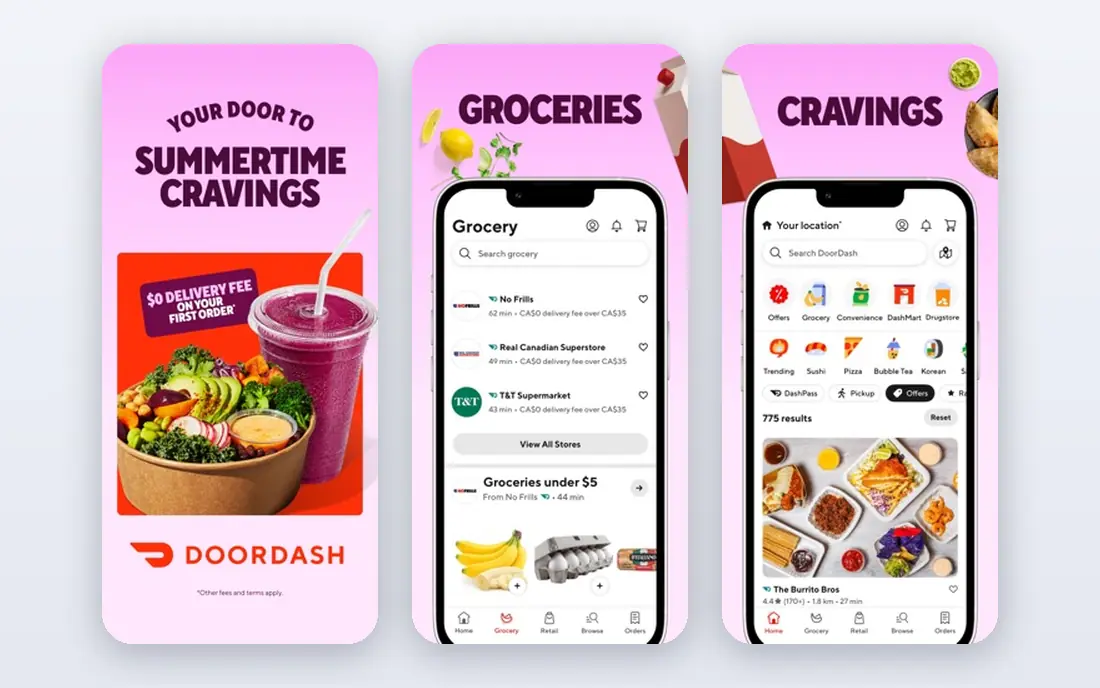
DoorDash is our pick for most people who want food fast, because independent testing found it fastest on average among the three large national apps, at about 26 minutes, compared with about 36 minutes for Grubhub and 38 minutes for Uber Eats. That gap is meaningful at dinner time, and it likely reflects driver density: more drivers near restaurants means shorter waits for pickup. Coverage is also broad, covering restaurants, groceries, and convenience items in many cities and suburbs.
The honest catch is reliability of the estimate. The same study found DoorDash most likely to arrive later than its quoted time, even though it was fastest overall. Fees also vary, and a small order can carry a small-order fee on top of delivery and service fees. DashPass, at $9.99 per month, removes delivery fees on eligible orders and can pay off if you order often, but check whether your favorite restaurants are eligible before subscribing.
- Largest driver network in many US markets
- DashPass removes delivery fees on eligible orders
- Wide restaurant and grocery coverage
- Most likely of the big three to miss its quoted time in one study
- Fees vary by restaurant and order size
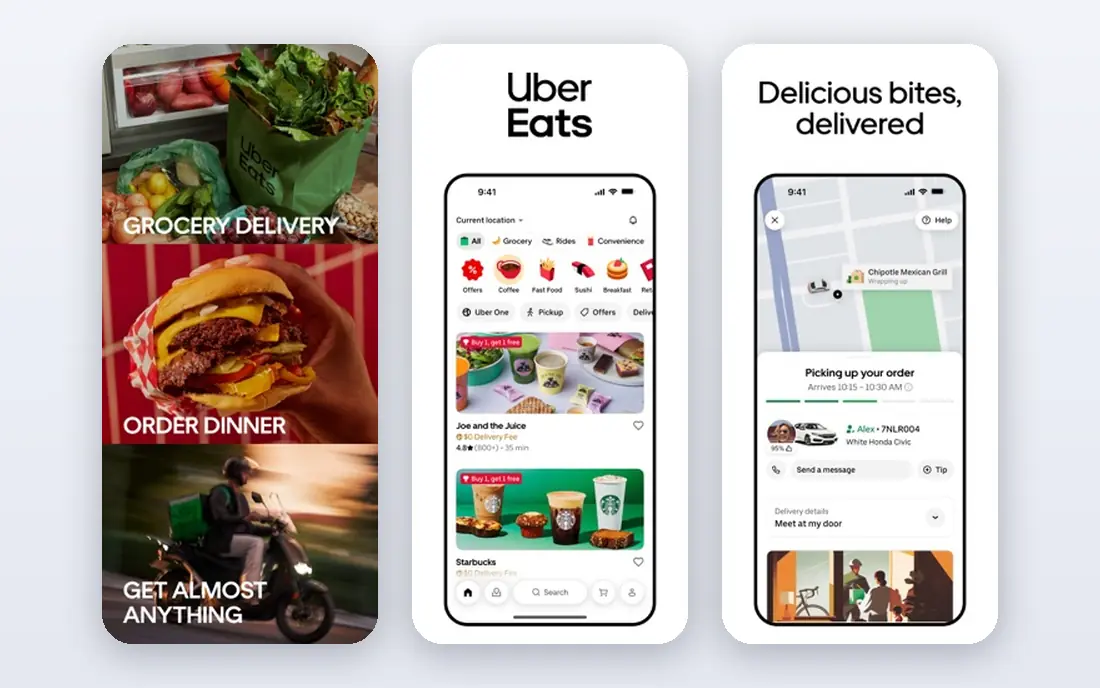
Uber Eats is strongest where Uber rideshare is already dense, which usually means larger cities. Ordering inside the same app as rides, shared accounts, and Uber One benefits make it convenient for households already in the Uber system. Uber One, at $9.99 per month, offers delivery fee savings and member pricing on eligible orders, which helps frequent users.
The speed record is the weakness. In the study cited above, Uber Eats averaged about 38 minutes and was most likely to arrive later than its post-order estimate. That does not mean every Uber Eats order is slow: a nearby restaurant with a driver close by can still arrive quickly. It does mean you should compare the live estimate in Uber Eats with DoorDash before a time-sensitive order, rather than assuming one app always wins.
- Strong in dense cities with Uber rideshare
- Uber One bundles delivery benefits
- Easy ordering inside the Uber app
- Slowest average time in the study cited above
- Most likely to arrive late against its estimate
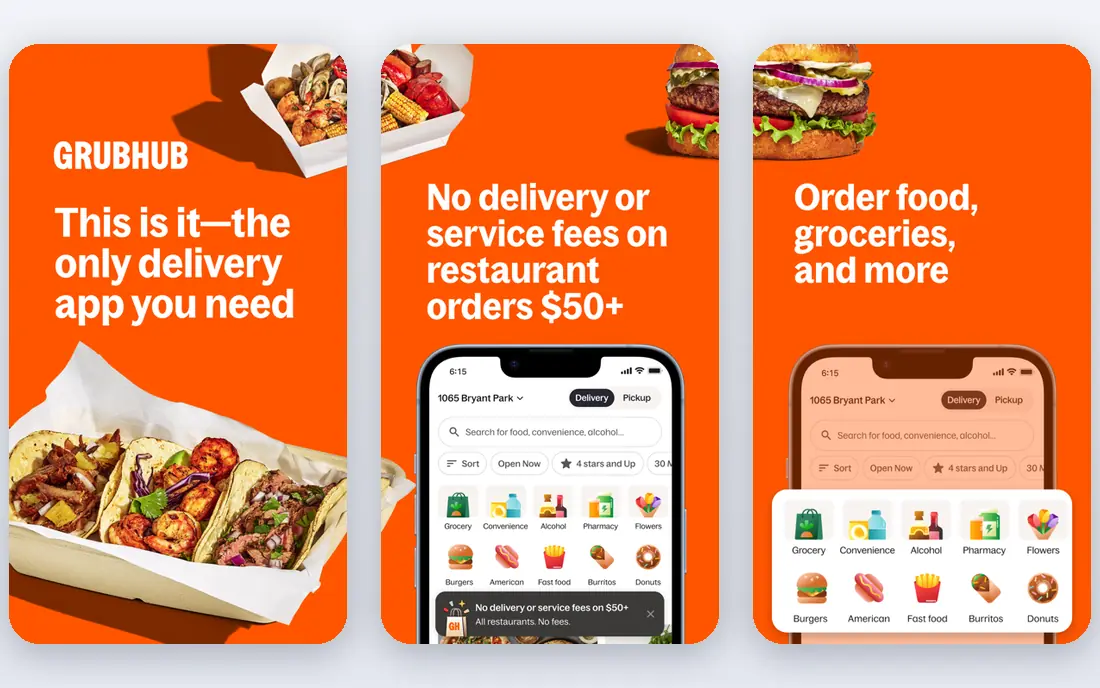
Grubhub is the pick when you value an estimate you can plan around. In the same study, Grubhub deliveries arrived earlier than the quoted time about three quarters of the time, and earlier than the post-order estimate about 63 percent of the time, both better than its rivals. Its average of about 36 minutes sits between DoorDash and Uber Eats, but that average hides a useful trait: Grubhub tends to quote conservatively, so food often arrives sooner than promised.
Coverage is the limit. Grubhub is strongest in major Northeast and Midwest cities, and its restaurant choice can be thinner in suburbs and smaller markets. Grubhub+, at $9.99 per month, offers free delivery on eligible orders. If you live in a Grubhub-strong city, it is a very good second app to keep alongside DoorDash for comparison.
- Most likely to beat its quoted and estimated times
- Strong in New York, Boston, and Chicago
- Grubhub+ subscription available
- Slower average time than DoorDash
- Thinner coverage in some suburbs and rural areas
goPuff plays a different game from the restaurant apps, and for its category it is often the fastest. Because it stocks snacks, drinks, groceries, household items, and some prepared food in its own local warehouses, a driver does not wait for a restaurant to cook. Orders are commonly delivered in about 30 minutes in covered areas, and the model works late at night when many restaurants are closed.
The limit is scope. If you want a hot meal from a specific local restaurant, goPuff will not replace DoorDash or Uber Eats. Delivery costs $3.95 for non-members in the figures published on deal pages, with free delivery through FAM membership at $7.99 per month. Keep goPuff for essentials, late-night snacks, and forgotten items, and use a restaurant app for dinner.
- Own warehouses near customers enable very fast trips
- Flat delivery fee for non-members
- FAM membership offers free delivery
- Not a restaurant app
- Selection is convenience and grocery items, not full menus
ChowNow is not the fastest app in raw minutes, but it can be the smartest order for local restaurants. Because it does not charge restaurants commissions, menu prices are often lower, and customers pay a small support fee instead of the layered fees on large marketplaces. One published comparison found the same order notably cheaper on ChowNow than on Uber Eats, which matters when you order from the same local place every week.
Speed depends on the restaurant, since ChowNow does not run its own driver fleet in the same way as DoorDash. Some restaurants deliver with their own drivers, others use a third-party service, so delivery time varies by place. Use ChowNow when you already know the restaurant and want a better total, and use a large app when you need the fastest driver match for an unfamiliar order.
- Commission-free ordering for restaurants
- Lower totals than large marketplaces in comparisons
- Focused on independent restaurants
- Restaurants handle delivery themselves, so speed varies
- Smaller restaurant list than national apps
Slice is the specialist pick for pizza, and specialists often beat general apps on their own turf. It connects you directly with independent pizzerias, many of which deliver with their own drivers who know the area. That direct link can mean faster handoff than a marketplace driver who is new to the shop, and it keeps ordering fees lower for the restaurant, which helps small shops stay on the platform.
The obvious limit is that Slice is pizza only. It will not help with sushi, tacos, or groceries, and delivery time still depends on how busy the shop is and how far you live from it. For a Friday pizza order from a local shop, check Slice first. For everything else, keep a general app ready.
- Built for independent pizzerias
- Direct ordering keeps more money with the shop
- Pizza-focused search and deals
- Pizza only
- Speed depends on the individual shop and its drivers
Favor Delivery is a Texas-focused service that has built a loyal following in cities such as Austin, Houston, Dallas, and San Antonio. Its runner model covers restaurant meals, groceries, convenience items, and other local errands, which makes it a useful all-purpose app inside its coverage area. Local density and familiarity with merchants help keep pickup and delivery times competitive with national apps in those cities.
The limit is geography. Outside Texas, Favor is not an option, so it cannot be a national recommendation. Fees, minimums, and delivery charges vary by merchant, so check the total before confirming. If you live in a Favor city, it deserves a place on your home screen next to DoorDash. If you do not, skip it without a second thought.
- Strong coverage in Texas cities
- Delivers restaurants, groceries, and essentials
- Runner model covers varied errands
- Limited outside Texas
- Fees and minimums vary by merchant and order
Seamless is the New York original, and it remains a strong choice inside its home market. Its restaurant depth in New York City, including many local spots that have used it for years, makes it a natural first check for Manhattan, Brooklyn, and nearby areas. Ordering on the web is smooth for office orders, and group ordering features suit team lunches.
Outside the New York area, Seamless adds little beyond Grubhub, since both sit in the same company family. Speed in New York depends on the same factors as elsewhere: restaurant prep, driver supply, and distance. Keep Seamless if you live or work in its core market, and use Grubhub or DoorDash as your backup elsewhere.
- Deep restaurant list in New York City
- Web and app ordering
- Part of the Grubhub family for support
- Coverage is concentrated in the New York area
- Largely overlaps Grubhub elsewhere
How we picked these
We compared published delivery-time studies, app store listings, subscription prices, and coverage notes for US food delivery apps. We favored apps that are live in October 2026, that publish clear fee and subscription terms, and that serve a distinct speed or coverage need. We left out grocery-only services and apps that have shut down or merged into a rival.
How to get the fastest order tonight
Compare live estimates, not brand loyalty. Open two apps, search the same restaurant, and compare the quoted arrival time and the total cost. The fastest app yesterday may quote slower tonight if drivers are busy or the restaurant is backed up, and a five-minute difference is worth a quick check.
Order for speed, not just for price
Choose restaurants close to you, avoid peak dinner rush when you can, and keep your address and delivery notes accurate so the driver does not lose time at the door. Pickup is often faster than delivery for a nearby favorite, and scheduled orders help when you need food at a set time rather than as soon as possible.
Frequently asked questions
Which food delivery app is fastest overall?
In the independent study cited above, DoorDash was fastest on average at about 26 minutes, ahead of Grubhub at about 36 minutes and Uber Eats at about 38 minutes. Averages vary by city and time, so compare live estimates in your area for a time-sensitive order.
Why does the same restaurant arrive faster on one app?
Driver supply near the restaurant, the order queue at the kitchen, and the route to your address all differ by app and moment. A driver who is already nearby will always beat a driver coming from across town, regardless of brand.
Are delivery subscriptions worth it for speed?
Subscriptions such as DashPass, Uber One, and Grubhub+ mainly save on delivery fees, not on travel time. They can pay off if you order often, but they do not guarantee a faster driver. Check eligible restaurants before subscribing.
Does goPuff deliver restaurant meals?
goPuff mainly delivers snacks, groceries, household items, and some prepared food from its own warehouses and kitchens. For a full restaurant menu, use a restaurant delivery app instead.
How can I reduce delivery fees without slowing the order?
Order from nearby restaurants, meet any free-delivery minimum, and compare totals across apps, since fees and menu prices differ. A subscription helps frequent users, but a single comparison often saves more than a loyalty perk.
Sources
See where you really rank - block by block
ProMapRanker scans Google Maps across a grid of your service area. Simple monthly plans from $19, white-label on every plan.
Start freeKeep reading
 zoro.to alternatives
Best Zoro.to Alternatives in 2026
We compare the best zoro.to alternatives in 2026, listing only legal licensed anime streaming services, from Crunchyroll to free options for fans today.
Read → zip alternatives
Best Zip Alternatives in 2026
We compare the best zip alternatives for buy now, pay later in 2026, covering pay-in-4 plans, fees, spending limits, and credit reporting options today.
Read → yesware alternatives
Best Yesware Alternatives in 2026
Compare the best yesware alternatives for sales email tracking, templates, and sequences, with current pricing and honest tradeoffs for small sales teams.
Read →