 ProMapRanker
Best Financial Automation for Lending Companies in 2026

Key takeaways
- nCino and ICE Encompass suit banks and mortgage lenders that need end-to-end origination on one platform.
- Blend stands out for borrower-facing mortgage and consumer lending experiences with strong verification automation.
- Cloud-native options such as Mambu and DigiFi fit newer lenders that want faster launches and flexible product design.
- Pricing for most lending platforms is quoted, so compare implementation, integrations and servicing scope alongside licence cost.
Quick comparison
| Pick | Great for | Pricing starts at | Free tier | |
|---|---|---|---|---|
 nCino | Banks modernising lending end to end | See website | No | Visit |
 Blend | Borrower-friendly mortgage origination | See website | No | Visit |
 ICE Encompass | Mortgage lenders of any size | See website | No | Visit |
 Finastra | Large banks and trade-related lending | See website | No | Visit |
 Mambu | Cloud-native lenders and fintechs | See website | No | Visit |
 Temenos | Core banking with lending automation | See website | No | Visit |
 Abrigo | Community banks and credit unions | See website | No | Visit |
 Amount | Digital consumer and small business lending | See website | No | Visit |
 DigiFi | Fast digital lending launches | See website | No | Visit |
The best financial automation for lending companies
We compared lending platforms on origination coverage, decision automation, document handling, compliance support and integration options. Most enterprise pricing is quoted, so we mark unverified prices as See website rather than guessing.
nCino is built for financial institutions that want one system across onboarding, commercial lending, small business lending and home lending. Its workflows, CRM features and document handling reduce rekeying between teams, and its integration network covers core banking systems and common fintech tools. That breadth suits a bank replacing several point tools at once.
The honest cost is change. nCino is an enterprise platform, and rollout needs process design, data migration and staff training. Smaller lenders should ask for a phased plan and confirm which modules are included in the quote, since pricing varies by size and scope.
- Single platform for onboarding, origination and account opening
- Commercial, small business and mortgage coverage
- Large integration network
- Enterprise implementation effort
- Pricing is quoted and varies by institution size and modules
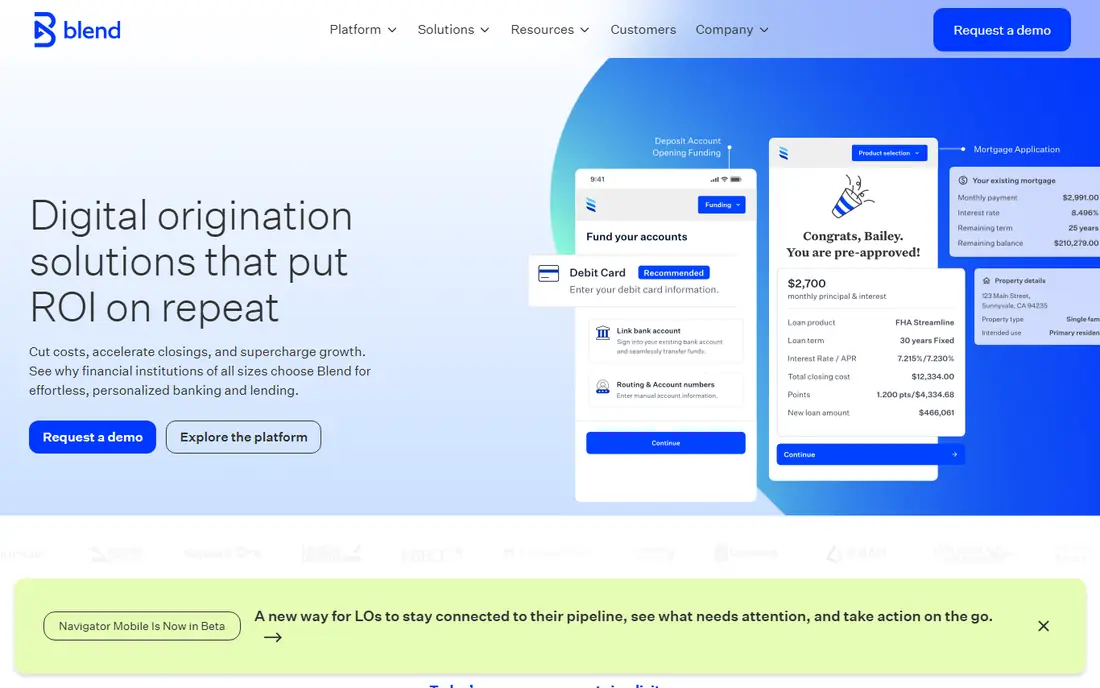
Blend focuses on the borrower journey and the manual work behind it. Applicants complete applications online, while lenders use automated verification for income and employment to reduce document chasing. That combination can shorten cycle times and improve pull-through, which matters when borrowers compare lenders on speed.
Blend is strongest in mortgage and related consumer lending. A commercial lender or a lender with unusual products should test how well its workflows map to those loans. Ask for a demo using your own application and verification steps, not only a standard mortgage flow.
- Consumer-friendly application experience
- Automated income and employment verification
- Works alongside existing loan systems
- Pricing is not published for lenders
- Mortgage focus means non-mortgage lenders should check fit carefully
ICE Encompass, from ICE Mortgage Technology, is one of the most widely used loan origination systems in US mortgage lending. It covers application through closing, with eClose options, partner integrations and tools for compliance checks and investor delivery. Lenders that sell loans onward benefit from its established secondary-market connections.
Its scale is also its challenge. Encompass can feel large for a small lender, and configuration choices affect daily work for processors and underwriters. Budget time for training and for partner integrations such as credit, verification and document providers.
- Widely used mortgage origination system
- EClose and partner integrations
- Compliance and investor delivery tools
- Depth brings complexity
- Pricing and setup depend on lender size and configuration
Finastra offers lending automation as part of a wider banking platform, including corporate lending and trade finance tools. Its recent cloud options for specific tasks, such as standby letter of credit processing, show a move toward faster deployment for mid-size banks. Large banks value the depth and the ability to connect lending with other banking systems.
For a smaller lender, the full suite may be more than required. Clarify which product covers your lending type, what deployment model applies, and how much services work is needed. A focused product inside the Finastra range may fit better than a broad platform deal.
- Broad banking software portfolio
- Lending, trade finance and treasury options
- Global bank customer base
- Enterprise scope and services effort
- Smaller lenders may find the suite larger than they need
Mambu suits a lender building a new product or a fintech launching lending from scratch. Its cloud-native core lets teams configure loan products, schedules and fees through APIs and configuration rather than custom code alone. That flexibility helps when a lender wants to test a product, change terms or enter a new segment quickly.
Mambu is a core platform, not a complete out-of-the-box origination suite for every lender. Expect to pair it with application, decisioning, document and servicing tools, or with partners that bundle those pieces. Price the full stack, not just the core licence.
- Cloud-native core with flexible product configuration
- API-first design
- Faster launches for new lending products
- Needs integration work for full origination and servicing
- Enterprise support costs vary
Temenos is a core banking provider whose platform covers lending alongside deposits, payments and other banking functions. For a bank modernising its core, that single-vendor scope can simplify data, servicing and reporting. Its lending tools support retail and corporate products with workflow and decision features.
The trade-off is programme size. Temenos deals are major transformations, not quick software purchases, and they need strong internal sponsorship. A lender that only needs origination automation may find a focused platform faster and cheaper than a core replacement.
- Core banking and lending in one vendor stack
- Global bank deployments
- Product and servicing depth
- Large implementation programmes
- Quoted pricing with significant services costs
Abrigo focuses on community banks, credit unions and regional lenders, which shows in its product mix. It offers lending and credit tools alongside compliance and risk support, aimed at institutions that need automation without a global-bank platform. Implementation and support are pitched at teams with limited IT capacity.
Larger or highly specialised lenders should check coverage for their product types. Abrigo fits mainstream community lending well, but a lender with complex corporate or cross-border needs may need additional tools. Ask for customers of similar asset size and loan mix.
- Focus on community institutions
- Lending, credit and compliance tools
- Practical implementation support
- Less suited to very large global banks
- Product fit varies by lending type
Amount provides digital lending technology for banks, credit unions and fintechs, covering application, decisioning and account opening for consumer and small business products. Its focus on a fast, mobile-friendly borrower experience helps lenders compete with fintech-only rivals. Verification and fraud tools can sit alongside the application flow.
Because Amount works with varied core and servicing systems, integration planning matters. Confirm which cores and data providers are supported for your products, and how decision rules are managed by your credit team. A pilot on one product is a sensible first step.
- Digital origination for consumer and small business loans
- Decisioning and verification integrations
- Bank and fintech customers
- Quoted pricing
- Fit depends on product type and existing core systems
DigiFi helps lenders launch digital lending with acquisition, decision automation and a smoother borrower journey. It is pitched at institutions that want to grow lending without a long core replacement, and its configurable workflows suit teams that iterate on products often. That speed is its main appeal.
As a growth-stage vendor, DigiFi needs the same diligence as any smaller platform. Check servicing, reporting and compliance coverage for your loan types, and ask about uptime, security reviews and customer references. For a lender prioritising launch speed, it earns a place on the shortlist.
- Omnichannel acquisition and decision automation
- Configurable lending workflows
- Built for growth-stage lenders
- Newer and smaller than the largest vendors
- Check servicing and reporting depth for your needs
How we picked these
We compared official product pages, lending industry coverage and each platform's stated origination, decisioning and servicing features. We favoured platforms live in October 2026 with real bank, credit union or fintech customers, and we included both broad enterprise suites and focused digital lenders. We did not invent prices, and quoted platforms are marked See website.
How to choose a lending automation platform
Start with your loan types. Mortgage, consumer, small business and commercial lending have different documents, rules and investor needs, and no platform leads on every type. List your top three products, your volumes and your current pain points, such as slow verification, manual underwriting queues or servicing handoffs. That list keeps vendor demos honest.
Then test the full journey, not just the application form. Follow one loan from application through verification, decision, documents, closing and servicing. Ask how exceptions are handled, how audit trails are kept, and how rules change without vendor help. Integration depth with your core, credit bureaus and document providers matters as much as screen design.
Finally, compare total cost and timeline. Licence fees, implementation, integrations, training and ongoing support all count, and enterprise rollouts can run for months. Ask for a phased plan with clear milestones, and confirm what happens to your data if you later move platforms. A platform that exports clean loan data protects you in the long run.
Frequently asked questions
What is financial automation for lending companies?
It covers software that automates application intake, verification, credit decisioning, documents, closing and servicing. The goal is faster decisions, fewer manual errors and clearer audit trails, while keeping human review where rules require it.
How much does lending automation software cost?
Most enterprise platforms in this guide use quoted pricing based on institution size, products and modules. Smaller digital lenders may price by volume or subscription, so request a written quote that includes implementation and support.
Is nCino or Encompass better for mortgage lending?
Encompass is a dedicated mortgage origination system with deep investor and closing connections. nCino covers mortgage alongside commercial and consumer lending on one platform, which suits banks that want a single system across lines.
Can a small lender use these platforms?
Yes, but fit varies. Abrigo, Amount and DigiFi target smaller or growth-stage lenders, while Temenos and Finastra suit larger banks. Start with one product and a phased rollout rather than replacing everything at once.
Does automation replace underwriters?
No. Automation handles routine checks, documents and data gathering, but credit judgement, exceptions and regulatory review still need people. Good platforms make those reviews faster and better documented, rather than removing them.
What integrations should we check?
Check your core banking system, credit bureaus, income and employment verification, e-signature, document providers and servicing system. Confirm whether integrations are native, partner-built or custom, since that affects cost and timeline.
Sources
See where you really rank - block by block
ProMapRanker scans Google Maps across a grid of your service area. Simple monthly plans from $19, white-label on every plan.
Start freeKeep reading
 worlds best local seo company
8 Worlds Best Local SEO Companies for Map Pack Growth in 2026
Compare the worlds best local seo company options for Google Business Profile work, citations, reviews, and multi-location rankings and reporting in 2026.
Read → world's best web hosting company
World's Best Web Hosting Company in 2026
Searching for the world's best web hosting company? We compared 10 hosts on price, renewal rates, speed, and support to help you choose well today in 2026.
Read → who's got the best nanny tax services
Who's Got the Best Nanny Tax Services in 2026
We answer who's got the best nanny tax services, comparing full filing, back taxes, software, and pricing so families can handle nanny taxes correctly.
Read →