 ProMapRanker
Best Feature Flag Tools in 2026

Key takeaways
- The best feature flag tool depends on how you pay: per seat, per user, per request or per event all behave differently as traffic grows.
- Open source tools such as Unleash, GrowthBook and Flagsmith suit teams that want to self-host, while hosted tools suit teams that want less infrastructure work.
- A flag tool that also runs experiments can replace a separate testing tool, but only if its statistics and targeting match your needs.
- Always set a default value for every flag, review stale flags regularly, and test the kill switch before a risky release, not during one.
Quick comparison
| Pick | Great for | Pricing starts at | Free tier | |
|---|---|---|---|---|
 LaunchDarkly | Enterprise release governance | Free | Yes | Visit |
 Flagsmith | Open source with hosted option | Free | Yes | Visit |
 Unleash | Self-hosted enterprise flags | Free | Yes | Visit |
 ConfigCat | Simple, predictable flag delivery | Free | Yes | Visit |
 GrowthBook | Flags plus experimentation | Free | Yes | Visit |
 Statsig | Flags, experiments and analytics | Free | Yes | Visit |
 Harness Feature Management | Teams already on Harness | Free | Yes | Visit |
 DevCycle | Developer-first flag management | Free | Yes | Visit |
 PostHog | Flags plus product analytics | Free | Yes | Visit |
 Optimizely Feature Experimentation | Rigorous experimentation at scale | Free | Yes | Visit |
The best feature flag tools
We compared official pricing pages, hosting options and public feature descriptions for tools that are live in October 2026. The list below covers enterprise governance, open source self-hosting, and experimentation-led tools, so a team can shortlist by hosting preference and billing model rather than by brand alone.

LaunchDarkly is the enterprise standard for feature flag management. Its Developer plan is free, with unlimited seats, unlimited flags and a set number of service connections and client-side monthly active users, plus experimentation allowances. Paid plans add governance features such as approvals, audit history and advanced targeting, which large teams need when many engineers can change a flag.
The billing model needs care. Paid pricing is based on service connections and client-side users, so a team with many services or a large user base should model its real usage before committing. LaunchDarkly does not offer a self-hosted option, so teams with strict data residency needs should check its hosting and relay options. For a large team that needs governance at scale, it remains the safest default.
- Free Developer plan with unlimited seats
- Broad SDK range
- Strong targeting, approvals and audit controls
- Paid pricing is usage-based and can rise with traffic
- Experimentation is an add-on in some tiers
- No self-hosted option
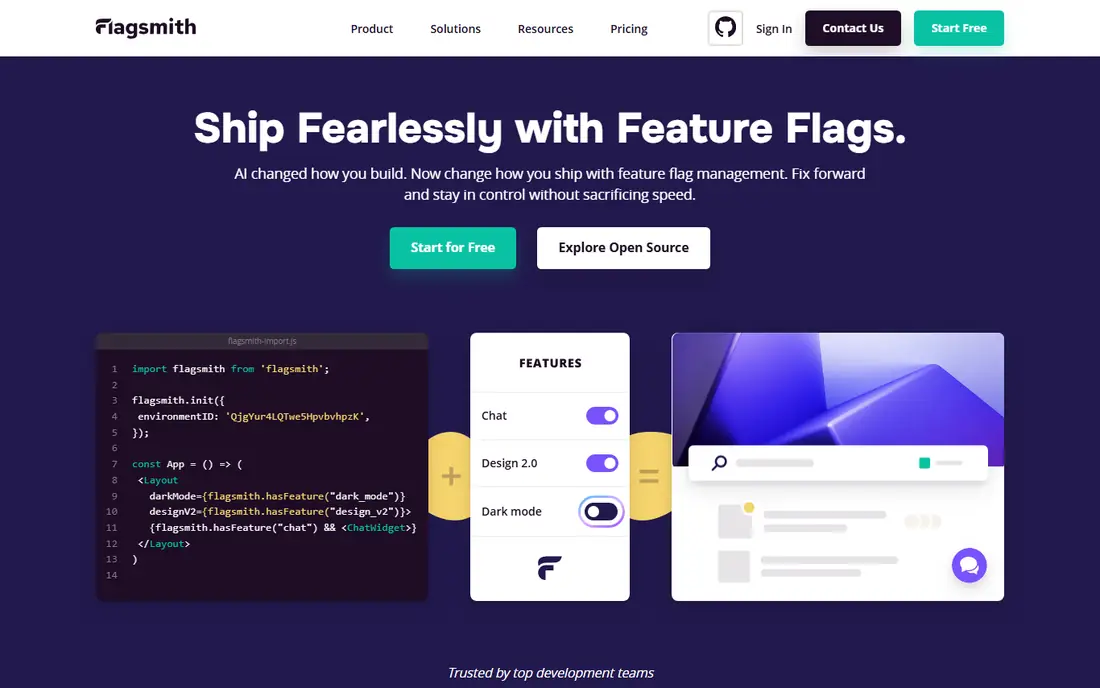
Flagsmith suits a team that wants open source flexibility without giving up a hosted option. Its free cloud plan covers 50,000 requests a month for one team member, with unlimited flags, environments and segments, and its Start-Up plan starts at $45 per month for higher request volume and more seats. Self-hosting is available for teams that need full control over data and infrastructure.
The main limits are request volume and governance. Free and low-cost tiers cap requests, so a high-traffic app should model its flag evaluation volume before choosing a tier. Advanced features such as audit logs and single sign-on sit on higher plans. For a small or mid-size team that values open source and a simple hosted start, Flagsmith is a strong, low-cost choice.
- Open source core with self-hosting
- Free cloud plan with 50,000 requests a month
- Unlimited flags and environments
- Paid tiers rise with requests and seats
- Advanced governance sits on higher plans
- Smaller SDK range than LaunchDarkly
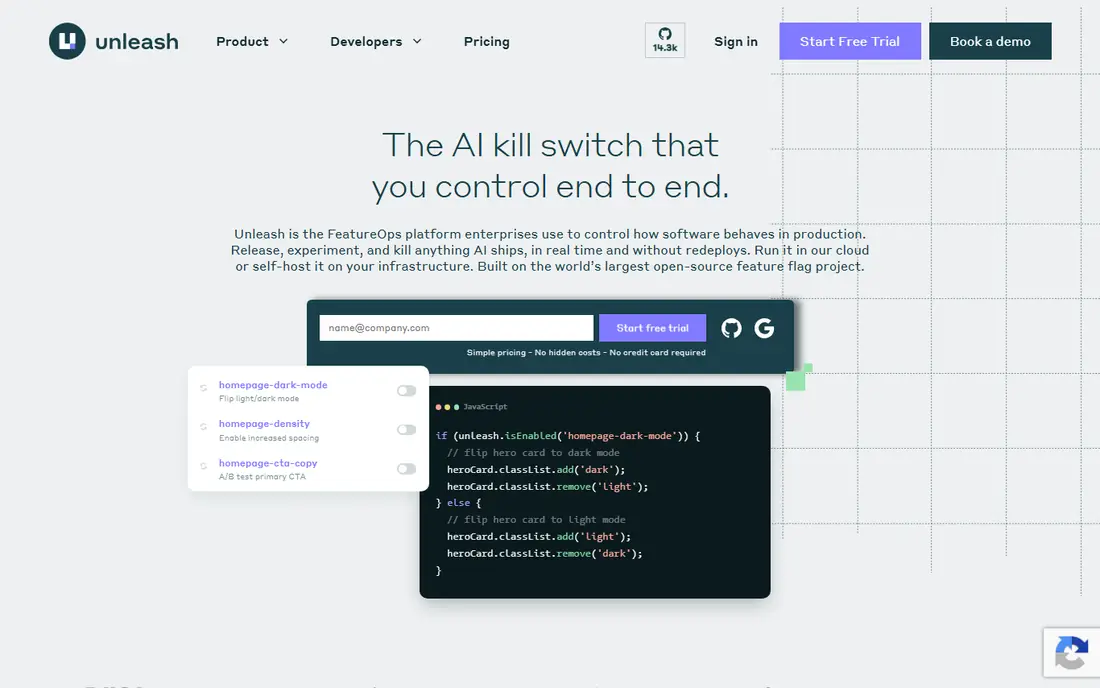
Unleash is the most established open source feature flag platform, and it is a good fit for teams that need self-hosting plus enterprise governance. Its open source edition is free to self-host, with basic roles and targeting, while its cloud pay-as-you-go plan starts at $75 per seat per month with a seat minimum. Enterprise adds change request approvals, granular roles, audit logs and edge evaluation.
Self-hosting is not free in effort, since the team must run, update and back up the service, but it gives full control over data and uptime. Unleash focuses on flags and progressive delivery rather than deep experimentation, so a team that runs many A/B tests may pair it with another tool or choose GrowthBook instead. For regulated or privacy-sensitive teams, Unleash is a strong default.
- Open source core with self-hosting
- Enterprise governance and change requests
- Strong targeting strategies
- Cloud pricing is per seat with a minimum
- Experimentation is less mature than GrowthBook or Statsig
- Self-hosting needs operations time
ConfigCat is the simplest tool on this list, and that simplicity is its appeal. Its free plan covers 10 flags, two environments and unlimited seats and service connections, with a generous config download allowance. Setup is quick, SDKs are available for major languages, and flag values are delivered through a global content delivery network, which keeps checks fast.
The limits are flag count and targeting depth. Teams with many flags or complex targeting rules will move to a paid plan, and paid prices should be confirmed on the vendor site, since third-party summaries differ. ConfigCat also uses polling rather than streaming by default, with a proxy for real-time updates. For a small team that wants flags without a large platform, ConfigCat is a clean, low-friction start.
- Free plan with 10 flags and unlimited seats
- Simple setup
- Global CDN delivery for fast flag checks
- Paid pricing varies by source and should be confirmed
- Flag count limits on lower tiers
- Real-time updates need a proxy setup
GrowthBook combines feature flags with serious experimentation in one open source platform. Its cloud Starter plan is free for up to three users with unlimited flags and experiments, and its Pro plan starts at $40 per seat per month with a visual experiment editor, multi-armed bandits and safe rollout controls. The self-hosted edition is free with unlimited users, which suits teams that want full control.
The warehouse-native design is both a strength and a cost. Experiment data stays in your own warehouse, which helps data control, but setting up that warehouse connection takes more work than a fully hosted tool. Approval workflows and single sign-on need an Enterprise plan. For a product team that runs experiments often and wants statistics it can trust, GrowthBook is one of the best choices on this list.
- Free cloud Starter for up to three users
- Free self-hosted edition
- Strong statistics for experiments, including bandits
- Warehouse-native setup adds complexity
- Approval and SSO features need Enterprise
- Cloud Pro is per seat
Statsig is built by engineers with experimentation experience, and it shows in the product. Its Developer plan is free with 2 million events a month and unlimited flag and config checks, while Pro starts at $150 per month with higher event volume and advanced statistics. Flags, experiments, analytics and session replay can run on one SDK, which reduces integration work for a product team.
The pricing model is event-based, so a team should model its event volume, not just its user count, before choosing a tier. Flag checks themselves are unlimited, which is a useful distinction from request-based tools. For a team that wants flags and experiments together, with guardrail metrics that can roll back a harmful release automatically, Statsig is a strong, developer-friendly choice.
- Free Developer plan with 2 million events a month
- Unlimited flag checks
- Strong statistics and guardrail metrics
- Paid Pro starts at $150 per month
- Event-based pricing needs volume modeling
- Analytics depth can be more than a flags-only team needs
Harness Feature Management, formerly Split, is a good fit for teams that already use Harness for continuous integration and delivery. Flags, targeting, experimentation and guardrails sit alongside deployment pipelines, so a release, a flag change and a rollback can be managed in one workflow. A free plan is available for getting started, with paid tiers quoted by the vendor.
The main limit is ecosystem fit. A team that does not use Harness can still buy feature management on its own, but much of the value comes from the pipeline connection. Paid pricing is quote-based, so a buyer should ask for a written quote tied to its flag volume and experiment needs. For a Harness shop, it is the most natural flag tool to shortlist.
- Free plan available
- Feature flags plus experimentation and guardrails
- Broad SDK range
- Fits Harness CI and CD workflows
- Paid pricing is quote-based
- Best value inside the Harness platform
- Experimentation depth varies by tier
DevCycle is a developer-first feature flag tool that focuses on a clean SDK experience and fast local evaluation. Its free plan suits a small team getting started with flags, and paid plans add more seats, environments and advanced targeting. Scheduling, targeting by user attributes and percentage rollouts cover the core progressive delivery jobs without a heavyweight platform.
The trade-off is scale and governance depth. DevCycle does not match LaunchDarkly or Unleash Enterprise on approval workflows and audit controls, and its paid pricing should be confirmed on the vendor site before budgeting. For a small or mid-size product team that wants a modern, developer-friendly flag tool and does not need enterprise governance yet, DevCycle is a good fit.
- Free plan for small teams
- Developer-friendly SDKs and local evaluation
- Targeting and scheduling features
- Paid pricing should be confirmed on the vendor site
- Smaller ecosystem than LaunchDarkly
- Enterprise governance is less deep
PostHog is a product analytics platform that also offers feature flags, which makes it a good choice for a startup that wants analytics and flags together. Its flag product includes a free allowance of 1 million flag requests a month, with usage-based pricing beyond that and no seat fees. Self-hosting is available through its open source edition, and billing limits can cap each product separately.
The main watch point is usage. Each PostHog product is metered separately, so a team that turns on analytics, replay, surveys and flags will see several meters on one bill. Flag requests beyond the free allowance are charged per request on a sliding scale, so high-traffic apps should model that cost. For a small team that already uses PostHog for analytics, adding its flags is a natural, low-friction step.
- Free allowance of 1 million flag requests a month
- Flags plus analytics, replay and surveys on one bill
- Open source option
- Usage-based billing needs volume modeling
- Flags are one product among many
- Enterprise features need a paid package
Optimizely Feature Experimentation
Great for: Rigorous experimentation at scale
Optimizely Feature Experimentation is the enterprise experimentation option on this list. Its free Rollouts plan covers basic flag delivery with one experiment at a time, while paid plans add rigorous statistics, including sequential and Bayesian methods, plus governance, approvals and audit controls. That depth suits a large product team that runs many experiments and needs results it can defend to stakeholders.
The cost and complexity are the limits. Full pricing is quote-based, and the platform takes longer to learn than a simple flag tool. A team that only needs on-off flags and percentage rollouts will not use most of its power. For a team where experimentation is a core product discipline, Optimizely is one of the strongest tools available, and its free Rollouts plan is a fair way to test flag delivery first.
- Free Rollouts plan for basic flags
- Strong statistics and governance for experiments
- Broad enterprise integrations
- Full experimentation pricing is quote-based
- Setup and learning curve are larger
- More than a flags-only team needs
How we picked these
We compared official pricing pages, hosting options and public feature descriptions for feature flag tools that are live in October 2026. We favored tools with a free plan or a free self-hosted edition, a clear billing model, and SDK coverage for server and client apps. We used See website where a vendor quotes privately or where third-party price summaries differ, rather than publishing a figure we could not verify.
How to choose the right billing model
Start with your traffic and team size, not with the feature list. A per-seat tool is predictable for a small team but expensive as headcount grows. A per-request or per-event tool is cheap at low traffic but can rise fast with a popular app. A per-user tool can punish growth, since more users mean a higher bill even if flag count stays flat. Model your bill at three points: today, at double your traffic, and at ten times your traffic.
Next, test the workflow that matters most. Create a flag, roll it out to 5 percent of users, check the SDK behavior when the service is unreachable, and practice a rollback. Confirm that every flag has a safe default value, so a service outage does not break your app. Finally, agree on flag hygiene: name flags clearly, set an owner and an expiry review date, and delete flags that are fully rolled out.
Frequently asked questions
What is the best feature flag tool?
The best feature flag tool depends on hosting and billing needs. LaunchDarkly suits enterprise governance, Unleash and GrowthBook suit self-hosting, and Statsig suits teams that want flags plus experiments. Model your bill at your real traffic level before choosing, since billing models differ sharply.
What is the best feature flag software for a small team?
For a small team, Flagsmith, ConfigCat, GrowthBook and PostHog all offer free plans that cover real use. Choose Flagsmith or ConfigCat for simple flags, GrowthBook for flags plus experiments, and PostHog if you also want product analytics on the same bill.
What is the best feature flag platform for experiments?
GrowthBook, Statsig and Optimizely Feature Experimentation are strong choices for experiments, since all three offer statistical methods beyond a simple split test. GrowthBook suits warehouse-native teams, Statsig suits teams that want flags and analytics together, and Optimizely suits large teams that need rigorous governance.
Is there a free feature flag tool?
Yes. LaunchDarkly, Flagsmith, Unleash, ConfigCat, GrowthBook, Statsig, Harness, DevCycle, PostHog and Optimizely all offer a free plan or a free self-hosted edition, though limits differ by requests, events, users or flags. Check the limit that matches your traffic before relying on a free tier in production.
How do feature flags help releases?
Feature flags let a team ship code to production while keeping a feature hidden, then turn it on for a small group, monitor errors and behavior, and expand or roll back without a new deployment. That separation between deployment and release reduces risk, especially for risky changes, and it gives a fast kill switch when something goes wrong.
Sources
See where you really rank - block by block
ProMapRanker scans Google Maps across a grid of your service area. Simple monthly plans from $19, white-label on every plan.
Start freeKeep reading
 zoho inventory alternatives
6 Alternatives to Zoho Inventory, Compared on Price and Fit
Zoho Inventory alternatives: 6 tools compared on price, free plans and fit. Katana leads the list for manufacturers. Fit and flaws are laid out for each entry.
Read → zoho crm alternatives
Best Zoho CRM Alternatives (2026)
Need Zoho CRM alternatives? We compare 7 tools on cost, free access and who each suits. Every pick gets a straight assessment. Built for quick decisions.
Read → zelle alternatives
Best Zelle Alternatives in 2026
Compare the best Zelle alternatives for sending money to friends, paying sellers and moving funds abroad, with honest notes on fees, speed and safety in 2026.
Read →