 ProMapRanker
Best Family Office Software in 2026


Large offices needing deep investment analytics · Pricing starts at: See website
Key takeaways
- Addepar and Masttro suit large, complex offices with many entities, custodians and private market holdings.
- Aleta, Asora and Landytech Sesame give smaller offices a lower, flatter starting price for consolidated reporting.
- Eton Solutions AtlasFive and Asset Vantage suit offices that need full back-office accounting, not just reporting.
- Pricing models differ sharply, with asset-based, flat and module pricing giving very different totals as wealth grows.
Quick comparison
| Pick | Great for | Pricing starts at | Free tier | |
|---|---|---|---|---|
| Addepar | Large offices needing deep investment analytics | See website | No | Visit |
 Masttro | Multi-jurisdictional wealth with private markets | See website | No | Visit |
 Aleta | Smaller offices wanting fast, AI-assisted reporting | $1,000 per month | Free trial | Visit |
 Asora | Entry-level offices focused on public markets | $900 per month | Free trial | Visit |
 Eton Solutions AtlasFive | Large offices needing full back-office operations | See website | No | Visit |
 Asset Vantage | Mid-market offices needing integrated accounting | See website | No | Visit |
 Altoo | Offices wanting a clean consolidated wealth view | See website | Free trial | Visit |
 Landytech Sesame | Offices wanting flat-rate reporting | $895 per month | Yes | Visit |
The best family office software
This article is general information only, not financial advice, and it does not promise investment returns. Family office software organizes wealth data, it does not choose investments for you. The eight platforms below cover reporting, private markets, accounting and client portals for single-family and multi-family offices.
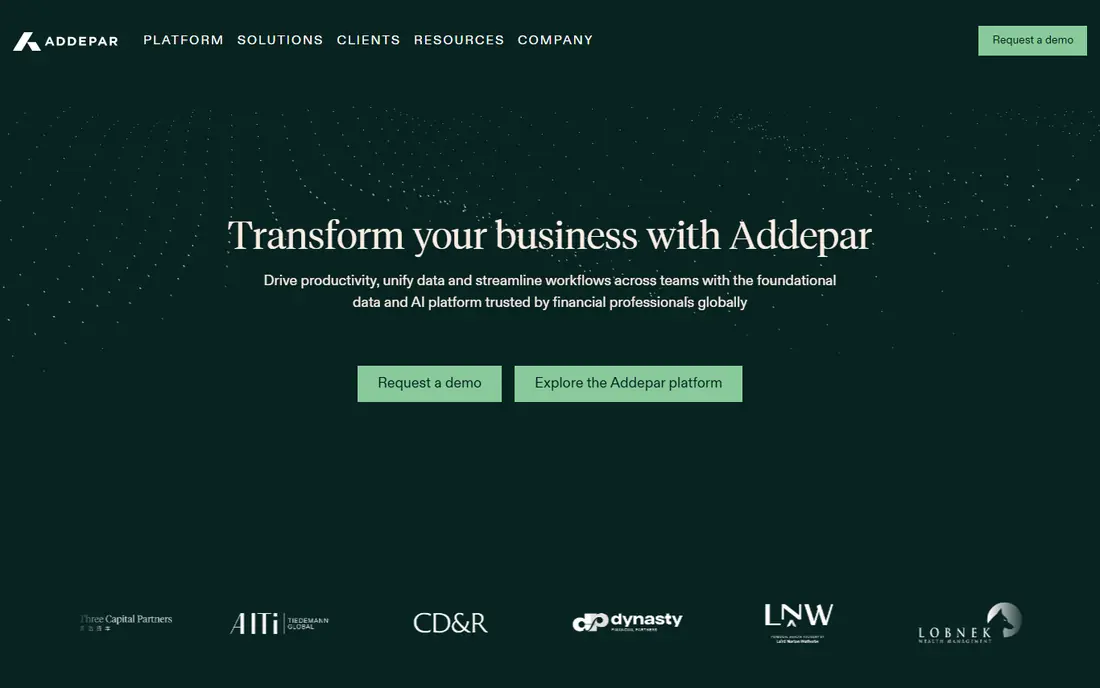
Addepar is the most widely adopted data and reporting platform for large wealth managers and family offices. It aggregates accounts across custodians, handles alternatives and private markets, and lets offices build custom reports for principals, advisors and accountants. In 2026 it added AI features for data work and reporting, which fit offices drowning in capital call notices and statements.
Addepar does not publish pricing. Contracts are quoted per client and often scale with assets on platform, with family office deployments commonly reported from around $50,000 per year plus implementation. Addepar is a reporting and analysis platform rather than a full general ledger, so most offices pair it with accounting tools. It fits large, complex offices best, while smaller offices may find flat-rate tools cheaper.
- Very broad custodian and asset-class coverage
- Strong alternatives handling and reporting flexibility
- Large integration ecosystem
- Pricing is quoted and often asset-based, so costs rise with wealth
- Implementation takes months for complex offices
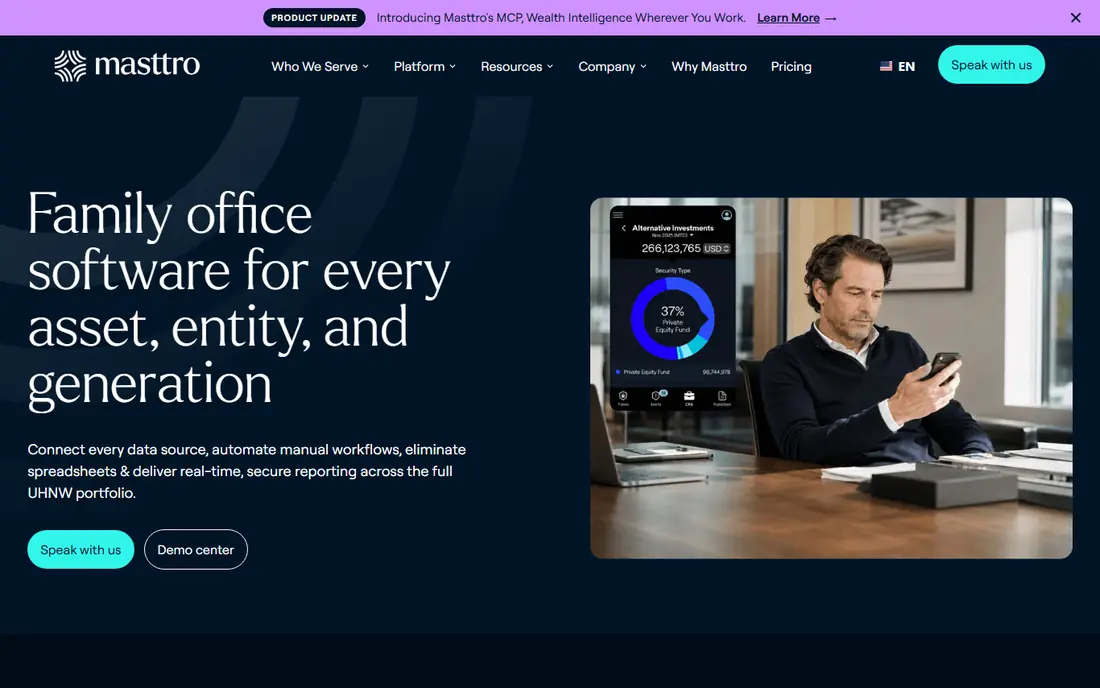
Masttro is built for dynastic, multi-jurisdictional wealth, with a global wealth map that shows entities, owners and holdings across countries and asset types. It handles passion assets alongside investment portfolios, and its document AI reads capital calls and tax documents to reduce manual entry. Data is hosted in a Swiss private cloud with strong security controls, which appeals to international families.
Pricing is not published and is not based on assets under management, with third-party estimates often above $50,000 per year. Masttro does not include a full general ledger, so offices that need double-entry accounting should pair it with an accounting system or choose a back-office platform. It fits large international offices that value a principal-first view and fixed pricing.
- Fixed annual pricing not tied to assets under management
- Strong global entity mapping
- Document AI for capital calls and tax forms
- Reporting-first, without a full double-entry general ledger
- Implementation takes months
- Pricing is quoted
Aleta is a newer family office platform aimed at offices that want consolidated reporting without an enterprise price or a year-long implementation. It combines wealth reporting with a built-in investment general ledger and AI document extraction, so statements and private market documents can flow into reports with less manual work. A principal mobile experience and open data access help families and advisors share the same view.
Pricing starts around $1,000 per month in recent comparisons, which makes Aleta one of the most accessible options on this list. Implementation is reported at 4 to 8 weeks, far faster than large enterprise platforms. Aleta fits smaller and mid-size offices that want modern reporting quickly, while the largest offices should test its depth against Addepar or Masttro.
- Low flat starting price for family office reporting
- Built-in investment general ledger
- AI document automation
- Fast implementation reported at 4 to 8 weeks
- Newer and smaller than Addepar, so ecosystem depth should be checked
- Complex enterprise needs may still need larger platforms
Asora, formerly known in some listings under related wealth reporting brands, targets entry-level family offices that mainly hold public market investments. It consolidates bank and brokerage accounts into one view, tracks performance, and produces reports for principals without the complexity of a full back-office system. That simplicity is its main appeal for a first family office platform.
Pricing starts around $900 per month in recent comparisons. Offices with large private market holdings, complex entities or full accounting needs will likely outgrow Asora within a year or two. For a smaller office with mainly liquid portfolios, Asora gives a clear, affordable starting point.
- Low flat starting price
- Simple consolidated reporting for public market portfolios
- Fast setup for smaller offices
- Private market and accounting depth are thinner than larger platforms
- Reporting is more basic than Addepar or Masttro
Eton Solutions AtlasFive
Great for: Large offices needing full back-office operations
Eton Solutions AtlasFive is a full back-office platform, not just a reporting tool. It combines investment accounting, general ledger, entity management, reporting and workflow for large family offices and multi-family offices. That breadth suits offices that run accounting, tax reporting and investment operations in-house, rather than outsourcing them.
Enterprise pricing is quoted, with third-party estimates ranging from $50,000 to over $250,000 per year depending on scope. Implementation takes months and needs internal effort. AtlasFive fits large offices that want one system for operations and reporting, while smaller offices will find Aleta or Asora far more accessible.
- Full back-office platform with general ledger, accounting and reporting
- Built for large single and multi-family offices
- Strong entity and fund handling
- Enterprise pricing, often reported from $50,000 to $250,000 per year
- Implementation is a major project
Asset Vantage combines an investment general ledger with consolidated reporting for mid-market family offices. Offices that need accounting-grade data, partnership accounting and entity reporting can run those functions in the same system that produces principal reports. Module-based pricing lets an office buy the pieces it needs rather than a single enterprise bundle.
Pricing is quoted, with third-party estimates around $40,000 per year for typical deployments. The interface leans toward accountants rather than principals, so families that want a polished client portal should test that experience carefully. Asset Vantage fits mid-market offices where accounting accuracy matters more than a consumer-style app.
- Integrated general ledger with wealth reporting
- Module-based pricing
- Suits mid-market offices with accounting needs
- Principal experience is more accountant-focused than client-focused
- Private market automation is thinner than Aleta or Masttro
Altoo is a Swiss wealth platform for family offices and wealthy families that want a single, clear view of total wealth. It aggregates bank accounts, portfolios, real estate and other assets into consolidated reports, with a focus on privacy and clean presentation. That simplicity suits families and advisors who want reporting without a heavy back-office system.
Pricing is quoted, with third-party estimates around $15,000 per year, though firms should confirm current plans. US offices should check tax reporting, custodian coverage and accounting integration before choosing Altoo over a US-focused platform. For international families, especially in Europe, Altoo is a strong, privacy-focused option.
- Clean consolidated view across banks and asset types
- Swiss-based platform with strong privacy focus
- Good for international families
- Pricing is quoted
- Depth for US tax and accounting workflows should be checked
- Smaller ecosystem than Addepar
Landytech Sesame is a flat-rate wealth reporting platform that suits smaller family offices and wealth managers. It consolidates investment data, tracks performance and produces client reports without asset-based pricing, so costs do not rise simply because wealth grows. A free tier has been listed in some comparisons, with paid plans up to $895 per month.
Sesame is reporting-focused, so offices that need a full general ledger or complex private market accounting will need another system alongside it. For a smaller office that wants predictable reporting costs and a fast start, Sesame is a credible alternative to Aleta and Asora, and firms should compare all three on custodian coverage.
- Flat-rate pricing from free to $895 per month in recent listings
- Consolidated reporting for investments
- Accessible entry for smaller offices
- Back-office accounting depth is thinner than Eton or Asset Vantage
- Private market automation is more basic than Aleta
How we picked these
We compared official product pages, pricing pages and recent third-party pricing checks for family office software in use in 2026. We kept only platforms built for family offices or wealth reporting with multi-entity, multi-custodian and private market features, and we left out general portfolio trackers and consumer budgeting apps. Prices are quoted where vendors do not publish a rate, and we note that enterprise totals vary widely by scope.
What to check before you buy
Start with your data, not with a demo dashboard. List custodians, banks, private funds, real estate, trusts and entities, then ask each vendor which feeds are direct, which need manual uploads, and how private market documents are handled. A platform that cannot ingest your largest holdings cleanly will create manual work every month, no matter how good its reports look.
Next, compare pricing models over five years, not one year. Asset-based pricing rises with wealth, flat pricing stays steadier, and module pricing depends on which modules you add. Ask about implementation time, data migration, security certifications, user permissions and data export, because switching family office software is costly. Finally, trial the principal report with your own data, and check whether advisors, accountants and family members each get the view they need.
Frequently asked questions
What does family office software do?
It consolidates accounts, entities and holdings across custodians and asset types into one view, with reporting, performance tracking and, on some platforms, accounting and document handling.
Is Addepar worth the cost for a small family office?
Usually not at entry level, because Addepar pricing is quoted and often asset-based, with deployments commonly reported from $50,000 per year. Smaller offices often start with Aleta, Asora or Landytech Sesame.
Does family office software replace an accountant?
No. It organizes data and produces reports, but tax, legal and accounting advice still need qualified professionals. Some platforms include a general ledger, but they do not replace professional judgment.
What is the difference between reporting and back-office software?
Reporting software shows consolidated wealth and performance. Back-office software adds accounting, general ledger, entity management and operational workflow. Eton AtlasFive and Asset Vantage lean toward back-office, while Addepar and Masttro lean toward reporting.
How long does implementation take?
Smaller platforms report 4 to 8 weeks, while enterprise platforms often take 3 to 12 months, depending on data quality, entity complexity and private market holdings.
Is this financial advice?
No. This article is general information only, not financial advice, and it does not promise returns. Investment decisions should be made with qualified advisors who understand your circumstances.
Sources
See where you really rank - block by block
ProMapRanker scans Google Maps across a grid of your service area. Simple monthly plans from $19, white-label on every plan.
Start freeKeep reading
 zoro.to alternatives
Best Zoro.to Alternatives in 2026
We compare the best zoro.to alternatives in 2026, listing only legal licensed anime streaming services, from Crunchyroll to free options for fans today.
Read → zip alternatives
Best Zip Alternatives in 2026
We compare the best zip alternatives for buy now, pay later in 2026, covering pay-in-4 plans, fees, spending limits, and credit reporting options today.
Read → yesware alternatives
Best Yesware Alternatives in 2026
Compare the best yesware alternatives for sales email tracking, templates, and sequences, with current pricing and honest tradeoffs for small sales teams.
Read →