 ProMapRanker
Best Family Office Accounting Software in 2026

Key takeaways
- Addepar suits large, complex family offices that need deep portfolio analytics and consolidated reporting across many custodians.
- Archway and Eton AtlasFive suit offices where the general ledger, bill pay, and entity accounting drive the decision.
- Masttro and Aleta suit families that want a polished, consolidated view of total wealth, including lifestyle assets and private holdings.
- Asora and Asset Vantage offer lower-cost or mid-market paths for smaller offices moving away from spreadsheets.
- This is general information only, not accounting or tax advice. Pricing is mostly quote-based, so request a demo and a written quote before you commit.
Quick comparison
| Pick | Great for | Pricing starts at | Free tier | |
|---|---|---|---|---|
 Addepar | Complex portfolio analytics | See website | No | Visit |
 Archway | Operational accounting | See website | No | Visit |
 Asset Vantage | Mid-market ledger and reporting | See website | No | Visit |
 Masttro | Multi-jurisdiction families | See website | No | Visit |
 FundCount | Partnership accounting | See website | No | Visit |
 Eton Solutions AtlasFive | Full operating platform | See website | No | Visit |
 Asora | Smaller offices | See website | No | Visit |
 Aleta | Consolidated reporting | See website | No | Visit |
 SS&C Black Diamond | Advisor-led reporting | See website | No | Visit |
The best family office accounting software
Family office accounting software is not the same as small business accounting software. A family office must track many legal entities, bank and brokerage accounts, private investments, real estate, and family expenses, then roll them into one view for reporting, tax work, and decision making. Some tools focus on the general ledger, some focus on portfolio reporting, and some try to cover both. We compared official vendor pages and current 2026 family office guides, and we favored tools with a clear family office or wealth reporting focus. Prices in this category are mostly quote-based, so we list them as See website rather than inventing figures.
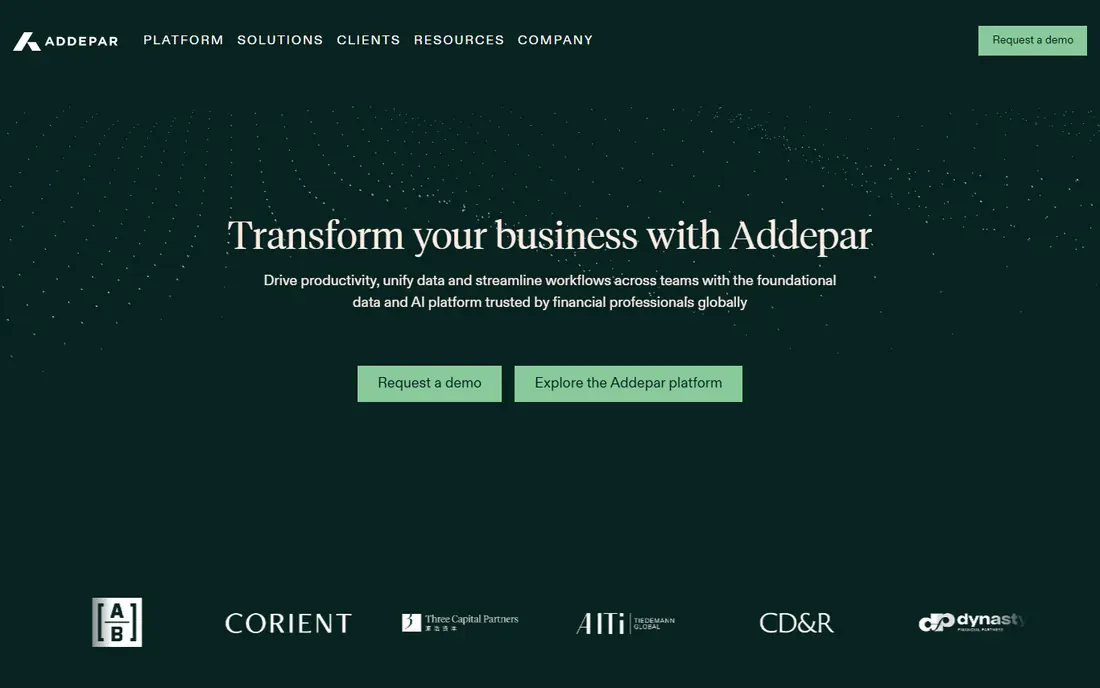
Addepar is the analytics-led choice for large family offices with dedicated investment teams. It aggregates portfolio, market, and client data into one model that can represent listed securities, private funds, real estate, and direct investments together. Performance reporting, risk modeling, and ownership analysis across entities and currencies are its strengths. For a family with many custodians and complex structures, that unified view is the reason to pay for Addepar.
The trade-off is scale and effort. Pricing is based on assets under reporting in many cases, and implementation is a serious project that can take months for a complex book. Smaller offices will find the cost hard to justify against flat-fee alternatives. If your office is large, complex, and analytics-driven, Addepar is a leading option. If your main need is day-to-day ledger work, an accounting-first tool below may fit better.
- Unified data model across public and private assets
- Strong performance, risk, and attribution reporting
- Large custodian and data integration set
- Pricing is quote-based and aimed at larger firms
- Implementation can take months
Archway, from SEI, is the accounting-first choice in this list. It supports multi-entity general ledger consolidation, payroll, accounts payable, and vendor payments, which are the daily jobs of a family office back office. Reporting draws on ledger data, so numbers reconcile to the books rather than sitting in a separate reporting layer. For offices where accounting drives the software decision, that structure matters more than a polished family member portal.
The interface feels built for accountants, not for family members browsing on a phone, and private markets automation is less modern than on some reporting-first rivals. Offices already inside the SEI ecosystem will get the most from Archway, since data flows with less custom work. If your team is accounting-led and needs a strong ledger, Archway deserves a demo.
- Multi-entity general ledger consolidation
- Payroll, accounts payable, and vendor payments
- Reporting tied to ledger data
- Interface leans toward finance teams
- Less modern private markets automation than some rivals
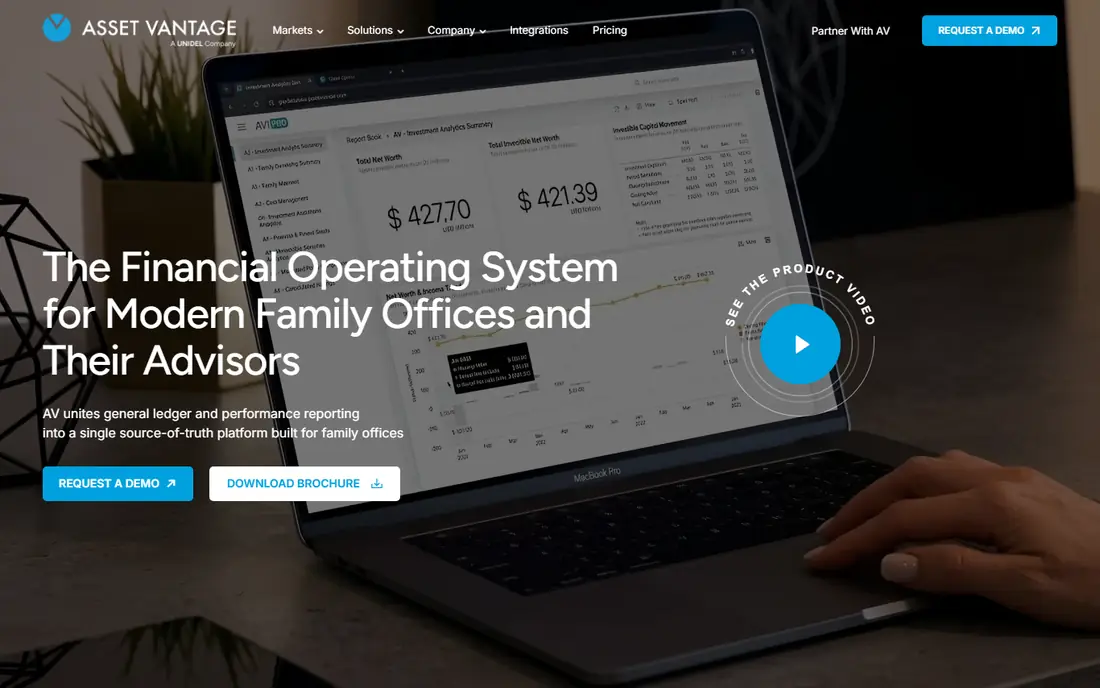
Asset Vantage combines general ledger workflows with portfolio reporting in one environment, which can simplify reconciliation for a mid-size office. Instead of moving numbers between a ledger system and a separate reporting tool, the team works in one place for both jobs. That matters for offices that need clean books and client-ready reports without enterprise pricing. Multi-entity support covers the common family office structure of trusts, companies, and personal accounts.
The interface is finance-team focused, and AI document automation is more limited than on newer reporting platforms, according to current guides. That is less of a problem if your team already handles documents through other tools. For a mid-market office that wants ledger and reporting together at a workable price, Asset Vantage is a sensible shortlist entry.
- Ledger and portfolio reporting in one system
- Mid-market pricing relative to enterprise platforms
- Multi-entity support
- Interface leans toward finance teams
- AI document automation is limited in current guides
Masttro suits dynastic families with assets across jurisdictions, including investments, real estate, art, and other lifestyle assets alongside financial holdings. The platform gives a consolidated view of total wealth, with document handling and secure communications for family members and advisors. The experience is polished for principals who want to see the whole picture without digging through accounting screens. Fixed license pricing, rather than asset-based pricing in many cases, can also make costs more predictable as assets grow.
Masttro is more closed than some competitors, with less flexibility for open integrations, according to current guides. That can matter if your office runs custom tools or wants broad API access. Pricing is also aimed at larger families, so smaller offices may find it expensive. For a complex, multi-jurisdiction family that values a single polished view, Masttro is a strong candidate.
- Consolidated view across jurisdictions and asset types
- Lifestyle asset tracking
- Secure document and communication tools
- More closed ecosystem than some rivals
- Pricing is aimed at larger families
FundCount is best for offices and administrators with fund-style structures, partnership accounting, and waterfall-heavy allocations. It handles the accounting logic that generic tools struggle with, including capital calls, distributions, and partner allocations, while also offering portfolio reporting. For a family office that operates like a fund, or that manages partnerships alongside direct holdings, that depth is valuable. Ledger and reporting sit together, which helps reconciliation.
Wealth reporting and user experience are less polished than on reporting-first platforms, and the system expects finance expertise to use well. That makes FundCount a specialist pick, not a general family portal. If partnership accounting is your core complexity, FundCount should be on the demo list. If you mainly need a clean family dashboard, a reporting-first tool may feel easier.
- Deep partnership and fund accounting
- Waterfall and allocation support
- Ledger plus portfolio reporting
- Wealth reporting and user experience feel secondary in guides
- Implementation needs finance expertise
Eton Solutions AtlasFive is a full operating platform for large family offices, covering general ledger and ERP functions, bill pay, entity management, document handling, and reporting in one system. It suits offices that want to replace several tools with one governed platform, with audit trails and controls that support a professional back office. Large single-family and multi-family offices with complex entity structures are its natural audience.
Enterprise pricing and implementation time are the honest barriers. This is not a tool for a small office moving off spreadsheets, and the project will need staff time and vendor support. For a large office that needs a single system of record, AtlasFive is one of the most complete options. For a smaller office, a lighter reporting or ledger tool will be faster and cheaper to adopt.
- General ledger, bill pay, entity management, and reporting in one platform
- Built for large single and multi-family offices
- Strong audit trails
- Enterprise pricing and long implementation
- More system than a small office needs
Asora is designed for early-stage and smaller family offices moving away from spreadsheets. It offers consolidated reporting at a lower entry cost than enterprise platforms, with deployment that can be measured in weeks rather than months for a simpler book. For a family with mainly public-market holdings and a handful of entities, Asora gives a clean total-wealth view without enterprise overhead. That makes it a useful first system for a growing office.
The limit is complexity. Asora is mainly suited to public-market portfolios with lighter private holdings, and offices that grow into complex private, real estate, or multi-jurisdiction structures may need to migrate later. Treat that as a known trade-off, not a surprise: start with Asora if it fits today, and plan for a review when complexity rises. For a small office, that path is often better than paying for enterprise features you do not yet use.
- Lower-cost entry point than enterprise platforms
- Faster deployment for simpler portfolios
- Clear consolidated reporting
- Mainly suited to public-market portfolios
- May need migration as complexity grows
Aleta is a consolidated reporting platform that appeals to offices wanting a clear principal view without asset-based pricing escalation. It offers AI-assisted document processing for private markets, which can reduce manual data entry for fund statements and capital notices. Open API access also helps offices that want to connect their own tools or build custom views. Implementation times in guides are shorter than enterprise platforms, often measured in weeks for a standard book.
Aleta is newer than Addepar or Eton, and its focus is reporting rather than full operational accounting, so offices that need deep ledger, payroll, and bill pay may still need a second system. For an office whose main pain is seeing total wealth clearly, with private holdings included, Aleta is a modern option worth a demo. Check how it handles your specific private asset types before you commit.
- Entity-based pricing rather than asset-based pricing in guides
- AI document processing for private markets
- Open API access
- Newer than some enterprise rivals
- Reporting focus means ledger needs may need another tool
SS&C Black Diamond, formerly part of the Advent suite, is a portfolio accounting and reporting platform used by advisors and multi-family offices. It offers clean client reporting, a client portal, and billing and trading workflows that suit firms that are also registered investment advisors. Integration with the wider SS&C stack helps firms already running SS&C tools, since data flows between products with less custom work. For an MFO that serves many families, that advisor focus matters.
Pricing is quote-based, and standalone value is lower than for firms already in the SS&C ecosystem. The system is also advisor-led rather than family-member-led, so a single-family office that wants a principal dashboard may prefer Masttro or Aleta. For an MFO or RIA-style office, Black Diamond is a proven and well-supported choice.
- Strong client reporting and portal
- Portfolio accounting for advisors and multi-family offices
- Wide SS&C integration set
- Pricing is quote-based
- Best value comes with other SS&C products
How we picked these
We compared official vendor pages and current 2026 family office guides, favoring tools with a clear family office, wealth reporting, or portfolio accounting focus and a live product in October 2026. We included ledger-first, reporting-first, and full-platform options, since no single tool fits every office. We did not invent prices, since most vendors price by quote, assets, entities, or implementation scope. We also did not claim hands-on testing of enterprise installs, which require vendor demos and client data. Request a demo on your own entity structure before you choose.
What to decide before you buy
Start with your main complexity. If the pain is the ledger, bill pay, and multi-entity close, shortlist accounting-first tools such as Archway, Asset Vantage, FundCount, and AtlasFive. If the pain is seeing total wealth across custodians and private holdings, shortlist reporting-first tools such as Addepar, Masttro, and Aleta. If you need both at enterprise scale, expect a longer project and a higher quote, and plan staff time for implementation.
Check four practical points in a demo. First, ask how your private investments, real estate, and lifestyle assets are handled, not just listed securities. Second, ask how data flows from custodians and banks, and how often it reconciles. Third, ask who will use the system daily, since an accountant-led tool and a principal-led portal feel very different. Fourth, get pricing in writing, including implementation, data fees, and user counts. A tool that fits your structure today and can grow with you is better than a tool that looks polished but misses your core asset type.
Frequently asked questions
What is the best accounting software for family offices?
There is no single best tool, since the answer depends on whether ledger work or reporting work drives the decision. Addepar suits large analytics-led offices, Archway and AtlasFive suit accounting-led offices, and Masttro and Aleta suit reporting-led families. Smaller offices should also look at Asora and Asset Vantage. Demo at least two tools on your own entity structure before you decide.
How much does family office accounting software cost?
Most family office software is priced by quote, and costs vary widely by assets, entities, users, and implementation scope. Smaller reporting tools can start at a monthly subscription level, while enterprise platforms can cost six figures per year. Ask for a written quote that includes implementation, data feeds, and ongoing support, since those items change the total cost.
Can family office software replace QuickBooks?
For a simple single-entity book, QuickBooks can work, but it struggles with multi-entity consolidation, private investment accounting, and consolidated family reporting. Family office tools add entity-aware ledgers, partnership logic, custodian aggregation, and family reporting that QuickBooks does not offer as standard. Offices that outgrow spreadsheets or QuickBooks usually move for those reasons, not for a nicer invoice screen.
What is the difference between reporting software and accounting software?
Reporting software aggregates holdings and presents performance, allocation, and total wealth views, often from custodian data. Accounting software maintains the general ledger, posts transactions, handles payables and payroll, and supports audit trails. Some tools do both, but many do one job better than the other. Choose based on which job causes the most pain in your office, and check whether the other job needs a second tool.
How long does implementation take?
Implementation ranges from weeks for a smaller reporting tool to many months for a large enterprise platform, depending on entity count, asset complexity, and data quality. Custodian connections, private asset setup, and historical data migration are the usual slow steps. Ask the vendor for a realistic timeline based on offices like yours, and plan staff time for data checks during the project.
Sources
See where you really rank - block by block
ProMapRanker scans Google Maps across a grid of your service area. Simple monthly plans from $19, white-label on every plan.
Start freeKeep reading
 who has the best home internet service
Who Has the Best Home Internet Service in 2026
Who has the best home internet service in 2026? Compare fiber, cable, and 5G providers on speed, price, data caps, and availability at your address today.
Read → visio alternatives
Best Visio Alternatives in 2026
Compare 9 Visio alternatives for flowcharts, org charts, and network diagrams, with free plans, pricing, and the best pick for teams and solo users in 2026.
Read → top 10 logistics software
Top 10 Logistics Software in 2026
We compared the top 10 logistics software tools for transport, warehousing, visibility and shipping, for shippers, carriers and 3PL teams in 2026 today.
Read →