 ProMapRanker
Best Facial Recognition Software in 2026


AWS developers and video analysis · Pricing starts at: See website
Key takeaways
- Amazon Rekognition and Azure AI Face suit developers who want cloud APIs, while FaceTec leads for liveness-checked onboarding.
- NEC, IDEMIA, and Cognitec suit large identity and access programs where on-premise control and scale matter most.
- Face++ and Luxand give developers a wide API menu and a clear entry price, with Luxand strongest for offline and on-device use.
- Facial recognition uses biometric data, so consent, retention limits, and lawful use must be settled before deployment, not after.
Quick comparison
| Pick | Great for | Pricing starts at | Free tier | |
|---|---|---|---|---|
| Amazon Rekognition | AWS developers and video analysis | See website | Yes | Visit |
 Microsoft Azure AI Face | Microsoft-based identity systems | See website | Yes | Visit |
 FaceTec | Liveness-checked onboarding | See website | No | Visit |
 Face++ | Wide face API menu for apps | See website | Free trial | Visit |
 NEC Bio-IDiom | Large-scale identity programs | See website | No | Visit |
 IDEMIA | Government and enterprise identity | See website | No | Visit |
 Cognitec | Specialist face recognition vendor | See website | No | Visit |
 Luxand | Offline and developer-friendly APIs | $19 per month | Free trial | Visit |
The best facial recognition software
We compared enterprise and developer tools on accuracy features, liveness checks, deployment options, and pricing, using official pages and current comparisons. These tools are for legitimate uses such as secure access, employee onboarding with consent, and identity verification where the person agrees to the check. Do not use facial recognition to identify strangers without consent, to stalk, or to build a watchlist of people who have not agreed to it, and check biometric privacy laws in your region, such as Illinois BIPA, GDPR, and the EU AI Act, before deployment.
Amazon Rekognition is the fastest route for a team already running on AWS. Its APIs detect faces, compare faces, search face collections, and check liveness, and it can analyse stored and streaming video as well as still images. That breadth suits media indexing, secure access, and identity verification flows built on other AWS services such as storage and serverless functions.
Pricing is usage-based, starting at about $0.001 per image for the first million images per month in recent listings, with face storage and liveness checks billed separately. AWS gives you the tools, but consent, data retention, and access controls are your job, so set retention limits and access policies before you load real faces.
- Scales for images and video
- Face search, detection, and liveness in one service
- Deep AWS integration
- Usage-based pricing needs careful estimates
- You must manage consent and retention yourself
- Video costs add up
Azure AI Face suits organisations already standardised on Microsoft services. It offers face detection, verification, and identification, with liveness support, and it fits naturally with Entra ID for workforce access and with other Azure services for onboarding workflows. The free tier gives 5,000 transactions per month in recent comparisons, which is enough to test a prototype.
Access to face identification is gated, and Microsoft reviews use cases before granting it, which is a safeguard, not a drawback, for lawful deployment. Paid pricing is transaction-based and varies by feature, so we list See website here, and you should confirm the current tier for the exact operations your app will call.
- Free tier for trials
- Integrates with Microsoft Entra ID
- Strong compliance documentation
- Face identification access requires review and approval
- Azure-centred setup
- Paid pricing varies by transaction type
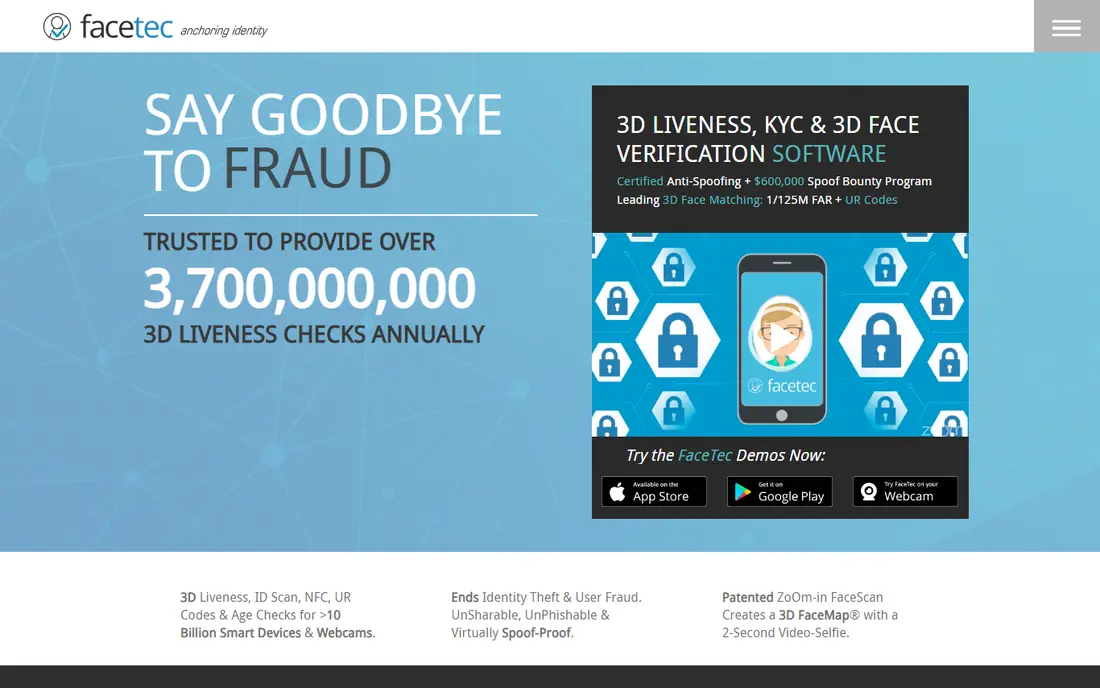
FaceTec focuses on one job: proving that the person in front of the camera is real and matches their ID. During onboarding, a short video selfie checks 3D liveness, matches the face to the photo ID, and reads the ID text, and later logins repeat the liveness and matching check without a password. That makes it a strong pick for banks, fintech apps, and other services where account takeover is a real risk.
The product is sold as an enterprise service, so pricing is quoted rather than published, and integration takes planning with your onboarding flow. For high-risk onboarding, that cost is easier to justify than for a low-risk app, where a simpler verification API may be enough.
- 3D liveness and face matching in a short video selfie
- Strong anti-spoofing certifications
- Works across devices
- Enterprise pricing, not a casual developer plan
- Integration needs planning
- No free tier for production use
Face++, from Megvii, gives app developers one of the widest face API menus on this list, covering detection, recognition, verification, landmarks, attributes, and liveness. That breadth suits consumer apps that need several face features at once, rather than a single verification check, and it handles high-volume workloads well.
Pricing is tiered and varies by API and volume, with a free tier available in recent listings, so we list See website here. Before using it for regulated or European users, check data residency, retention, and consent handling carefully, since those terms matter as much as API coverage for this kind of product.
- Wide range of face APIs
- Liveness detection available
- Handles high-volume app workloads
- Pricing and free tier details vary
- Data residency needs checking for regulated use
- Documentation quality varies by API
NEC Bio-IDiom is a biometric platform for large identity programs, including border, government, and enterprise deployments where millions of identities must be matched reliably. It can combine face with other biometric modes, which helps when a single mode is not enough for a given population or environment. That scale and breadth set it apart from developer APIs built for a single app.
For a small team, Bio-IDiom is almost certainly more than needed, and pricing and implementation are enterprise-grade. It belongs on the shortlist when the program itself is large, regulated, and long-lived, and when the buyer can run a formal procurement and pilot process.
- Proven at very large scale
- Multimodal biometrics beyond face alone
- Strong government and border use cases
- Enterprise pricing and procurement
- Long implementation cycles
- Overkill for small apps
IDEMIA is a large identity company whose facial recognition products sit inside wider identity, document, and access systems. That matters for buyers who need face matching alongside ID documents, enrolment, and physical access, rather than a standalone API call. Its government and enterprise experience suits programs where identity proofing, fraud checks, and audit trails must work together.
The range is also a drawback for small buyers, since scoping the right product takes time and pricing is quoted. If your need is a single app feature, a developer API will be faster and cheaper, while IDEMIA fits when identity is a core system, not a feature.
- Deep identity and document expertise
- Access control and border solutions
- Global enterprise support
- Enterprise pricing
- Product range is broad, so scoping takes care
- Not a developer self-serve API
Cognitec is a pure-play face recognition vendor, which appeals to buyers who want a specialist rather than a general cloud platform. Its software handles face detection, matching, and video analysis, with SDK and on-premise options for teams that cannot send biometric data to a public cloud. That deployment control is a real advantage for regulated or high-security settings.
Pricing is quoted, and the vendor is smaller than Amazon or Microsoft, so check support coverage, update cadence, and reference customers in your sector before committing. For a focused face matching system with data control, though, a specialist vendor can be a better fit than a general API.
- Specialist focus on face recognition alone
- Video and image matching
- On-premise and SDK options
- Pricing is quoted
- Smaller vendor than cloud giants
- Integration support varies by deployment
Luxand suits developers who want a clear price and the option to run face recognition on their own hardware. Its cloud API covers detection, recognition, verification, landmarks, and liveness, while its FaceSDK runs offline for access control and kiosk use where cloud calls are not wanted. The cloud entry price is listed at $19 per month for 10,000 API requests in recent listings, which makes budgeting simple for small projects.
The ecosystem is smaller than the cloud giants, so check SDK support for your platform and test accuracy with your own cameras and lighting before deployment. For a developer project, a small access system, or a prototype that may later move on-premise, Luxand is a practical and affordable starting point.
- Cloud API and offline SDK options
- Clear entry price
- Liveness and landmark detection included
- Smaller ecosystem than cloud giants
- High-volume pricing needs checking
- Accuracy depends on camera and lighting
How we picked these
We compared official pages and current facial recognition comparisons for tools that are live in October 2026 and serve legitimate enterprise, government, or developer use. We kept only tools framed for access, onboarding, and identity verification with consent, and we left out consumer face search tools framed for finding strangers online. Where pricing is quoted or varies by transaction, we wrote See website.
What to check before you choose
Start with the legal basis. Confirm that you have consent or another lawful basis for collecting face data, set a retention period, and limit access to the templates and images you store. Check biometric laws in every region where users live, since rules differ sharply, and get legal review before you enrol real users, especially employees or customers who may feel they cannot refuse.
Then test in your real environment. Accuracy varies with lighting, camera angle, age, and face coverings, so run a pilot with a diverse group and measure false matches and false rejections, not only headline accuracy. Also confirm fallback options for people who cannot or will not use face recognition, since a system with no alternative route will exclude users and create complaints.
Frequently asked questions
What is the best facial recognition software for businesses?
Amazon Rekognition and Azure AI Face suit cloud-based businesses, while FaceTec leads for liveness-checked onboarding and Cognitec suits on-premise deployments.
What is the best facial recognition app for access control?
Luxand and FaceTec are strong picks for access control, with Luxand offering offline SDK options and FaceTec offering liveness-checked matching for secure entry.
Is there a best free facial recognition app?
Free tiers exist on cloud APIs such as Azure AI Face and Amazon Rekognition, but free tiers are for trials and small volumes. Production biometric systems need a paid plan, plus legal and security work that a free tier does not cover.
Is facial recognition legal to use?
It depends on the use, the region, and consent. Some regions restrict biometric collection heavily, and employee or customer enrolment usually needs clear consent, a lawful basis, and retention limits. Get legal advice for your specific use before deployment.
What is the difference between face detection and face recognition?
Detection finds that a face is present in an image, while recognition matches that face to a known person or template. Verification checks one person against one claimed identity, while identification searches a database for a match.
How do I protect face data once collected?
Store templates, not raw photos, where possible, encrypt data in transit and at rest, limit access to named roles, set retention limits, and log access. Delete templates when the purpose ends or consent is withdrawn.
Sources
See where you really rank - block by block
ProMapRanker scans Google Maps across a grid of your service area. Simple monthly plans from $19, white-label on every plan.
Start freeKeep reading
 zoho inventory alternatives
6 Alternatives to Zoho Inventory, Compared on Price and Fit
Zoho Inventory alternatives: 6 tools compared on price, free plans and fit. Katana leads the list for manufacturers. Fit and flaws are laid out for each entry.
Read → zoho crm alternatives
Best Zoho CRM Alternatives (2026)
Need Zoho CRM alternatives? We compare 7 tools on cost, free access and who each suits. Every pick gets a straight assessment. Built for quick decisions.
Read → zelle alternatives
Best Zelle Alternatives in 2026
Compare the best Zelle alternatives for sending money to friends, paying sellers and moving funds abroad, with honest notes on fees, speed and safety in 2026.
Read →