 ProMapRanker
Shortlist


Festivals, expos and markets juggling vendors, artists and schedules · Pricing starts at: See website
Key takeaways
- This list starts with Eventeny, which is built for Festivals, expos and markets juggling vendors, artists and schedules.
- Check the limits for Skedda before you commit: it schedules spaces, not people or event programs.
- Expect to ask for a quote from Eventeny, Skedda, WhenToWork and Planning Pod; the other tools show a starting price.
- Planning Pod suits event venues and planners managing bookings, timelines and clients.
- Neither Eventeny nor Planning Pod, nor any of the other 3 tools, has a permanent free plan; trials and quotes are the norm.
Direct answer
For Festivals, expos and markets juggling vendors, artists and schedules, Eventeny is where this list starts. Look at Sched for conferences and festivals needing published agendas and session management, and at Skedda for booking meeting rooms, desks, studios and shared spaces. The other 2 tools in the list cover narrower or pricier cases.
Quick comparison
| Pick | Great for | Pricing starts at | Free tier | |
|---|---|---|---|---|
| Eventeny | Festivals, expos and markets juggling vendors, artists and schedules | See website | No | Visit |
 Sched | Conferences and festivals needing published agendas and session management | $500 per event (Engage plan, includes 500 attendees) | No | Visit |
 Skedda | Booking meeting rooms, desks, studios and shared spaces | See website | No | Visit |
 WhenToWork | Managers scheduling hourly employees across shifts | See website | Free trial (30 days) | Visit |
 Planning Pod | Event venues and planners managing bookings, timelines and clients | See website | No | Visit |
Event Scheduling Software profiles
This ProMapRanker guide covers 5 options for event scheduling software. Each profile lists a starting price, free plan details, strengths and drawbacks, so you can drop poor fits quickly.
Eventeny
Great for: Festivals, expos and markets juggling vendors, artists and schedules

Eventeny is built with Festivals, expos and markets juggling vendors, artists and schedules in mind. The trade-off is breadth compared with depth in pure scheduling. Vendor applications, booth assignments, artist scheduling and ticketing live together, which matches how festival teams actually work.
Watch-outs: Broader than pure scheduling, so evaluate the modules you will actually use.
If the need is strictly staff shifts or room bookings, the specialists above are tighter. From a buyer's view, pricing is not published, so budget discovery happens in the sales process. As for the details, the concrete strength is stakeholder management. This comparison lists no price for Eventeny; ask the vendor. Eventeny has no free plan.
- Designed for the chaos of multi-stakeholder outdoor events
- Vendor and exhibitor management alongside ticketing and scheduling
- Pricing not published
Sched
Great for: Conferences and festivals needing published agendas and session management
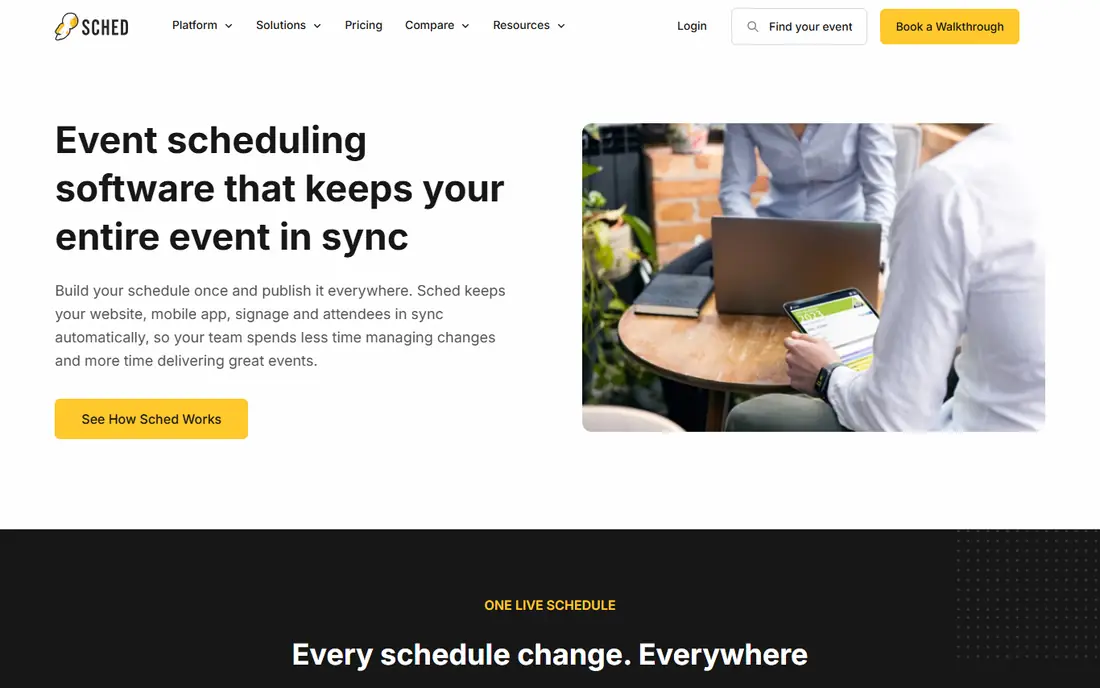
Sched is designed for conferences and festivals needing published agendas and session management. Sched is refreshingly transparent in a market of quote-based pricing: Engage at $500, Reserve at $1,500 and Native at $2,500 per event, each including 500 attendees, with nonprofit and education discounts available. From a buyer's view, for the actual conference agenda, the thing attendees stare at all day, Sched's combination of published pricing and purpose-built workflow is hard to beat.
Honest limits: Event-schedule focused.
Best features of Sched: speakers and feedback in one place.
Beyond that, the limitation is focus. The attendee counts per level mean very large events have to check overage terms. Beyond that, the concrete strength is the conference workflow. What you pay to start with Sched: $500 per event. Sched has no free tier.
- Attendees build personal agendas
- Organizers handle sessions
- Not a staff or venue scheduler
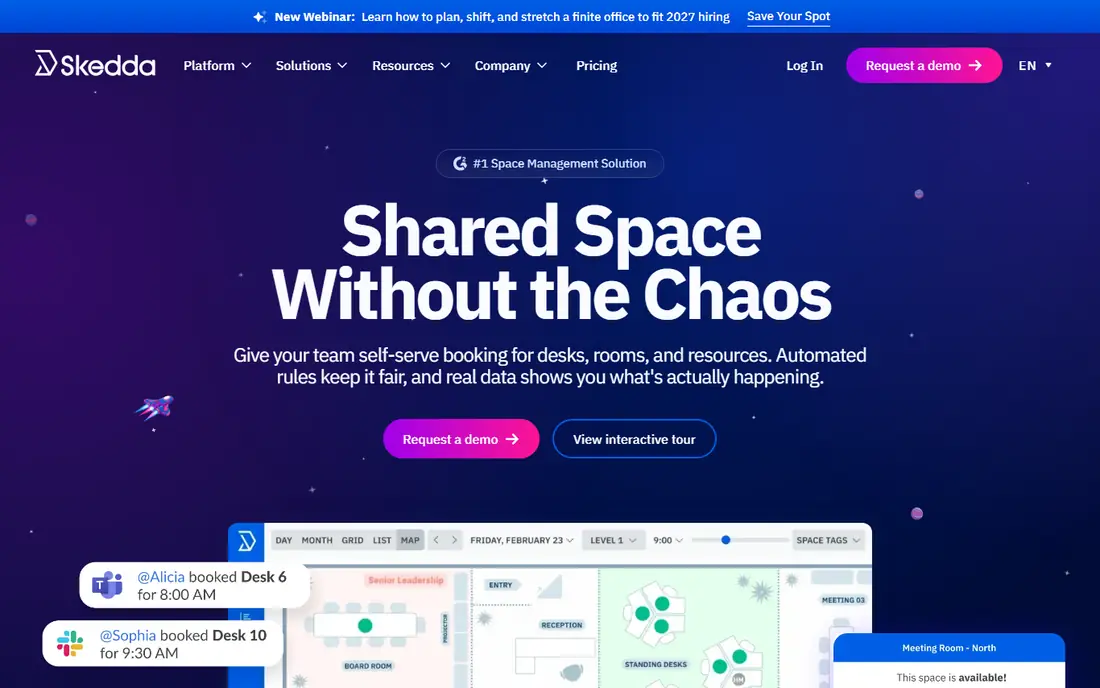
Skedda was built for booking meeting rooms, desks, studios and shared spaces. The concrete strength is the booking experience: visual availability, self-service reservations and conflict prevention without an admin in the middle.
Limits to weigh: It schedules spaces.
More specifically, if your event problem is "who gets which room when," this is the specialist. In daily use, the honest boundary is that Skedda does not schedule staff shifts or build conference agendas. No starting price is listed for Skedda here; confirm pricing on the vendor site. No free plan comes with Skedda.
- Booking rules and access control
- Takes care of hot-desking and room reservations elegantly
- Pricing not published
WhenToWork targets managers scheduling hourly employees across shifts. The concrete strength is AutoFill, which produces schedules considering employee preferences, time-off requests and overtime, plus the capacity to suspend accounts seasonally at no cost whereas keeping data.
Where it falls short: Concentrated on shift scheduling.
Also, for restaurants, clinics, parks, security businesses and other shift-based operations, that focus is the point. WhenToWork shows no starting price here, so confirm the cost on the vendor site. Free plan details: Free trial (30 days).
- Time-off and overtime rules
- Refreshingly straightforward shift scheduling with AutoFill that builds schedules from preferences
- Not broader HR or event management
Planning Pod
Great for: Event venues and planners managing bookings, timelines and clients
Planning Pod works best for event venues and planners managing bookings, timelines and clients. Planning Pod serves the business of events: venues, caterers, planners and rental companies that run dozens of events per year. Leads become proposals, proposals become contracts, contracts produce timelines, task lists and floor plans, and client communication stays attached to each event.
It is operations software for event businesses, with scheduling as part of that flow. From a buyer's view, a corporate team planning its annual conference will find it heavy. An event venue managing 200 weddings per year will find it essential. Planning Pod shows no starting price here, so confirm the cost on the vendor site. Planning Pod has no permanent free option.
Trade-offs to know: Pricing not published.
- Made for event companies: lead management, proposals, contracts
- Timelines and floor plans in one system
- Geared to event professionals, not one-off organizers
Selection criteria
Pricing pages, product documentation and feature lists were the main sources, and every entry carries at least one honest drawback. Where a vendor does not publish a price, the entry says quote. Where a price depends on seats or billing term, the entry says so. We ordered the tools by general fit, then by how clearly pricing is shown, then by free access. A buyer with unusual needs may reorder them.
Before you commit
- Get a written quote from Eventeny, Skedda, WhenToWork and Planning Pod; the list shows no starting price for them.
- Run a trial of WhenToWork with real work before paying for a year; your own workflow is the best test.
- Before choosing Eventeny, weigh its main limit: pricing not published.
- Check whether Sched bills monthly or annually, and what cancelling early costs.
- Check the integration list for Skedda against the tools you run today, and note which ones need a higher plan.
Frequently asked questions
How are the tools for event scheduling software ordered?
The order follows typical fit for event scheduling software, with Eventeny first and Planning Pod last, then price clarity and free access. It is editorial judgement, not a score, so another team could rank the tools differently.
Can I try these options before paying?
Often, yes. WhenToWork offers a free trial. Use your own data and a real task during the test, and check what the free tier or trial limits before you rely on it.
What is the difference between event scheduling software and ticketing software?
Some products do both, but most specialize. If your problem is "who works when" or "what happens where," you need scheduling, not ticketing.
How long does setup take?
Staff schedulers can run within days once employee data is clean. Conference systems need weeks for content collection. Beyond that, venue and operations systems like Planning Pod take longer because of pipeline and template setup.
What about free choices?
WhenToWork provides a 30-day free trial. Most others do not offer free levels. General calendar apps are free but lack the shift, booking-rule and agenda features these specialists offer.
Does any tool for event scheduling software here have a free plan?
A permanent free plan is not offered by Eventeny, Planning Pod or the other tools here. WhenToWork offer a trial. Plan a short evaluation period instead.
Sources
See where you really rank - block by block
ProMapRanker scans Google Maps across a grid of your service area. Simple monthly plans from $19, white-label on every plan.
Start freeKeep reading
 zscaler alternatives
Best Zscaler Alternatives in 2026
Looking for zscaler alternatives? We compare 9 SASE and zero trust platforms on architecture, data protection, pricing, and fit for your network and team.
Read → zapier alternatives free
Best Zapier Alternatives Free in 2026
Nine automation tools for zapier alternatives free in 2026, all with genuinely free tiers, plus free plan limits, starting prices and upgrade paths explained.
Read → which platform is best for online reputation
Which Platform Is Best for Online Reputation in 2026
Wondering which platform is best for online reputation? We compare 8 review, listing, and response tools for small and multi-location businesses and agencies.
Read →