 ProMapRanker
Best Estimating Software for Remodeling in 2026


Remodel-specific templates and local pricing · Pricing starts at: See website
Key takeaways
- Clear Estimates is the strongest fit for remodelers who want ready-made templates and local pricing, rather than a full project management suite.
- Buildertrend and Houzz Pro suit firms that need estimating plus scheduling, client communication, and change orders in one place.
- Contractor Foreman gives small crews estimating, invoicing, and scheduling at 49 dollars per month, which undercuts most larger platforms.
- Takeoff tools like STACK and PlanSwift matter most when plans drive the estimate, while template tools matter most for repeat kitchen and bath work.
Quick comparison
| Pick | Great for | Pricing starts at | Free tier | |
|---|---|---|---|---|
| Clear Estimates | Remodel-specific templates and local pricing | See website | Free trial | Visit |
 Buildertrend | Estimating plus project management for growing firms | See website | No | Visit |
 Houzz Pro | All-in-one business tools for residential pros | $149 per month | Free trial | Visit |
 Contractor Foreman | Affordable all-in-one tools for small crews | $49 per month | Free trial | Visit |
 ProEst | Detailed estimating for larger contractors | See website | Free trial | Visit |
 STACK | Cloud takeoff and estimating from plans | See website | Free trial | Visit |
 PlanSwift | Fast digital takeoff for plan-based bids | See website | Free trial | Visit |
 Handoff AI | AI-assisted estimates for residential remodelers | $149 per month | Free trial | Visit |
The best estimating software for remodeling
Remodeling estimates are harder than new-build estimates, because every job starts with an existing house, hidden conditions, and a homeowner who will change the scope. The tools below differ in how they handle that reality, from template pricing to plan takeoff to full project delivery.

Clear Estimates is built for remodelers first, and that focus shows in its templates. A kitchen, bath, basement, or addition estimate starts from a ready-made scope rather than a blank spreadsheet, with labor and material pricing adjusted for the local market. For a small firm that bids similar work week after week, that structure produces consistent estimates and fewer missed lines.
The limit is scope beyond estimating. A firm that also needs detailed scheduling, selections tracking, and client messaging will need another tool alongside Clear Estimates, or a larger platform instead. Local pricing is also a starting point, not a supplier quote, so a careful estimator still checks current material costs before sending a proposal. For estimating speed and consistency, though, it is a strong first pick.
- Hundreds of remodeling templates
- Localized labor and material pricing
- Professional proposals and invoicing included
- Not a full scheduling or client management suite
- Local prices still need checking against suppliers

Buildertrend suits a remodeling firm whose biggest problem starts after the sale is won. Estimates flow into budgets, schedules, selections, and change orders, so a change approved by a homeowner updates the project record instead of living in a separate email thread. The client portal also reduces the daily status calls that eat into a project manager's week, because homeowners can see progress, selections, and documents in one place.
The trade-off is size and price. Buildertrend is sold by quote, so a small firm must request pricing and compare it honestly against a simpler estimating tool plus a separate scheduler. A solo operator sending a few quotes a week will likely find it heavy. A firm running several multi-week remodels at once, with multiple trades to coordinate, will get more value from the connected workflow.
- Estimating connects to scheduling, budgets, and change orders
- Client portal keeps homeowners informed
- Good for multi-week projects
- Quote-based pricing can be hard to compare
- More software than a solo remodeler needs
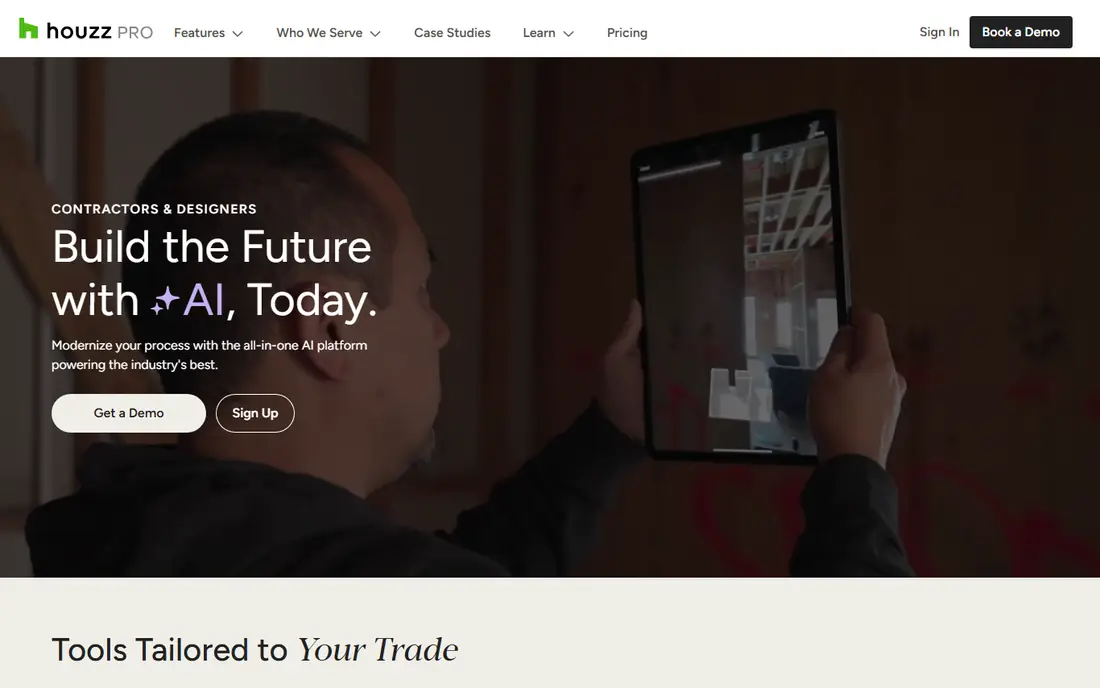
Houzz Pro tries to cover the full customer journey for a residential contractor, from lead to final payment. Estimates, takeoffs, 3D floor plans, project management, selections, invoicing, and online payments sit in one system, with a client portal for communication. For a remodeler who already gets leads through Houzz, keeping the job in the same system reduces duplicate entry and lost follow-ups.
The catch is that breadth is not the same as depth. A firm with very detailed takeoff or cost-database needs may still prefer a specialist estimating tool, and the monthly bill should be checked against the add-ons the firm actually uses. Houzz Pro starts at 149 dollars per month, which is fair for an all-in-one tool, but a firm that only needs estimating will pay for features it never opens.
- Covers leads, estimates, takeoffs, 3D plans, invoicing, and payments
- Large homeowner audience on Houzz
- QuickBooks integration
- Monthly cost rises with add-ons
- Breadth can mean less estimating depth than a specialist tool
Contractor Foreman
Great for: Affordable all-in-one tools for small crews
Contractor Foreman is the value pick for a small crew that wants one system without a large monthly bill. Starting at 49 dollars per month for the whole company, it covers estimates, invoices, online payments, scheduling, daily logs, and time tracking, with QuickBooks integration to reduce double entry. For a firm moving off spreadsheets, that package removes several separate subscriptions at once.
The compromise is polish and estimating depth. The tools are solid and practical, but a firm that needs deep cost databases, complex assemblies, or detailed plan takeoff will find Contractor Foreman lighter than Clear Estimates, ProEst, or STACK. For many small remodelers, the low price and the breadth outweigh that gap, especially in the first year of using software.
- Low company-wide monthly price
- Estimates, invoices, scheduling, and time tracking included
- QuickBooks integration
- Interface is practical rather than polished
- Advanced estimating features are lighter than specialist tools
ProEst is a serious estimating platform for contractors who need detail, not just a quick quote. It supports assemblies, cost databases, and detailed breakdowns that hold up on larger or more complex remodels, and it connects with project management and accounting tools so an approved estimate does not need rebuilding. A firm that bids work where a missed assembly can erase the margin will value that structure.
The learning curve is the honest cost. ProEst rewards a firm that invests time in setup, templates, and training, and it is less inviting for a solo remodeler who wants a quote out the same afternoon. Pricing is also quote-based, so a firm should request a proposal tied to its team size and volume. For larger remodeling firms, the depth is worth it.
- Strong cost database and assembly estimating
- Good for detailed commercial-style estimates
- Integrates with project management tools
- Learning curve is steeper than template tools
- Pricing is quote-based and suits larger teams
STACK is a cloud takeoff and estimating tool, and it fits remodelers whose estimates start with drawings. A team can measure plans, build quantities, apply pricing, and share the takeoff with colleagues without passing files around on a single desktop. For design-build firms and larger remodelers that bid from architect plans, that workflow is faster and easier to review than paper takeoff.
The limit is that STACK is not a full business system. Invoicing, scheduling, and client communication live elsewhere, so a firm should pair it with a project or accounting tool. Takeoff accuracy also depends on plan quality, and a remodeler should still walk the site before finalizing a price, because existing conditions rarely match a drawing perfectly. As a takeoff engine, STACK is strong.
- Cloud-based takeoff from plans and PDFs
- Good collaboration for estimating teams
- Libraries and reports speed repeat work
- Takeoff focus means business tools like invoicing sit elsewhere
- Plan quality affects takeoff accuracy
PlanSwift has long been a staple for digital takeoff, and it remains a good pick for remodelers who measure a lot of work from plans. Point-and-click takeoff, area and linear counts, and assembly-style pricing help a bidder turn a set of drawings into quantities quickly, with a paper trail that a reviewer can check. For a firm that bids competitively, that speed and auditability matter.
PlanSwift is a takeoff tool first, not a complete remodeling business platform. A firm will still need estimating templates, proposals, scheduling, and invoicing elsewhere, unless it pairs PlanSwift with another system. It also leans desktop, so a team that wants pure cloud collaboration should compare it with STACK before choosing. For takeoff speed alone, it earns its place.
- Fast point-and-click takeoff
- Strong for quantity counts from plans
- Works with common estimating workflows
- Desktop focus
- Needs a separate estimating or accounting tool for full job costing
Handoff AI targets residential remodelers who bid a high volume of smaller jobs and need estimates fast. It builds estimates from plan PDFs, voice descriptions, or text input, then adds CRM, proposal generation, and invoicing in the same platform. Starting at 149 dollars per month, it suits a firm that spends too much time turning site notes into a priced proposal.
The honest caution applies to any AI estimating tool: the output needs a human check against site conditions, supplier prices, and scope before it goes to a homeowner. A vendor claim about accuracy should be tested on the firm's own past jobs, not accepted at face value. Used as a draft that an experienced estimator reviews and adjusts, Handoff AI can save real time on repeat residential work.
- Builds estimates from PDFs, voice, and text input
- Includes CRM, proposals, and invoicing
- Trained on residential project data
- AI estimates need human review before sending
- Newer platform with less track record than older tools
How we picked these
We compared official vendor pages, pricing pages, and public 2026 roundups for remodeling estimating, and we kept only tools that a remodeler can use to price real residential work. We weighted remodeling templates, local or assembly pricing, takeoff ability, proposal quality, and fit for firms of different sizes. Where a vendor publishes no list price, we wrote See website rather than repeating a roundup estimate as a vendor price.
How to choose for your remodeling firm
Start with how your estimates begin. If most jobs start from a repeat scope, such as a kitchen or bath, a template tool like Clear Estimates will save the most time. If most jobs start from architect plans, a takeoff tool like STACK or PlanSwift should lead the shortlist. If the pain starts after the sale, with scheduling and change orders, a platform like Buildertrend or Houzz Pro may be worth the higher cost, even if its estimating alone is not the deepest.
Then test with a real past job. Rebuild one completed kitchen and one completed bath in each finalist, compare the totals with the actual job cost, and time how long each rebuild takes. Check how a change order flows through the system, how the proposal looks to a homeowner, and how the estimate moves into invoicing or accounting. A tool that wins on a demo but loses on a real past job is the wrong tool, however polished the demo looked.
Frequently asked questions
What is the best estimating software for remodeling?
Clear Estimates is the best starting point for many remodelers, because its templates and local pricing match repeat kitchen, bath, and addition work. Firms that need full project management should also look at Buildertrend and Houzz Pro, while plan-driven firms should look at STACK and PlanSwift.
What is the best remodeling estimating software for small contractors?
Contractor Foreman is a strong value pick at 49 dollars per month for the whole company, covering estimates, invoices, and scheduling. Clear Estimates is a better pick if estimating accuracy and templates matter more than having every business tool in one place.
How much does remodeling estimating software cost?
Prices on this list range from 49 dollars per month to quote-based enterprise pricing, with Houzz Pro and Handoff AI starting at 149 dollars per month. A firm should confirm the full price, including users, add-ons, and any cost-database fees, before signing.
Do remodelers still need to check AI estimates?
Yes, every AI estimate should be reviewed by an experienced estimator before it is sent to a homeowner. Site conditions, hidden damage, supplier prices, and scope changes can all move a price, and the estimator, not the software, is responsible for the final number.
Can estimating software handle change orders?
Platforms like Buildertrend and Houzz Pro handle change orders as part of the project record, while specialist estimating tools may need a separate project tool for that step. A firm should test the change-order flow before buying, because that step causes many disputes.
Is takeoff software worth it for a small remodeler?
It is worth it if a large share of work is priced from plans, because digital takeoff is faster and easier to review than paper measurement. If most work is priced from site visits and repeat templates, a template tool will usually save more time.
Sources
See where you really rank - block by block
ProMapRanker scans Google Maps across a grid of your service area. Simple monthly plans from $19, white-label on every plan.
Start freeKeep reading
 zscaler alternatives
Best Zscaler Alternatives in 2026
Looking for zscaler alternatives? We compare 9 SASE and zero trust platforms on architecture, data protection, pricing, and fit for your network and team.
Read → zapier alternatives free
Best Zapier Alternatives Free in 2026
Nine automation tools for zapier alternatives free in 2026, all with genuinely free tiers, plus free plan limits, starting prices and upgrade paths explained.
Read → which platform is best for online reputation
Which Platform Is Best for Online Reputation in 2026
Wondering which platform is best for online reputation? We compare 8 review, listing, and response tools for small and multi-location businesses and agencies.
Read →