 ProMapRanker
Best ERP Software for Construction Industry in 2026


Single-database ERP for large contractors · Pricing starts at: $100 per user per month
Key takeaways
- CMiC is the single-database ERP for larger general contractors that need job costing and project controls in one ledger.
- Sage 300 Construction and Vista by Viewpoint are the established mid-market and enterprise options, starting at $6,600 and $10,000 per year in third-party listings.
- Acumatica Construction Edition suits diversified firms that want a general cloud ERP with construction modules, starting at $10,000 per year in listings.
- FOUNDATION, Jonas and Deltek ComputerEase cover the mid-market with stronger accounting depth, while Premier suits firms that want faster implementation.
Quick comparison
| Pick | Great for | Pricing starts at | Free tier | |
|---|---|---|---|---|
| CMiC | Single-database ERP for large contractors | $100 per user per month | No | Visit |
 Sage 300 Construction | Established construction accounting | $6,600 per year | No | Visit |
 Vista by Viewpoint | Enterprise construction ERP | $10,000 per year | No | Visit |
 Acumatica Construction Edition | General cloud ERP with construction modules | $10,000 per year | No | Visit |
 FOUNDATION | Job costing and complex payroll | $500 per month | No | Visit |
 Jonas Construction | Integrated construction management | $249 per user per month | No | Visit |
 Deltek ComputerEase | Accounting plus project management | $5,000 one-time | No | Visit |
 Premier Construction Software | Faster implementation for mid-sized firms | See website | No | Visit |
The best ERP software for construction industry
A construction ERP is not just accounting with a job field added. It has to carry job costing, progress billing, retainage, change orders, subcontracts, certified payroll and procurement in the same system, or the office ends up reconciling spreadsheets at month end. Every tool below does that to some degree, but they split sharply on size, implementation time and cost.
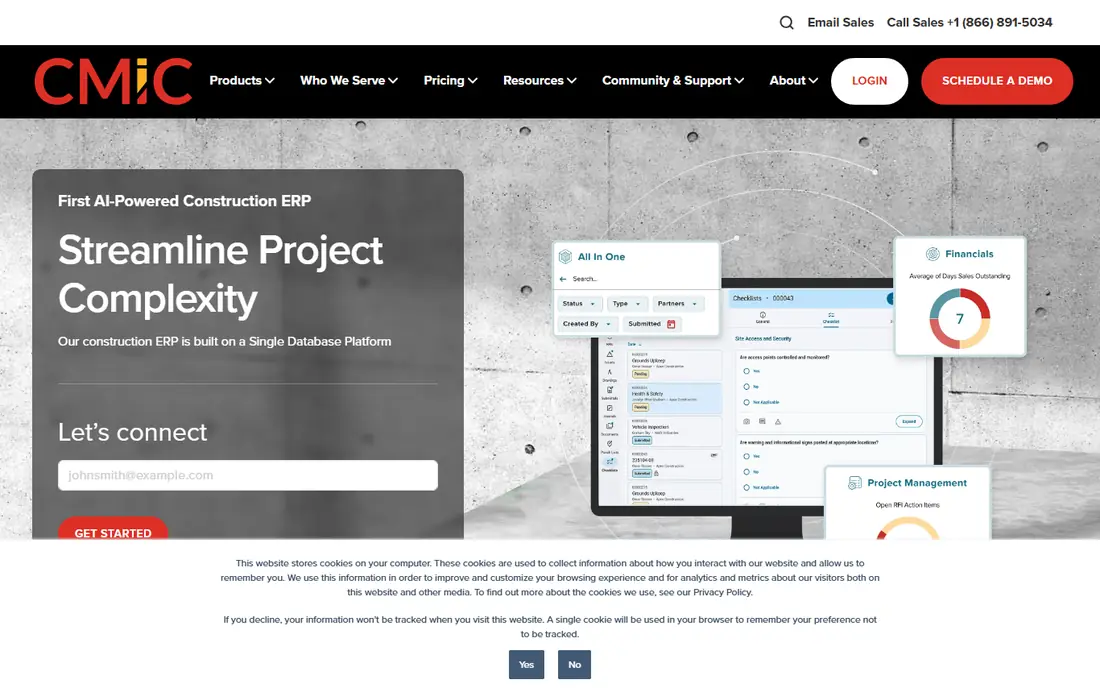
CMiC is the construction-first ERP for mid-sized and large general contractors that need one ledger, not several systems stitched together. Accounting, project management, procurement, HR and field operations share a single database, so job cost, work in progress and progress billing stay in step without reconciliation. That single-database design is the reason firms choose CMiC despite its cost.
The cost is the catch. Third-party listings place entry pricing around $100 per user per month, with most contractors spending far more per year once implementation is included, and deployments often running 6 to 18 months. Role-based licensing helps, since field and read-only users cost less than finance users, but buyers should still budget implementation separately and plan for a long rollout.
- One database for accounting, project controls and HR
- Strong WIP and progress billing
- Role-based licences
- Implementation can run many months
- Total cost is high
- Steep learning curve
Sage 300 Construction is a long-established construction accounting and management system, with modules for job costing, billing, payroll and project control. Its custom reporting is a genuine strength, letting finance teams build the job and company reports they actually use, rather than living with fixed templates. Cloud integration connects project points to one accessible location, which helps firms moving away from on-site servers.
The interface feels dated next to newer cloud ERPs, and some users report thin training resources and slow performance on large data sets. Third-party listings place pricing from $6,600 per year, with no free trial, so a demo with your own job data is essential. For firms that already know Sage and want depth in construction accounting without a full ERP rebuild, it remains a solid choice.
- Long-established construction accounting
- Custom reporting
- Integration options
- Interface feels dated
- Training resources are thin for some users
- No free trial
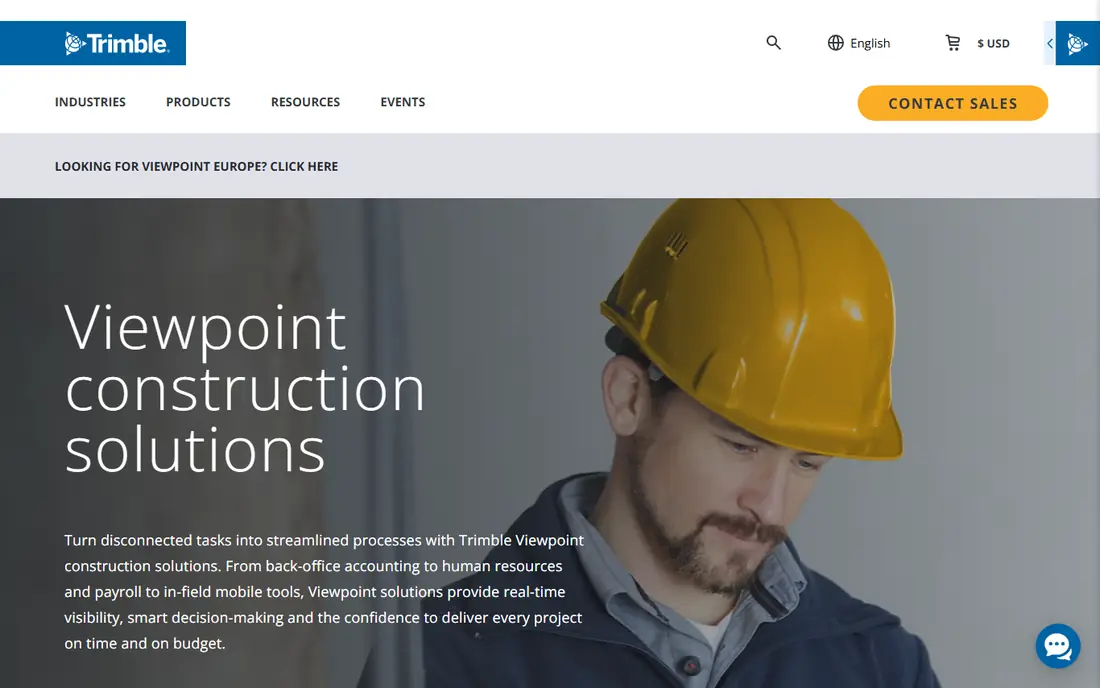
Vista by Viewpoint, now part of Trimble, is the enterprise counterpart to Sage 300 in this list. It handles accounting, job costing, project management, HR and equipment in one system, with strong tracking for subcontracts, payments and project status. Firms running multiple projects or business units benefit from that scale, since data stays in one system rather than spreading across tools.
The entry price in third-party listings is $10,000 per year, with no free trial, and users report that navigation can be difficult and the system is not easy to learn at first. That complexity is the price of its customisation depth. Larger contractors with IT support and a planned rollout will get the most from Vista, while smaller firms will find it more system than they need.
- Enterprise-scale job costing and project control
- Subcontract tracking
- Strong customisation
- High entry price
- Complex to navigate
- Implementation needs planning
Acumatica Construction Edition
Great for: General cloud ERP with construction modules
Acumatica Construction Edition is a general cloud ERP with construction-specific modules, rather than a construction-only system. It covers project billing, including progress billing and time-and-material billing, retainage handling, change management and AIA reporting, inside the same ERP as general ledger, purchasing and inventory. Its resource-based licence model, with no per-user fees, suits firms whose user count grows faster than their budget.
The trade is configuration. Construction features work well once set up, but a diversified firm will spend time configuring workflows, reports and integrations through a partner. Third-party listings place pricing from $10,000 per year on a quote basis, with implementation on top. Firms that run construction alongside other lines of business, or multiple entities, will value that flexibility more than a construction-only firm will.
- Cloud ERP with no per-user fees on licence model
- Construction modules for billing and retainage
- Multi-entity support
- Construction features need configuration
- Learning curve
- Implementation via partners
FOUNDATION, from Foundation Software, leans into construction accounting depth. It offers hundreds of job costing reports, executive dashboards and scheduling, with a Microsoft SQL Server reporting backend that finance teams can query directly. Its payroll strength stands out for multi-state, multi-trade and multi-union work, with rate tables that handle prevailing wage and union rules.
The learning curve is steep, so plan ramp-up time before users feel productive, and mobile coverage is thinner than in rivals with dedicated field apps. Third-party listings place pricing from $500 per month, though the full cost depends on modules and users. If payroll complexity and job costing drive your decision, FOUNDATION deserves a demo. If field mobility drives it, check the mobile story first.
- Deep job costing reports
- Multi-state and union payroll
- SQL Server reporting backend
- Steep learning curve
- Mobile coverage is thinner than rivals
- Price rises with modules
Jonas Construction Software covers accounting, project management, service management and payroll in one integrated system for contractors. Users praise its interface and accessibility, and frequent updates keep the system current, which matters for a tool the whole office touches daily. For a mid-sized contractor that wants one system without the scale of CMiC or Vista, Jonas is a credible middle path.
The per-user price in third-party listings is $249 per user per month, which adds up quickly as headcount grows, and some users find reporting less deep than in FOUNDATION or CMiC. There is no free trial, so a demo with your own jobs, payroll rules and billing types is the only reliable test. Firms that value usability and integration over the deepest reporting will like Jonas best.
- Integrated accounting, project and service management
- User-friendly interface
- Frequent updates
- High per-user price
- Reporting could be deeper for some firms
- No free trial
Deltek ComputerEase, formerly ComputerEase, bundles accounting, payroll and job costing with project management in one package. Its Job Center, Red Flag subcontractor insurance checks, dispatch boards and FieldEase mobile app keep field-to-office work connected, which is a real advantage over accounting-only tools. General ledger, AIA billing, retainage tracking and certified payroll are built in, so labour hits the right project without manual transfers.
The interface feels dated, and users report that creating and sending reports can be awkward. Third-party listings place pricing from $5,000 as a one-time cost, a different model from monthly subscriptions, so compare total cost over the years you plan to run it, not just the headline figure. Contractors who want accounting depth plus field tools, and who can absorb the learning curve, will find ComputerEase a strong fit.
- Integrated accounting and project management
- Subcontractor insurance checks
- FieldEase mobile app
- Dated interface
- Reporting creation can feel awkward
- Learning curve
Premier Construction Software
Great for: Faster implementation for mid-sized firms
Premier Construction Software is pitched at general contractors, subcontractors and specialty firms that want a purpose-built system without a year-long implementation. It offers a real-time job dashboard with drilldown, WIP reporting, AIA billing, a subcontractor portal and predictive forecasting tools, with the vendor claiming implementation in as few as 60 days for some firms. For a firm that needs visibility quickly, that speed is attractive.
Pricing is tiered and quoted rather than published as a single figure, so buyers should get a written quote for their job count, users and modules, and check what the money-back terms actually cover. Its track record is also shorter than Sage, Vista or CMiC, so ask for references from firms of a similar size and trade. If fast rollout and clear job dashboards matter most, Premier is worth a demo alongside the established names.
- Real-time job dashboard
- WIP reporting
- AIA billing and subcontractor portal
- Faster rollout claims
- Pricing is tiered and quoted
- Smaller track record than Sage or Vista
- Check module scope
How we picked these
We compared official product pages, pricing pages and public reviews for construction ERP tools live in October 2026 that handle job costing, progress billing, payroll or procurement in one system, not just project scheduling alone. We favoured tools with a clear construction workflow and a pricing route we could check, and we used See website wherever a vendor did not publish a clear starting price.
How to choose an ERP without a painful rollout
Start from job costing, not from the demo dashboard. List the billing types you actually use, such as progress billing, time-and-material, AIA forms, retainage and change orders, plus payroll rules for union, prevailing wage and multi-state work. Any tool that cannot handle those natively will force workarounds that cost more than the subscription.
Then price the whole project, not just the licence. Get implementation, data migration, training and first-year support in writing, and ask how long similar firms took to go live. Run a pilot with one live job from estimate to invoice to payment, and check WIP, job cost and payroll reports against your current system before you commit the whole company. A slower, honest pilot beats a fast rollout that breaks month-end reporting.
Frequently asked questions
What is the difference between construction ERP and construction accounting software?
Construction accounting software handles the books and job costing, while a full ERP adds project controls, procurement, HR, equipment and field operations in the same database. Larger contractors need the ERP view, while smaller firms often manage with accounting plus a project tool.
How much does construction ERP cost?
It varies widely. FOUNDATION is listed from $500 per month, Sage 300 from $6,600 per year, and Vista and Acumatica from $10,000 per year in third-party listings, with CMiC and Jonas priced per user. Implementation is usually extra and can exceed the first-year licence cost.
How long does implementation take?
It depends on size and modules. Premier claims as few as 60 days for some firms, while CMiC deployments often run 6 to 18 months. Ask vendors for timelines from firms of your size, and plan for data migration and training time on top of software setup.
Can a small contractor use a construction ERP?
Yes, but most small firms do not need one. FOUNDATION, Jonas or ComputerEase may fit a growing mid-sized firm, while a two-person trade firm will usually manage with accounting software plus a project tool, and should only move to ERP when job volume makes reconciliation painful.
Does construction ERP handle certified payroll and prevailing wage?
The tools here with payroll depth, such as FOUNDATION, CMiC and ComputerEase, handle certified payroll and prevailing wage rules, but the details depend on your states and unions. Test your own payroll scenarios in the pilot before you sign.
Sources
See where you really rank - block by block
ProMapRanker scans Google Maps across a grid of your service area. Simple monthly plans from $19, white-label on every plan.
Start freeKeep reading
 worlds best local seo company
8 Worlds Best Local SEO Companies for Map Pack Growth in 2026
Compare the worlds best local seo company options for Google Business Profile work, citations, reviews, and multi-location rankings and reporting in 2026.
Read → world's best web hosting company
World's Best Web Hosting Company in 2026
Searching for the world's best web hosting company? We compared 10 hosts on price, renewal rates, speed, and support to help you choose well today in 2026.
Read → who's got the best nanny tax services
Who's Got the Best Nanny Tax Services in 2026
We answer who's got the best nanny tax services, comparing full filing, back taxes, software, and pricing so families can handle nanny taxes correctly.
Read →