 ProMapRanker
Best Equipment Rental Software in 2026


Online bookings for small rental businesses · Pricing starts at: $29 per month
Key takeaways
- Booqable gives small rental businesses the lowest clear entry price we found, at $29 per month, with a 14-day trial.
- Rentman stands out for event and audiovisual rental, because it plans equipment, crew and transport in one project.
- EZRentOut and Quipli suit heavier operations and storefront-led businesses, but both are priced on request or at a higher tier, so get a written quote before you commit.
- HireHop is the only option here with a free starter tier, which makes it a low-risk way to test online bookings.
Quick comparison
| Pick | Great for | Pricing starts at | Free tier | |
|---|---|---|---|---|
| Booqable | Online bookings for small rental businesses | $29 per month | Free trial (14 days) | Visit |
 Rentman | AV and event rental with crew planning | $39 per month | Free trial (30 days) | Visit |
 EZRentOut | Heavy equipment rental operations | See website | Free trial | Visit |
 Quipli | Storefront-led independent rental companies | See website | Free trial | Visit |
 Current RMS | AV and production rental teams | $50 per month | Free trial | Visit |
 Goodshuffle Pro | Event rental businesses with online quotes | See website | Free trial | Visit |
 HireHop | Small hire companies testing online bookings | Free | Yes | Visit |
 Flex Rental Solutions | Live event warehouses with complex inventory | See website | Free trial | Visit |
 Rentle | Simple online rental stores | $29 per month | Free trial | Visit |
The best equipment rental software
Rental software has to do three jobs at once: show what is available, take a booking without double-booking it, and turn that booking into an invoice. The tools below cover those jobs in different ways, and the right one depends more on your fleet and your customers than on the feature list alone. We compared official pricing pages, product pages and public reviews to put this list together.
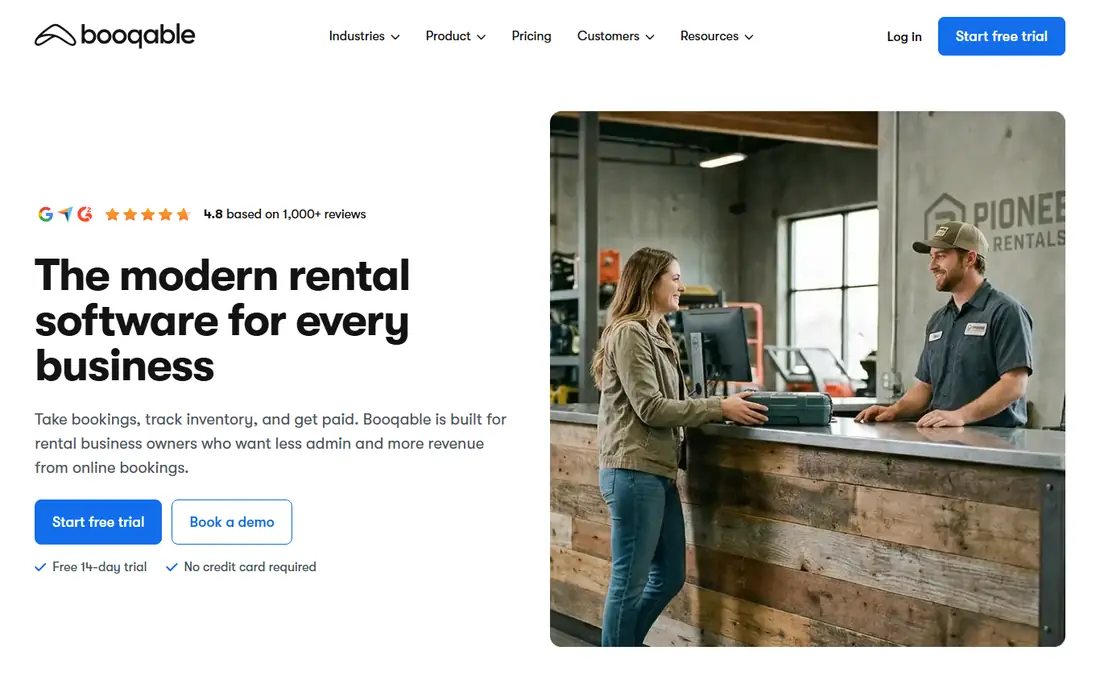
Booqable is our pick for most small rental businesses that already have a website, or are happy to embed a booking page into one. The Start plan at $29 per month covers order and inventory management, quotes, contracts and invoices, and real-time availability tracking. Customers can see what is free for their dates, add bundles, and pay through Stripe or PayPal, which cuts down on back-and-forth emails.
The catch is scope. Booqable does not track vehicles by GPS, so a trailer or vehicle rental business will still need a separate tracking tool. The rental website builder is an add-on rather than part of the base plan, and 14 days is not long to test a system that will hold your whole fleet. Even with those limits, the price and the checkout experience make it hard to beat for general equipment rental.
- Low entry price
- Clean online booking checkout
- Strong inventory and serial tracking
- No GPS fleet tracking
- Website builder is a paid add-on
- 14-day trial is short for a core system
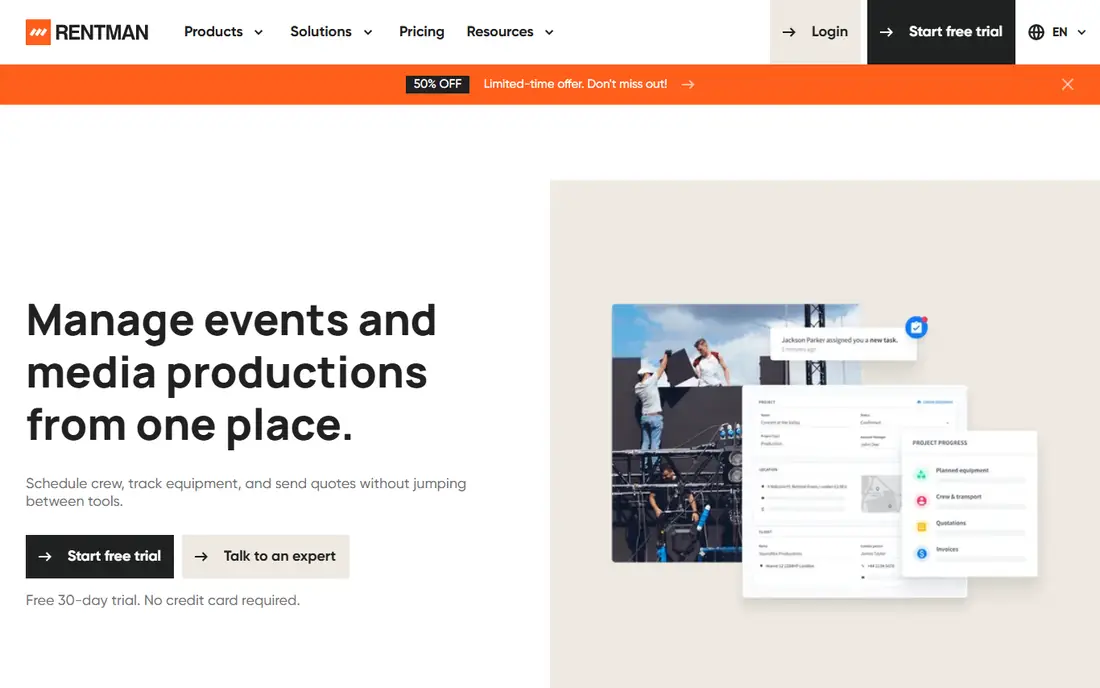
Rentman is built for audiovisual, event production and broadcast rental, where a job is never just a piece of gear. A project can hold the equipment, the crew schedule, transport and the quote, so a shortage or a missing crew member shows up before the truck leaves. Barcode and QR scanning, invoicing and a mobile app round out a system that fits how production teams actually work.
That depth comes with a pricing model you need to read carefully. The platform base is $39 per month, and then inventory, crew and other modules are priced per power user, so a larger team pays more than the headline figure suggests. If you rent general tools or party equipment and do not schedule crews, some of that machinery will sit unused. For event rental, though, it is the most purpose-built option here.
- Equipment, crew and transport in one project
- Shortage warnings and packing lists
- 30-day trial with no card required
- Modular pricing adds up as you add power users
- Equipment tracking is a paid add-on
- Pricing is shown in euros on its own site
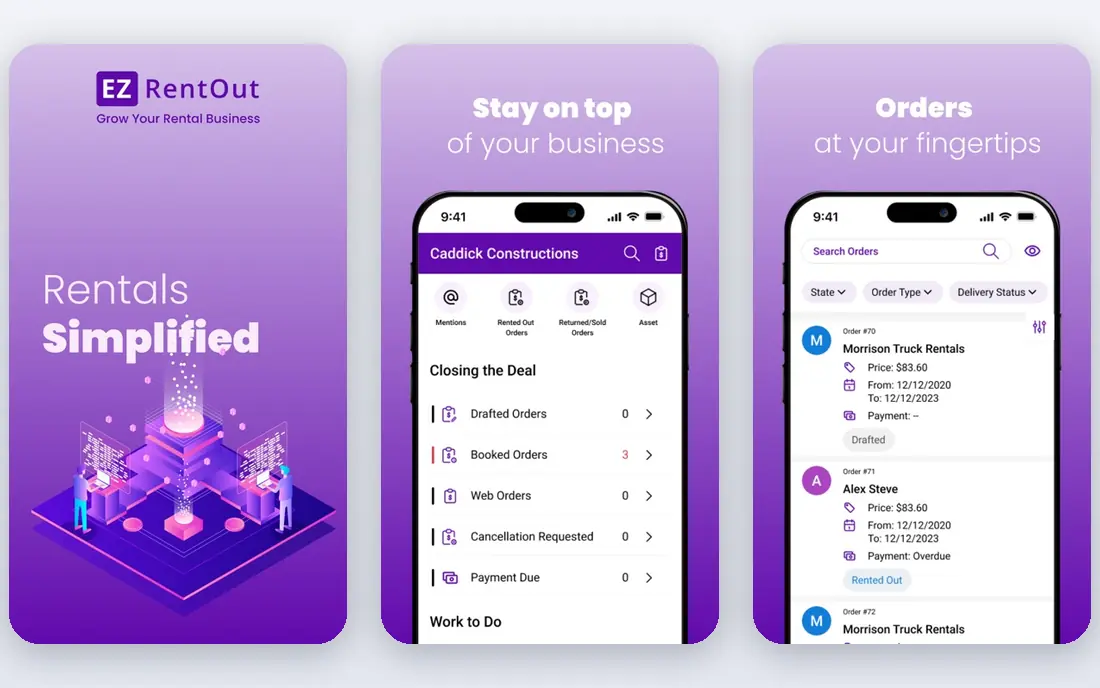
EZRentOut, from EZO, is a full rental platform rather than a simple booking widget. It covers orders, availability, maintenance tied to readiness, billing for extensions and partial returns, and a customer portal, plus a rental webstore that can go live quickly. Field teams can log work offline and sync later, which matters on yards and job sites with patchy signal.
The main drawback is pricing transparency. The vendor publishes plan information on request for some tiers, and third-party listings disagree on the entry figure, so we list it as See website rather than repeat a number we could not confirm on the vendor page. If your operation is heavy equipment with recurring rentals and service work, that extra setup is worth it. A one-person rental shop may find it more than it needs.
- Full rental operations from quote to return
- Barcode, QR and RFID support
- QuickBooks sync and customer portal
- Pricing is not published clearly for every plan
- Setup takes time for a large fleet
- Interface feels busy for very small teams
Quipli puts the storefront first. Independent rental companies get a modern online shop where customers can browse, book and pay, with customer accounts, order management and QR-based check-out and return behind it. That focus makes sense if most of your bookings come from customers finding you online rather than from repeat trade accounts phoned in by a dispatcher.
The trade-off is depth outside the storefront. Field service and telematics features are more limited than in EZRentOut, and pricing is not published as a simple monthly rate, so you will need a demo and a quote. For a company that wants its website to do the selling, Quipli is a strong shortlist pick. For a yard-led operation, test the back-office workflows before you sign.
- Strong online storefront
- Customer accounts and order management
- QR workflows for check-out and return
- Pricing is quote-based
- GPS and telematics coverage is narrower than some rivals
- Smaller feature set for field service work
Current RMS is a cloud rental system for the AV, lighting, broadcast, production and event sectors. It handles the whole job from the first enquiry through quotes, proposals, invoices and rental agreements, using drag-and-drop document templates that keep paperwork consistent. Links to Xero and QuickBooks Online help keep the accounts side in step with the warehouse side.
Its weakness is the customer-facing side. If you want customers to book directly online with little staff help, Booqable or Quipli give a smoother checkout. Current RMS is stronger as an internal operations system for teams that still take many bookings by phone or email. The $50 per month starting figure is for the first user, with extra users charged on top, so price a realistic team size, not just one seat.
- Full rental lifecycle from enquiry to invoice
- Quote and document templates
- Xero and QuickBooks Online links
- Online booking is weaker than storefront-first rivals
- Pricing rises with extra users
- Design feels dated in places
Goodshuffle Pro is aimed squarely at event rental: tents, tables, linens, lighting and similar items that are booked for a date, delivered, collected and turned around. Customers can request quotes online, staff can track orders and inventory, and the system is shaped around event workflows rather than general asset hire. That focus shows in how quickly a team can quote a full event package.
It is not the best fit for construction or industrial equipment, where maintenance, utilisation and telematics matter more than event presentation. Pricing is also plan-dependent, so we list it as See website and suggest asking for the total with any add-ons you need. For event rental businesses that live on weekend peaks, it is worth a trial alongside Booqable.
- Online quoting and booking for event items
- Inventory and order tracking
- Built for party and event rental workflows
- Less suited to heavy construction equipment
- Pricing varies by plan and add-ons
- Smaller range of field service tools
HireHop is the low-risk entry point in this list. It offers a free starter tier, so a small hire company can put its stock online, take bookings and test whether online ordering actually helps before paying anything. Paid plans add more users and features, and the system covers the basics: stock, availability, bookings and invoices.
The limits are honest ones. It does not match the depth of Rentman or EZRentOut for complex operations, multi-location work or detailed maintenance, and some pricing is shown in pounds, which US buyers should convert before comparing. Even so, for a small business moving off spreadsheets, a free start with a real booking page is a practical first step.
- Free starter tier
- Availability calendar and online booking
- Low cost to get started
- Paid tiers are priced in pounds for some plans
- Feature depth is lower than enterprise rivals
- Support and integrations are more limited
Flex Rental Solutions
Great for: Live event warehouses with complex inventory
Flex Rental Solutions is a web-based platform for the live event industry, built around warehouse reality: items, kits, virtual racks and road cases, with barcoding, maintenance tracking and financial management alongside. Labour and staffing features help larger event houses plan the people as well as the gear, and the system scales to complex, multi-project operations.
That power is also the drawback. Flex is sold on a quote basis, implementation takes real effort, and a small shop with a simple fleet will pay in time and cost for features it never uses. It belongs on the shortlist for established event rental houses that have outgrown a simple booking tool, not for a business taking its first bookings online.
- Detailed inventory modelling with kits and cases
- Barcoding and warehouse workflows
- Financial and labour tracking
- Pricing is quote-based
- Setup and training take time
- Overkill for a small single-location shop
Rentle gives small merchants a straightforward way to rent products online, including subscriptions alongside one-off rentals. The setup is lighter than an enterprise system, the storefront is the point, and a business selling or renting consumer goods can get going without a long implementation project. It suits shops that want a rental option on top of an existing online presence.
The trade-off is operational depth. Yard management, maintenance scheduling and complex multi-location work are not its strengths, and larger rental fleets will likely outgrow it. At $29 per month to start, though, it is a fair test for a business that mainly needs clean online rental checkout rather than a full back-office system.
- Simple storefront for rental products
- Subscription and rental options in one place
- Quick to set up
- Less depth for yard and field operations
- Fewer enterprise integrations
- Pricing and limits vary by plan
How we picked these
We compared official pricing pages, product pages and public review listings for rental software that is still sold and supported in October 2026. We kept only tools that cover core rental work, such as availability, bookings, inventory and billing, and we left out tools that are only booking widgets or only accounting software. Where a vendor did not publish a clear price, we wrote See website instead of copying a third-party estimate.
We also weighed fit over feature count. A tool that is excellent for event rental can be a poor fit for heavy equipment, and a cheap booking tool can cost more in manual work for a large fleet. That is why this list mixes low-cost starters, event specialists and heavier operations platforms, with the trade-offs stated for each one.
What to check before you buy
Start with your booking flow, not the feature list. Walk through a real order: a customer books for a weekend, extends by a day, returns one item damaged and pays a deposit. Ask each vendor to show that exact sequence, including how the invoice changes and how availability updates for the next customer. A tool that handles the happy path well but struggles with extensions and partial returns will create manual work every week.
Next, check availability, maintenance and payments together. An item under repair should not show as available, a deposit should be easy to collect and refund, and payments should flow to your accounting software without retyping. Ask about barcode or QR scanning if you run a yard, and about GPS or telematics only if you rent vehicles or mobile plant, since that feature adds cost for businesses that do not need it.
Finally, price the whole team and the whole year. Count every user who will log in, add any website builder, scanning or extra-location fees, and ask about contract length and notice periods. A 14-day or 30-day trial is useful, but it only helps if you test with your real stock, your real prices and your real staff during that window.
Frequently asked questions
What is the best equipment rental software for a small business?
Booqable is a strong starting point for most small businesses, because it combines a $29 per month entry price with online booking, inventory tracking and invoicing. HireHop is worth testing first if you want a free tier, and Rentle suits a simple online store. The best choice still depends on your fleet, so trial with your real products before you commit.
What is the best rental equipment software for event rental?
Rentman and Current RMS are built for event and AV rental, with project, crew and warehouse workflows that general tools lack. Goodshuffle Pro is another event-focused option with online quoting. If your team schedules crew and transport alongside gear, Rentman has the clearest advantage.
Does equipment rental software handle maintenance and repairs?
Some tools do, and some do not. EZRentOut and Flex Rental Solutions tie maintenance and readiness to availability, so an item under repair does not show as bookable. Simpler storefront tools may only track orders, so check maintenance, downtime and service history on a demo if that matters to your fleet.
Can customers book and pay online?
Yes, most tools here offer online booking and payment, but the experience differs. Booqable, Quipli and Rentle are storefront-first, while Current RMS and Flex are stronger as internal systems. Test the checkout on a phone, since many customers will book from a mobile device.
How much does equipment rental software cost?
Entry prices in this list range from free for HireHop to $50 per month for Current RMS, with several tools priced on request. The total cost depends on users, locations and add-ons, so ask for a written quote for your team size. A low headline price can rise quickly once scanning, website or extra-user fees are added.
Sources
See where you really rank - block by block
ProMapRanker scans Google Maps across a grid of your service area. Simple monthly plans from $19, white-label on every plan.
Start freeKeep reading
 zscaler alternatives
Best Zscaler Alternatives in 2026
Looking for zscaler alternatives? We compare 9 SASE and zero trust platforms on architecture, data protection, pricing, and fit for your network and team.
Read → zapier alternatives free
Best Zapier Alternatives Free in 2026
Nine automation tools for zapier alternatives free in 2026, all with genuinely free tiers, plus free plan limits, starting prices and upgrade paths explained.
Read → which platform is best for online reputation
Which Platform Is Best for Online Reputation in 2026
Wondering which platform is best for online reputation? We compare 8 review, listing, and response tools for small and multi-location businesses and agencies.
Read →