 ProMapRanker
Best EPM Software in 2026: 8 Tools Compared


Large enterprises running Oracle ERP · Pricing starts at: See website
Key takeaways
- EPM and CPM describe the same job in most vendor marketing, which is planning, budgeting, forecasting, consolidation and reporting in one governed system.
- Anaplan and OneStream lead for large-scale connected planning and unified close work, while Vena and Datarails suit finance teams that want to keep Excel.
- Oracle Cloud EPM suits large Oracle ERP customers, and Workday Adaptive Planning suits teams already running Workday HCM or Financials.
- Pigment and Prophix offer modern and mid-market alternatives, but both need a careful look at implementation scope and total contract cost.
- Almost every EPM vendor prices by quote, so a three-year total cost, including implementation and support, matters more than any headline figure.
Quick comparison
| Pick | Great for | Pricing starts at | Free tier | |
|---|---|---|---|---|
| Oracle Cloud EPM | Large enterprises running Oracle ERP | See website | No | Visit |
 Anaplan | Connected planning across functions | See website | No | Visit |
 Workday Adaptive Planning | Teams already on Workday | See website | No | Visit |
 OneStream | Unified consolidation, close and planning | See website | No | Visit |
 Vena | Excel-native finance teams | See website | No | Visit |
 Pigment | Modern AI-native planning teams | See website | No | Visit |
 Prophix | Mid-market finance teams | See website | No | Visit |
 Jedox | Planning teams wanting Excel-like modeling | See website | No | Visit |
The best epm software
Enterprise performance management software replaces spreadsheet planning that has grown too large, too slow and too hard to control. The tools in this list handle budgeting, forecasting, scenario modeling, financial consolidation and reporting, but they differ sharply in how much they ask finance teams to change the way they work. Some keep Excel at the center, others replace it with a new modeling environment, and that choice shapes implementation more than any feature list.
Oracle Cloud EPM is the natural pick for a large enterprise already running Oracle ERP. Its planning, budgeting, forecasting, consolidation and reporting modules share data with Oracle financial systems, which reduces the reconciliation work that comes from pairing a separate planning tool with a different ERP. For a global company with many entities, currencies and reporting requirements, that depth is a real advantage.
The cost is complexity and price. Oracle EPM is quote-based, implementation often needs IT support, and the total cost rises with modules and users. A mid-size finance team may find the platform more than it needs, and a team not on Oracle ERP gains less from the native fit. For Oracle-centric enterprises that need a full EPM suite, Oracle remains one of the strongest choices available.
- Deep consolidation and planning depth
- Strong fit with Oracle ERP and data systems
- Broad module range for large enterprises
- Quote-based enterprise pricing
- Implementation needs more IT involvement
- Can be heavy for mid-size teams
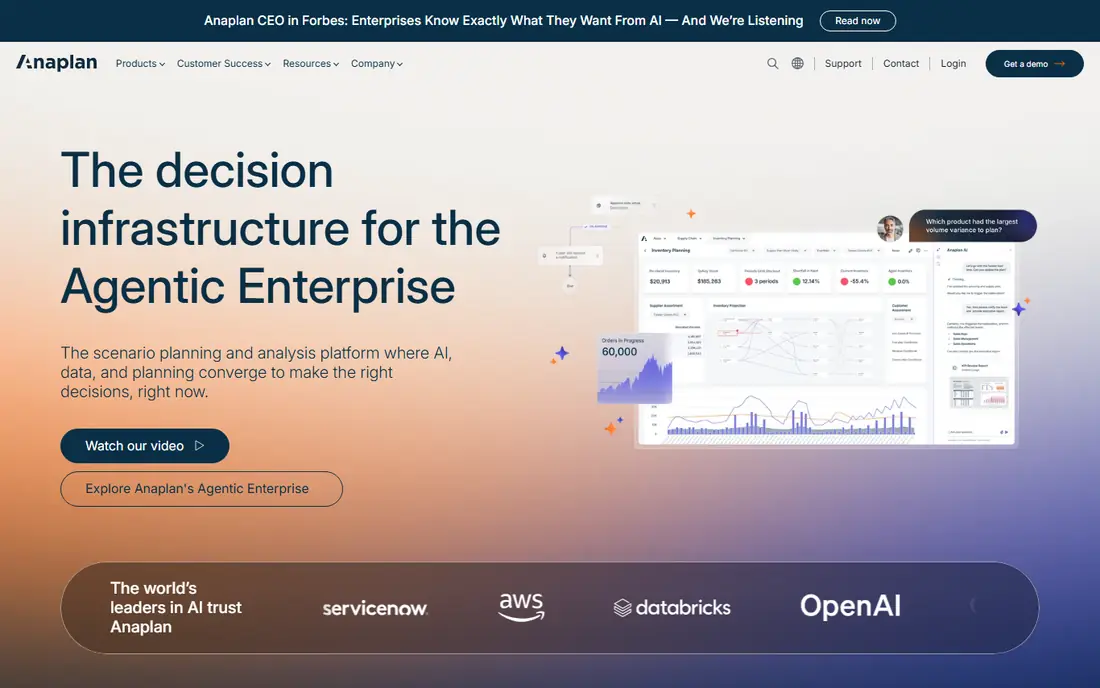
Anaplan leads for connected planning, where finance, sales, supply chain and workforce plans need to stay linked. Its modeling engine lets teams build drivers, run scenarios and see how a change in one area flows through revenue, headcount and costs. That connected view is the reason large companies choose Anaplan over a budgeting tool that only handles finance, because plans that live in separate spreadsheets rarely stay consistent.
The trade-offs are cost and effort. Anaplan pricing is by quote, with annual contracts often running into six figures for full platforms, and enterprise rollouts take months to design and build. Teams also need modeling skill in-house or from a partner. For a large company that wants one connected planning system across functions, Anaplan is the benchmark. For a smaller finance team, a lighter tool may deliver faster value.
- Connected planning across finance, sales and operations
- Advanced modeling and scenario planning
- Large enterprise customer base
- Quote-based pricing with large annual contracts
- Implementation takes months for enterprise rollouts
- Modeling skill needed

Workday Adaptive Planning, formerly Adaptive Insights, suits finance teams that already run Workday HCM or Financials. Budgeting, forecasting and scenario planning draw on Workday people and financial data, so headcount and cost plans stay linked to actual workforce data. The interface is built for finance users rather than developers, and visualization tools make it easier to present forecasts to leaders who do not work in spreadsheets every day.
Outside the Workday ecosystem, the value drops. Pricing is by quote, and smaller teams may find the total cost high for a planning tool alone. Teams should also check how much of the planning work depends on Workday data versus external sources. For Workday customers that want planning close to their HR and finance systems, Adaptive Planning is a strong and practical choice.
- Flexible scenario planning
- Strong data visualization
- Natural fit with Workday HCM and Financials
- Quote-based pricing
- Less attractive outside the Workday ecosystem
- Can be costly for smaller teams
OneStream stands out by unifying the financial close and planning in one platform. Instead of running consolidation in one system, budgeting in another, and reporting in a third, finance teams work from a single data model. That unity cuts reconciliation work at month end and gives leaders one set of numbers for actuals, forecasts and plans, which is a major gain for companies with complex entity structures.
The platform is enterprise-grade in price and effort. Pricing is by quote, and a full rollout needs careful design, especially for companies with many subsidiaries or complex ownership. Smaller teams may find the platform more than they need. For a company that wants close, consolidation and planning together, rather than three linked tools, OneStream is one of the leading options.
- Consolidation, close and planning in one platform
- Strong financial reporting
- Unified data model reduces reconciliation
- Quote-based enterprise pricing
- Implementation scope can be large
- Needs skilled finance and IT input
Vena takes the opposite approach from Anaplan and OneStream by keeping Excel as the interface. Finance teams build models in Excel, while Vena adds workflow, permissions, version control and a central database underneath. That design makes adoption faster, because staff do not need to learn a new modeling language, and it preserves the formulas and layouts that finance teams already trust.
The limit is that Vena does not replace Excel, it governs it. Teams that want a fully connected planning model across many functions may find Anaplan or Pigment a better fit, and pricing is by quote, so the total depends on users and modules. For a mid-market finance team that wants control and auditability without abandoning Excel, Vena is one of the best choices in this list.
- Keeps Excel as the interface finance teams already know
- Adds governance, workflow and version control
- Faster adoption for Excel users
- Quote-based pricing
- Excel dependence can limit some modeling approaches
- Larger enterprises may need more connected planning
Pigment is the modern challenger in this group, built for finance and business teams that want connected planning without a legacy platform feel. Its modeling tools link finance, sales and workforce plans, and AI features help with forecasting, anomaly checks and scenario work. Teams that find older EPM tools slow to change often prefer Pigment interface and setup speed.
The risks are vendor maturity and ecosystem size. Pigment is newer than Oracle, Anaplan or OneStream, and its partner network is smaller, so implementation support varies by region. Pricing is also by quote, which makes early comparison harder. For a growth-stage or mid-size company that wants modern planning with connected models, Pigment is a strong alternative to the enterprise incumbents.
- Modern interface with AI-assisted planning
- Connected modeling across functions
- Faster setup than legacy enterprise platforms
- Quote-based pricing
- Newer vendor than Oracle or Anaplan
- Implementation partners are fewer
Prophix serves the mid-market well, where finance teams need budgeting, forecasting, consolidation and reporting without an enterprise rollout. Its workflows are built around the monthly and annual planning cycles that finance teams actually run, and reporting tools make it easier to share results with leaders. For a company moving from spreadsheet budgeting to a governed system, Prophix offers a manageable step up.
The trade-off is scale and connected planning depth. Prophix does not match Anaplan for cross-functional connected models, and a very large enterprise with complex global consolidation may need OneStream or Oracle instead. Pricing is by quote, so a team must request a proposal to compare costs. For a mid-market finance team that wants a complete planning and reporting system, Prophix is a reliable choice.
- Strong mid-market fit for budgeting and forecasting
- Financial consolidation and reporting included
- Familiar workflow for finance teams
- Quote-based pricing
- Less connected planning depth than Anaplan
- Larger enterprises may outgrow it
Jedox pairs an Excel-like modeling experience with a central database, workflow and reporting layer. Finance teams can build budgets and forecasts in a familiar grid, while the platform handles version control, permissions and data consolidation underneath. That mix suits teams that like spreadsheet modeling but need governance, audit trails and shared data as planning grows beyond a few files.
The drawbacks are price clarity and brand scale in the US market. Most buyers face quote-based pricing, and the full modeling depth takes time to learn, even if the interface feels familiar. Jedox also has a smaller US partner presence than Oracle, Workday or Anaplan. For a planning team that wants Excel-style modeling with enterprise governance, Jedox deserves a place on the shortlist.
- Excel-like modeling with a governed database behind it
- Strong planning and forecasting features
- Familiar feel for spreadsheet users
- Quote-based pricing for most buyers
- Needs planning to use its full modeling depth
- Smaller brand presence in the US than rivals
How we picked these
We compared official feature pages, analyst comparisons and public reviews for EPM tools that cover budgeting, forecasting, consolidation and reporting. We favored tools that are live in October 2026, that serve a distinct buyer, from mid-market finance teams to global enterprises, and that state their planning approach clearly, whether Excel-native or model-native. We left out pure business intelligence tools and pure HR performance tools, because the keyword calls for enterprise performance management in the finance planning sense, and we note that distinction in the FAQ.
What to check before you buy
Start with the planning calendar and ownership. List every budget, forecast, close and report the finance team must produce, who owns each one, and how often it changes. That list shows whether the team needs a full EPM suite, a mid-market planning tool, or simply better spreadsheet governance, and it prevents buying a platform far larger than the process requires.
Next, test a real planning cycle, not a vendor demo model. Build a budget with actual drivers, run a forecast change, consolidate a set of entities, and produce the report leaders actually read. That exercise reveals modeling effort, data integration work and reporting limits far better than a feature checklist. Also ask for a three-year total cost in writing, including licenses, implementation, support and any partner fees.
Finally, check data and integration fit. Confirm which ERP, HR and CRM systems the tool connects to, how data is loaded and validated, and who maintains those links after go-live. An EPM tool that needs constant manual data work will not save time, no matter how strong its modeling features look in a demo.
Frequently asked questions
What is the best epm software?
Anaplan leads for large-scale connected planning, OneStream leads for unified close and planning, Vena suits Excel-native finance teams, and Workday Adaptive Planning suits Workday customers. The best choice follows company size, ERP fit and whether the team wants to keep Excel or move to a new modeling environment.
What are the best epm tools for mid-market companies?
Vena, Prophix, Pigment and Jedox are the strongest mid-market options in this list. Vena and Jedox keep a familiar spreadsheet feel with governance underneath, Prophix offers a complete mid-market planning suite, and Pigment offers a modern connected planning alternative.
Is EPM the same as CPM?
In most vendor marketing, yes. EPM, enterprise performance management, and CPM, corporate performance management, both describe software for planning, budgeting, forecasting, consolidation and reporting. Vendors use whichever term their market prefers, so buyers should compare features rather than the label.
How much does EPM software cost?
Almost every EPM vendor in this list prices by quote, with mid-market tools often running into five figures per year and full enterprise platforms running into six figures per year, plus implementation costs. Ask for a three-year total cost that includes licenses, implementation and support before comparing vendors.
How long does EPM implementation take?
Focused deployments can go live in weeks, while enterprise-wide rollouts take months. The timeline depends more on process scope, entity count and data complexity than on the software alone, so a clear planning calendar and data plan matter more than a vendor speed claim.
Sources
See where you really rank - block by block
ProMapRanker scans Google Maps across a grid of your service area. Simple monthly plans from $19, white-label on every plan.
Start freeKeep reading
 zscaler alternatives
Best Zscaler Alternatives in 2026
Looking for zscaler alternatives? We compare 9 SASE and zero trust platforms on architecture, data protection, pricing, and fit for your network and team.
Read → zapier alternatives free
Best Zapier Alternatives Free in 2026
Nine automation tools for zapier alternatives free in 2026, all with genuinely free tiers, plus free plan limits, starting prices and upgrade paths explained.
Read → which platform is best for online reputation
Which Platform Is Best for Online Reputation in 2026
Wondering which platform is best for online reputation? We compare 8 review, listing, and response tools for small and multi-location businesses and agencies.
Read →