 ProMapRanker
Best EOR for Remote-First Companies in 2026

Key takeaways
- RemoFirst has the lowest published starting price here, from $199 per employee per month, while Deel, Remote, G-P and Oyster sit at $599 to $699.
- Deel and Remote offer the broadest all-round platforms for remote-first teams, combining EOR, contractor management and global payroll.
- Multiplier and Papaya Global suit teams that want a balance of price and finance or payroll depth, with starting prices from $459 and $499.
- The EOR service fee sits on top of salary and local employer contributions, so model total employment cost per country before signing.
- Deposits, currency conversion, offboarding fees and benefits margins can change the real cost, so ask for a sample invoice.
Quick comparison
| Pick | Great for | Pricing starts at | Free tier | |
|---|---|---|---|---|
 Deel | Broad remote-first platform | $599 per employee per month | No | Visit |
 Remote | Remote-first culture and payroll | $599 per employee per month | No | Visit |
 Oyster | Distributed team experience | $699 per employee per month | No | Visit |
 Papaya Global | Finance-led global payroll | $499 per employee per month | No | Visit |
 Multiplier | Mid-price global hiring | $459 per employee per month | No | Visit |
 RemoFirst | Budget-first international hires | $199 per employee per month | No | Visit |
 G-P | Enterprise global employment | $599 per employee per month | No | Visit |
 Rippling | HR and EOR in one system | See website | No | Visit |
The best eor for remote-first companies
We compared official provider pages, pricing pages and public reviews for employer-of-record providers that serve remote-first companies. Employment, tax and compliance rules vary by country and state, and this article is general information only, not legal advice.
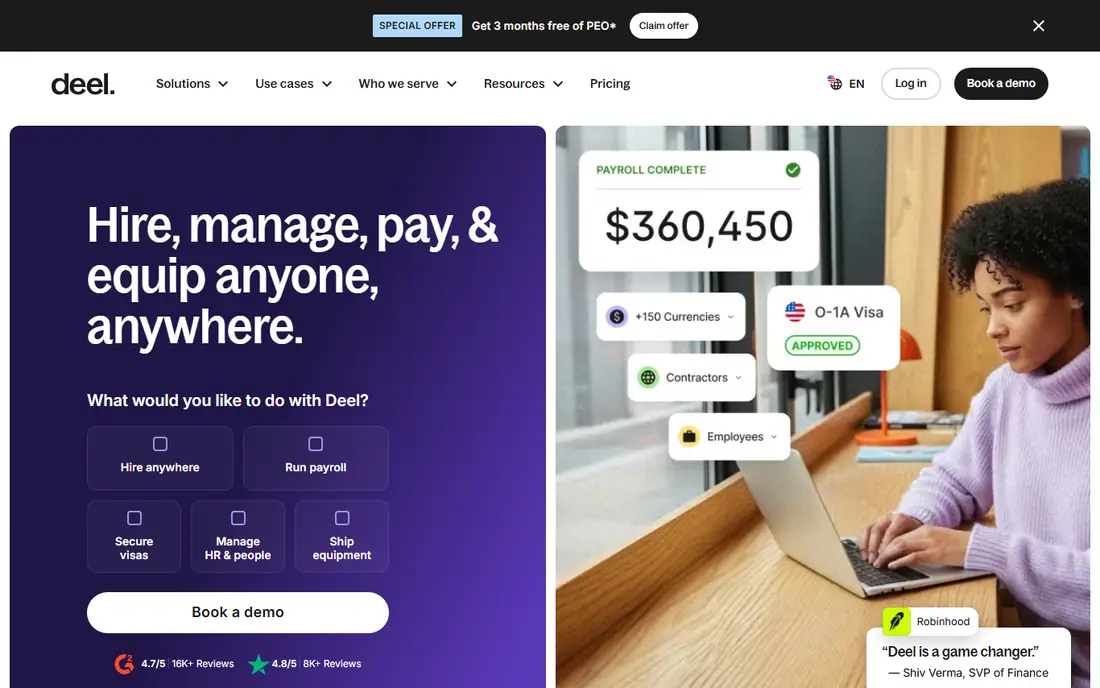
Deel is the default shortlist pick for many remote-first companies because it covers the full hiring journey in one platform. EOR employment, contractor management, global payroll, benefits administration and equity support sit together, which helps a remote-first team hire in several countries without a separate vendor for each step. Its contractor and US PEO options also help teams that mix employees, contractors and US staff.
The price reflects that breadth. EOR starts at $599 per employee per month, before salary and local employer contributions, and complex countries or add-ons can raise the total. Deel is still good value for teams that will use several parts of the platform, but a team hiring one person in a simple market may pay less elsewhere. If breadth, tooling and a single dashboard matter most, Deel is hard to beat.
- Wide country coverage for EOR and contractors
- Strong payroll, benefits and equity tooling
- US PEO option alongside global EOR
- Price is at the higher end
- Country surcharges and add-ons need checking
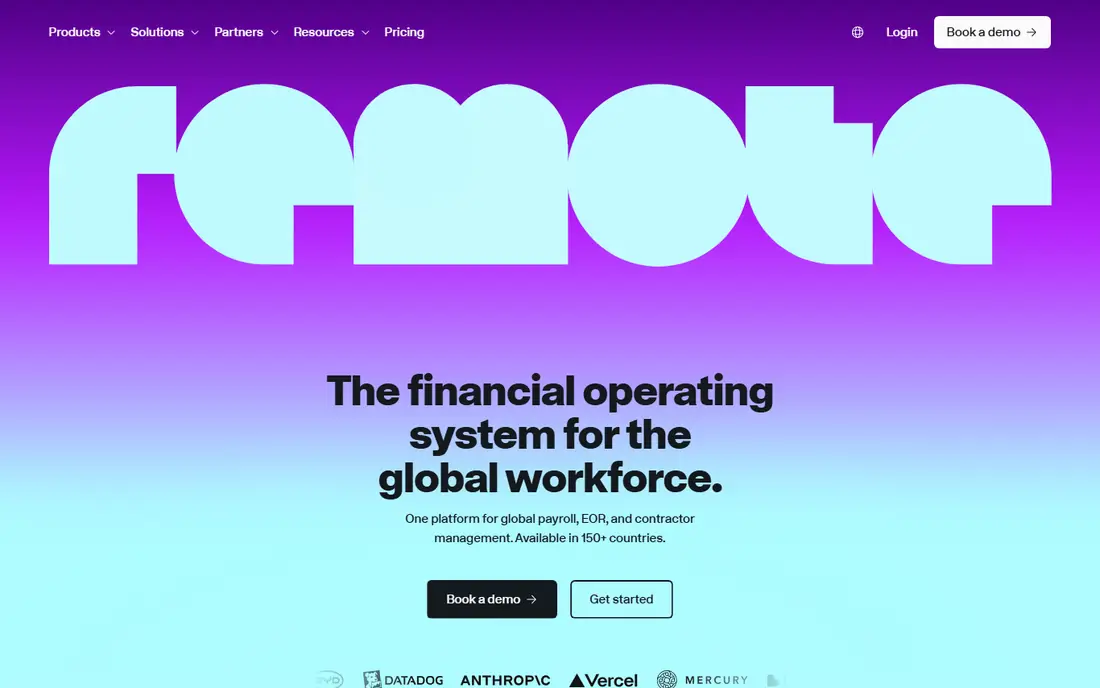
Remote is built specifically for remote-first companies, and that focus shows in its product. EOR, contractor management and global payroll are presented as one remote hiring system, with local contracts, benefits and compliance handled by Remote or its local entities. For founders who want a provider that understands asynchronous, distributed teams, Remote feels like a natural fit rather than a generic payroll vendor adapted to remote work.
Pricing starts at $599 per employee per month on annual terms in recent published comparisons, with monthly billing higher in some reports, so confirm the billing term in the quote. Local benefits and entity coverage also vary by country, which means the experience in one market may differ from another. For a remote-first team that values product clarity and a remote-native provider, Remote is a strong finalist alongside Deel.
- Remote-first product design
- Owned entities in many markets
- Clear contractor and payroll options
- Monthly price can be higher than annual rivals
- Local benefits depth varies by country
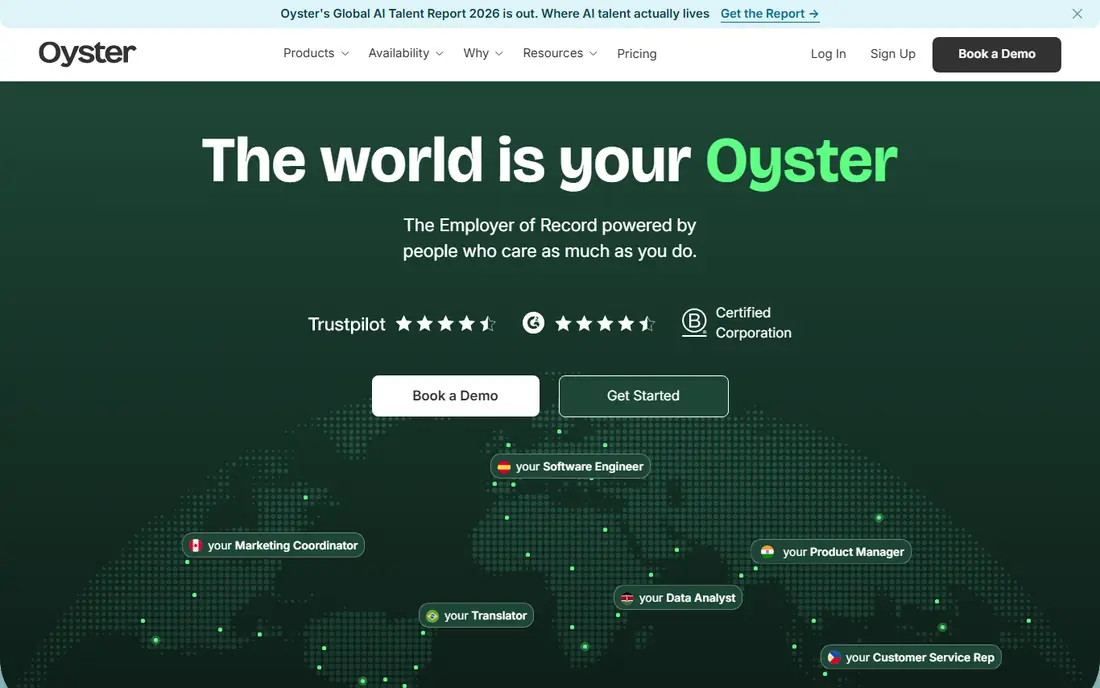
Oyster positions itself around the distributed team experience, not just payroll compliance. Its platform covers EOR hiring, contractor management, benefits and tools for managing a global team, with an emphasis on making remote employees feel supported rather than merely processed. That angle appeals to remote-first founders who worry about retention, belonging and consistent benefits across countries.
The price is the main barrier. Oyster starts at $699 per employee per month, the highest starting price here, and buyers should check deposit terms and annual seat discounts before budgeting. A team that mainly needs compliant payroll may find cheaper coverage elsewhere. A team that values employee experience, benefits guidance and a remote-first partner may still find Oyster worth the premium, especially at smaller headcounts where experience matters most.
- Strong focus on distributed employee experience
- Global benefits and hiring tools
- Good fit for fully remote cultures
- Highest starting price in this list
- Deposits and annual terms need checking
Papaya Global suits remote-first companies where finance control matters as much as hiring speed. Its platform combines EOR, contractor management and global payroll with reporting, payments and workforce cost visibility that finance teams can use for budgeting and audits. That reporting depth helps companies with many countries, currencies and cost centres, where a simple per-head fee hides the real picture.
Pricing starts from $499 per employee per month, but the final rate depends on country, scope and services, so a tailored quote is essential. Papaya is less of a budget-first pick than RemoFirst or Multiplier, and smaller startups may not need its finance depth. For a remote-first company with a finance-led buyer and multi-country payroll complexity, Papaya Global is a strong, serious contender.
- Strong payroll and finance reporting
- EOR plus contractor and payroll options
- Suited to finance-led buyers
- Final price varies by country and scope
- Less of a low-cost startup pick
Multiplier offers a useful middle ground between budget providers and premium platforms. EOR starts at $459 per employee per month on annual billing, with contractor and global payroll options in the same system. That price, combined with coverage across Asia-Pacific, Europe and other regions, makes it attractive to remote-first startups and scale-ups that need reliable coverage without paying $599 or more per head.
The cautions are billing and add-ons. The lowest published tier is annual, and compliance-mandated add-ons or implementation fees can apply, so the quote should state the full first-year cost. Multiplier also competes on price rather than on the deepest enterprise tooling. For a remote-first team hiring across several regions on a controlled budget, Multiplier is a balanced pick.
- Competitive mid-range starting price
- EOR, contractors and payroll in one platform
- Good for Asia-Pacific and European hiring
- Annual billing for the lowest tier
- Add-ons and implementation fees need checking
RemoFirst is the budget leader in this list, with EOR from $199 per employee per month and no minimum headcount or annual contract in its published terms. It also offers contractor management, global payroll and visa support, which helps early-stage remote-first companies make a first international hire without a large monthly commitment. For a startup testing a new market, that low entry price changes the decision.
The honest caveat is that $199 is a starting floor, not a guaranteed rate for every country. RemoFirst states that the fee may vary with local country requirements, and it works with vetted in-country partners in many markets rather than owning every entity itself. That model is fine for many hires, but senior or complex-market hires deserve a closer look at entity, benefits and support arrangements. For budget-first, early remote hiring, RemoFirst is our pick.
- Lowest published starting price here
- No minimum headcount or long contract in published terms
- Contractor and visa options
- Fee may vary by country
- Partner-delivered in many markets
G-P, formerly Globalization Partners, is one of the most established names in global employment. Its EOR platform covers contracts, payroll, taxes and benefits through its entity network, and it suits enterprise and regulated employers that need consistent compliance across many countries. For remote-first companies that are growing into enterprise scale, or hiring in complex markets, that established network is reassuring.
Pricing starts from $599 per employee per month, with volume discounts for larger teams, so it is a premium choice rather than a budget pick. Smaller startups may find the same core coverage cheaper elsewhere, and G-P is best judged on compliance depth, support and country coverage rather than headline price. For enterprise remote-first hiring, G-P belongs on the shortlist with Deel and Remote.
- Long-established global employment provider
- Strong compliance and entity network
- Suited to enterprise and regulated hiring
- Price is premium
- Less suited to tiny startups on price alone
Rippling is a different kind of EOR pick, because it starts from HR rather than from global employment alone. Teams already using Rippling for HR, payroll and IT can add EOR hiring in the same console, so a new international hire triggers the same onboarding, payroll and access workflows as a domestic hire. That single-system advantage matters for remote-first tech companies that already run on Rippling.
EOR pricing is not published, so buyers need a custom quote by country and headcount, and global depth should be checked for each target market. A team that does not already use Rippling may find a dedicated EOR provider simpler. For Rippling customers expanding internationally, however, keeping HR and EOR together is a strong reason to quote Rippling first.
- HR, payroll, IT and EOR in one console
- Good for teams already using Rippling
- Automates onboarding and access
- EOR pricing is quote-based
- Global depth varies by country
How we picked these
We compared official provider pricing pages, country coverage descriptions and public reviews for EOR providers serving remote-first companies in October 2026. We kept only live providers with current EOR products, and we used published starting prices where available and See website where a provider does not publish a price. We treated the service fee as separate from salary and statutory employer contributions, because confusing the two is the most common budgeting error.
How to choose an EOR for a remote-first team
The cheapest headline fee is rarely the cheapest year. Model total cost, check entity arrangements and test support before hiring in a new country.
Model total cost per country
Ask for salary, employer social contributions, statutory benefits, EOR fee, currency conversion, deposits and any offboarding fees for each target country. A $199 fee in a low-contribution country can still cost less than a $599 fee in a high-contribution country, and the reverse can also be true once all charges are included. Run the sample invoice before making an offer.
Check entity, benefits and support
Ask whether the provider uses its own entity or a vetted partner in each country, what local benefits are included, and how employee support works. Check onboarding time, payroll cut-off dates and how terminations are handled. Remote-first employees need clear, local support, not just a contract template.
Plan the entity crossover point
EOR is usually best for one to five employees in a country with uncertain commitment. At ten or more employees with long-term commitment, setting up your own entity plus global payroll often costs less over three years. Review the crossover every six months, because headcount growth can change the answer faster than expected.
Frequently asked questions
What is an employer of record?
An employer of record becomes the legal employer of a worker in their country, handling contracts, payroll, taxes and statutory benefits, while you manage day-to-day work. You pay a monthly fee per employee, plus salary and local employer contributions. It lets you hire where you have no legal entity.
How much does an EOR cost per employee?
Published starting prices in this list run from $199 to $699 per employee per month, depending on provider and country. Salary and statutory employer contributions sit on top of that fee, and deposits, currency conversion and offboarding fees can add further cost.
Is an EOR better than hiring contractors?
Contractors are cheaper and faster for short-term or part-time work, but full-time, exclusive contractors can be reclassified as employees in many countries, with fines and back-pay risk. EOR is safer for core, long-term team members, while contractor management suits genuine short-term or independent work.
How long does EOR onboarding take?
Onboarding can take days in standard markets once documents clear, and longer where local registration sets the start date. Complex markets, work permits and benefits enrolment can extend the timeline, so confirm the expected start date for each country before promising one to a candidate.
Should a remote-first company set up its own entity?
Below about three employees in a country, EOR is usually cheaper and faster. Above ten employees with long-term commitment, an entity plus global payroll is often cheaper over three years, despite setup time and overhead. Between those points, model both options for each country.
Sources
See where you really rank - block by block
ProMapRanker scans Google Maps across a grid of your service area. Simple monthly plans from $19, white-label on every plan.
Start freeKeep reading
 worlds best local seo company
8 Worlds Best Local SEO Companies for Map Pack Growth in 2026
Compare the worlds best local seo company options for Google Business Profile work, citations, reviews, and multi-location rankings and reporting in 2026.
Read → world's best web hosting company
World's Best Web Hosting Company in 2026
Searching for the world's best web hosting company? We compared 10 hosts on price, renewal rates, speed, and support to help you choose well today in 2026.
Read → who's got the best nanny tax services
Who's Got the Best Nanny Tax Services in 2026
We answer who's got the best nanny tax services, comparing full filing, back taxes, software, and pricing so families can handle nanny taxes correctly.
Read →