 ProMapRanker
Best Enterprise Software in 2026


Large sales and service teams · Pricing starts at: $25 per user per month
Key takeaways
- Enterprise software is rarely one purchase, so we compared suites and single-purpose platforms side by side rather than treating them as interchangeable.
- Salesforce and Microsoft Dynamics 365 publish entry prices, while SAP, Oracle NetSuite, Workday and ServiceNow price by quote, which makes demos and scope documents essential.
- HubSpot and Atlassian are the easiest to trial, with free plans that let a real team test the basics before a wider rollout.
- Zoho One stands out for companies that want CRM, finance, HR and support from one vendor at a lower entry cost, with less depth in each area than the category leaders.
- Implementation, data cleanup and training often cost as much as the first year of licences, so budget for people and process change, not just the subscription.
Quick comparison
| Pick | Great for | Pricing starts at | Free tier | |
|---|---|---|---|---|
| Salesforce | Large sales and service teams | $25 per user per month | Free trial | Visit |
 Microsoft Dynamics 365 | Companies already on Microsoft 365 | $65 per user per month | Free trial | Visit |
 SAP S/4HANA Cloud | Complex manufacturing and supply chains | See website | No | Visit |
 Oracle NetSuite | Growing companies outgrowing basic accounting | See website | No | Visit |
 Workday | HR and finance at larger employers | See website | No | Visit |
 ServiceNow | IT and employee service workflows | See website | No | Visit |
 HubSpot | Marketing-led mid-market teams | Free | Yes | Visit |
 Zoho One | One vendor for many business apps | See website | Free trial | Visit |
 Atlassian | Software, IT and project teams | See website | Yes | Visit |
The best enterprise software
These picks cover the main ways large and growing companies run sales, finance, people, service and delivery work, from full suites to focused platforms.
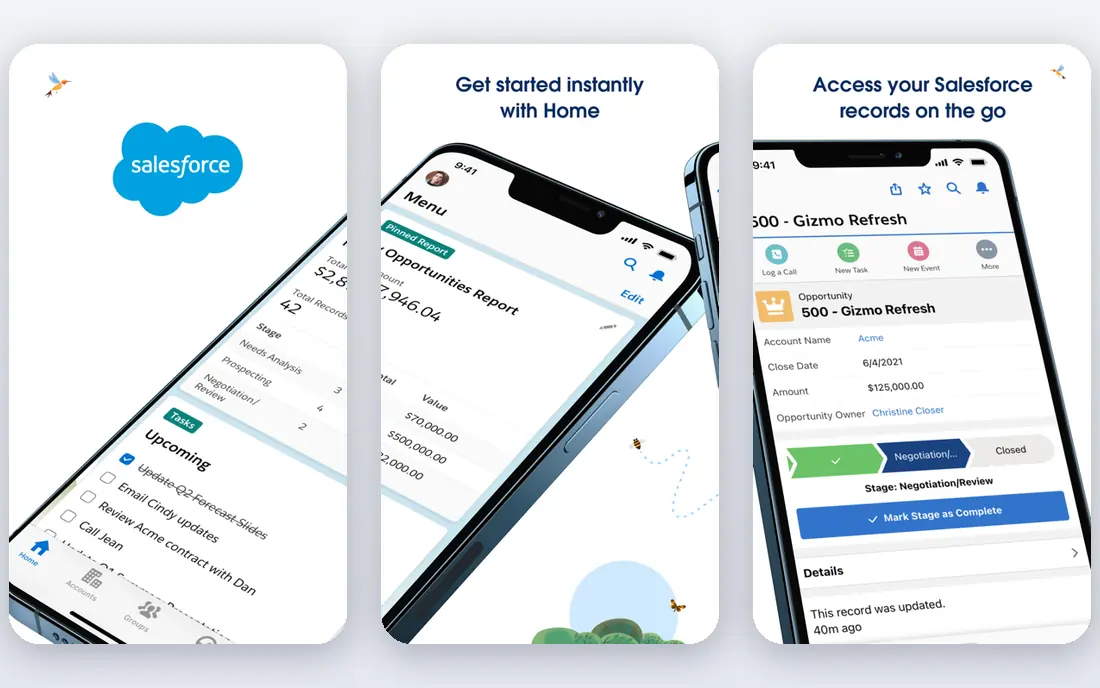
Salesforce earns its place first because it is the most complete CRM choice for companies that sell through large, distributed teams. It covers leads, accounts, opportunities, service cases, marketing journeys and partner work in one system, and its marketplace adds thousands of connected apps. For a company that needs territory rules, approval chains and detailed reporting, that depth matters more than a simple contact list.
The trade-off is complexity and cost. Small teams can start with the Starter Suite, but larger deployments often need higher editions, integration work and ongoing administration. We would shortlist Salesforce when customization, scale and a deep partner network matter more than the lowest price or the fastest setup.
- Very broad app and integration ecosystem
- Strong customization and automation
- Widely used by sales and service teams
- Costs rise fast with editions and add-ons
- Setup needs skilled admins for complex deployments
Dynamics 365 makes most sense for companies that already live in Microsoft 365. Sales, customer service, finance and supply chain modules share data and sign-in, and staff often find the interface familiar. That familiarity can cut training time, especially for finance and operations teams that already use Excel heavily.
The catch is that Dynamics 365 is a family of apps, not one fixed product, so two buyers can end up with very different bundles. Pricing also assumes yearly payment on published plans, so confirm what each licence includes. We would pick it when Microsoft tools, Azure and Power BI are already central to how the company works.
- Strong fit with Outlook, Teams and Excel
- Covers sales, finance and operations
- Familiar Microsoft security controls
- Module choices can confuse buyers
- Implementation still needs planning and partners for larger rollouts
SAP is the choice for companies whose core problem is running a complex operation, not just tracking customers. S/4HANA Cloud ties finance, procurement, inventory, production and logistics together, which helps when a company runs plants, warehouses and subsidiaries across countries. Its controls suit regulated and audit-heavy settings.
That power comes with a heavy project. Buyers should expect discovery, data migration and change management, and should not judge SAP on licence price alone. We would shortlist it for manufacturers and large distributors, and look elsewhere when the main need is a simple CRM or a quick rollout.
- Deep finance, manufacturing and supply chain controls
- Built for global, multi-entity operations
- Real-time data model
- Quote-only pricing
- Long implementations and specialist partners are common
NetSuite suits the company that has outgrown separate accounting, inventory and sales tools. It brings financials, order management, inventory, CRM and ecommerce into one system, which reduces manual reconciliation between tools. Multi-entity and multi-currency reporting is a clear strength for companies expanding into new markets.
The honest limit is that NetSuite is a suite purchase, not a light app, and implementation quality varies by partner. Ask for a scoped quote that names users, modules and implementation separately. We would pick it for mid-size companies that want one system of record for finance and operations.
- Finance, inventory, CRM and ecommerce in one cloud suite
- Strong for multi-subsidiary reporting
- Large partner network
- Quote-only pricing
- Customization and reporting can need partner help
Workday focuses on people and money, which makes it a strong fit for employers with hundreds or thousands of staff. HR, recruiting, talent, time and finance planning sit in one system, so leaders can connect headcount plans to budgets without stitching spreadsheets together. Employees get one place for pay, time off and career information.
Smaller companies will likely find Workday too large and too costly for their needs. It is also a system that rewards careful configuration up front. We would shortlist it when HR and finance transformation is the main project, rather than when a company only needs a CRM or a project tool.
- Strong HR, payroll-adjacent and finance planning tools
- Clean employee experience
- Built for large workforces
- Quote-only pricing
- Best suited to larger employers, not small teams
ServiceNow started in IT service management and now covers employee requests, customer service workflows and broader business operations. Its strength is turning messy requests into tracked, routed and measured work, with approvals and automation built in. Large IT and HR service teams use it to replace email queues and shared inboxes.
The risk is building too many custom workflows without clear ownership. Companies should agree on service definitions, owners and reporting before expanding. We would pick ServiceNow when service delivery, incident handling and internal requests are the central problem to solve.
- Strong workflow automation for IT and employee services
- Good case and request tracking
- Broad enterprise adoption
- Quote-only pricing
- Needs process design and governance to avoid sprawling custom workflows
HubSpot is the friendliest enterprise-adjacent option on this list. Teams can start on the free CRM, add marketing and sales tools as they grow, and keep contacts, deals and tickets in one place. Its onboarding and documentation are clearer than most enterprise suites, which helps adoption across non-technical staff.
At enterprise scale, costs climb with marketing contacts and hub editions, and very complex sales processes may hit limits. Still, for marketing-led companies that value speed and usability, HubSpot is a strong first shortlist pick. We would trial it with a real campaign and pipeline before committing to higher tiers.
- Free CRM to start
- Clear interface and fast onboarding
- Marketing, sales and service hubs share contacts
- Enterprise costs rise with contacts and hubs
- Deep customization is thinner than Salesforce
Zoho One bundles dozens of apps under one subscription, which appeals to companies tired of paying for separate CRM, accounting, HR, help desk and project tools. The shared sign-in and common data model make it easier to connect sales, support and finance than a patchwork of unrelated apps. For budget-conscious mid-size companies, the bundle value is real.
The compromise is depth. Zoho CRM is capable, but it is not Salesforce for the most complex global sales operations, and Zoho Books is not NetSuite for complex multi-entity finance. We would pick Zoho One when breadth, cost control and one vendor relationship matter more than best-in-class depth in every category.
- Wide bundle of CRM, finance, HR, support and collaboration apps
- Lower bundle cost than buying point tools
- Single sign-in
- Depth varies by app
- Some advanced needs still need specialist tools or integrations
Atlassian earns its place for delivery work rather than finance or CRM. Jira tracks software and project work, Confluence holds documentation and decisions, and Jira Service Management handles service requests. Together they give product, engineering and IT teams a shared way to plan, build and support work.
Companies outside software sometimes struggle with Jira terminology and setup, so a pilot with one team is wise. Pricing also varies by product and tier, so confirm the exact bundle. We would pick Atlassian when project delivery and service work are central, and pair it with a separate CRM or ERP where needed.
- Jira and Confluence work well together for delivery teams
- Free plan for small teams
- Large app marketplace
- Needs configuration to fit non-software teams
- Enterprise pricing and admin controls add cost and complexity
How we picked these
We compared official product pages, pricing pages and public documentation for suites and platforms that are widely used by mid-size and large companies, and we checked that each one is still sold and supported in October 2026. We favored products with clear scope, a real customer base and a defined role, whether that role is CRM, ERP, HR, service workflows or delivery. Where a vendor does not publish a price, we wrote See website rather than estimating a deal size, since enterprise quotes vary by users, modules and contract length.
What to check before you sign
Start with the business problem, not the vendor demo. List the three workflows that must improve in the first six months, such as quote to cash, hire to retire or request to resolution, and ask each vendor to show those workflows with your data types. A polished demo of unrelated features tells you little about daily work.
Next, price the whole project. Ask for licences, implementation, data migration, integrations, training and first-year support as separate lines, and ask what happens at renewal. Confirm who owns configuration after go-live, because a system that only the implementation partner can change becomes costly fast. Finally, run a pilot with one team and real records, and measure adoption, time saved and report accuracy before rolling out company wide.
Frequently asked questions
What is the best enterprise software for most companies?
There is no single winner, because CRM, ERP, HR and service work are different problems. Salesforce leads for large CRM needs, Dynamics 365 fits Microsoft-centered companies, and NetSuite or SAP fit finance and operations at scale. Shortlist by the workflow you must fix first, then compare two or three finalists on a pilot.
What are the top enterprise software companies?
The largest and most widely used vendors on this list include Salesforce, Microsoft, SAP, Oracle and Workday, with ServiceNow, HubSpot, Zoho and Atlassian strong in their own areas. Size alone is not a reason to buy, since a large vendor can still be a poor fit for a small or specialist team. Match the vendor to your size, industry and existing tools.
Is there a best platform for enterprise apps on a tight budget?
Zoho One is the strongest budget bundle here, and HubSpot and Atlassian offer free plans that lower the cost of a trial. Budget buyers should still check limits on users, contacts, storage and support, since those limits often decide the real cost. A low licence price with a large implementation bill is not a bargain.
What is the best enterprise software solution for manufacturing?
SAP S/4HANA Cloud and Oracle NetSuite are the strongest fits for manufacturing and supply chain work on this list, with Dynamics 365 also strong for Microsoft-centered operations. The right choice depends on plant complexity, inventory needs and global reporting. Ask each vendor to model your production and procurement flow, not just a generic demo.
How much does enterprise software cost?
Entry prices we could verify include Salesforce from $25 per user per month and Dynamics 365 Sales Professional from $65 per user per month paid yearly, while several vendors quote by deal. Implementation, migration and training can match or exceed the first year of licences. Get itemized quotes and renewal terms before comparing headline prices.
How long does enterprise software take to implement?
Timelines vary from weeks for a focused HubSpot or Atlassian rollout to many months for SAP, NetSuite or Workday. Data quality, integration count and process change are the main drivers. A phased rollout with one team first usually reduces risk compared with a company-wide launch on day one.
Sources
See where you really rank - block by block
ProMapRanker scans Google Maps across a grid of your service area. Simple monthly plans from $19, white-label on every plan.
Start freeKeep reading
 zoho inventory alternatives
6 Alternatives to Zoho Inventory, Compared on Price and Fit
Zoho Inventory alternatives: 6 tools compared on price, free plans and fit. Katana leads the list for manufacturers. Fit and flaws are laid out for each entry.
Read → zoho crm alternatives
Best Zoho CRM Alternatives (2026)
Need Zoho CRM alternatives? We compare 7 tools on cost, free access and who each suits. Every pick gets a straight assessment. Built for quick decisions.
Read → zelle alternatives
Best Zelle Alternatives in 2026
Compare the best Zelle alternatives for sending money to friends, paying sellers and moving funds abroad, with honest notes on fees, speed and safety in 2026.
Read →