 ProMapRanker
Best Enterprise Risk Management Software in 2026

Key takeaways
- LogicGate and Onspring suit teams that want flexible risk workflows without a long implementation, while MetricStream and ServiceNow suit large enterprises with complex governance.
- AuditBoard pairs risk management with audit and compliance work, which helps teams that report to the same board and regulators.
- Most enterprise risk platforms price by quote, so compare implementation time, integrations, and reporting, not just a headline price.
- A risk register alone is not a risk programme. Controls, owners, testing, and board reporting must be part of the platform you choose.
Quick comparison
| Pick | Great for | Pricing starts at | Free tier | |
|---|---|---|---|---|
 LogicGate | Flexible risk workflows | See website | Free trial | Visit |
 Resolver | Integrated risk and incident work | See website | No | Visit |
 Riskonnect | Large enterprise risk | See website | No | Visit |
 MetricStream | Governance and compliance scale | See website | No | Visit |
 ServiceNow GRC | Risk inside ServiceNow | See website | No | Visit |
 AuditBoard | Risk plus audit and compliance | See website | Free trial | Visit |
 Onspring | Configurable risk platform | See website | Free trial | Visit |
 Archer | Established enterprise GRC | See website | No | Visit |
 Fusion Risk Management | Resilience and continuity | See website | No | Visit |
 Origami Risk | Insurance and risk pooling | See website | No | Visit |
The best enterprise risk management software
Enterprise risk management software helps large organisations track risks, controls, incidents, and audits in one place, and report them to executives and boards. We compared official product pages, feature lists, and customer use cases for platforms that serve enterprises today.
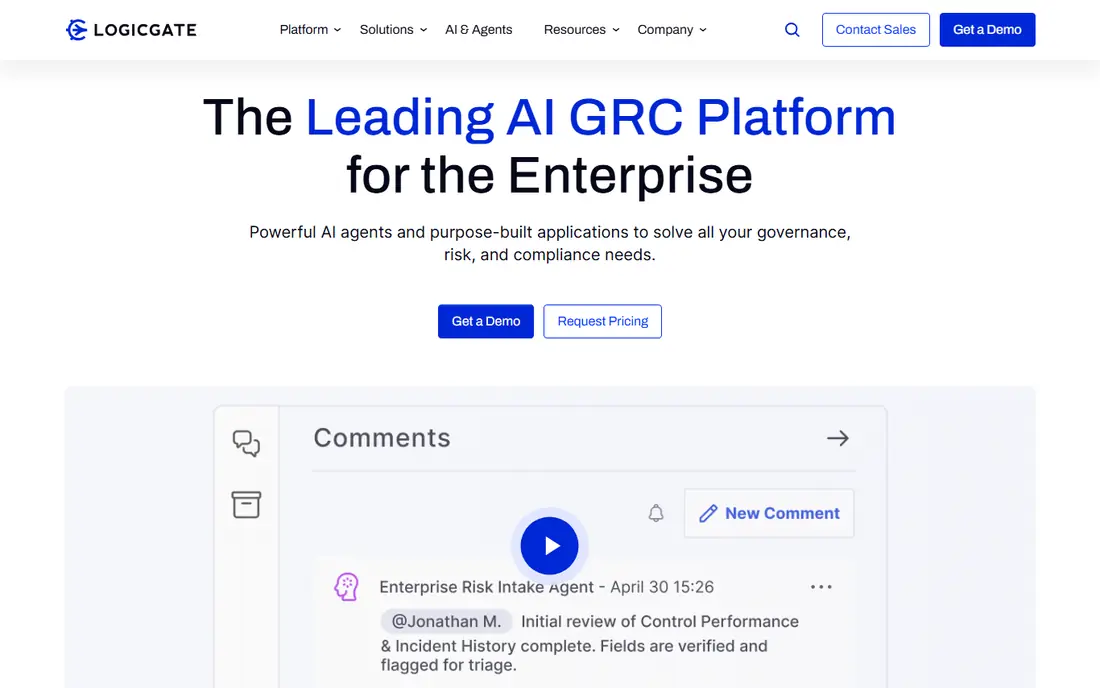
LogicGate suits risk teams that want to build their own workflows without waiting months for a custom build. Its Risk Cloud platform lets teams create risk registers, link controls to risks, run assessments, and track issues in a visual builder. Dashboards can show risk posture by business unit, which helps risk managers prepare board reports without stitching spreadsheets together.
The catch is that flexibility needs discipline. A team that builds too many custom fields and workflows can create a system that is hard to maintain. Pricing is by quote, so get a clear scope for implementation, training, and support before you commit. For mid-size enterprises and growing risk teams, LogicGate offers a good balance of speed and control.
- Drag-and-drop workflow builder
- Risk register, controls, and assessments in one platform
- Reporting dashboards for executives
- Pricing is by quote
- Deep customisation still needs planning and governance
Resolver, part of Kroll, brings risk management together with incident and investigation work. That combination helps organisations that need to track a risk, record an incident when it occurs, and follow the investigation through to closure in the same system. Reporting tools can show trends in incidents and control failures, which supports root cause work.
The drawback is enterprise scale. Resolver is priced for large organisations, and a full deployment needs planning across risk, compliance, and security teams. Smaller teams may find the platform more than they need. For regulated firms that already manage incidents and risks separately, bringing them together in Resolver can reduce duplicate work and improve audit trails.
- Risk, incident, and investigation workflows in one system
- Strong reporting and analytics
- Used by large regulated organisations
- Pricing is by quote
- Implementation can take time for large deployments
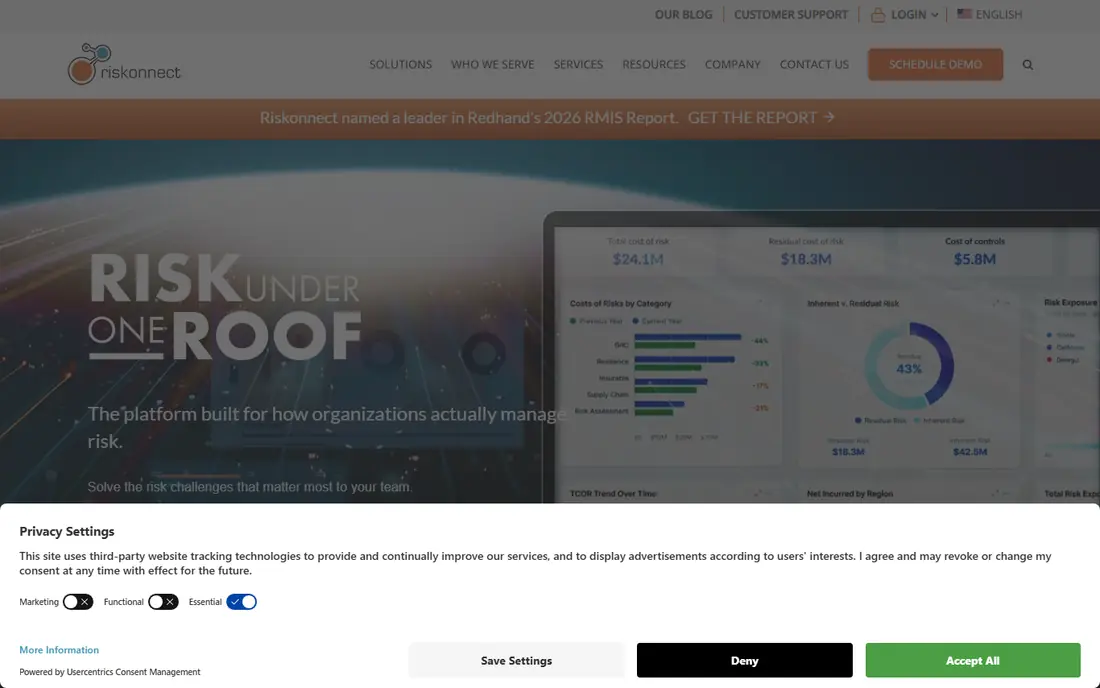
Riskonnect serves large enterprises with broad risk needs, including enterprise risk, claims, insurance, and safety. Its platform can handle risk registers, assessments, controls, and loss data in one system, which helps global firms that otherwise manage risk in many local tools. Analytics and reporting support executive and board views across business units and regions.
Breadth is also the warning. A platform that covers claims, insurance, and safety as well as enterprise risk needs careful scoping, or implementation can stretch over many months. Riskonnect fits large firms with dedicated risk teams and complex insurance programmes. Smaller firms will likely find a more focused tool faster to deploy.
- Broad risk, claims, and insurance features
- Strong for large and global programmes
- Analytics and board reporting
- Pricing is by quote
- Breadth can make setup complex for smaller teams
MetricStream is a long-standing governance, risk, and compliance platform for large, regulated organisations. It covers enterprise risk, operational risk, compliance, audit, and third-party risk, with workflows that link risks to controls, policies, and regulatory requirements. That depth helps banks, insurers, and global firms that must show regulators a clear chain from risk to control to test result.
The trade-off is scale and effort. MetricStream deployments are major projects, with implementation, data migration, and training that need senior sponsorship. It is not a quick spreadsheet replacement for a small team. For enterprises with complex regulatory duties and many business units, MetricStream offers the depth and audit trail that simpler tools cannot match.
- Deep governance, risk, and compliance coverage
- Audit and regulatory reporting
- Strong for banks and large regulated firms
- Pricing is by quote
- Implementation is a major project for most buyers
ServiceNow Governance, Risk, and Compliance suits organisations that already run ServiceNow for IT service management. Risk registers, controls, policies, audits, and vendor risk live on the same platform as IT workflows, so a control failure can trigger an IT task without manual handoffs. Automation can route assessments, reminders, and approvals across teams.
The limit is platform fit. If your organisation does not use ServiceNow, the cost and effort of adopting the whole platform for risk alone may be hard to justify. Licensing is also by quote and can be complex. For ServiceNow customers, though, GRC is a natural extension that reuses existing skills, integrations, and security controls.
- Risk, policy, audit, and vendor risk on the ServiceNow platform
- Strong workflow automation
- Familiar to IT teams already on ServiceNow
- Pricing is by quote and tied to ServiceNow licensing
- Best value if you already use ServiceNow
AuditBoard pairs enterprise risk management with audit and compliance management, which helps teams that report risk and audit findings to the same executives. Risks can be linked to controls, and control tests can feed back into risk ratings, so the risk register stays tied to evidence rather than opinion. Dashboards present risk, control, and audit status in a form boards can read quickly.
The platform is priced by quote, and its audit features may be more than a risk-only team needs at first. AuditBoard suits firms that want risk, audit, and compliance in one system, especially public companies with internal audit and Sarbanes-Oxley work. Risk-only teams should check whether the audit modules add cost without adding value for their programme.
- Risk management linked to audit, controls, and compliance
- Clear dashboards for boards
- Modern interface for risk and audit teams
- Pricing is by quote
- Audit depth may exceed what a risk-only team needs
Onspring is a configurable platform that lets risk teams build risk registers, assessments, and workflows without code. It offers apps for enterprise risk, audit, compliance, and vendor management that share data, so a vendor risk finding can update a related enterprise risk. That shared data model helps teams avoid duplicate entry across tools.
As with LogicGate, configurability needs governance. Without an owner for fields, workflows, and reports, a flexible platform can grow messy over time. Onspring offers a trial, which helps teams test the builder before buying. For mid-size firms that want enterprise features without a long, code-heavy implementation, Onspring is a strong contender.
- Highly configurable no-code platform
- Risk, audit, and compliance apps in one system
- Faster setup than many enterprise rivals
- Pricing is by quote
- Configurability needs clear ownership to avoid sprawl
Archer, formerly RSA Archer, is one of the most established enterprise risk platforms, with modules for enterprise risk, operational risk, compliance, business continuity, and third-party risk. Large banks, insurers, and global firms use it to manage complex risk programmes with many users, approvals, and reports. Its breadth and history give it credibility with regulators and auditors.
The drawback is weight. Archer deployments are enterprise projects, and smaller teams may find the interface and setup heavy compared with newer cloud platforms. Pricing is by quote and reflects that enterprise scope. For large firms that need a proven, broad GRC platform and have the team to run it, Archer remains a safe, well-understood choice.
- Long track record in enterprise GRC
- Broad risk, compliance, and third-party modules
- Strong for large regulated firms
- Pricing is by quote
- Interface and implementation feel enterprise-heavy for smaller teams
Fusion Risk Management, often called Fusion, links enterprise risk to business continuity, crisis management, and operational resilience. That link matters when a risk becomes a real disruption, because the same platform can move from risk assessment to continuity plan to incident response. Scenario planning helps teams test how a disruption would affect critical services.
Fusion is priced by quote and is built for firms with serious resilience duties, such as banks and critical infrastructure operators. Teams that only need a risk register and control testing may find the resilience modules extra. For firms where regulators ask about operational resilience as well as risk, Fusion covers both in one programme.
- Risk management linked to business continuity and resilience
- Scenario planning and incident response
- Strong for operational resilience
- Pricing is by quote
- Resilience focus may be broader than a pure risk register need
Origami Risk suits organisations where insurance and risk data sit close together, including insurers, risk pools, and large companies with complex insurance programmes. It combines enterprise risk, claims, policy, and exposure data, so risk managers can see insured losses alongside risk assessments. That view helps with renewals, limits, and programme design.
General enterprise risk teams without a large insurance programme may find Origami broader than they need, and pricing is by quote. For insurance-heavy organisations, though, the combination of risk and claims data in one system is a real advantage over keeping those datasets in separate tools.
- Risk, claims, and insurance data in one platform
- Strong for risk pools, insurers, and large insureds
- Reporting and analytics
- Pricing is by quote
- Insurance focus may be more than a general enterprise risk team needs
How we picked these
We compared official product pages, module lists, and customer use cases for enterprise risk platforms that serve large organisations today. We kept only platforms that offer a risk register, controls, assessments, and reporting, and we left out spreadsheet templates and small business risk tools. We weighed breadth, configurability, audit linkage, resilience features, and implementation effort, because a platform that takes a year to deploy may miss the risk cycle it was bought to support.
We did not run live deployments, and we did not claim pricing we could not verify, since most enterprise platforms price by quote. Instead we compared published modules, integrations, and use cases, and we noted where a platform fits best. Get a scoped quote, a demo with your own risk data, and references from firms of similar size before you commit.
How to choose an enterprise risk platform
Start with your risk programme, not with a feature list. Write down your top risks, your control owners, your assessment cycle, and the board report you must produce each quarter. A platform that cannot produce that report without manual work is the wrong platform, even if it has many other modules. Test the demo with a real risk, a real control, and a real test result, and watch how the rating changes.
Next, check ownership and integrations. A risk platform needs owners for each risk and control, a clear assessment workflow, and links to audit, compliance, and incident data where those teams exist. Check integrations with your HR system for owners, your ticketing system for issues, and your reporting tools for board packs. A platform that sits apart from daily work will go stale.
Finally, plan for adoption. Budget for implementation, data migration from spreadsheets, training for risk owners, and a first assessment cycle with support from the vendor. Start with a pilot in one business unit, prove the reporting works, and then roll out more widely. A phased rollout is slower at first, but it produces a risk register that people actually use, which is the point of the whole programme.
Frequently asked questions
What is the best enterprise risk management software?
LogicGate and Onspring suit flexible mid-size programmes, MetricStream and Archer suit large regulated firms, and AuditBoard suits teams that combine risk with audit. The best choice depends on your size, your regulatory duties, and your existing platforms.
What is the best risk management software for enterprises with ServiceNow?
ServiceNow GRC is the natural pick if you already use ServiceNow, because risk, audit, and vendor work share the same platform, workflows, and security controls as your IT service work.
How much does enterprise risk management software cost?
Most platforms price by quote, based on users, modules, and implementation scope. Expect enterprise pricing rather than a fixed monthly fee, and get a scoped quote that includes implementation, training, and support.
What is the difference between ERM and GRC software?
Enterprise risk management focuses on identifying, assessing, and treating risks across the organisation. Governance, risk, and compliance software adds policy, compliance, and audit management to that risk core, often in the same platform.
Do I need ERM software or can I use spreadsheets?
Spreadsheets work for a small risk list, but they break down when risks, controls, owners, and assessments grow across business units. ERM software adds version control, audit trails, automated reminders, and board reporting that spreadsheets cannot sustain at scale.
How long does ERM implementation take?
It varies by scope, from weeks for a focused pilot on a configurable platform to many months for a full enterprise GRC deployment. A pilot in one business unit, with a clear board report as the goal, is a practical way to prove value early.
Sources
See where you really rank - block by block
ProMapRanker scans Google Maps across a grid of your service area. Simple monthly plans from $19, white-label on every plan.
Start freeKeep reading
 zoho inventory alternatives
6 Alternatives to Zoho Inventory, Compared on Price and Fit
Zoho Inventory alternatives: 6 tools compared on price, free plans and fit. Katana leads the list for manufacturers. Fit and flaws are laid out for each entry.
Read → zoho crm alternatives
Best Zoho CRM Alternatives (2026)
Need Zoho CRM alternatives? We compare 7 tools on cost, free access and who each suits. Every pick gets a straight assessment. Built for quick decisions.
Read → zelle alternatives
Best Zelle Alternatives in 2026
Compare the best Zelle alternatives for sending money to friends, paying sellers and moving funds abroad, with honest notes on fees, speed and safety in 2026.
Read →