 ProMapRanker
Best Enterprise Resource Management Software


Growing mid-size firms that need one cloud ERP · Pricing starts at: quote only
Key takeaways
- Only two of the eight systems here publish a starting price: Business Central at $80 per user per month and Odoo Standard at $31.10 per user per month, both billed annually.
- NetSuite, SAP S/4HANA Cloud, Acumatica, Sage Intacct, Infor CloudSuite, and Workday all price by quote, so cost depends on users, modules, entities, and contract length.
- Business Central and Odoo suit smaller teams that want a published price and a fast start, while NetSuite, SAP, Infor, and Workday suit larger groups with complex needs.
- Implementation, migration, training, and add-on modules are usually quoted separately, so ask for the full first-year total before you sign.
Quick comparison
| Pick | Great for | Pricing starts at | Free tier | |
|---|---|---|---|---|
| Oracle NetSuite | Growing mid-size firms that need one cloud ERP | quote only | No | Visit |
 SAP S/4HANA Cloud | Large firms with complex finance and supply chain | quote only | No | Visit |
 Microsoft Dynamics 365 Business Central | Small and mid-size firms on Microsoft tools | $80 per user/month (billed annually) | Free trial (30 days) | Visit |
 Acumatica | Distributors and manufacturers that want unlimited users | quote only | No | Visit |
 Odoo | Small and mid-size firms that want low entry cost | $31.10 per user/month (billed annually) | Yes | Visit |
 Sage Intacct | Finance teams in multi-entity groups | quote only | No | Visit |
 Infor CloudSuite | Manufacturers and distributors in one industry | quote only | No | Visit |
 Workday | Large firms that need HR and finance in one system | quote only | No | Visit |
The best enterprise resource management software
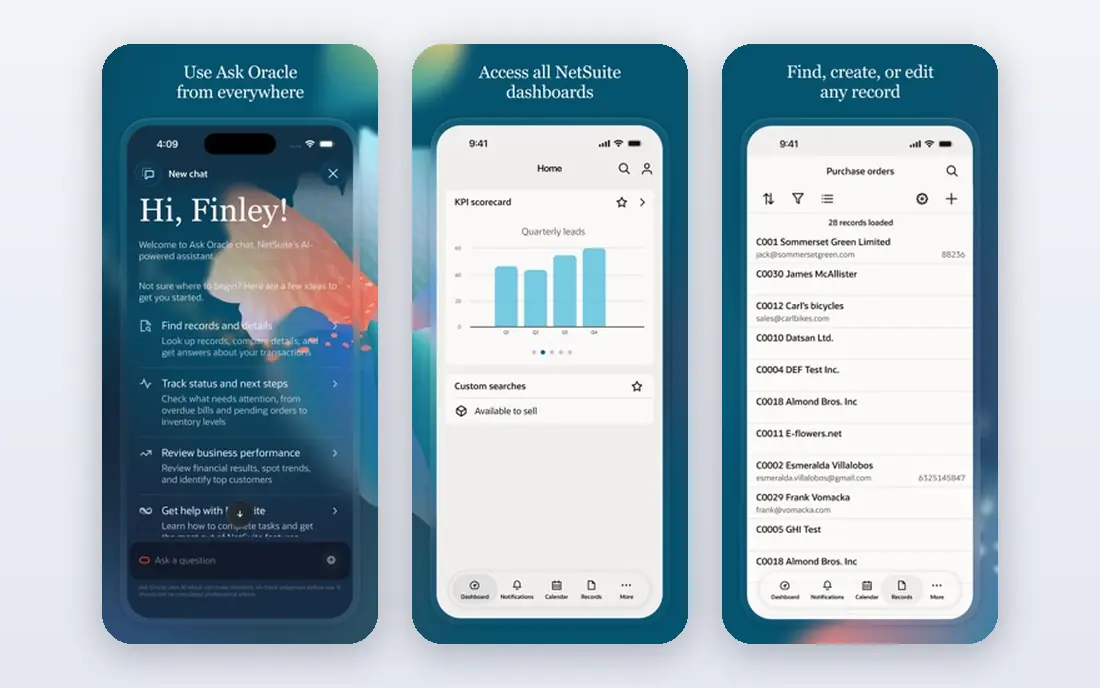
Oracle NetSuite is a cloud ERP that brings finance, sales, inventory, and customer records into one system. It covers general ledger, order management, procurement, and reporting, with optional modules for manufacturing, warehouse management, and ecommerce. NetSuite also supports several subsidiaries and currencies, which helps groups that trade across borders or run more than one legal entity from a single login.
The main drawback is cost clarity. Oracle does not publish a list price, so you must request a quote and discuss edition, user types, and modules with Oracle or a partner. Implementation is a second cost line, and it often runs close to the first year subscription for a mid-size deployment, so ask for both numbers in writing before you commit.
- One cloud system for finance, CRM, inventory, and ecommerce
- Strong multi-entity and multi-currency support
- No public price list, so every quote needs a sales conversation
- Implementation often needs partner help and adds a large separate cost
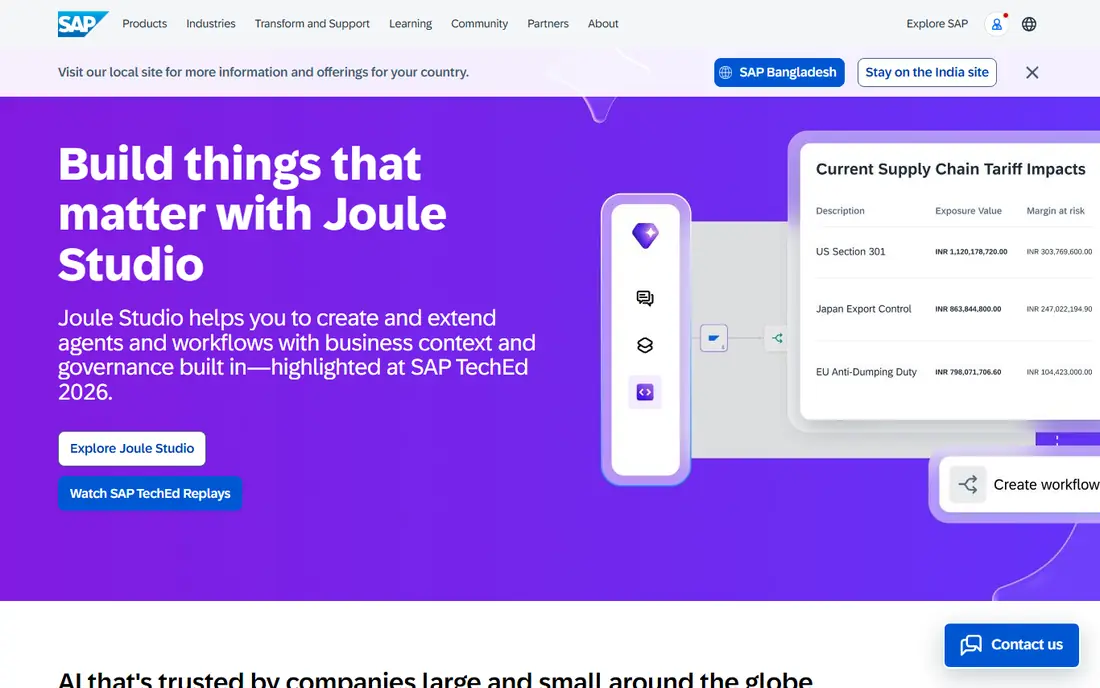
SAP S/4HANA Cloud, now sold as SAP Cloud ERP, is the cloud ERP from SAP for large and complex groups. It covers finance, procurement, sales, manufacturing, and supply chain in one system, with built-in analytics and industry processes for sectors such as manufacturing, retail, and professional services. It also connects finance with operations, so stock, orders, and cash flow stay in step.
Pricing is by quote only. SAP does not publish a per-user list price, and the final figure depends on edition, user count, modules, and contract length. Ask for a written quote tied to a named scope, and ask what is included in the subscription and what is charged as a separate service. S/4HANA Cloud suits large firms with complex supply chains and strict controls, not a small firm that needs a simple ledger and a fast start.
- Deep finance, procurement, and supply chain depth
- Preconfigured industry processes for many sectors
- No public price, so budgeting starts with a sales quote
- Long setup times and a steep learning curve for new users
Microsoft Dynamics 365 Business Central
Great for: Small and mid-size firms on Microsoft tools
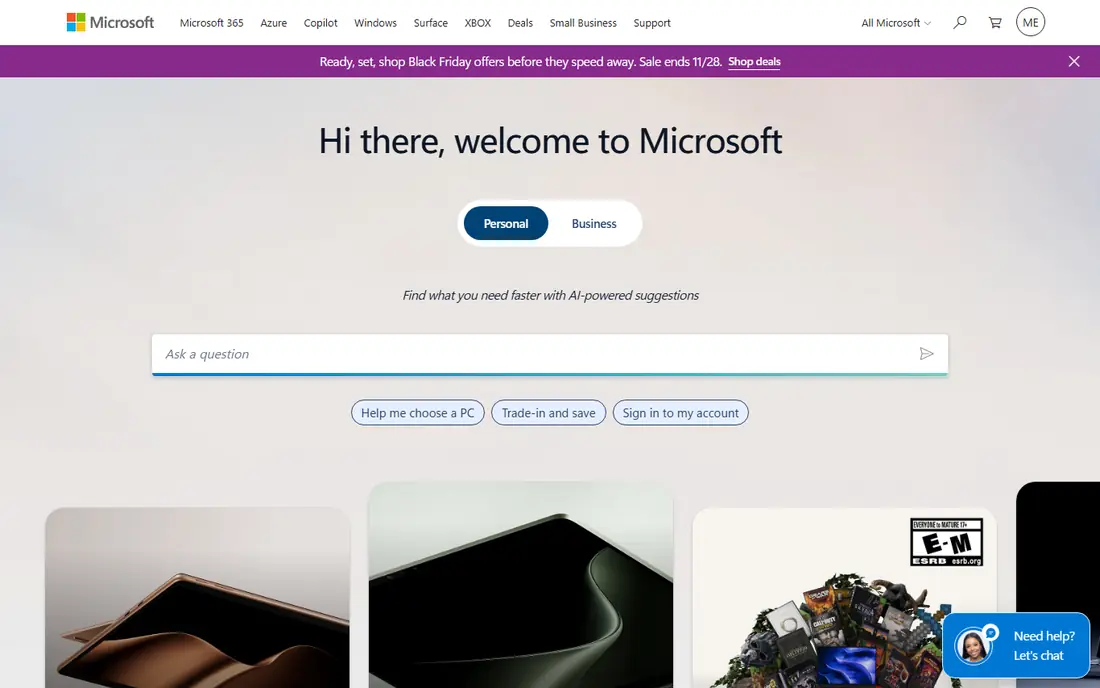
Microsoft Dynamics 365 Business Central is a cloud ERP for small and mid-size firms, and one of the few enterprise systems here with a published price. Microsoft lists Essentials at $80 per user per month and Premium at $110 per user per month, both billed annually, with Team Members at $8 per user per month for light access. Premium adds service management and manufacturing to the Essentials set, which covers finance, sales, purchasing, inventory, projects, and warehousing.
Business Central fits firms that already use Microsoft 365, Teams, and Outlook, because users can work with familiar tools and sign in with existing accounts. The licence model has limits worth noting. You cannot mix Essentials and Premium licences in the same environment, so a firm that needs Premium for a few staff must plan around that rule. Implementation is handled by a Microsoft partner and priced separately, so ask for a fixed scope, a timeline, and a data migration plan before you sign.
- Clear published price and a 30-day free trial
- Works with Microsoft 365, Teams, and Outlook
- Essentials and Premium licences cannot be mixed in the same environment
- Some Copilot agents need Copilot Credits that are sold separately
Acumatica is a cloud ERP aimed at small and mid-size firms, with a pricing model that differs from most rivals. Instead of charging per named user, Acumatica prices on the applications you license and a resource tier tied to transaction volume and computing use. That model can suit firms with many occasional users, such as warehouse staff, sales reps, and field teams, because adding a user does not always add a licence fee.
The trade-off is price clarity. Acumatica publishes no list price, and every subscription is quoted through a certified partner. The quote depends on edition, modules, and the transaction tier, so two firms of the same size can receive very different numbers. Ask the partner to explain the tier in plain terms, including the monthly transaction count that sets the tier and the cost of moving to the next tier.
- Resource-based pricing with no per-user charge on most editions
- Strong distribution, manufacturing, and construction editions
- No public price list, so every deal needs a partner quote
- Transaction volume tiers can be hard to predict before you go live
Odoo is a modular business system with apps for accounting, CRM, inventory, manufacturing, projects, HR, and ecommerce. The pricing page lists three plans. One App Free costs $0 for one app with unlimited users. Standard costs $31.10 per user per month on annual billing, with a first-year rate of $24.90 per user per month for initial users. Custom costs $61.00 per user per month on annual billing, with a first-year rate of $49.00.
The low entry price makes Odoo attractive to small firms, but the plan limits matter. Standard runs only on Odoo Online, so a firm that needs custom code, external API access, or several companies on one database must move to Custom. Light users cost $8.90 per user per month for narrow roles such as time off and expense reports. Implementation is also separate, and Odoo sells Success Packs for project work, while larger firms usually work with a partner for setup, data import, and training.
- Published price and a free One App plan with unlimited users
- One per-user price covers all apps on the Standard plan
- Standard is limited to Odoo Online, with no Studio, API, or multi-company access
- Implementation and expert services cost extra
Sage Intacct is a cloud financial management system for finance teams that need more than a basic ledger. It covers general ledger, accounts payable and receivable, cash management, billing, and reporting, with dimensions that let finance teams tag transactions by department, project, location, or fund. That structure helps multi-entity groups consolidate results, compare entities, and close the books faster. It also supports audit trails and approval controls for finance teams.
Pricing is tailored to each group. Sage does not publish a per-user list price for Intacct in the United States, and the final quote depends on users, modules, entities, and integrations. In the United Kingdom, Sage lists Intacct plans from £1,200 per month excluding VAT, with a base subscription that includes 3 full users and one employee 10-pack as standard. Implementation, data migration, and training are quoted separately, so the monthly subscription is only part of the first-year cost.
- Strong multi-entity consolidation and dimensional reporting
- Good automation for accounts payable, billing, and close
- No public per-user price in the United States, so budgeting starts with a quote
- Add-on modules and implementation are quoted separately
Infor CloudSuite is a family of industry-specific cloud ERPs rather than a single generic system. Editions include CloudSuite Industrial, CloudSuite Distribution, CloudSuite Food and Beverage, CloudSuite Healthcare, CloudSuite Fashion, and CloudSuite Automotive, each with data models, workflows, and reports for that sector. The systems run on Amazon Web Services and use Infor OS for integration, data, and automation across Infor products.
Pricing is custom quoted, and Infor does not publish a list price for any CloudSuite edition. The quote depends on user count, user roles, modules, edition, and industry, and every deal is negotiated with Infor or an authorised partner. Published guides put typical annual licence costs at $40,000 to $100,000 for a small deployment of 20 to 50 users, but those are third-party ranges, not vendor prices, so use them only as a rough guide. Infor suits manufacturers and distributors that want an ERP built for their industry, not a firm that wants a generic system or a fast go-live.
- Industry-specific editions with preconfigured processes and reports
- Runs on Amazon Web Services with Infor OS integration tools
- No public list price, so every deal is custom quoted
- Typical go-live takes 9 to 18 months, which is long for a mid-size firm
Workday is a cloud system for large firms that want human capital management and financial management on one platform. It covers core HR, talent, payroll, time tracking, finance, procurement, and planning, with shared data across HR and finance teams. That shared model helps large groups plan headcount and labour cost, track skills and performance, and report on people and money from the same source.
Pricing is by quote only. Workday does not publish a public price list, and the final figure depends on modules, employee count, and contract terms. Human capital management is priced per employee, while financial management is priced per user, so the headcount definition matters as much as the rate. Third-party benchmarks suggest list rates of $20 to $40 per employee per month for core HR, but those are not vendor prices and delivered rates are often lower after negotiation.
- One system for HR, finance, and planning with shared employee data
- Strong workforce planning and reporting for large teams
- No public price list, so every quote needs a sales process
- Long implementation and a high cost for smaller headcounts
How we chose
We compared vendor pricing pages, product pages, and documentation for each system on 2026-11-11, and we listed only the prices that the vendor itself publishes. Microsoft lists Business Central Essentials at $80 per user per month, billed annually, and Odoo lists Standard at $31.10 per user per month, billed annually, with a first-year rate of $24.90. NetSuite, SAP S/4HANA Cloud, Acumatica, Sage Intacct, Infor CloudSuite, and Workday publish no per-user list price, so we recorded each as quote only and noted the starting point where a vendor publishes one, such as Sage Intacct from £1,200 per month in the United Kingdom. We checked that each website is the official vendor homepage and that each tool covers finance and operations. We did not test any system hands-on, and we did not use third-party prices as vendor prices. Prices change, so confirm the current figure on the vendor pricing page before you sign.
What to check before you buy
Start with scope, not with a demo. Write down the entities, users, and modules you need, the transactions you run each month, and the reports your finance team must produce. Ask each vendor to price that exact scope in writing, with software, implementation, migration, training, and support shown as separate lines. Check the contract length, the renewal terms, and what happens to your data if you leave. Test the system with your own chart of accounts, approval rules, and a real month of transactions, not with sample data. Ask for two reference firms in your sector and size, and ask how long their go-live took and what it cost in total.
Use this decision table to match a system to your size and budget. The budget bands are first-year totals for software plus implementation, based on the vendor prices and the third-party ranges named in the tool sections, so treat them as planning guides and confirm them with a written quote.
| Team size and budget | Best match | Why it fits | | Under 25 users, under $25,000 first year | Odoo Standard | Published $31.10 per user per month, free One App start, low licence cost | | 25 to 100 users, $25,000 to $150,000 first year | Business Central Essentials | Published $80 per user per month, Microsoft integration, 30-day trial | | 25 to 100 users, quote-based budget | Acumatica or Sage Intacct | Acumatica suits high user counts, Intacct suits multi-entity finance | | 100 to 500 users, $150,000 to $500,000 first year | NetSuite or Infor CloudSuite | NetSuite suits growing groups, Infor suits one industry in depth | | Over 500 users, $500,000 and above first year | SAP S/4HANA Cloud or Workday | SAP suits complex supply chain, Workday suits HR plus finance |
Also check user roles, because a light user, a Team Member, and a full user carry very different prices. Count read-only staff, approvers, and warehouse users separately from full finance users, and ask each vendor which licence each role needs. Check integration with your payroll, CRM, and ecommerce tools, and ask who supports each integration after go-live. Finally, agree the go-live date, the data migration owner, and the training plan in writing, with named staff on both sides, before you sign the contract.
Frequently asked questions
What is enterprise resource management software?
Enterprise resource management software, often called ERP, is one system that joins finance, inventory, sales, purchasing, HR, and reporting, so teams share the same data instead of retyping it between tools. It suits firms that have outgrown separate accounting and stock systems and need controls, approvals, and consolidated reports across departments, entities, or locations.
How much does enterprise resource management software cost?
The cost varies widely. Odoo Standard lists $31.10 per user per month, billed annually, and Business Central Essentials lists $80 per user per month, billed annually. The other six systems in this guide price by quote, so the total depends on users, modules, entities, and contract length, plus implementation, migration, and training, which are usually quoted separately.
Which ERP is best for a small business?
Odoo and Business Central are the strongest small-business picks in this guide, because both publish a starting price and offer a low-cost way to start. Odoo has a free One App plan and a $31.10 Standard plan, while Business Central has a 30-day trial and an $80 Essentials plan. Choose Odoo for low entry cost and Business Central for Microsoft integration.
Is NetSuite or SAP better for a large firm?
NetSuite suits a growing mid-size or large firm that wants one cloud ERP with multi-entity and multi-currency support and a broad module set. SAP S/4HANA Cloud suits a very large firm with complex manufacturing, procurement, and supply chain needs and preconfigured industry processes. Both price by quote, so compare written quotes for the same scope before you decide.
Does enterprise resource management software need a partner to set up?
Most systems in this guide need a partner or the vendor for implementation, data migration, and training. Business Central, NetSuite, SAP, Acumatica, Infor, and Workday are usually set up by a partner, while Odoo offers Success Packs and partner help. Only a small Odoo setup can be self-serve, so budget for implementation time and cost from the start.
How long does it take to set up an ERP system?
Setup time depends on size and scope. A small Odoo or Business Central project can take 1 to 3 months, a mid-size NetSuite or Acumatica project often takes 3 to 6 months, and a large SAP, Infor, or Workday project can take 9 to 18 months or more. Data quality, integrations, and training are the usual causes of delay, so agree the timeline and migration plan in writing.
Sources
See where you really rank - block by block
ProMapRanker scans Google Maps across a grid of your service area. Simple monthly plans from $19, white-label on every plan.
Start freeKeep reading
 best invoicing software for roofers
Best Invoicing Software for Roofers
The best invoicing software for roofers compared on price, card fees, and job billing, so a roofing company can send invoices fast and collect money sooner.
Read → best invoicing software for auto repair shops
Best Invoicing Software for Auto Repair Shops
Compare the best invoicing software for auto repair shops, with real starting prices, repair-ready templates, and payment links that get invoices settled fast.
Read → best insulation contractor software
Best Insulation Contractor Software 2026
Compare the best insulation contractor software for spray foam, fiberglass and cellulose crews in 2026. See prices, trials and the right fit for your team size.
Read →