 ProMapRanker
Best Insulation Contractor Software 2026


In-home insulation sales and proposals · Pricing starts at: $249 per month
Key takeaways
- Jobber Core at $49 per month is the cheapest way for a solo insulation contractor to run quotes, scheduling and invoices in one place.
- Housecall Pro Basic at $79 per month adds a price book and job costing that suit spray foam crews who price by board foot.
- JobProgress at $249 per month is built for home improvement sales, with in-home proposals and digital signatures for larger insulation jobs.
- STACK and Clear Estimates cover the estimating side, while JobNimbus and Buildertrend cover the full job from lead to final invoice.
- Only STACK offers a free version on this list, so use the free trials to test with your own crew before you commit.
Quick comparison
| Pick | Great for | Pricing starts at | Free tier | |
|---|---|---|---|---|
| JobProgress | In-home insulation sales and proposals | $249 per month | Free trial (14 days) | Visit |
 Housecall Pro | Solo and small spray foam crews | $79 per month (billed monthly) | Free trial (14 days) | Visit |
 Jobber | Solo contractors who want the lowest entry price | $49 per month (billed monthly) | Free trial (14 days) | Visit |
 JobNimbus | Roofing and insulation shops that run insurance work | quote only | Free trial (14 days) | Visit |
 STACK | Takeoffs and estimates from plans | $299 per user/month (billed annually) | Yes | Visit |
 Clear Estimates | Fast residential estimates with a cost database | $79 per month (billed monthly) | Free trial (30 days) | Visit |
 Contractor Foreman | Budget all-in-one job management | $49 per month (billed annually) | Free trial (30 days) | Visit |
 Buildertrend | Established builders running insulation as one trade | quote only | No | Visit |
The best insulation contractor software for 2026
JobProgress, now sold under the Leap name, is built around the in-home sale. An insulation contractor can walk a home, measure the attic or wall cavities, build the proposal on a tablet and collect a digital signature before leaving the driveway. That flow matters for insulation work, where the sale often closes at the kitchen table and the crew needs the scope locked down the same day. The system also covers lead capture, scheduling, production and invoicing, so the job moves from first call to final payment without retyping the details.
The catch is the price and the contract. The legacy JobProgress plan runs $249 per month per account for up to three users, plus a $500 one-time setup fee, and every plan runs on a one-year contract with no month-to-month option. A solo operator who only needs scheduling and invoicing will find cheaper tools on this list. JobProgress earns its price when the sales process is the bottleneck and the team closes large retrofit or new-build insulation packages every week.
- Built for home improvement sales
- Digital signatures and proposals in one flow
- Entry price is high for a one-truck shop
- Plans run on a one-year contract

Housecall Pro is the most common pick for small home service crews, and insulation fits it well. The Basic plan at $79 per month billed monthly, or $59 per month billed annually, covers scheduling, dispatch, estimates, invoicing, online booking and a price book. A spray foam crew can build flat-rate pricing by board foot or by square foot, and the job costing tools show the margin on each job once material and labor are logged. The mobile app is solid, which matters when the crew is in an attic with no desk nearby.
The limits show up as the team grows. QuickBooks Online sync, GPS tracking and photo reports sit on Essentials at $149 per month billed annually for up to five users, and the MAX plan at $299 per month billed annually adds sales proposals and route optimization. There is no free plan, only a 14-day trial. For a one or two person insulation crew that wants a simple system with honest pricing, Housecall Pro is a strong default.
- Price book and job costing included on Basic
- Strong mobile app for techs
- QuickBooks sync needs Essentials at $149 per month billed annually
- No free plan
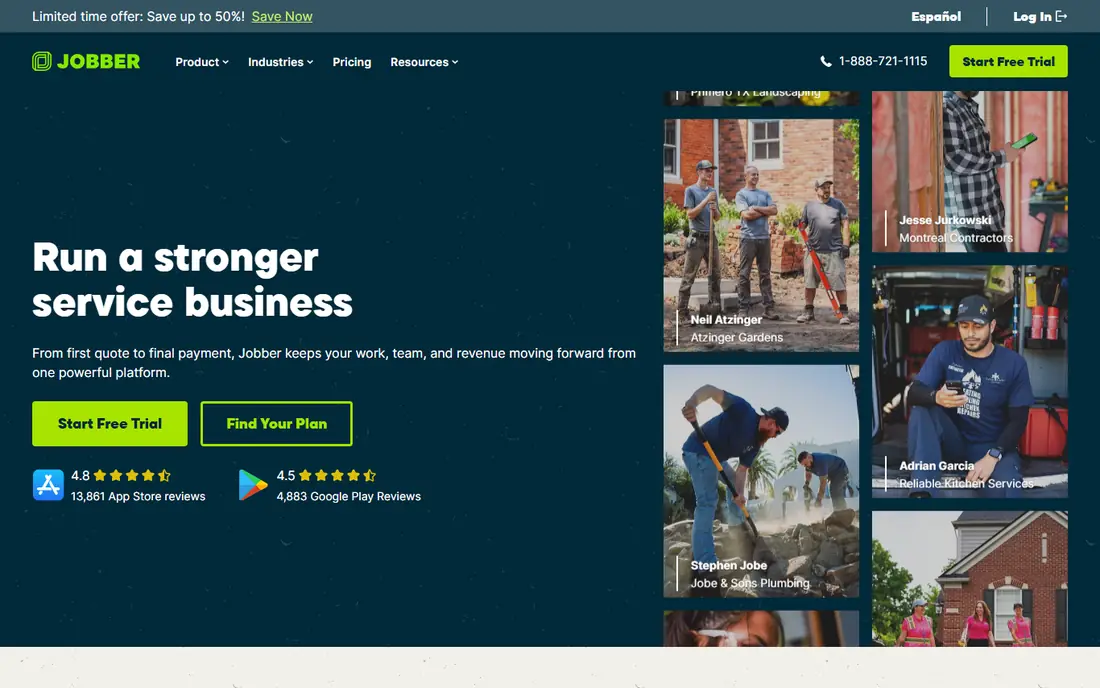
Jobber starts at $49 per month billed monthly for the Core plan, or $29 per month when the full year is billed up front, and that is the lowest entry price in this comparison. Core covers one user with quoting, invoicing, scheduling, a client hub, online booking and reporting. A solo insulation contractor can run the whole business on Core, and the price stays flat until the team grows. Connect, Grow and Plus add automation, two-way texting, job costing and pipeline tools as the crew expands.
The trade-off is that the features insulation sellers lean on sit above Core. Automated quote follow-ups, QuickBooks sync and time tracking need Connect at $139 per month billed monthly for one user, and job costing needs Grow at $199 per month. Add-ons such as Marketing Suite and AI Receptionist are billed separately. Jobber is the right pick when the budget is tight and the owner is comfortable adding tiers later, but the headline $49 figure covers the basics only.
- Lowest entry price on this list
- Clear plan tiers by team size
- Quote follow-ups and QuickBooks sync need higher plans
- Add-ons raise the bill
JobNimbus is a CRM built for roofing and exterior trades, and insulation contractors who also do roofing or storm work will find it familiar. It covers contacts, estimates, documents, e-signatures, invoices and supplier integrations, and it includes SumoQuote for proposals. The sales pipeline helps a shop track leads from first call to signed contract, which suits insulation firms that sell through referrals and repeat builders. A 14-day free trial lets a team test it with real jobs.
The main drawback is price transparency. JobNimbus lists four tiers by user cap on its pricing page, and every tier says request pricing. Third-party reports put the base near $225 to $550 per month plus per-user fees by role, and the Engage texting bundle adds $49 to $249 per month. That means a small shop cannot budget from the website alone. JobNimbus fits a growing insulation and roofing shop that wants a real CRM, but a solo operator should get the written quote before committing.
- Strong CRM and sales pipeline for exterior trades
- SumoQuote proposals included
- No published prices, so budgeting needs a sales call
- Texting costs extra
STACK is the takeoff and estimating tool on this list. It runs in the browser, so an insulation estimator can measure plans, count areas and volumes, and build the estimate with costs attached, all without desktop software. For new-build insulation work, where the bid starts from architectural plans, that workflow is faster than measuring by hand. STACK also offers a free version of Takeoff and Estimate with limits on projects and measurements, which is rare in this category.
The price is the filter. Takeoff and Estimate Premium runs $299 per user per month billed annually, or $349 billed monthly, and Pro runs $349 per user per month billed annually. Three estimators cost nearly $900 a month, and every plan runs on a 12-month term. STACK is the right pick when plan-based estimating is the core of the business and the team wins work by bidding fast and accurately. A crew that prices from site visits rather than plans will get less value from it.
- Free version for takeoff work
- Cloud based, so the office and field see the same plans
- Per-user price adds up fast for a multi-estimator shop
- The plans need a 12-month term
Clear Estimates is the simplest estimating tool here. It ships with a cost database of more than 13,000 line items and 60-plus job templates, with localized pricing across 400 US regions, so a residential insulation contractor can produce a professional estimate and proposal in minutes. The Standard plan runs $79 per month billed monthly, or $59 per month billed annually, and Pro runs $119 per month billed monthly. A 30-day free trial covers every plan.
The limits are about focus. Clear Estimates is built for remodelers, so the templates lean toward kitchens, baths and additions rather than insulation scopes, and the crew will need to build its own insulation line items. It also has no free plan beyond the trial, and it does not run scheduling or dispatch. It is a good pick for a small insulation firm that wants fast, clean estimates without learning a full construction platform, and it pairs well with Jobber or Housecall Pro for the field work.
- Ready-made remodeling cost database with 13,000 line items
- Simple to learn
- Built for remodelers, so insulation-specific templates are thin
- No free plan
Contractor Foreman packs estimates, scheduling with a Gantt chart, daily logs, work orders, permits, time cards, purchase orders, invoicing and job costing reports into one low price. Basic runs $49 per month billed annually for one user, Standard runs $105 per month billed annually for up to three users, and Plus runs $166 per month billed annually for up to eight users. Every plan starts with a 30-day free trial, and there is a 100-day money-back promise on the annual Plus, Pro and Unlimited plans.
The catches are the user caps and the billing. Basic is not sold on monthly billing, and Basic and Standard do not include pricing from the local material database. The interface is functional rather than polished, and the learning curve is real because so many modules are included. For an insulation contractor who wants one system for the office and the field at a low monthly cost, and who can live with the annual billing, Contractor Foreman is hard to beat on value.
- Flat pricing with many modules included
- Gantt scheduling and job costing reports
- Basic is capped at one user and has no monthly billing option
- Interface feels dated
Buildertrend is the all-in-one construction platform for custom home builders and remodelers, and it fits an insulation contractor who works as a trade partner on new builds. It covers bids, estimates, budgets, change orders, schedules, daily logs, selections and a client portal where homeowners see progress and approve work. Subcontractors get their own portal, and the system syncs with QuickBooks, Xero and Sage Intacct. Users and projects are unlimited on every plan.
The price is the problem for a small shop. Buildertrend stopped publishing prices and now quotes based on annual construction volume and onboarding package, with the last published starting figure at $499 per month and 10 percent off for annual prepayment. There is no free plan and no free trial listed on the pricing page. Buildertrend suits an established insulation firm that runs many projects a year and wants one system for the whole build, but a one-truck crew should look at Jobber or Housecall Pro first.
- Full project platform with client portal and selections
- Unlimited users and projects
- No published pricing, so the quote sets the budget
- Built for residential builders, not solo trades
Which tool fits your crew size
| Crew size | Best pick | Monthly cost from | Why it fits | | Solo operator | Jobber Core | $49 per month | Lowest entry price, covers quotes, scheduling and invoices | | 2 to 3 people | Housecall Pro Essentials | $149 per month billed annually | Adds QuickBooks sync, GPS tracking and photo reports | | 3 to 5 people | Contractor Foreman Plus | $166 per month billed annually | Eight users, Gantt scheduling and job costing in one flat price | | 5 to 10 people | JobProgress | $249 per month | In-home sales and proposals built for home improvement | | Plan-based bidders | STACK Premium | $299 per user/month billed annually | Cloud takeoff and estimating from plans | | Established builder | Buildertrend | quote only | Full project platform with client portal and unlimited users |
How we chose
We compared vendor pricing pages, feature pages and help documentation for each tool, and we checked the prices in November 2026. We favored tools that insulation contractors actually use for quotes, scheduling, invoicing and job costing, and we noted where a price is published and where the vendor asks for a quote instead. We did not run hands-on tests, and we did not accept review-site ratings as facts. Where two sources disagreed on a price, we used the figure closest to the vendor's own pricing page and named the billing terms so the reader can check it.
What to check before you buy
Check the billing terms before you sign. A $49 monthly figure can mean $49 billed monthly or $49 per month when a full year is billed up front, and the difference over a year is real money. Ask how many users are included, because several tools charge per user while others charge a flat rate for the whole company. Ask about the contract length, since JobProgress, STACK and Buildertrend all involve annual terms or quotes, while Jobber and Housecall Pro offer month-to-month billing. Test the mobile app on a real job, because the crew will use it in attics and crawl spaces with poor signal. Confirm that the estimating cost database covers insulation materials and local labor rates, or budget time to build those line items yourself. Finally, confirm the trial length and whether a credit card is needed to start it.
Frequently asked questions
What is the cheapest insulation contractor software?
Jobber Core at $49 per month billed monthly, or $29 per month when the full year is billed up front, is the cheapest entry point on this list. Contractor Foreman Basic matches it at $49 per month billed annually. Both cover quotes, scheduling and invoicing for one user, so a solo insulation contractor can start there and move up when the team grows.
Does insulation contractor software include estimating?
Most tools on this list include basic estimating, but the depth varies. STACK and Clear Estimates are built for estimating first, with takeoff tools and cost databases. Jobber, Housecall Pro and JobProgress include quotes and proposals as part of the job flow. Buildertrend and Contractor Foreman carry the estimate into budgets and job costing.
Is there free insulation contractor software?
STACK offers a free version of its Takeoff and Estimate product with limits on projects and measurements. No other tool on this list offers a free plan. Most offer a free trial of 14 or 30 days, which is enough to test the system with a few real jobs before paying.
How much should a small insulation company budget for software?
A solo operator can run on $49 to $79 per month. A crew of three to five people should budget $150 to $350 per month for a field service tool plus an estimating tool. A firm that bids from plans should add $299 per user per month for STACK. Get written quotes for JobNimbus and Buildertrend before budgeting.
Can insulation software handle spray foam pricing?
Yes, if the tool has a price book or a cost database. Housecall Pro includes a price book on every plan, so a spray foam crew can price by board foot. Clear Estimates lets a crew build insulation line items with local material and labor rates. Ask the vendor whether foam, fiberglass and cellulose line items are included before you buy.
Sources
See where you really rank - block by block
ProMapRanker scans Google Maps across a grid of your service area. Simple monthly plans from $19, white-label on every plan.
Start freeKeep reading
 best invoicing software for roofers
Best Invoicing Software for Roofers
The best invoicing software for roofers compared on price, card fees, and job billing, so a roofing company can send invoices fast and collect money sooner.
Read → best invoicing software for auto repair shops
Best Invoicing Software for Auto Repair Shops
Compare the best invoicing software for auto repair shops, with real starting prices, repair-ready templates, and payment links that get invoices settled fast.
Read → best image based backup software
Best Image-Based Backup Software Compared
Compare the best image based backup software for full system images, bare-metal restores and scheduled backups, with real prices, so your PC can recover fast.
Read →