 ProMapRanker
Best Enterprise Performance Management Software in 2026


Financial consolidation and close · Pricing starts at: $250 per user per month
Key takeaways
- Enterprise performance management covers planning, budgeting, forecasting, consolidation and reporting in one finance system.
- Oracle Fusion Cloud EPM leads on financial consolidation, while Anaplan leads on connected planning across departments.
- Most EPM pricing is quote based or annual, so compare total cost, including implementation and specialist help.
- Excel-friendly tools such as Vena suit finance teams that want to keep spreadsheet workflows with controls.
- Test scenario modeling, consolidation and reporting on your real chart of accounts before you buy.
Quick comparison
| Pick | Great for | Pricing starts at | Free tier | |
|---|---|---|---|---|
| Oracle Fusion Cloud EPM | Financial consolidation and close | $250 per user per month | No | Visit |
 Anaplan | Connected planning across departments | See website | Free trial | Visit |
 Workday Adaptive Planning | Workday finance teams | See website | No | Visit |
 Board | Unified planning and analytics | See website | No | Visit |
 OneStream | Unified CPM platform | See website | No | Visit |
 Planful | Mid-market to enterprise planning | See website | No | Visit |
 Vena | Excel-native finance teams | See website | No | Visit |
 SAP Analytics Cloud | SAP planning and analytics | $36 per user per month | No | Visit |
 Jedox | Flexible planning and reporting | $160 per month | No | Visit |
The best enterprise performance management software
We compared official product pages, pricing pages and public documentation for enterprise performance management platforms live in October 2026. The list covers planning, budgeting, forecasting, consolidation and reporting, since EPM is a finance system, not a single report tool. This is not financial advice; EPM choices affect close, audit and forecast quality, so involve your finance leadership before you commit.

Oracle Fusion Cloud Enterprise Performance Management is the enterprise standard for many large finance teams. It covers planning, budgeting, forecasting, financial consolidation, close management, account reconciliation and reporting in one cloud suite. EPM Standard is $250 per user per month, while EPM Enterprise is $500 per user per month, with pricing varying by component.
The strength is consolidation and close. Teams that must consolidate many entities, currencies and intercompany transactions will find the controls and audit trail they need. The trade is cost and complexity: enterprise pricing is high per user, and implementation benefits from Oracle specialists. For an Oracle ERP company, it is the natural EPM choice. For others, compare total cost with Anaplan, OneStream and Board.
- EPM Standard starts at $250 per user per month
- Strong consolidation, close and reporting tools
- Deep Oracle ERP and finance integration
- EPM Enterprise is $500 per user per month
- Implementation needs Oracle expertise
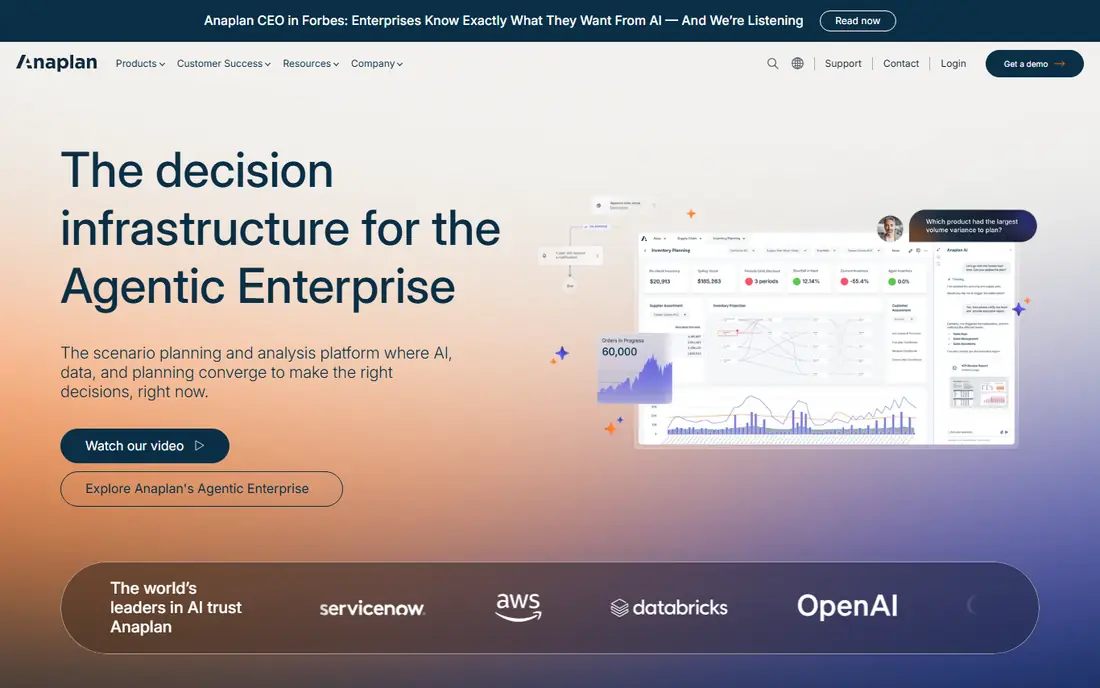
Anaplan is a connected planning platform that links finance, sales, supply chain and workforce plans in one model. Finance teams can run scenarios, test drivers and see effects across departments in real time, rather than passing spreadsheets between teams. That connected view is why large enterprises use Anaplan for sales forecasting, supply planning and financial planning together.
The cost is the main barrier. Pricing is quote based, with third-party estimates often starting around $20,000 per year for entry packages and rising with users and model size. Model design also needs training and, often, specialist help. If your planning problem is cross-departmental and scenario-heavy, Anaplan is a leading pick. If you only need budgeting and consolidation, a narrower tool may cost less.
- Flexible scenario modeling across finance, sales and supply chain
- Real-time connected planning
- Scales to large, complex models
- Pricing is quote based and annual costs are high
- Models need specialist design and training
Workday Adaptive Planning, formerly Adaptive Insights, is Workday's planning tool for budgeting, forecasting, workforce planning and scenario analysis. Finance teams can build driver-based models, run what-if scenarios and report against actuals without rebuilding spreadsheets each cycle. Integration with Workday HCM and Financials keeps headcount and cost data linked to plans.
Pricing is quote based, with third-party listings often showing around $3,000 per month as a starting point for some packages, so confirm your quote. The value case is strongest for Workday customers. Non-Workday companies should compare it with Anaplan, Planful and Board on model flexibility and total cost.
- Strong budgeting, forecasting and scenario planning
- Works with Workday HCM and Financials
- Driver-based planning for finance teams
- Pricing is quote based
- Best value inside Workday stack
Board combines enterprise performance management with business intelligence in one platform. Finance teams can plan, budget, forecast, consolidate and report, while also building dashboards and analytics on the same data. That unity reduces the need to move data between a planning tool and a reporting tool.
Pricing is quote based, so budget planning needs a Board quote tied to users and modules. Implementation also needs care, since flexible modeling can grow complex without governance. For a company that wants planning and analytics together, Board is a strong alternative to Oracle and Anaplan. Test its consolidation and reporting on your real close process before deciding.
- Planning, budgeting, forecasting and analytics in one platform
- Flexible model design
- Strong for financial consolidation and reporting
- Pricing is quote based
- Implementation needs planning expertise
OneStream is a unified corporate performance management platform that covers financial consolidation, planning, budgeting, forecasting, close and reporting in one system. Its strength is replacing several point tools with one platform, which helps finance teams keep one version of the truth for actuals and plans. Consolidation controls, intercompany handling and audit trails suit large, complex groups.
Pricing is quote based, and implementation is a significant project that needs finance and IT time. Smaller companies may find OneStream more than they need. For a large enterprise that wants one CPM platform instead of a patchwork, OneStream is a leading choice to compare with Oracle EPM and Board.
- One platform for planning, consolidation, close and reporting
- Strong financial consolidation controls
- Extensible for finance and operations
- Pricing is quote based
- Implementation is a significant project
Planful, formerly Host Analytics, offers planning, budgeting, forecasting, consolidation, close and reporting for mid-market and enterprise finance teams. It is known for faster implementation than the largest suites, which helps a finance team moving from spreadsheet planning to a controlled system. Reporting and dashboards help managers see plan versus actual without waiting for month-end packs.
Pricing is quote based, with third-party listings showing around $1,250 per month as a starting point for some packages, so confirm your quote. For very complex, cross-departmental connected planning, Anaplan may offer more flexibility. For a finance-led planning and close upgrade, Planful is a practical, focused choice.
- Budgeting, forecasting, consolidation and reporting
- Faster implementation than larger suites
- Good for finance teams moving from spreadsheets
- Pricing is quote based
- Less depth for very complex connected planning than Anaplan
Vena is built for finance teams that live in Excel and do not want to abandon it. It adds workflow, version control, data integration and reporting around Excel models, so planners keep a familiar interface while finance gains audit trails and a single source of actuals. Budgeting, forecasting and reporting workflows run inside that controlled Excel environment.
Pricing is quote based, and adoption depends on good model governance. If Excel models are already messy, Vena will not fix them on its own; finance must still design drivers and controls. For a team that wants to keep Excel but add control, Vena offers the smoothest transition in this list.
- Keeps Excel as the planning interface with controls
- Budgeting, forecasting and reporting workflows
- Easier adoption for Excel-heavy finance teams
- Pricing is quote based
- Excel dependence can limit model governance if not managed
SAP Analytics Cloud combines planning, budgeting, forecasting and business intelligence in one cloud tool. For SAP companies, it links planning to ERP and S/4HANA data, with dashboards and predictive features alongside planning models. The published starting price of $36 per user per month makes early budgeting easier than with quote-only tools, though higher tiers cost more.
The trade is stack fit. Non-SAP companies may find Board, Planful or Anaplan more flexible for their data sources. SAP companies gain from native integration and a single vendor for ERP, planning and analytics. Check which planning features sit in the base tier versus higher tiers before you compare prices.
- Planning and analytics in one SAP tool
- Published starting price at $36 per user per month
- Strong for SAP ERP and S/4HANA companies
- Higher tiers cost more
- Best value inside SAP stack
Jedox offers planning, budgeting, forecasting, reporting and analytics with both Excel and web interfaces. Finance teams can build driver-based models, consolidate data and share reports without giving up spreadsheet familiarity. Its flexibility suits companies with varied planning needs across finance, sales and operations.
Pricing is listed by third parties at $160 per month as a starting point, but vendor quotes vary by users and modules, so confirm the current rate. Jedox has a strong European base and growing global use, so check local support for your region. For a flexible, mid-priced planning tool, Jedox is worth a demo alongside Planful and Vena.
- Flexible planning, budgeting and reporting
- Excel and web interfaces
- Starting price at $160 per month in third-party listings
- Pricing varies by user and module
- Smaller US presence than Oracle or SAP
How we picked these
We checked official product pages, pricing pages and public documentation for enterprise performance management platforms live in October 2026. We kept tools that cover planning, budgeting, forecasting or consolidation for large organizations, not only simple budgeting apps. Where a vendor quotes rather than publishes a price, we wrote See website.
What to check before you buy
Start with your close and planning calendar. List your entities, currencies, intercompany rules, budget cycles and reporting deadlines. Give that list to each vendor and ask for a worked example on your chart of accounts. A demo on generic data will not show whether consolidation, allocations or driver models work for your business.
Test scenario and reporting depth next. Change a key driver, such as headcount or price, and see how fast the plan updates across departments. Check how reports are built, who can change a model and how changes are audited. Poor governance turns a powerful planning tool into a new spreadsheet mess.
Finally, price the full project. Include licenses, implementation, training, integration and ongoing model support. Ask about user tiers, since planners, contributors and viewers often cost different amounts. EPM value comes from faster, more reliable planning and close, so measure the demo against those outcomes, not only feature counts.
Frequently asked questions
What is enterprise performance management software?
Enterprise performance management software helps large companies plan, budget, forecast, consolidate results and report performance in one system. It replaces disconnected spreadsheets with controlled models, workflows and audit trails. Common uses include annual budgeting, rolling forecasts, financial consolidation and management reporting.
What is the best enterprise performance management software?
Oracle Fusion Cloud EPM leads for financial consolidation and close, while Anaplan leads for connected planning across departments. OneStream and Board suit unified CPM platforms, and Vena suits Excel-native finance teams. The best pick depends on whether consolidation, connected planning or spreadsheet adoption matters most.
How much does enterprise performance management software cost?
Prices vary widely. Oracle EPM Standard starts at $250 per user per month, SAP Analytics Cloud starts at $36 per user per month, and most other platforms are quote based with annual costs. Total cost includes implementation and specialist help, so get a written quote tied to users, modules and entities.
Is Anaplan better than Oracle EPM?
Anaplan is often better for flexible, connected planning across finance, sales and supply chain, with strong scenario modeling. Oracle EPM is often better for financial consolidation, close management and reporting inside an Oracle finance stack. Many large companies choose based on whether planning flexibility or close control is the bigger need.
Can EPM software replace Excel?
It can replace uncontrolled spreadsheet planning with governed models, but tools such as Vena and Jedox keep Excel as an interface. The goal is not to ban spreadsheets, but to add version control, data integration, workflows and audit trails. Finance teams should still design drivers and controls carefully.
What is the difference between EPM and FP&A software?
The terms overlap. FP&A software usually focuses on financial planning and analysis, while EPM is broader, covering planning, consolidation, close and performance reporting for the whole enterprise. Many vendors in this list sell both, so check which modules are included in your quote.
Sources
See where you really rank - block by block
ProMapRanker scans Google Maps across a grid of your service area. Simple monthly plans from $19, white-label on every plan.
Start freeKeep reading
 zscaler alternatives
Best Zscaler Alternatives in 2026
Looking for zscaler alternatives? We compare 9 SASE and zero trust platforms on architecture, data protection, pricing, and fit for your network and team.
Read → zapier alternatives free
Best Zapier Alternatives Free in 2026
Nine automation tools for zapier alternatives free in 2026, all with genuinely free tiers, plus free plan limits, starting prices and upgrade paths explained.
Read → which platform is best for online reputation
Which Platform Is Best for Online Reputation in 2026
Wondering which platform is best for online reputation? We compare 8 review, listing, and response tools for small and multi-location businesses and agencies.
Read →