 ProMapRanker
Best Enterprise Cloud Service Comparison in 2026

Key takeaways
- AWS has the widest service catalogue and partner network, which suits teams that want the most choice and the deepest ecosystem.
- Azure is the strongest fit for organisations already running Microsoft 365, Windows, and Active Directory, with strong hybrid cloud tools.
- Google Cloud suits data, analytics, and AI-heavy work, with competitive pricing on sustained workloads.
- Oracle Cloud suits Oracle database and ERP workloads, with low network egress costs in many cases.
- There is no cheapest cloud in general: compare the same workload, including compute, storage, network, and support, before you commit.
Quick comparison
| Pick | Great for | Pricing starts at | Free tier | |
|---|---|---|---|---|
 Amazon Web Services | Widest service choice | See website | Free trial | Visit |
 Microsoft Azure | Microsoft shops | See website | Free trial | Visit |
 Google Cloud | Data and AI workloads | See website | Free trial | Visit |
 IBM Cloud | Regulated industries | See website | Free trial | Visit |
 Oracle Cloud Infrastructure | Oracle workloads | See website | Yes | Visit |
 Alibaba Cloud | China and APAC operations | See website | Free trial | Visit |
 OVHcloud | European hosting | See website | No | Visit |
 DigitalOcean | Simpler cloud workloads | $4 per month | No | Visit |
The best enterprise cloud services compared
Enterprise cloud choice is rarely about one service. It is about regions, compliance, existing software, support, and the cost of the workload you actually run. We compared the major providers on those points, using their public pricing and service pages, and we note where pricing is usage-based and therefore cannot be reduced to a single monthly figure.
AWS is the market leader for a reason: it offers more than 200 services, from compute and storage to databases, analytics, machine learning, and serverless tools. That breadth means a team can usually find a managed service for a given job, rather than building it from scratch. Region coverage is wide, and the partner network is large, which helps with migration, training, and specialist help.
The downside is complexity. Pricing varies by service, region, instance type, and commitment, so a small misconfiguration can produce a large bill. Teams need cost controls, budgets, and tagging from the start. Support also costs extra beyond basic coverage. For a team that wants maximum choice and can manage cloud costs carefully, AWS remains the default comparison point.
- Largest service catalogue
- Wide region coverage
- Deep partner and training ecosystem
- Pricing is complex
- Costs can grow without controls
- Support tiers add cost
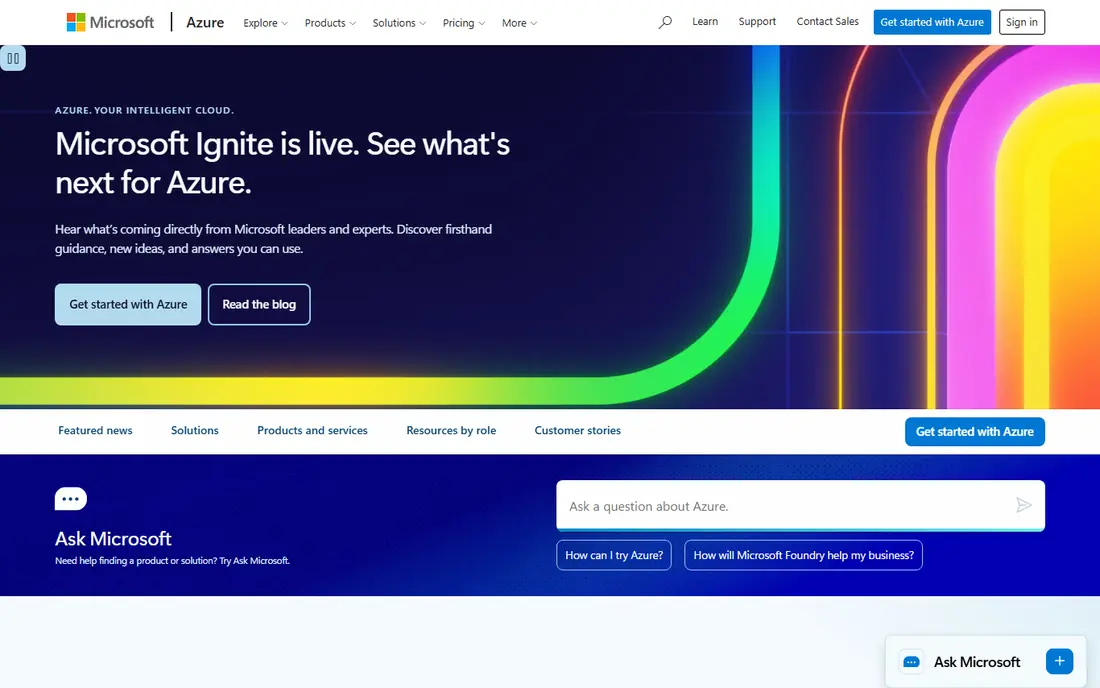
Azure is the natural cloud for organisations that already run Microsoft software. Identity, email, office apps, and Windows workloads connect to Azure with less friction than on a rival cloud, and hybrid tools such as Azure Arc help manage on-premises and cloud resources together. Azure OpenAI services also give Microsoft shops a direct route to large language models inside their existing agreements.
The limits are similar to AWS: pricing is usage-based and complex, and teams need budgets and alerts to avoid surprises. Some services are also designed first for Microsoft workloads, so a team running mainly open-source tools should compare service quality on its own stack. For a Microsoft-heavy enterprise, Azure is usually the strongest fit.
- Deep Microsoft 365 and Windows integration
- Strong hybrid tools
- Wide region coverage
- Pricing is complex
- Some services feel Windows-first
- Cost controls need care
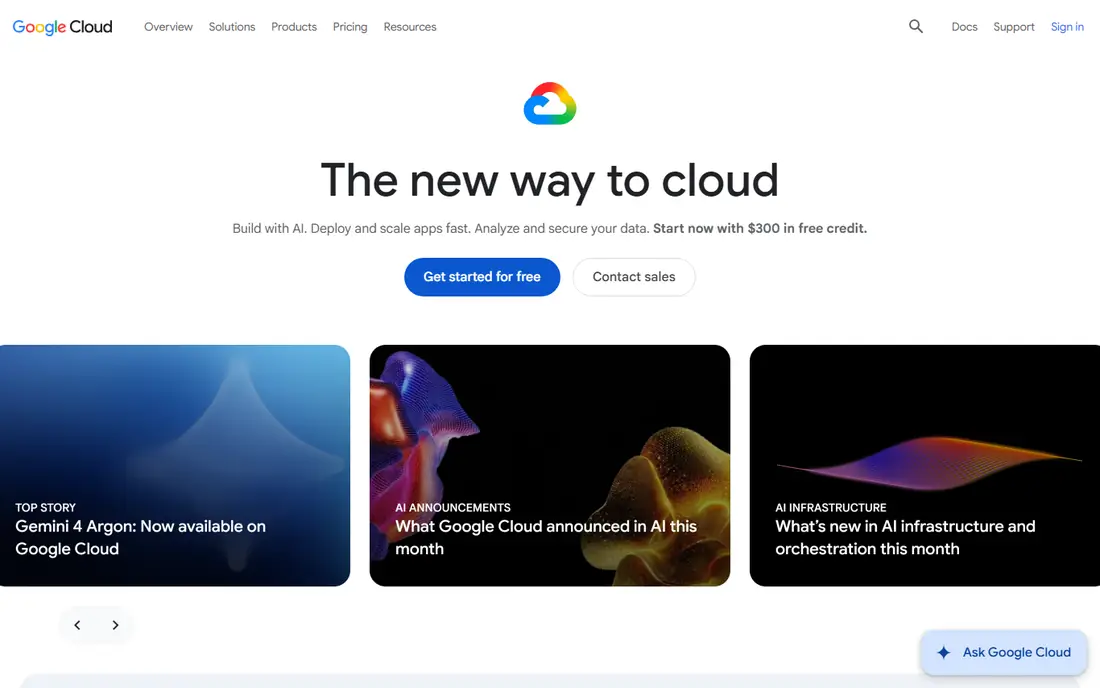
Google Cloud stands out for data and AI work. BigQuery, its data warehouse, and its Vertex AI platform are widely used for analytics and machine learning, and its container and Kubernetes tools reflect Google's long experience running large-scale systems. Sustained-use discounts can also make a long-running workload cheaper than the headline on-demand price, which matters for teams that run services around the clock.
The trade-off is enterprise breadth. Google Cloud has grown fast, but its partner and enterprise support network is still smaller than those of AWS and Azure in some regions and sectors. Network egress costs also need checking, because moving large amounts of data out of a cloud can be expensive. For data, analytics, and AI-led teams, Google Cloud is a strong first choice.
- Strong data and analytics tools
- Competitive sustained-use pricing
- Modern container tools
- Smaller enterprise partner network than AWS or Azure
- Some enterprise services are newer
- Egress costs need checking
IBM Cloud focuses on hybrid cloud and regulated industries such as banking, healthcare, and government. Its integration with Red Hat OpenShift lets teams run containers across on-premises systems and cloud regions with a consistent platform, which suits organisations that cannot move everything to the public cloud at once. Security and compliance controls are a central selling point, not an afterthought.
The limit is scale and breadth. IBM Cloud has fewer regions and fewer developer-facing services than AWS, Azure, or Google Cloud, and pricing is often set through enterprise agreements rather than simple public tiers. For a regulated enterprise with a hybrid strategy and IBM or Red Hat software already in place, IBM Cloud is worth serious consideration. For a cloud-native startup, a larger hyperscaler is usually simpler.
- Strong hybrid and regulated-industry focus
- Red Hat OpenShift integration
- Enterprise security controls
- Smaller public cloud footprint than leaders
- Fewer developer services
- Pricing is enterprise-led
Oracle Cloud Infrastructure, known as OCI, is the best fit for organisations running Oracle databases and Oracle ERP applications. Database performance is a central strength, and Oracle's multicloud partnerships also let customers run Oracle Database inside Azure and Google Cloud. Network egress is notably cheaper than on several rivals in many regions, with a large free monthly allowance, which matters for data-heavy workloads.
The downside is ecosystem size. OCI has fewer third-party integrations and a smaller partner network than AWS, Azure, or Google Cloud, so a team that relies on many marketplace tools should check availability. Its always-free tier, which includes small compute, storage, and database resources, is generous for testing. For Oracle-heavy enterprises, OCI can be both faster and cheaper than a general-purpose cloud.
- Strong Oracle database performance
- Low egress costs in many cases
- Generous always-free tier
- Smaller ecosystem than leaders
- Fewer third-party integrations
- Best value tied to Oracle software
Alibaba Cloud is the leading cloud provider in China and a major provider across Asia Pacific. For a company that needs to serve customers in China, or that runs operations across APAC, its regional data centres, local compliance support, and network performance in the region are hard to match from a Western hyperscaler. Its service range covers compute, storage, databases, AI, and content delivery.
Outside APAC, its presence and partner network are smaller, and data rules in China require careful legal advice. Teams should also check support coverage in their own time zones. Alibaba Cloud is not the default global choice, but for APAC-led operations it is often the practical choice, and many global companies run it alongside another cloud for that region.
- Strong China and APAC presence
- Wide service range
- Competitive regional pricing
- Smaller presence outside APAC
- Compliance and data rules need local advice
- Support varies by region
OVHcloud, based in Europe, appeals to organisations that want European hosting, data sovereignty, and predictable pricing. It offers public cloud, private cloud, and bare metal servers, so a team can mix dedicated hardware with cloud resources. Pricing is often clearer than hyperscaler pricing, and European data centres suit companies with strict data location requirements.
The limit is catalogue depth. OVHcloud offers fewer managed services, especially in AI and advanced analytics, than the large hyperscalers, so teams may need to run more software themselves. Support quality also varies by tier. For European teams that value data location, bare metal options, and simpler bills, OVHcloud is a credible alternative. For teams that need the widest managed service range, a hyperscaler remains stronger.
- European data centres and data sovereignty focus
- Bare metal and cloud options
- Transparent pricing
- Smaller service catalogue than hyperscalers
- Fewer managed AI services
- Support tiers vary
DigitalOcean is the simplest cloud in this list, and that simplicity is its appeal. Droplets, managed databases, and app platform services start at low monthly prices, pricing is easy to understand, and documentation is aimed at developers who want to deploy quickly. Small teams, agencies, and product teams with straightforward workloads often find DigitalOcean faster to use than a hyperscaler.
The trade-off is enterprise depth. DigitalOcean does not match the compliance, managed service, and global region range of AWS, Azure, or Google Cloud, and very large or heavily regulated workloads may outgrow it. It belongs in an enterprise comparison because many enterprises use it for smaller projects, development environments, and customer-facing apps that do not need hyperscaler complexity. For a simple, well-defined workload, it can also be far cheaper.
- Simple pricing
- Fast setup
- Good documentation for developers
- Not a full enterprise hyperscaler
- Fewer compliance and managed services
- Scale limits for very large workloads
How we picked these
We compared official service and pricing pages for providers that operate at enterprise scale in October 2026, with weight given to region coverage, service breadth, compliance focus, and hybrid cloud capability. We did not claim hands-on testing, and where pricing is usage-based we wrote See website rather than inventing a single monthly figure. Providers that had closed, that served only a single niche without enterprise relevance, or that lacked current public pricing information were left out.
How to compare clouds on the same workload
Pick one real workload and price it on each cloud: the same compute size, storage amount, database type, and monthly data transfer, in the same region, with the same support tier. Include commitment discounts only if you are willing to commit for one or three years, and include data egress, backups, and monitoring, which are often left out of headline comparisons. A cloud that looks cheap on compute can be expensive on network or storage, and the reverse is also true.
Check non-price factors with the same care. Confirm region and data residency options, compliance certifications for your sector, hybrid and migration tools, and the quality of support in your time zone. Run a pilot with a non-critical workload, measure performance and cost for a full month, and test the migration path back out. A cloud that is hard to leave is a long-term commitment, not just a monthly bill.
When to use more than one cloud
Multicloud makes sense when different workloads have different best fits, such as Oracle databases on OCI, Microsoft workloads on Azure, and analytics on Google Cloud. It also helps with regional needs, such as Alibaba Cloud in China. The cost is complexity: more skills, more security controls, and more billing to manage. For most teams, one primary cloud plus a second cloud for a specific region or workload is more manageable than spreading every service across three clouds.
Frequently asked questions
Which enterprise cloud is cheapest?
There is no single cheapest cloud. The answer depends on your workload, region, commitment length, and data transfer. Price the same workload on each provider, including compute, storage, network, and support, before you decide.
Should a Microsoft-heavy company choose Azure?
In most cases, yes. Azure integrates closely with Microsoft 365, Windows, and Active Directory, and its hybrid tools suit organisations that keep some systems on premises. Check service quality for any non-Microsoft workloads before committing fully.
Is Google Cloud good for AI?
Yes. Google Cloud has strong data, analytics, and AI platforms, including Vertex AI and BigQuery, and competitive pricing for sustained workloads. It is a strong choice for data-led and AI-led teams.
What is the advantage of Oracle Cloud?
Oracle Cloud performs well for Oracle databases and ERP workloads, and its network egress costs are low in many cases. Its always-free tier is also generous for testing and small projects.
Do I need a multicloud strategy?
Not necessarily. A single primary cloud is simpler to secure and manage. Add a second cloud only for a clear reason, such as a regional requirement, a specific workload fit, or a compliance need.
How do cloud free tiers work?
Most hyperscalers offer a trial credit plus some always-free resources, with limits on size, region, and time. Read the terms carefully, set billing alerts, and check what happens when the trial ends, because charges can start without a further warning.
Sources
See where you really rank - block by block
ProMapRanker scans Google Maps across a grid of your service area. Simple monthly plans from $19, white-label on every plan.
Start freeKeep reading
 zoro.to alternatives
Best Zoro.to Alternatives in 2026
We compare the best zoro.to alternatives in 2026, listing only legal licensed anime streaming services, from Crunchyroll to free options for fans today.
Read → zip alternatives
Best Zip Alternatives in 2026
We compare the best zip alternatives for buy now, pay later in 2026, covering pay-in-4 plans, fees, spending limits, and credit reporting options today.
Read → yesware alternatives
Best Yesware Alternatives in 2026
Compare the best yesware alternatives for sales email tracking, templates, and sequences, with current pricing and honest tradeoffs for small sales teams.
Read →