 ProMapRanker
Best Enterprise AI Search Software in 2026


Permission-aware workplace search at scale · Pricing starts at: See website
Key takeaways
- Glean and Moveworks suit workplace knowledge search across many apps, while Coveo and Algolia suit customer-facing and product search at scale.
- Permission-aware retrieval is the most important safety feature, since search must never surface documents a user cannot already access.
- Elastic and Lucidworks offer the most customization, but they need engineering time that managed tools such as Glean and Guru avoid.
- Most enterprise vendors price by quote, so pilot cost, connector coverage, and deployment time matter more than a headline price.
- Run a pilot with real documents, real permissions, and real user questions before signing an enterprise contract.
Quick comparison
| Pick | Great for | Pricing starts at | Free tier | |
|---|---|---|---|---|
| Glean | Permission-aware workplace search at scale | See website | No | Visit |
 Coveo | Relevance tuning for portals and commerce | See website | No | Visit |
 Elastic | Custom search apps with vector retrieval | $99 per month | Free trial | Visit |
 Algolia | Fast API-first product and site search | Free | Yes | Visit |
 Lucidworks | Complex search programs with pipeline control | See website | No | Visit |
 Sinequa | Governed search for regulated industries | See website | No | Visit |
 Guru | Verified internal knowledge with AI answers | See website | Free trial | Visit |
 Moveworks | Conversational search with action workflows | See website | No | Visit |
The best enterprise AI search software
These eight platforms help employees and customers find answers across documents, apps, and sites using AI. We compared connector coverage, permission handling, relevance tools, and deployment effort.
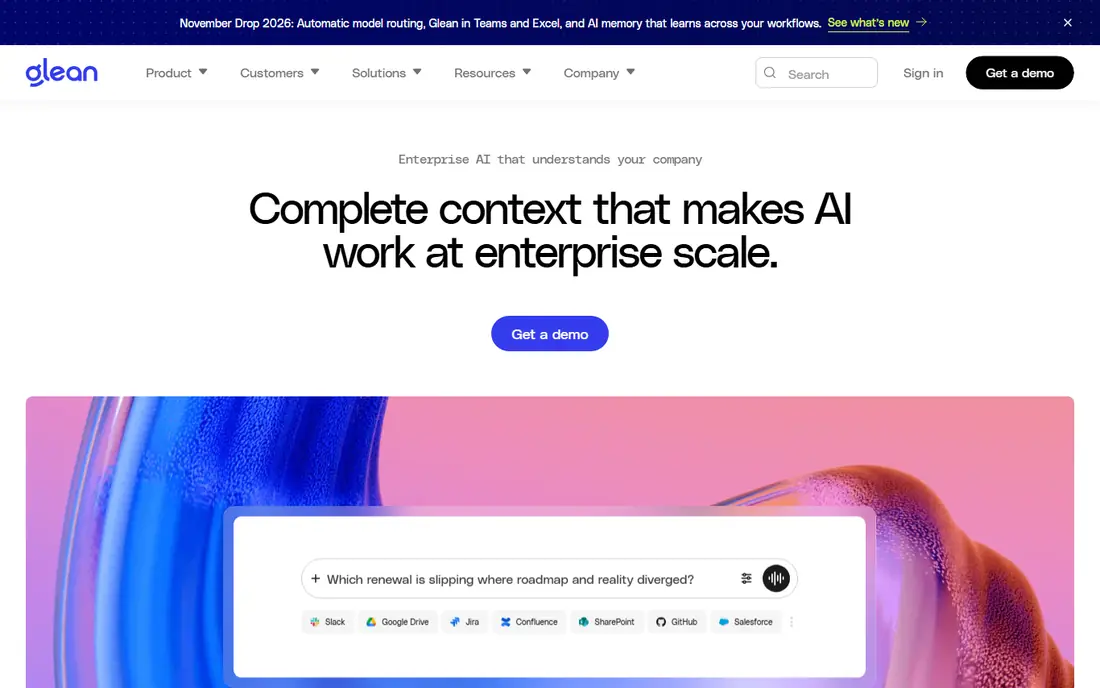
Glean is the most common shortlist pick for workplace AI search. It indexes content from tools such as Google Drive, Slack, Confluence, and Salesforce, then returns permission-aware answers with citations to source documents. Employees can ask a question in plain language and reach the right internal page without hunting through many apps.
The trade-offs are cost and rollout time. Glean does not publish pricing, and larger deployments can take weeks to configure, test permissions, and tune relevance. Smaller companies may find the minimum scope too large. For a mid-size or large company with scattered knowledge, Glean offers the broadest managed workplace search in this group.
- Broad connectors across work apps
- Permission-aware results
- Knowledge graph and AI answers
- Quote-based pricing
- Deployment can take weeks for large estates
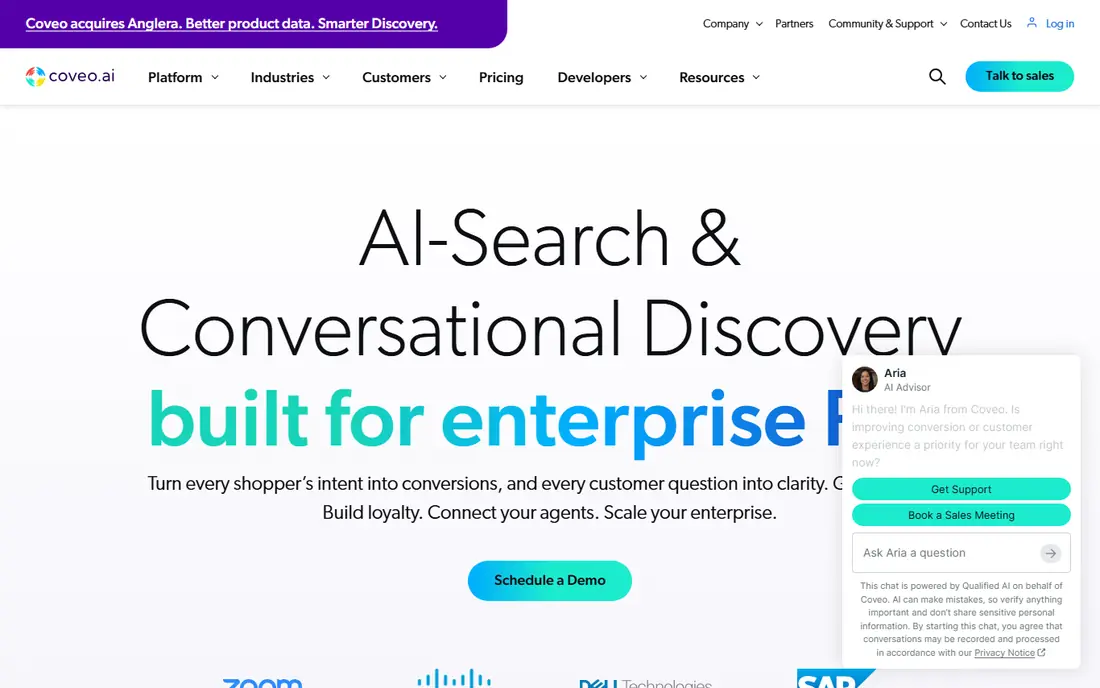
Coveo suits organizations that treat search as a measurable experience, not just a box on a page. Its relevance models, personalization, and analytics show which queries succeed, which fail, and where content gaps hurt customers or employees. That data helps product and support teams improve search over time rather than guessing.
Coveo pricing is custom, shaped by content volume, connectors, and AI usage, so buyers should request a full quote early. It also works best when a team owns relevance tuning, since out-of-the-box results improve with feedback. For customer portals, support sites, and commerce search at scale, Coveo is a strong enterprise choice.
- Strong relevance models and personalization
- Search analytics showing failed queries
- Works for portals, service, and commerce
- Quote-based pricing
- Best value needs a team to tune relevance
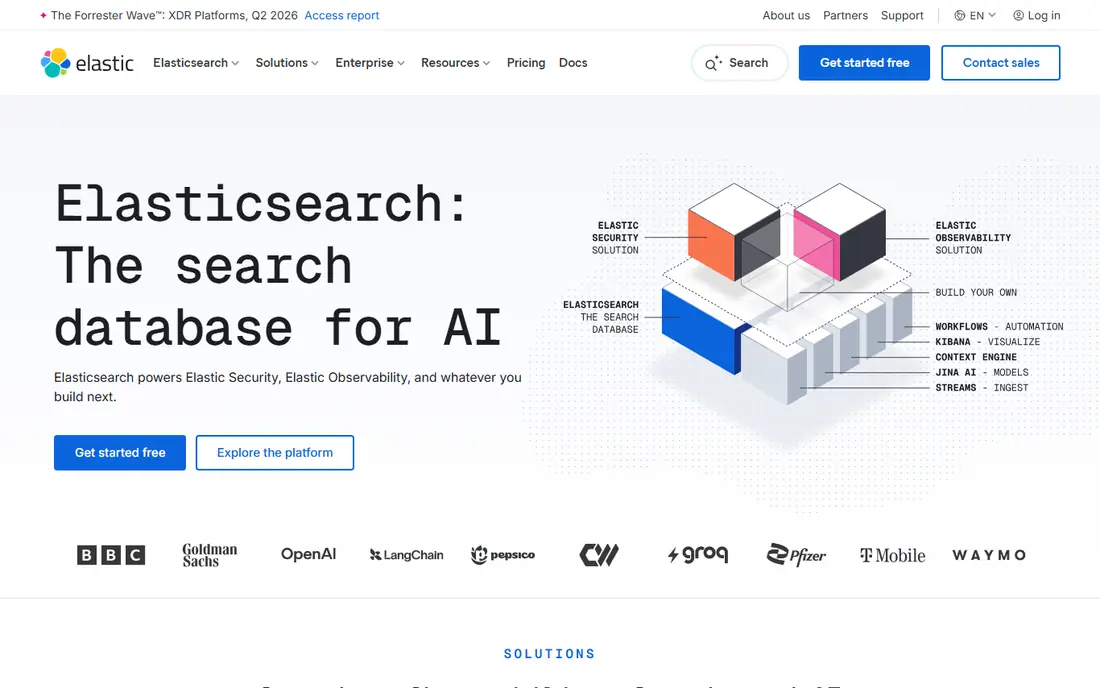
Elastic, built on Elasticsearch, suits engineering teams that want to build their own search experience. It supports hybrid retrieval, combining keyword and vector search, plus APIs for custom ranking, filtering, and analytics. Teams can run it in the cloud or self-manage it, which helps regulated firms with strict hosting needs.
The cost is engineering time. Elastic is infrastructure, not a finished workplace search product, so teams must build connectors, permission handling, and user interfaces themselves or buy managed layers on top. Cloud pricing starts from $99 per month in recent listings, but real enterprise use costs far more. For teams with search engineers, that control is worth it.
- Flexible search infrastructure
- Hybrid keyword and vector retrieval
- Self-managed or cloud deployment
- Needs engineering effort
- Managed enterprise features add cost and complexity
Algolia is the developer favorite for customer-facing search. Its API-first design delivers fast results for product catalogs, help centers, and websites, with ranking rules, analytics, and A/B testing built in. A free tier covering 10,000 search requests per month lets small teams start without a contract.
Algolia is less of a turnkey workplace search tool than Glean or Moveworks. Permission-aware internal search across many SaaS apps needs custom architecture, and usage-based pricing can climb quickly on high-traffic sites. For product and site search where speed and developer control matter most, Algolia remains a top pick.
- Very fast search with a free tier
- Excellent developer docs and SDKs
- Strong analytics and A/B testing
- Usage-based costs rise with traffic
- Workplace permission handling needs custom work
Lucidworks suits organizations with mature search teams that want control over every stage of the search pipeline, from ingestion and enrichment to ranking and personalization. Its Fusion platform supports complex data sources and relevance tuning that simpler managed tools cannot match. That depth helps large firms with unusual content types or strict ranking needs.
The drawback is effort. Lucidworks pricing is custom, and deployments often need specialist skills and professional services, with timelines measured in weeks or months. Smaller teams without search engineers will find managed rivals faster to launch. For a complex, high-stakes search program, Lucidworks offers control that few rivals match.
- Detailed pipeline control for relevance tuning
- Flexible deployment
- Strong for ML-heavy search teams
- Quote-based pricing
- Setup needs specialist skills and professional services
Sinequa focuses on governed enterprise AI search, with an emphasis on security, permissions, and accurate grounding in company documents. Its multi-method retrieval combines keyword, semantic, and vector approaches, which helps with technical documents, contracts, and research material. Regulated industries value its audit and governance controls.
Sinequa pricing is custom, and its deployment scope fits larger firms better than small teams. A pilot should test retrieval quality on your own document types, not just demo content, since technical material stresses search harder than marketing pages. For a large firm that needs governed, accurate answers, Sinequa is a serious contender.
- Multi-method retrieval with secure grounding
- Broad connectors
- Strong governance and security controls
- Quote-based pricing
- Deployment scope suits larger firms better than small teams
Guru takes a knowledge-first approach. Teams create verified knowledge cards with owners and review dates, so AI answers draw on trusted, current content rather than stale documents. That verification loop helps support and operations teams that answer the same questions repeatedly. Connectors and browser tools bring answers into daily workflows.
The catch is governance effort. Guru works best when owners actually review and update cards, and neglected content can still mislead. Enterprise pricing is sales-led, so small teams should confirm self-serve terms during a trial. For companies that want a curated knowledge base behind AI search, Guru is a strong and practical pick.
- Verified knowledge cards with ownership and freshness checks
- Many connectors
- AI answers with citations
- Best value needs content governance habits
- Enterprise pricing is sales-led
Moveworks combines enterprise search with conversational AI that can act, not just answer. Employees ask a question in chat tools such as Slack or Teams, receive a cited answer, and can trigger workflows such as password resets or access requests. That search-to-action design helps IT and operations teams cut ticket volume.
Moveworks pricing is custom and headcount-based, so buyers should scope connector coverage and workflow needs early. Its value grows with the number of systems connected, so a narrow pilot may understate its benefit. For large firms that want search plus automation in one platform, Moveworks is a compelling choice.
- Conversational search across systems
- Search-to-action workflows
- Strong permission and citation handling
- Quote-based pricing
- Best value needs broad system coverage
How we picked these
We compared official product pages and recent published comparisons for enterprise AI search tools active in October 2026. We favored tools with broad connectors, permission-aware retrieval, hybrid or semantic search, and AI answering with citations. We kept a mix of workplace search, customer search, and developer infrastructure, since those jobs differ sharply. Where pricing was quote-based, we wrote See website rather than repeating a third-party estimate as a published price.
How to run a pilot that actually proves value
Pick twenty real questions from support tickets, sales queries, and internal help channels, then test each finalist against them. Check whether answers cite the right source, whether permissions block restricted documents, and how fast results arrive. Measure time saved, ticket deflection, and user satisfaction, not just demo polish.
Questions to ask every vendor
Ask how permissions are enforced and how quickly permission changes propagate to search results. Confirm connector coverage for your exact apps, including whether connectors index content or query it live. Ask about data retention, model training on your data, audit logs, and exit terms for exporting indexed content. A vendor that cannot answer permission questions clearly should not handle internal search.
Frequently asked questions
What is the best AI tool for enterprise search?
Glean suits workplace knowledge search, Coveo suits customer portals and commerce, and Algolia suits fast product search. The best tool depends on whether users are employees or customers, and on how much engineering help you have. Pilot two finalists with real questions before deciding.
What are the best enterprise AI search tools for internal knowledge?
Glean, Moveworks, and Guru suit internal knowledge best, with permission-aware results and AI answers tied to company sources. Sinequa suits regulated firms that need strong governance. Test permission handling carefully, since a search tool must never reveal documents a user cannot access.
What is the top enterprise search AI software for developers?
Elastic and Algolia suit developer-led teams best, with APIs, hybrid retrieval, and ranking control. Lucidworks suits teams that want pipeline control at scale. Managed tools such as Glean suit teams that want a finished product without building search infrastructure.
How much does enterprise AI search software cost?
Most vendors price by quote, based on users, content volume, connectors, and AI usage. Algolia offers a free tier and usage-based paid plans, while Elastic cloud pricing starts from $99 per month in recent listings. Request a full quote for your scope, including implementation and support, before comparing tools.
What are the best enterprise AI search tool reviews based on?
Reviews in this category focus on relevance quality, connector breadth, permission handling, deployment time, and support. Look for reviewers in a similar industry and company size, since a tool that fits a tech scaleup may not fit a regulated enterprise. Use reviews to build pilot questions, then verify answers with your own data.
Sources
See where you really rank - block by block
ProMapRanker scans Google Maps across a grid of your service area. Simple monthly plans from $19, white-label on every plan.
Start freeKeep reading
 zoho inventory alternatives
6 Alternatives to Zoho Inventory, Compared on Price and Fit
Zoho Inventory alternatives: 6 tools compared on price, free plans and fit. Katana leads the list for manufacturers. Fit and flaws are laid out for each entry.
Read → zoho crm alternatives
Best Zoho CRM Alternatives (2026)
Need Zoho CRM alternatives? We compare 7 tools on cost, free access and who each suits. Every pick gets a straight assessment. Built for quick decisions.
Read → zelle alternatives
Best Zelle Alternatives in 2026
Compare the best Zelle alternatives for sending money to friends, paying sellers and moving funds abroad, with honest notes on fees, speed and safety in 2026.
Read →