 ProMapRanker
Best Enterprise AI Platforms in 2026


Azure-based enterprises · Pricing starts at: See website
Key takeaways
- Microsoft Azure AI Foundry, Google Cloud Vertex AI, and Amazon Bedrock lead for companies already committed to one cloud.
- IBM watsonx.ai and Databricks suit enterprises that need strong governance, data control, or model training at scale.
- Palantir AIP suits organizations that need AI grounded in operational data with human oversight and audit trails.
- DataRobot and Snowflake Cortex AI suit teams that want AI closer to existing analytics, models, or data warehouses.
- All eight platforms are usage-based or quote-based, so budget by tokens, compute, and data processed, not by seats.
Quick comparison
| Pick | Great for | Pricing starts at | Free tier | |
|---|---|---|---|---|
| Microsoft Azure AI Foundry | Azure-based enterprises | See website | No | Visit |
 Google Cloud Vertex AI | Google Cloud teams | See website | No | Visit |
 Amazon Bedrock | AWS teams and model choice | See website | No | Visit |
 IBM watsonx.ai | Governed enterprise AI | See website | No | Visit |
 Databricks | Data and model teams | See website | No | Visit |
 Palantir AIP | Operational AI with oversight | See website | No | Visit |
 DataRobot | Governed model delivery | See website | Free trial | Visit |
 Snowflake Cortex AI | AI inside Snowflake data | See website | No | Visit |
The best enterprise AI platforms
These eight platforms all serve large organizations, but they start from different places: cloud, data, models, or operations. Match the platform to where your data already lives.
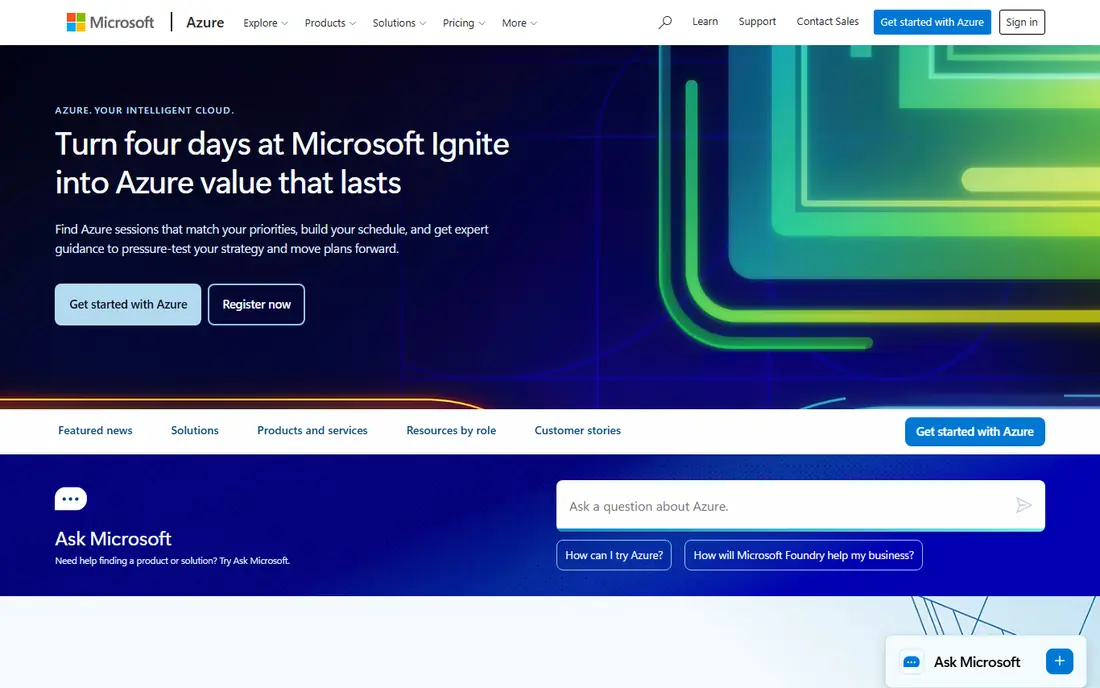
Azure AI Foundry, formerly Azure AI Studio, is Microsoft's platform for building AI apps and agents on Azure. There is no portal licence cost: you pay for the underlying Azure services, model tokens, compute, search, and storage you use. Reported token examples include GPT-4o at 2.50 dollars input and 10.00 dollars output per 1 million tokens, with smaller models far cheaper, and hosted agents billed by compute hour. The model catalog covers OpenAI models plus DeepSeek, Grok, Llama, Mistral, and others.
The strength here is breadth plus enterprise controls: grounding tools, identity, content safety, and evaluation sit alongside deployment options that include local and sovereign setups. The catch is billing complexity, since a single app can draw on several metered services at once. For a company already standardized on Azure and Microsoft 365, Foundry is the natural first choice, and our pick for most Azure shops.
- Wide model catalog
- Strong governance and grounding tools
- On-premises and sovereign options reported
- No portal licence cost means bills come from many underlying services
- Token and compute pricing needs care
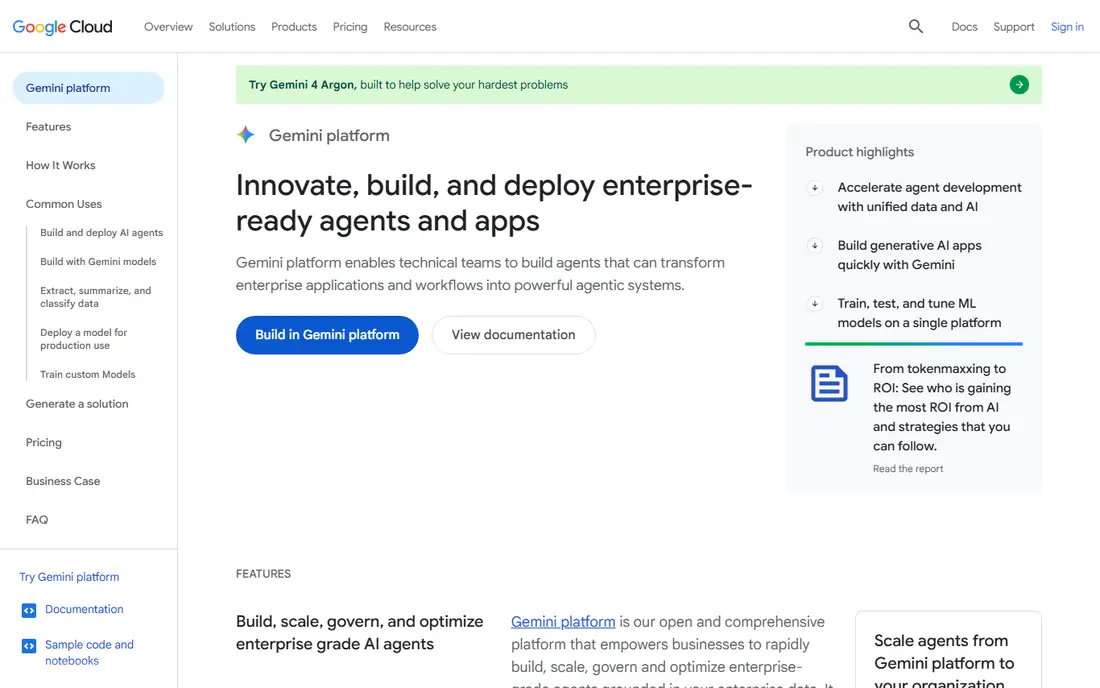
Vertex AI is Google Cloud's platform for building, training, and running machine learning and generative AI, and it is priced pay-as-you-go across training compute, prediction, pipelines, and feature storage. Reported Gemini rates include Gemini 2.5 Pro at 1.25 dollars input and 10.00 dollars output per 1 million tokens, with newer Gemini 3 models priced higher and a lighter Flash tier priced lower. Committed-use discounts of 20 to 40 percent are reported for steady workloads, and Google Cloud trial credits are a route to testing, though Vertex AI itself is not a free product.
The platform suits teams that want one place for custom model training, managed prediction, and agent building, with BigQuery and Google Workspace nearby. The trade-off is the same as with Azure: costs spread across services, and model pricing moves when new models launch, so a rate quoted in one quarter may not hold in the next. For Google Cloud enterprises, especially those using Gemini, Vertex AI is the obvious foundation.
- Strong Gemini models
- Training, prediction, and agent tools in one place
- Committed-use discounts reported
- Pricing spans many services
- Model rates change with new releases
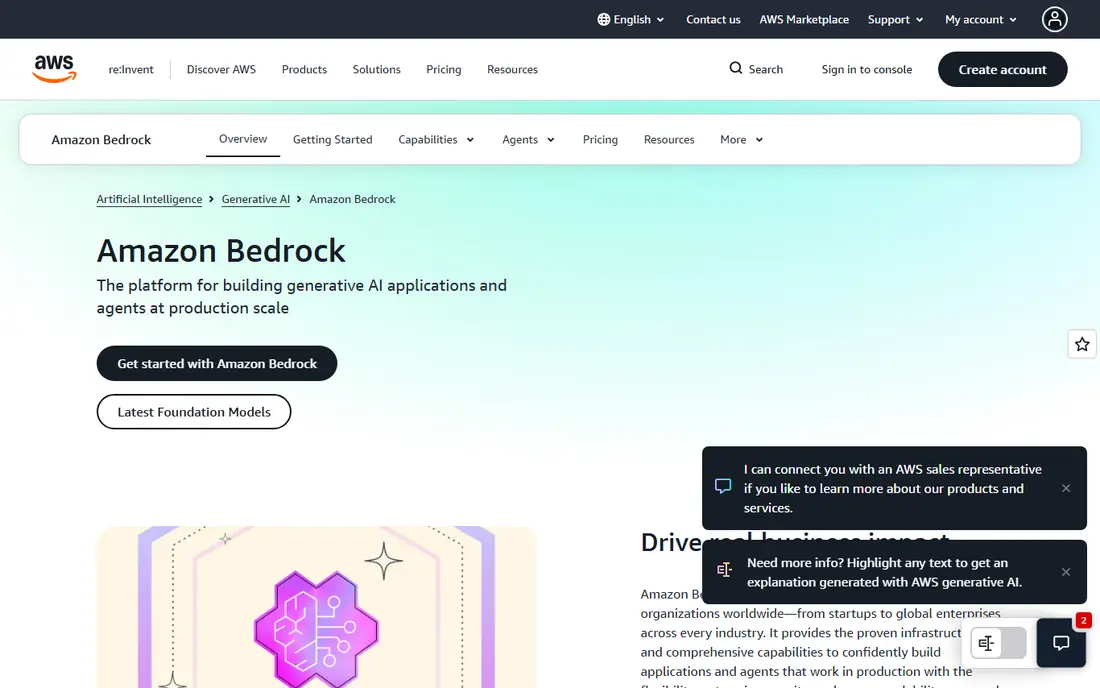
Amazon Bedrock gives AWS customers managed access to foundation models from Amazon, Anthropic, and other providers through one API, without running the models themselves. Pricing is pay-as-you-go per token, with a wide reported range: from Amazon Nova Micro at a few cents per 1 million input tokens to large frontier models at 10 dollars input and 50 dollars output per 1 million tokens. Batch processing is reported at a 50 percent discount, and provisioned throughput with a 1-month or 6-month commitment is reported at 20 to 40 percent off at scale.
Bedrock also covers knowledge bases, guardrails, embeddings, and agents, but those pieces bill separately, and agent token use can multiply the base model cost. There is no ongoing free monthly token allowance, though new AWS accounts have been reported to receive credits with an expiry window. For AWS enterprises that want model choice without managing infrastructure, Bedrock is a strong, flexible pick.
- Many model providers in one API
- Pay per token with no seats
- Batch and provisioned options
- No ongoing free token allowance
- Agent and knowledge base costs add up
IBM watsonx.ai is an enterprise AI studio for working with foundation models, tuning, retrieval-augmented generation, and governance, on IBM Cloud and other clouds. It targets regulated and large enterprises that need control over models, data, and deployment, with governance tools that track models and their use. No reliable flat price for watsonx.ai itself was found in current sources, so we list the starting price as See website.
One warning matters here: pricing reported for watsonx Orchestrate, a separate automation product, should not be used as the watsonx.ai price. The honest catch for buyers is that watsonx.ai is sold through enterprise conversations, which makes quick price comparison hard. For a bank, insurer, or large enterprise that puts governance first and already works with IBM, it belongs on the shortlist.
- Enterprise AI studio with tuning and RAG
- Governance focus
- Runs across clouds
- No reliable flat price published
- Do not confuse it with watsonx Orchestrate pricing
Databricks pairs a data platform with Mosaic AI, which covers model training, MLflow tracking, model registry, serving, fine-tuning, a gateway, and guardrails. Pricing is based on Databricks Units, or DBUs, plus the underlying cloud VM cost, except for serverless bundles. Reported approximate rates include Jobs Compute from 0.15 dollars per DBU on Standard, with higher rates for Premium and for all-purpose and SQL compute, and foundation model serving from around 0.07 dollars per DBU in one source.
Premium adds Unity Catalog governance, while Enterprise adds compliance and security features, so the tier choice matters for regulated teams. A usage-based Genie offer with a small free allowance per user per month has been reported for enterprise users, but that does not make the platform itself free. For teams whose AI work starts from large governed datasets, Databricks is often the most practical foundation.
- Data, training, and serving in one platform
- Mosaic AI covers the full model lifecycle
- Strong governance on higher tiers
- DBU pricing plus cloud VM cost is hard to forecast
- Premium features sit on higher tiers
Palantir AIP, or Artificial Intelligence Platform, builds on the Foundry Ontology to let AI work with operational data, take actions through an Action Graph, and stay under human oversight with audit controls. It suits defense, manufacturing, healthcare, and other operations-heavy organizations where an AI answer must connect to real systems and real decisions, not just generate text. Pricing is enterprise contract only, with no published AIP price, so we list the starting price as See website.
A pilot route is reported, with a working use case built in days and often low or no cost for evaluation, while production pricing is negotiated later. That makes AIP hard to compare on price, and it rules the platform out for small teams or quick self-serve tests. For a large organization that needs AI tied to operations with a clear audit trail, AIP is a distinctive option that the cloud platforms do not directly match.
- AI grounded in operational data
- Human oversight and audit controls
- Ontology-based actions
- Enterprise contracts only
- No self-serve pricing or trial path for most buyers
DataRobot covers predictive AI, generative AI, and agentic AI in one platform, with governance, observability, and MLOps for models in production. It suits enterprises that run many models and need to track performance, drift, and compliance after deployment, not just during training. Pricing is not published and is sold through sales as a custom enterprise annual subscription based on compute, workers, and deployment scale, so we list the starting price as See website.
Third-party reports cite annual contracts typically starting in the tens of thousands of dollars, with one user report far higher, which shows why a single figure would mislead. A 30-day free trial with full platform access is advertised in current sources, which gives teams a real way to test before a sales conversation. For model-heavy enterprises that need governance across the model lifecycle, DataRobot is a credible shortlist pick.
- AutoML plus generative and agentic AI
- Governance and observability
- MLOps included
- No public pricing
- Third-party annual figures vary widely
Snowflake Cortex AI brings AI functions, agents, search, document parsing, and Snowflake Intelligence to data already stored in Snowflake, so teams avoid moving sensitive data to a separate platform. Since April 2026, these features bill in AI Credits, a separate billing currency reported at 2.00 dollars per AI Credit for global routing and 2.20 dollars for regional routing, flat across editions. Warehouse queries still bill in platform credits, so a Cortex workload has two meters to watch.
Model choice drives cost sharply: one reported example showed the same workload costing far more on a large model than on a smaller one, which means prompt and model selection are budget decisions, not just quality decisions. A trial credit offer for the Cortex Code CLI has been reported for individual signups, but the platform itself is not free. For Snowflake customers, Cortex AI is the most direct way to add AI to existing data and analytics.
- AI runs where the data already sits
- AI Credits billing
- Model choice drives cost control
- Separate AI Credit currency adds billing complexity
- Costs vary sharply by model choice
How we picked these
We compared official product pages, pricing pages, documentation, and public reviews for platforms that serve large enterprises with model access, data connections, governance, and deployment controls. We kept only platforms that exist and work in October 2026 and truly operate at enterprise scale, and we mixed cloud platforms, data platforms, and specialist vendors. Where pricing was quote-based or varied across sources, we wrote See website instead of publishing a figure that would mislead a buyer.
How to buy an enterprise AI platform
Do not start with a vendor demo. Start with your data, your cloud, and your governance needs, because those three facts narrow the field faster than any feature table.
Follow where your data already lives
If your data sits in Snowflake, Cortex AI avoids a move. If it sits in Databricks, Mosaic AI builds on the same governance. If your company runs on Azure, AWS, or Google Cloud, the matching AI platform reduces integration work and keeps security controls consistent. Switching clouds for an AI feature alone rarely pays off.
Budget by workload, not by seats
Enterprise AI bills by tokens, compute, storage, and data processed, so a seat-based budget will be wrong in the first month. Run a realistic pilot workload, measure tokens and compute per task, and test a smaller model against a larger one for the same job. Set spend alerts and model guardrails early, because agent workloads can multiply token use without warning.
Prove governance before you scale
Ask how the platform logs prompts, outputs, model versions, and human approvals, and who can see that audit trail. Test data residency, access controls, and deletion handling with your security team during the pilot, not after rollout. A platform that cannot show its work will fail review in a regulated enterprise, no matter how good its models look in a demo.
Frequently asked questions
What is the best enterprise AI platform?
The best enterprise AI platform depends on your cloud and data setup. Azure AI Foundry suits Azure companies, Vertex AI suits Google Cloud companies, and Bedrock suits AWS companies. Databricks and Snowflake Cortex AI suit data-heavy teams, while Palantir AIP suits operations-heavy organizations that need audit trails.
What is the best AI platform for enterprise use?
For general enterprise use, the cloud platforms lead because they combine model choice, security controls, and integration with existing cloud services. IBM watsonx.ai and DataRobot suit enterprises that put governance and model lifecycle management first. Shortlist two platforms, run the same pilot workload on both, and compare total cost and governance, not just model quality.
Which enterprise AI tools are best for large companies?
Large companies most often choose Azure AI Foundry, Vertex AI, Bedrock, Databricks, or Palantir AIP, depending on their cloud and data estate. IBM watsonx.ai, DataRobot, and Snowflake Cortex AI also serve large companies with specific governance, model, or data needs. The right pick follows your existing stack, not a generic ranking.
Are enterprise AI platforms priced per user?
Most enterprise AI platforms are not priced per user. They charge by tokens, compute, storage, or data processed, or by negotiated annual contract, with some offering committed-use or provisioned discounts. That usage model means a small pilot can be cheap while a company-wide agent rollout can grow fast, so budget by workload and set spend controls early.
What is the best AI software for enterprise data teams?
For enterprise data teams, Databricks and Snowflake Cortex AI stand out, because AI runs close to governed data rather than in a separate system. Databricks suits teams that train and serve models from large datasets, while Cortex AI suits Snowflake customers that want AI functions, search, and agents on existing tables. Both need careful cost control, since model choice changes the bill sharply.
Sources
See where you really rank - block by block
ProMapRanker scans Google Maps across a grid of your service area. Simple monthly plans from $19, white-label on every plan.
Start freeKeep reading
 outreach alternatives
Outreach Alternatives in 2026
Compare outreach alternatives for 2026, from Salesloft and Apollo to HubSpot and Lemlist, with pricing, channels, features, limits, and honest trade-offs.
Read → best web conference tools
Best Web Conference Tools in 2026
Compare the best web conference tools for meetings, webinars and team calls, with current pricing, free plans and honest limits for each option here today.
Read → best voice cloning tools
Best Voice Cloning Tools in 2026
Compare the best voice cloning tools in 2026, from ElevenLabs and Descript to Resemble and Cartesia, with consent rules, pricing, licenses, and limits.
Read →