 ProMapRanker
Best EMR Software for Mental Health in 2026


Solo and small therapy practices · Pricing starts at: $49 per clinician per month
Key takeaways
- SimplePractice and TherapyNotes lead for most therapy practices on notes, billing, and telehealth.
- TheraNest offers a lower-cost route for budget-conscious groups.
- Valant and ICANotes fit prescribers and psychiatric groups with deeper clinical needs.
- Sessions Health, Carepatron, and Jane App suit solo and allied health practices.
- Software alone does not make a practice HIPAA compliant; check agreements, access controls, and training.
Quick comparison
| Pick | Great for | Pricing starts at | Free tier | |
|---|---|---|---|---|
| SimplePractice | Solo and small therapy practices | $49 per clinician per month | Free trial | Visit |
 TherapyNotes | Documentation and billing depth | $69 per clinician per month | Free trial | Visit |
 TheraNest | Budget-conscious groups | $29 per therapist per month | Free trial | Visit |
 Valant | Psychiatric groups | See website | No | Visit |
 ICANotes | Behavioural health documentation | See website | Free trial | Visit |
 Sessions Health | Low-cost solo start | Free | Yes | Visit |
 Carepatron | Modern allied health setup | Free | Yes | Visit |
 Jane App | Allied health bookings | See website | Free trial | Visit |
 PIMSY | Behavioural health agencies | See website | No | Visit |
The best emr software for mental health
This is general information only, not medical advice. We compared these tools on mental health notes, treatment plans, telehealth, e-prescribing, billing, and client portals. Prices are starting points from recent listings; quoted tools need a sales quote.

SimplePractice is the most widely shortlisted EHR for solo therapists and small practices, and its clean interface is a major reason. Scheduling, documentation, billing, telehealth, and a client portal sit in one system, with a 30-day trial. Plans start at $49 per clinician per month for Starter in recent listings, rising through Plus and Essential tiers.
Add-ons raise the total: e-prescribing and the Note Taker AI tool are paid extras, and claims carry per-claim fees. Psychiatric depth is thinner than in prescriber-focused tools. For a therapy practice that wants a polished, all-in-one start, SimplePractice remains our first suggestion.
- Clean interface
- Scheduling, notes, billing, and telehealth in one place
- Client portal
- E-prescribing and AI notes are paid add-ons
- Costs rise with add-ons
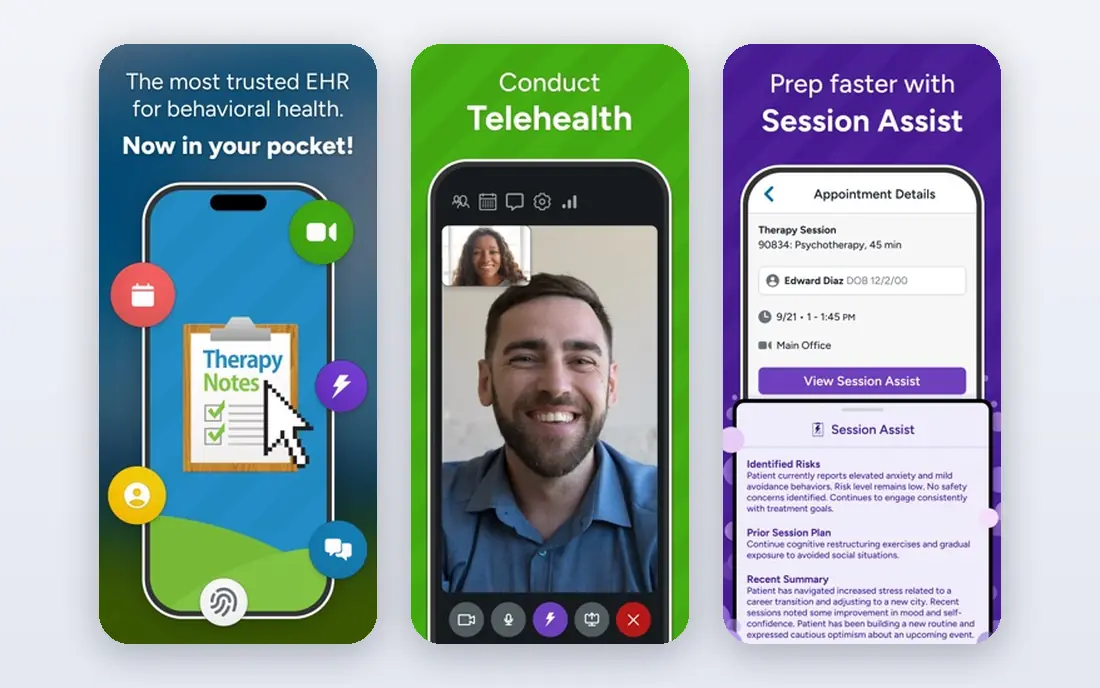
TherapyNotes suits practices that prioritise documentation quality and insurance billing. Its notes, templates, and to-do workflows help clinicians close charts on time, while electronic claims and billing tools handle insurance-heavy caseloads. Solo pricing starts at $69 per month in recent listings, with group pricing per added clinician.
Basic telehealth is free with limits, while premium telehealth and e-prescribing are paid add-ons, and claims carry a small per-claim fee. The interface is functional rather than flashy. If billing accuracy and note depth matter more than a modern look, TherapyNotes is a strong pick.
- Strong notes and templates
- Reliable billing
- US-based support
- Telehealth premium and e-prescribing are add-ons
- Interface feels utilitarian
TheraNest, now part of Ensora Mental Health, offers a lower-cost route for therapy groups, with Essentials starting at $29 per therapist per month in recent listings. It covers scheduling, client management, progress notes, billing, and reporting, with a 21-day trial on higher tiers. Groups that need to standardise across clinicians without a steep bill often start here.
Telehealth is an add-on on lower plans, and AI notes and Wiley planners are also paid extras. Prescriber depth is thinner than in Valant or ICANotes. For a budget-conscious group that needs core EHR work done well, TheraNest is good value.
- Low entry price
- Scheduling, notes, and billing
- Group-friendly plans
- Telehealth is an add-on on lower tiers
- Fewer prescriber tools
Valant is built for psychiatric and behavioural health groups, including intensive outpatient and partial hospitalisation programs. It combines documentation, medication management, group therapy workflows, scheduling, billing, and a patient engagement system with mobile access. That prescriber depth sets it apart from therapy-only tools.
Pricing is quote-only, so smaller practices should expect a sales process and a higher total than solo tools. There is generally no free trial. For a psychiatric group that needs medication and group workflows under one roof, Valant is worth a demo.
- Built for psychiatry and behavioural health
- Medication management
- Group therapy tools
- Quote-only pricing
- No free trial in most cases
ICANotes is purpose-built for behavioural health, with pre-configured documentation for therapy and psychiatry, including risk and assessment content. It supports e-prescribing, billing, lab connections, and clearinghouse workflows, with a 30-day trial. A prescribing plan around $213 per provider per month in recent listings includes e-prescribing, while lower plans start lower.
The breadth of features can feel overwhelming at first, so plan training time. Pricing varies by plan and prescriber needs. For a practice that wants deep behavioural health documentation without building templates from scratch, ICANotes is a leading choice.
- Pre-configured behavioural health notes
- E-prescribing and billing
- Lab and clearinghouse links
- Feature breadth can overwhelm new users
- Pricing varies by plan
Sessions Health offers a free tier and a Professional plan at $39 per practitioner per month in recent listings, making it one of the lowest-cost starts for solo therapists. It covers scheduling, notes, billing, telehealth as a paid add-on, and a client portal. Claims cost around $0.25 each, with lower rates at volume.
It is a smaller vendor with fewer advanced features than SimplePractice or TherapyNotes, so growing groups should check reporting and prescriber tools. For a solo therapist testing private practice, the free tier removes much of the risk of trying a new system.
- Free tier
- Low-cost Professional plan
- Simple notes and billing
- Smaller vendor
- Fewer advanced features than leaders
Carepatron is a modern practice platform for allied health and mental health clinicians, with scheduling, notes, telehealth, billing, and a client portal. A free tier suits solo users, with paid plans roughly $25 to $60 per user per month in recent listings. It even includes an AI scribe on its free plan in recent comparisons, which is unusual at this price.
Psychiatric prescribing depth and complex insurance billing are thinner than in specialist tools. The integration ecosystem is also smaller. For a solo or small therapy practice that wants a modern, low-cost start, Carepatron is an appealing option.
- Free tier for solo users
- Modern interface
- Telehealth and portal included
- Less depth for psychiatric prescribing
- Smaller integration ecosystem
Jane App serves allied health practices including psychologists and counsellors, with online booking, charting, scheduling, billing, and telehealth in a clean interface. Staff learn it quickly, and clients benefit from self-booking and reminders. It works well for practices where the calendar drives the day.
Complex insurance billing and prescriber workflows are less central than in US mental health EHRs, so test those pieces if they matter to you. Pricing varies by practitioner count. For a therapy practice with a strong booking focus, Jane App is a natural fit.
- Clean booking and charting
- Telehealth
- Client portal and reminders
- Mental health billing depth is thinner
- Pricing varies by practitioner
PIMSY is an EHR for mental health and substance use agencies, covering scheduling, documentation, billing, and reporting for multi-clinician organisations. It suits agencies that need structured workflows, group programs, and compliance reporting across sites. Its reporting tools help managers track caseloads and billing performance.
Pricing is quoted, and the interface is more business-focused than consumer-friendly solo tools. Solo therapists will likely prefer a simpler system. For an agency that needs behavioural health workflows at scale, PIMSY is a solid, specialised choice.
- Built for behavioural health agencies
- Scheduling, notes, and billing
- Reporting tools
- Quote-based pricing
- Interface is business-first
How we picked these
We reviewed vendor pricing pages and recent mental health EHR comparisons, keeping tools that are actively sold for therapy or behavioural health work. We favoured a mix of solo, group, and prescriber tools, and we left out general medical EHRs that lack mental health templates. Prices are shown only where recent listings support them; otherwise we used a quote-based starting point.
What to check before you buy
Ask to see a finished note, not a blank template, and time how long it takes to close a session note in a demo. Check how treatment plans, group notes, and outcome measures work for your caseload, since those details decide daily satisfaction. Confirm telehealth limits, e-prescribing costs, and claim fees, which often sit outside the headline price.
Also confirm privacy terms in writing. Ask for a business associate agreement, review who can access records, and plan how you export records if you leave. Remember that software alone does not make a practice HIPAA compliant; your access controls, device habits, and staff training matter just as much. A trial with real notes and billing will surface most problems early.
Frequently asked questions
What is the difference between an EMR and an EHR for mental health?
In practice, therapists use the terms for the same integrated systems. Strictly, an EHR is shared across providers, while an EMR stays inside one practice, but most products here cover both roles for a single practice.
Do I need e-prescribing in a therapy EHR?
Only if prescribers work in your practice. Therapy-only practices can skip it, while psychiatric groups should treat e-prescribing, medication management, and controlled substance support as core requirements.
Can I use telehealth inside these tools?
Yes, most include telehealth or offer it as an add-on. Check participant limits, video quality, and whether telehealth notes link directly to the client chart.
How do claims and billing work?
Most tools support electronic claims with per-claim fees, plus patient billing and payment collection. Confirm claim fees, clearinghouse links, and managed billing options before you commit.
Is my client data safe in these systems?
Reputable vendors use encryption, access controls, and business associate agreements. You still need strong passwords, role permissions, and staff training, and you should review data export terms before signing.
Sources
See where you really rank - block by block
ProMapRanker scans Google Maps across a grid of your service area. Simple monthly plans from $19, white-label on every plan.
Start freeKeep reading
 worlds best local seo company
8 Worlds Best Local SEO Companies for Map Pack Growth in 2026
Compare the worlds best local seo company options for Google Business Profile work, citations, reviews, and multi-location rankings and reporting in 2026.
Read → world's best web hosting company
World's Best Web Hosting Company in 2026
Searching for the world's best web hosting company? We compared 10 hosts on price, renewal rates, speed, and support to help you choose well today in 2026.
Read → who's got the best nanny tax services
Who's Got the Best Nanny Tax Services in 2026
We answer who's got the best nanny tax services, comparing full filing, back taxes, software, and pricing so families can handle nanny taxes correctly.
Read →