 ProMapRanker
Best Employee Assessment Tools

Key takeaways
- TestGorilla is the easiest starting point for skills-based hiring, with a broad test library and a free plan for small teams.
- Criteria and SHL suit teams that need validated cognitive and personality measures, with deeper science behind each score.
- HackerRank and Codility are the right specialists for engineering roles, where a general skills test is not deep enough.
- Mercer Mettl and HireVue fit high-volume and enterprise hiring, where proctoring, video, and scale matter most.
- No assessment should decide a hire alone, so keep a human review step and check each vendor for fairness and local hiring rules.
Quick comparison
| Pick | Great for | Pricing starts at | Free tier | |
|---|---|---|---|---|
 TestGorilla | Broad skills hiring | See website | Yes | Visit |
 Criteria | Cognitive and personality testing | See website | Free trial | Visit |
 SHL | Enterprise psychometrics | See website | No | Visit |
 HackerRank | Developer skills | See website | No | Visit |
 Codility | Engineering hiring | See website | No | Visit |
 Mercer Mettl | High-volume proctored hiring | See website | No | Visit |
 Vervoe | Job simulations | See website | Free trial | Visit |
 HireVue | Video interviews at scale | See website | No | Visit |
 eSkill | Custom hard-skills tests | See website | No | Visit |
The best employee assessment tools
Hiring on CVs alone leaves too much to chance, and a good assessment gives every candidate the same task under the same conditions. The tools below cover different kinds of evidence, from short skills tests to job simulations and structured video interviews. We compared test breadth, scoring clarity, anti-cheating controls, integrations, and pricing, so you can match the tool to the role rather than buying the biggest library and hoping it fits.

TestGorilla is the default shortlist pick for teams moving to skills-based hiring, because it covers so many roles in one place. The library spans cognitive ability, personality, language, and role-specific skills, and you can combine tests into a single link for every applicant. Candidates get a simple experience on any device, and hiring teams get ranked results without manual marking.
The free plan is genuinely useful for trying real assessments before paying, which is rare in this category. The limit shows up at the specialist end: for senior engineering work, pair TestGorilla with a coding specialist rather than expecting one library to cover everything. Check the current pricing page for credit and seat limits, since those details change by plan.
- Large test library
- Free plan for small teams
- ATS integrations and AI video options
- Less depth for senior technical roles
- Pricing varies by plan and candidate volume
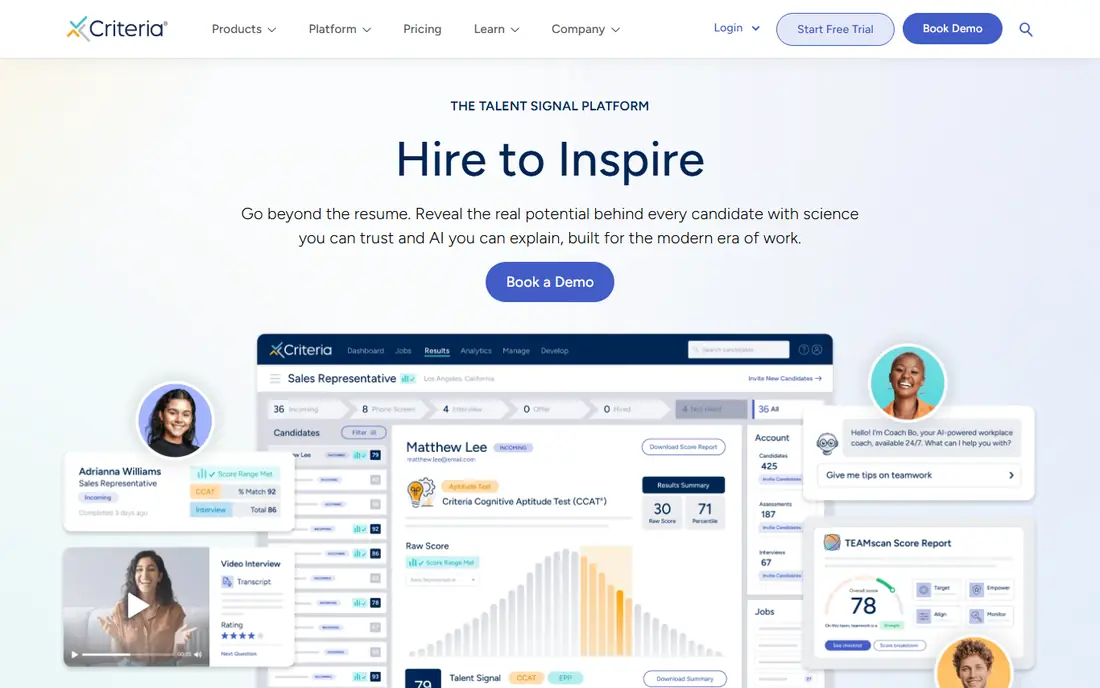
Criteria suits teams that want a defensible measure of how someone thinks and works, rather than a quiz about job trivia. Its cognitive and personality assessments are built for hiring decisions, and the platform adds structured interviews so the whole process stays consistent. That combination helps when a hiring manager needs to explain, in plain terms, why one candidate scored higher than another.
Pricing is quote-based, so small teams should ask for a written quote tied to headcount and expected volume before budgeting. The library is less broad for niche hard skills, so teams hiring across many technical roles may still need a second tool. For core office, sales, and service roles, Criteria is a strong, serious choice.
- Science-backed aptitude and personality tests
- Structured interview tools
- Flat-fee style pricing
- Quote-based pricing
- Narrower role-specific skills library than TestGorilla

SHL is the enterprise end of this list, built for organisations that hire at volume and need assessments with documented validation behind them. Its psychometric tests, simulations, and analytics suit graduate schemes, leadership pipelines, and regulated hiring where consistency matters. Global delivery and reporting make it easier to compare candidates across regions and business units.
That depth comes with enterprise pricing and a longer setup, so SHL is rarely the right first tool for a team hiring a handful of people a year. Smaller teams will find the process heavy and the cost hard to justify. For large employers who need audit-ready evidence, though, SHL remains one of the most trusted names in the category.
- Validated enterprise assessments
- Deep talent analytics
- Global delivery at scale
- Enterprise pricing and setup
- Heavier process than small teams need
HackerRank is built for one job: finding out whether a developer can actually code, under conditions close to real work. Candidates solve problems in a live environment, and hiring teams can run technical interviews on the same platform. The reporting breaks skills down by topic, which helps engineering managers spot strengths and gaps instead of relying on a single pass mark.
The trade is scope. HackerRank does not try to assess sales, service, or general aptitude, so it belongs alongside a broader hiring process, not as a replacement for it. Teams hiring only occasionally for engineering may find the cost steep for sporadic use. For regular developer hiring, it is one of the clearest signals available.
- Real coding tasks and interviews
- Large developer community
- Detailed skills reporting
- Focused on technical roles only
- Pricing needs a sales conversation for larger teams
Codility takes a similar specialist path to HackerRank, with coding tasks that mirror real engineering work rather than abstract puzzles. Integrity checks, including plagiarism detection, give hiring teams more confidence in remote results, and the platform moves cleanly from assessment to live interview. Engineering leaders tend to trust its output because the tasks look like the job.
As with any specialist, Codility is not a general hiring tool, and teams will still need interviews and reference checks to round out a decision. Pricing is handled through sales, so ask for a quote based on expected engineering hires per year. For companies where engineering quality decides the business, that specialist depth is worth paying for.
- Real-world coding tasks
- Plagiarism and integrity checks
- Interview and assessment in one flow
- Technical focus only
- Smaller general test library than broad platforms
Mercer Mettl fits high-volume hiring where trust in remote results matters as much as the test itself. Its proctoring tools, including identity checks and monitoring, help employers run large remote cohorts without flying candidates to a test centre. The suite covers cognitive, personality, coding, and domain skills, so one vendor can serve many departments.
The platform is built for enterprise scale, and pricing and setup reflect that, so small teams should expect a sales-led process. Reports are detailed, which is a strength for compliance and a burden if nobody owns the analysis. For campus hiring, mass recruitment drives, and regulated roles, Mercer Mettl is a practical, serious option.
- Strong proctoring for remote tests
- Broad enterprise assessment suite
- High-volume delivery
- Custom enterprise pricing
- Setup can be heavy for small teams
Vervoe stands out because it tests people by giving them the job, in miniature, rather than asking them about it. Candidates complete realistic tasks, such as drafting a reply, analysing a dataset, or prioritising a workload, and AI-assisted grading helps rank responses quickly. That work-sample evidence is often more persuasive to hiring managers than a generic test score.
Good simulations take time to design, and a rushed task can frustrate candidates or measure the wrong skill. Vervoe works best when a team invests in one or two strong simulations for its most common roles, then reuses them. Pricing is custom at larger volumes, so start with a trial on a single role and judge the quality of shortlisted candidates before scaling.
- Work-sample simulations
- AI-assisted grading
- Automated candidate ranking
- Custom pricing for larger use
- Simulations take time to build well
HireVue combines on-demand video interviews with assessments and hiring automation, which suits large employers screening thousands of applicants. Structured questions keep interviews consistent, and automation moves strong candidates forward faster while keeping a record of each decision. Integrations with major applicant tracking systems reduce manual work for recruiting teams.
Video interviewing is not right for every role, and some candidates will find it impersonal compared with a live conversation. Enterprise pricing also puts HireVue out of reach for small teams. For high-volume, multi-location hiring where consistency and speed matter, it is a proven platform, provided human reviewers stay in control of final decisions.
- Structured video interviews
- Assessments and automation
- Enterprise integrations
- Enterprise pricing
- Video-first process does not suit every role
eSkill suits teams that want to build their own tests from a large question bank, rather than accepting a fixed library. You can mix multiple-choice, simulation, and video questions, and tailor assessments to the exact skills a role needs. That flexibility helps for specialist office, technical, and trade roles where off-the-shelf tests miss the point.
The platform feels less modern than newer rivals, and pricing is quote-based, so budget planning needs a sales conversation. Support for custom test design is a real strength, though, especially for teams with a clear view of what good looks like. If your roles are too specific for a standard library, eSkill deserves a trial.
- Large question bank
- Custom test building
- Video and simulation question types
- Quote-based pricing
- Interface feels dated beside newer rivals
How we picked these
We compared vendor feature pages, pricing pages, app and platform documentation, and public reviews, and we favoured tools that are live today and used for real hiring decisions. Each tool had to measure something job-relevant, score results in a way a hiring team can explain, and integrate with common recruiting workflows. We excluded tools that only offer personality quizzes for team building, since this guide is about hiring and development decisions.
We also looked for honesty about limits, such as where a broad library lacks depth, or where enterprise pricing makes a tool a poor fit for small teams. No tool here should replace interviews, references, or a trial task. The best approach is to use an assessment as one piece of evidence, alongside human judgement, and to check fairness and legal requirements for your location before rollout.
How to choose the right assessment tool
Start with the decision you need to make, not the test library. A short skills test suits a high-volume screening step, a simulation suits a final-stage role check, and a validated psychometric suits leadership or regulated hiring. Write down the three skills that predict success in the role, then pick the tool that measures those three well.
Pilot before you buy
Run the assessment with current employees in the role, if you can, and with a small candidate group, then compare results with later job performance. A pilot exposes confusing questions, timing problems, and candidate experience issues before they affect a full hiring round. It also gives hiring managers confidence in the scores.
Keep the candidate experience fair
Tell candidates what the assessment covers, how long it takes, and how results will be used. Offer a quiet, accessible format, and allow reasonable adjustments where needed. A clear process improves completion rates and reduces complaints, and it protects the employer if a decision is ever questioned.
Watch cost per hire, not just licence cost
Quote-based tools can look cheap until volume, seats, and implementation are added. Model the cost for your expected hires per year, including time spent building tests and reviewing results. A cheaper tool that produces weak shortlists costs more in wasted interviews than a pricier tool that gets the shortlist right.
Frequently asked questions
What are the best talent assessment tools?
TestGorilla is the best broad starting point, Criteria and SHL lead on validated psychometrics, and HackerRank and Codility lead for engineering. The best talent assessment tool for your team depends on the roles you hire most. Match the tool to the evidence you need, rather than buying the largest library.
How much do employee assessment tools cost?
Costs range from a free TestGorilla plan for small teams to custom enterprise quotes for SHL, Mercer Mettl, and HireVue. Mid-market tools often price by seats, candidates, or annual volume, so ask for a written quote for your expected hiring numbers. Always model total cost, including setup and review time.
Are pre-employment assessments legal?
They can be, provided they measure job-relevant skills, are applied consistently, and follow local employment and anti-discrimination rules. Avoid tests that screen out protected groups without a clear job link, and keep records of how scores were used. Get legal advice for your location before rolling out a new assessment at scale.
How long should an assessment take?
Short screening tests of 20 to 40 minutes work best for early stages, while simulations and technical interviews can run longer at final stage. Long assessments reduce completion rates, especially for senior candidates with other options. Tell candidates the expected time up front, and respect it.
Should one test decide who gets hired?
No. Use assessments as one piece of evidence, alongside interviews, work samples, and references. A single score can miss context, such as experience, motivation, and growth potential. Keep a human review step for every final decision, and review assessment results for bias over time.
Can these tools assess current employees too?
Yes, many of them support development use, such as skills gaps, promotion readiness, and training needs. Tell employees clearly whether a result affects development only or also affects promotion and pay. Development use works best when results lead to coaching and learning, not just a score on file.
Sources
See where you really rank - block by block
ProMapRanker scans Google Maps across a grid of your service area. Simple monthly plans from $19, white-label on every plan.
Start freeKeep reading
 zscaler alternatives
Best Zscaler Alternatives in 2026
Looking for zscaler alternatives? We compare 9 SASE and zero trust platforms on architecture, data protection, pricing, and fit for your network and team.
Read → zapier alternatives free
Best Zapier Alternatives Free in 2026
Nine automation tools for zapier alternatives free in 2026, all with genuinely free tiers, plus free plan limits, starting prices and upgrade paths explained.
Read → which platform is best for online reputation
Which Platform Is Best for Online Reputation in 2026
Wondering which platform is best for online reputation? We compare 8 review, listing, and response tools for small and multi-location businesses and agencies.
Read →