 ProMapRanker
Best Email Marketing Platforms in 2026


Beginners and generalists who want a familiar platform · Pricing starts at: $13 per month
Key takeaways
- Brevo offers the best value for large lists with infrequent sends, because it charges by email volume rather than by contact count.
- Klaviyo is the strongest ecommerce platform, with deep Shopify and WooCommerce data, but its price rises steeply as your list grows.
- MailerLite is the best budget all-rounder for small businesses that want a clean editor and a generous free tier.
- ActiveCampaign leads on automation depth, while Kit leads for creators who run newsletters and sell digital products.
Quick comparison
| Pick | Great for | Pricing starts at | Free tier | |
|---|---|---|---|---|
| Mailchimp | Beginners and generalists who want a familiar platform | $13 per month | Yes, up to 250 contacts | Visit |
 Klaviyo | Ecommerce stores on Shopify and WooCommerce | $20 per month | Yes, up to 250 contacts | Visit |
 Brevo | Large lists, infrequent sends, and multichannel messaging | $9 per month | Yes, 300 emails per day, unlimited contacts | Visit |
 MailerLite | Small businesses that want simplicity and value | $10 per month | Yes, up to 1,000 subscribers | Visit |
 ActiveCampaign | Advanced automation and B2B marketing | $15 per month | No, 14-day trial | Visit |
 Kit | Creators, newsletters, and course sellers | $29 per month, billed annually for 1,000 subscribers | Yes, up to 10,000 subscribers on Newsletter plan | Visit |
 Omnisend | Ecommerce email, SMS, and push in one workflow | $16 per month | Yes, up to 250 contacts | Visit |
 Constant Contact | Local businesses, nonprofits, and event organisers | $12 per month for Lite | No, free trial | Visit |
The best email marketing platforms
Email platforms differ in billing model, automation depth, and store integration. Some charge per contact, some charge per send, and some charge a flat rate. That billing difference matters more than a small feature gap, because your cost at 5,000 subscribers can look very different from the starting price.
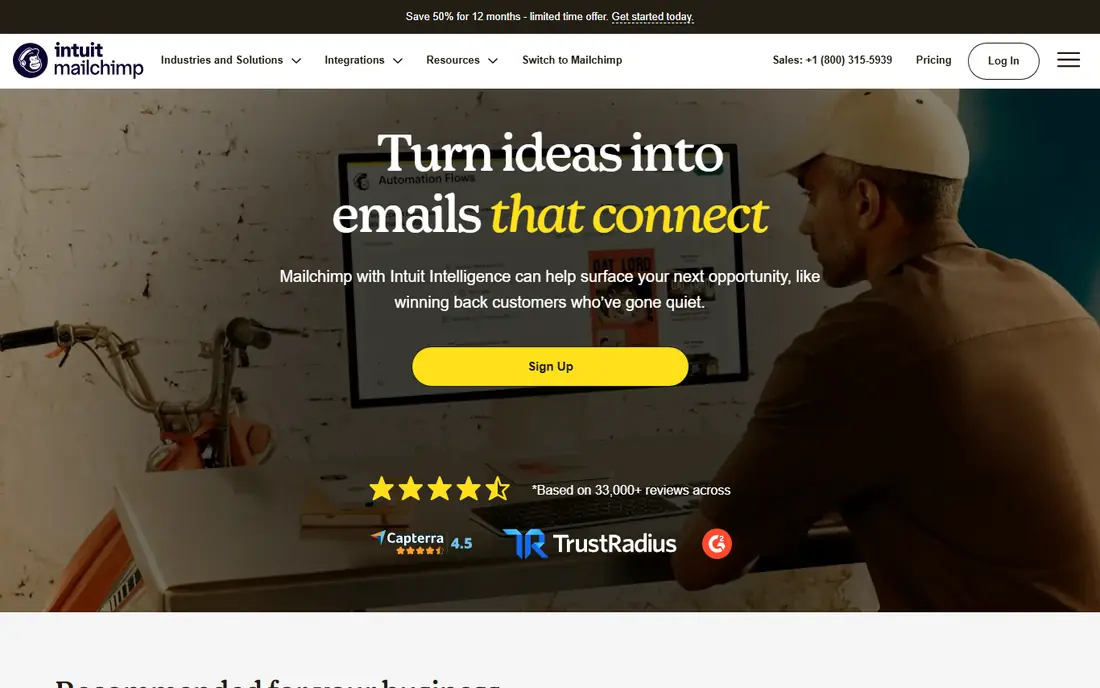
Mailchimp is the platform most small businesses have heard of, and that familiarity helps. The editor is easy to use, templates look modern, and integrations cover most website, store, and CRM tools a small business uses. Landing pages and social posting tools let you run a basic campaign without stitching together several products. The cost curve is the catch. At $13 per month for a small list, Mailchimp is reasonable, but pricing at 5,000 contacts and above is much higher, and the free plan now covers only up to 250 contacts. Automation is solid for welcome series and simple flows, but it trails ActiveCampaign for complex B2B journeys. Choose Mailchimp when you want a safe, well-known all-rounder and your list is still small.
- Wide integrations, strong templates, landing pages, social posting tools, familiar interface
- Price rises sharply as contacts grow, automation is less deep than ActiveCampaign, free plan is now limited
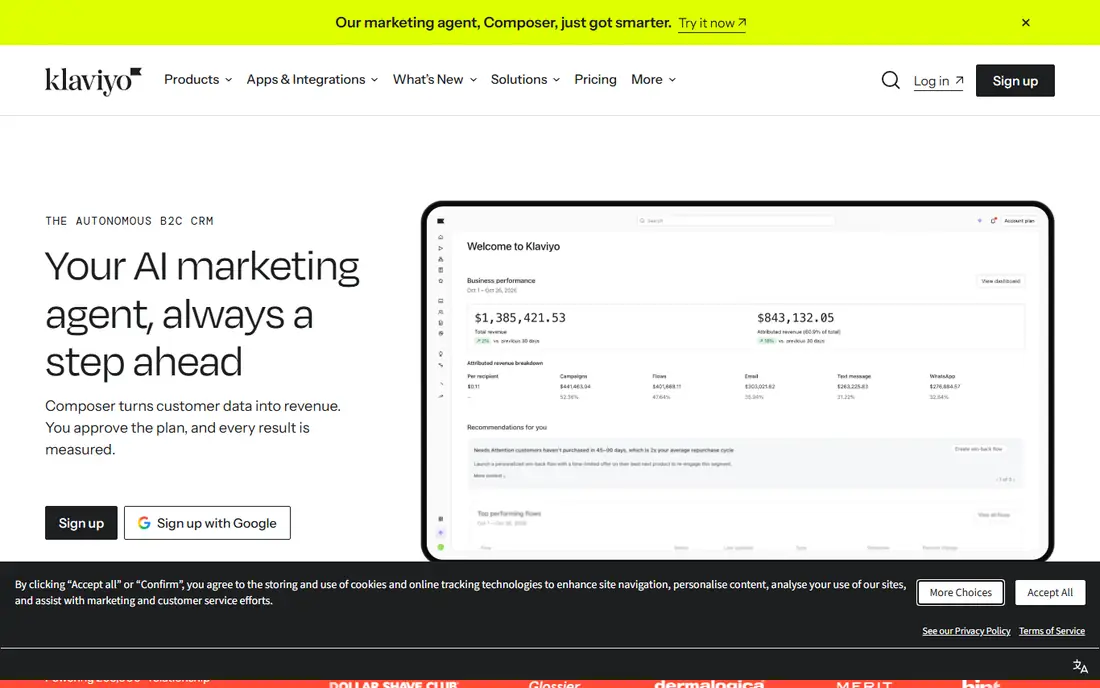
Klaviyo is the default for serious ecommerce email. It pulls purchase history, browsing behaviour, product views, and lifetime value from Shopify and WooCommerce, then lets you build flows for abandoned carts, post-purchase follow-ups, browse abandonment, and win-back campaigns. Revenue attribution shows what each email earns, which helps stores justify the cost. That power comes at a price. Paid plans start at $20 per month, and costs rise steeply with contacts, so a 10,000-contact store pays far more than a small newsletter sender. Non-ecommerce businesses will find Klaviyo overkill. If email drives a large share of store revenue, Klaviyo earns its fee. If you run a simple newsletter, a cheaper platform will do the same job for less.
- Deep store data, predictive analytics, ready-made ecommerce flows, revenue attribution
- Expensive as lists grow, overkill for non-ecommerce senders, learning curve for advanced flows
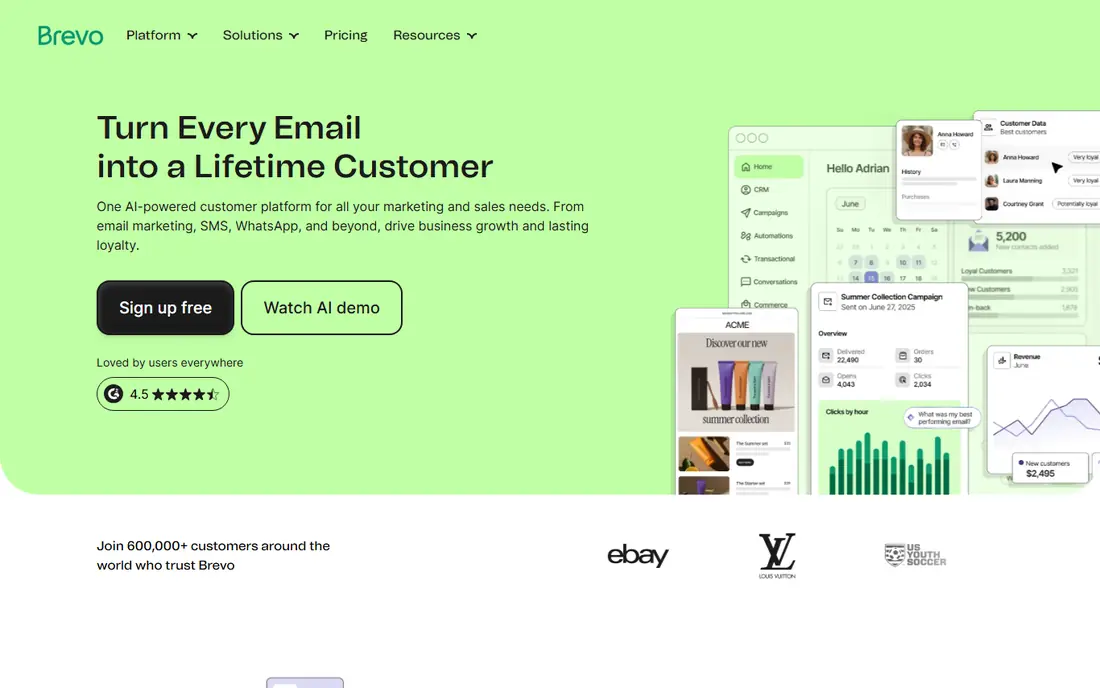
Brevo, formerly Sendinblue, changes the maths for large lists. Instead of charging per contact, it charges by email volume, so a list of 20,000 contacts that you email once a month costs far less than on a per-contact platform. The free plan allows 300 emails per day with unlimited contacts, which suits testing and low-volume sending. Automation covers welcome flows, transactional emails, and basic journeys well, but it is thinner than ActiveCampaign for complex B2B logic. The interface is functional rather than beautiful. Brevo suits businesses with large lists, seasonal sends, or a need for SMS alongside email. If you send daily to a small list, a per-contact platform may be simpler to budget.
- Pay by sends not contacts, unlimited contacts on free plan, SMS and WhatsApp options, built-in CRM features
- Automation is thinner than ActiveCampaign, interface is less polished than MailerLite
MailerLite is the budget pick that does not feel like a compromise for most small businesses. The editor is clean, landing pages are included, and automation covers welcome series, abandoned cart flows for simple stores, and basic segmentation. The free tier, up to 1,000 subscribers, is more generous than Mailchimp and Klaviyo, which makes MailerLite a low-risk starting point. Advanced users will hit limits. Segmentation and automation depth trail ActiveCampaign and Klaviyo, and ecommerce reporting is simpler. For a small business sending newsletters, promotions, and simple flows, those limits rarely matter. MailerLite is the platform we would pick for a new small business that wants to start sending this week without a steep learning curve.
- Clean editor, landing pages, automation for common flows, generous free tier, easy setup
- Segmentation is leaner than enterprise tools, fewer advanced ecommerce features than Klaviyo
ActiveCampaign is the automation leader here. Its builder supports conditional logic, lead scoring, CRM deal tracking, and multi-step journeys that adapt to how each contact behaves. B2B teams, agencies, and businesses with long sales cycles benefit most, because ActiveCampaign can nurture a lead over weeks without manual follow-up. The cost is learning time and price. There is no free plan, only a 14-day trial, and the interface assumes you understand automation concepts. Simple senders will pay for power they never use. Choose ActiveCampaign when your marketing needs complex flows, CRM integration, and lead scoring, and when you have time to build those flows properly.
- Deepest automation builder in this list, CRM features, lead scoring, many integrations
- No free plan, learning curve is steep, price rises with contacts and features
Kit, formerly ConvertKit, is built for creators rather than for general business marketing. The Newsletter plan is free for up to 10,000 subscribers, which is unmatched in this list for a newsletter-first product. Paid plans add visual automation, paid newsletter tools, and commerce features for selling digital products and courses. The paid price is higher than MailerLite for a similar subscriber count, and ecommerce depth trails Klaviyo. Kit suits writers, podcasters, YouTubers, and course creators who grow an audience and sell to that audience, rather than stores that need deep purchase data. If your business is a newsletter first, Kit's free cap alone makes it worth testing.
- Largest free subscriber cap in this list, creator-focused tools, paid newsletter features, simple automation
- Paid plans are pricier than MailerLite, ecommerce features trail Klaviyo, not built for complex CRM work
Omnisend is the ecommerce alternative to Klaviyo for stores that want email, SMS, and push notifications in one workflow. Ready-made flows cover abandoned carts, welcome series, order follow-ups, and win-back campaigns, and Shopify integration pulls store data without manual setup. For small and mid-sized stores, Omnisend offers much of Klaviyo's value at a lower starting price. The free plan covers only up to 250 contacts, so it is a trial rather than a long-term free tier. Costs also rise with contacts, as with Klaviyo. Non-ecommerce senders will find Omnisend less suited to pure newsletters than MailerLite or Kit. Choose Omnisend when your store needs multichannel flows and you want a simpler, cheaper alternative to Klaviyo.
- Ready-made ecommerce flows, email plus SMS and push, Shopify integration, good reporting
- Free plan is small, price rises with contacts, less suited to non-ecommerce newsletters
Constant Contact
Great for: Local businesses, nonprofits, and event organisers
Constant Contact suits local businesses that send newsletters, event invitations, and promotions to a community list. Templates are easy, event registration is built in, and support is accessible, which matters for owners who do not have a marketing team. Nonprofits and event organisers will find the event tools more useful than a generic email editor. Automation is limited next to ActiveCampaign, and there is no free plan, only a trial. The Lite plan at $12 per month is a low entry price, but costs rise as contacts grow. Constant Contact is best for businesses that value simplicity, events, and support over deep automation. For complex flows, ActiveCampaign or Klaviyo will serve you better.
- Easy templates, event registration tools, social posting, phone support on paid plans
- No free plan, automation is limited compared with ActiveCampaign, price rises with contacts
How we picked these
We compared official pricing pages, feature pages, and public reviews, and we kept only platforms that operate in October 2026. We checked billing model, free tier limits, automation depth, store integration, deliverability tools, and ease of use. Prices reflect starting paid plans found in our research, and we noted where a price depends on subscriber count or annual billing. Where a price could not be verified, we would have written "See website" rather than guessing, but all starting prices in this article were supported by our research.
How to choose an email marketing platform
Start with your list size, send frequency, and business type, because those three factors decide cost and fit.
For small businesses and newsletters
MailerLite and Brevo offer the best value. MailerLite is simplest for a small list with regular sends, while Brevo is cheapest for a large list with infrequent sends. Test both free tiers with a real campaign before paying.
For ecommerce stores
Klaviyo leads on data and revenue attribution, while Omnisend offers a cheaper multichannel alternative. Calculate cost at your actual subscriber count, not at the starting price, because ecommerce pricing rises steeply with contacts.
For creators
Kit leads for newsletters and course sales, with a free plan up to 10,000 subscribers. Mailchimp is a familiar alternative, but its free cap is far smaller. Choose Kit when your audience is the product, and Klaviyo or Omnisend when your store is the product.
For advanced automation
ActiveCampaign leads on automation depth, CRM features, and lead scoring. It suits B2B teams and agencies with complex journeys. Simple senders should avoid it, because the learning curve and price buy power they will not use.
A note on deliverability and consent
No platform can fix a poor list. Only email people who opted in, clean bounces and unsubscribes promptly, and avoid buying lists, because bought lists harm deliverability and can breach platform terms and privacy law. Use double opt-in where it fits your audience, and include a clear unsubscribe link in every campaign.
Frequently asked questions
What is the best email marketing platform for small business?
MailerLite is the best overall small business pick for simplicity and value, with a free tier up to 1,000 subscribers. Brevo is better for large lists with infrequent sends, because it charges by volume rather than contacts. Mailchimp is a familiar alternative, but its price rises faster as your list grows.
What is the best email marketing platform for ecommerce?
Klaviyo is the best ecommerce platform, with deep Shopify and WooCommerce integration, predictive analytics, and revenue attribution. Omnisend is the best cheaper alternative, with email, SMS, and push flows in one workflow. Both charge more as contacts grow, so compare cost at your real list size.
What is the best free email marketing service for small business?
MailerLite offers the most generous free tier for small businesses, with up to 1,000 subscribers. Brevo offers a free tier with 300 emails per day and unlimited contacts, which suits large lists with low send volume. Kit offers a free Newsletter plan up to 10,000 subscribers, which suits creators best.
How much does email marketing software cost?
Starting prices in this list range from $9 to $29 per month, but the real cost depends on subscriber count, send volume, and billing model. Per-contact platforms get expensive as lists grow, while Brevo charges by sends. Always check the price at 1,000, 5,000, and 10,000 contacts before committing.
Is Mailchimp still a good choice in 2026?
Yes, for beginners and generalists with small lists. Mailchimp offers a familiar editor, wide integrations, and solid templates. It is less competitive for large lists, because pricing rises sharply, and for advanced automation, where ActiveCampaign leads. Small businesses that value familiarity will still find Mailchimp useful.
Can I switch email platforms without losing my list?
Yes. Export your contacts, tags, and segments from your current platform, import them into the new one, and confirm consent records before sending. Test a small campaign first, check deliverability, and rebuild key automations in the new tool, because automation flows do not transfer directly between platforms.
Sources
- https://mailchimp.com
- https://www.klaviyo.com
- https://www.brevo.com
- https://www.mailerlite.com
- https://www.activecampaign.com
- https://kit.com
- https://www.omnisend.com
- https://www.constantcontact.com
- https://www.comparebiztech.com/best-email-marketing-software/
- https://www.mailercloud.com/blog/best-email-marketing-software-in-2026
- https://www.sendx.io/blog/email-marketing-software-comparison
See where you really rank - block by block
ProMapRanker scans Google Maps across a grid of your service area. Simple monthly plans from $19, white-label on every plan.
Start freeKeep reading
 youtube alternatives
Best YouTube Alternatives in 2026
Looking for youtube alternatives in 2026? We compare Vimeo, Dailymotion, Twitch, Rumble, and more on price, audience, monetization, control and privacy.
Read → what's the best ai tool for photo editing
What Is the Best AI Tool for Photo Editing in 2026
What is the best AI tool for photo editing? We compare ten tools for 2026, from Photoshop and Lightroom to Luminar, Topaz, Canva and mobile editors today.
Read → twitter alternatives
Best Twitter Alternatives in 2026
Compare the best twitter alternatives for 2026, from Bluesky, Threads, and Mastodon to Reddit, Tumblr, and Micro.blog, with free plans and audience notes.
Read →