 ProMapRanker
6 Top Electronic Lab Notebook Software Options Compared (2026)


Modern ELN for research organizations · Pricing starts at: See website
Key takeaways
- Top of the list is LabArchives, which targets modern ELN for research organizations.
- A fair warning about Benchling: enterprise pricing and implementation.
- Only LabArchives offers a free plan among these 6 tools.
- LabArchives, SciSure (formerly eLabNext) and the 4 others all sell by quote; expect sales conversations before you see a price.
- SciSure (formerly eLabNext) suits ELN plus LIMS and EHS in one system.
Direct answer
This list puts LabArchives first for modern ELN for research organizations. If your case is different, SciNote suits ELN with inventory and compliance and Sapio Sciences suits AI-native LIMS and ELN system. The full list of 6 tools follows, with prices and free plan facts.
Quick comparison
| Pick | Great for | Pricing starts at | Free tier | |
|---|---|---|---|---|
| LabArchives | Modern ELN for research organizations | See website | Yes | Visit |
 SciNote | ELN with inventory and compliance | See website | Free trial | Visit |
 Sapio Sciences | AI-native LIMS and ELN product | See website | Free trial | Visit |
 Benchling | Cloud R&D system for biotech | See website | No | Visit |
 Labguru | Unified ELN, LIMS, and inventory | See website | No | Visit |
 SciSure (formerly eLabNext) | ELN plus LIMS and EHS in one product | See website | No | Visit |
The best electronic lab notebook software
ProMapRanker compared 6 tools for electronic lab notebook software. The goal is a practical shortlist: published prices, free plan facts, best-fit use cases and honest limits for every entry.
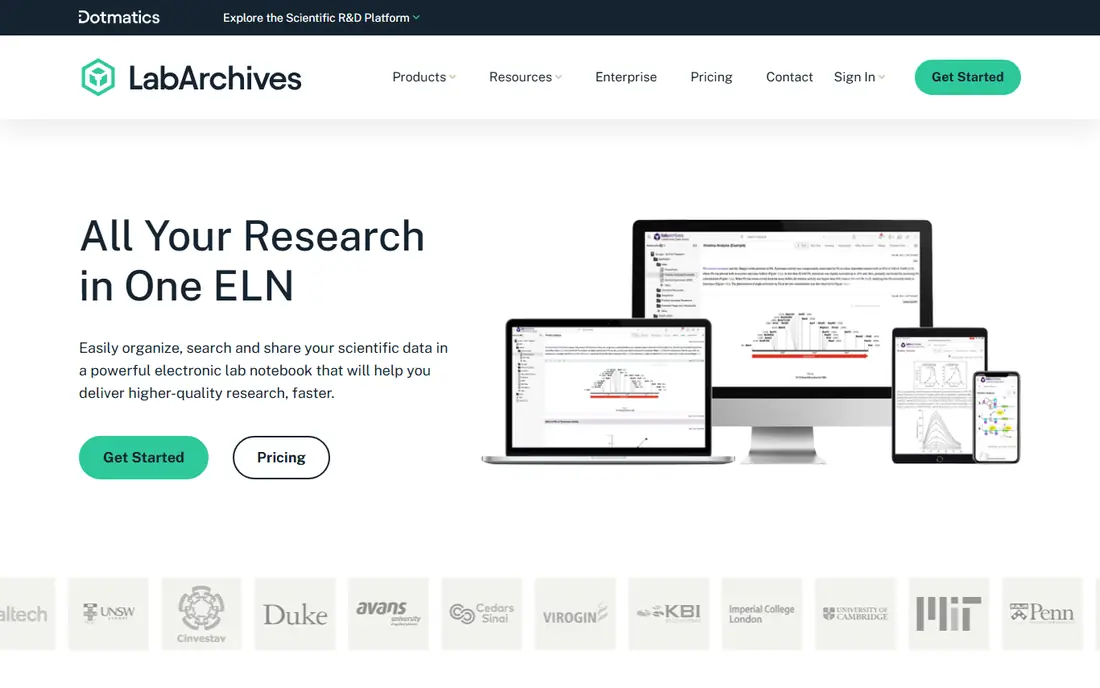
For modern ELN for research organizations, LabArchives is a natural candidate. LabArchives is the ELN for modern scientists who want to organize, search, and share research data without enterprise complexity. For research organizations from small labs to global institutions, it is the most accessible serious ELN.
For everyday use, compliance badges cover SOC 2, ISO 27001, NIST 800-171, and FDA 21 CFR Part 11. From a buyer's view, LabArchives is an ELN first; labs needing full LIMS, sample management, or manufacturing compliance will want a unified system. The rare virtue in this category is the free start: teams can begin without a purchase order and upgrade as they grow. Also, the cloud notebook integrates natively with the tools researchers already use: SnapGene, GraphPad Prism, Geneious, Microsoft 365, and PubMed. Pricing for LabArchives is not stated here, so ask the vendor for current figures. Free access exists with LabArchives.
The main drawbacks: Less LIMS depth than unified products.
- Microsoft 365 integrations
- Start free and upgrade as the team grows
- The free level has limits that push expanding labs to premium

SciNote was built for ELN with inventory and compliance. The projects, experiments, and tasks structure emulates how research actually happens, with protocol templates, visualized workflows, and an auto-generated report generator.
Compliance is a strength: electronic signatures, audit trails, timestamps, activity logs, and access controls support 21 CFR Part 11 and GLP/GMP requirements. SciNote does not show a starting price in this comparison, so check the vendor site for current pricing. Free access: Free trial.
Drawbacks to consider: Pricing is quote-based.
- ELN plus lab inventory and team management in one
- Used by the FDA and USDA with 100k+ scientists
- The interface carries the weight of its plenty of features
Pick Sapio Sciences if this describes you: AI-native LIMS and ELN system. The product story is strong: no-code LIMS and ELN configuration, end-to-end automation, GxP-compliant templated options, and built-in scientific tools from CRISPR design to compound design.
The main drawbacks: Enterprise sales with quote-based pricing.
In practice, for labs that want the most forward-looking informatics system and the configurability to evolve with their science, Sapio is the boldest choice. For everyday use, validate Elain against your real workflows before committing. Check the vendor site for Sapio Sciences pricing; none is listed in this comparison. Free plan details: Free trial.
- Elain
- The only AI-native product uniting LIMS and ELN
- The AI-native positioning is new and needs validation
Pick Benchling if this describes you: cloud R&D system for biotech. Options span bioresearch, bioprocess, biologics, in vivo, and automation. Worth adding: the honest catch is fit and price.
Benchling is designed for biotech and biopharma; academic chemistry or materials labs may find it overpowered and pricey. In practice, the unified data model is the differentiator. In practice, open integrations link instruments and software, and the system scales on secure infrastructure that adapts to the science. In practice, designing one data model across experiments powers computational science rather than trapping leads to free-text notes. No starting price is listed for Benchling here; confirm pricing on the vendor site. Benchling has no free tier.
Limits to weigh: less general than academic ELNs.
- The cloud product for biotech R&D from discovery to process development
- Trusted by Sanofi, Moderna, Beam
- Enterprise pricing and implementation
Labguru is built with unified ELN, LIMS, and inventory in mind. Plan and document experiments, track samples and storage, automate workflows with triggers and rules, and keep everything searchable and compliant with FDA 21 CFR Part 11. Support comes from PhD application scientists, and onboarding promises zero data loss.
Trade-offs to know: Quote-based pricing.
As for the details, for labs tired of ELN here, spreadsheets there, and inventory nowhere, it is the most proven single-vendor answer. For everyday use, full data ownership means the lab's IP stays the lab's. Labguru shows no starting price here, so confirm the cost on the vendor site. Labguru has no free tier.
- PhD application scientists for support
- ELN, LIMS, inventory
- The unified scope takes real onboarding
In short, SciSure (formerly eLabNext) is for ELN plus LIMS and EHS in one product. The scale is significant: 550,000-plus scientists across 55,000-plus laboratories, with customers including Bayer, Boston University, Fraunhofer, and Institut Pasteur. Compliance includes ISO 27001, GDPR, FDA 21 CFR Part 11, GxP, and HIPAA.
Points against: Pricing is quote-based.
The rebrand is fresh, so buyers should confirm product naming and contracts. Worth adding: the ELN (formerly eLabNext) takes care of experiment planning and documentation. The LIMS tracks samples and inventory; health and safety handles chemical inventories and inspections; integrations link instruments and data systems. Pricing for SciSure (formerly eLabNext) is not stated here, so ask the vendor for current figures. SciSure (formerly eLabNext) has no free tier. Upsides: ELN, LIMS.
- Solid compliance core
- Integrations on one scientific management product
- The rebrand from eLabNext is still settling
How these tools were picked
Each tool was reviewed on what its vendor publishes: price, plan limits, core features and stated drawbacks. We did not run hands-on tests. Seat minimums, billing terms and add-ons can move the real cost, so the starting prices here are a guide and not a quote. Position on the page reflects fit for a typical buyer first, with price clarity and free access breaking ties. Treat it as a guide, not a ruling.
What to confirm before you sign up
- Ask each vendor, from LabArchives to SciSure (formerly eLabNext), for a written quote; none of them publishes a starting price.
- Test the free plan from LabArchives against your real workload before relying on it.
- Use real work to test the free trial from SciNote and Sapio Sciences, rather than a demo project.
- Before choosing LabArchives, weigh its main limit: the free level has limits that push growing labs to premium.
- Run a one or two week pilot of Sapio Sciences with the people who will use it every day.
- Test the integrations you rely on with Benchling before committing; some connectors sit on upper tiers.
Frequently asked questions
Can I try these options before paying?
Often, yes. LabArchives has a free plan and SciNote and Sapio Sciences offer a free trial. Use your own data and a real task during the test, and check what the free tier or trial limits before you rely on it.
Which options for electronic lab notebook software have a free plan?
LabArchives is the only tool in this list with a free plan. Free plans usually cap users, projects or features, so check the limits on the vendor page. Several others offer a trial instead.
What is the difference between an ELN and a LIMS?
A LIMS (laboratory information management system) tracks samples, inventory, and workflows. On top of that, unified platforms like Labguru, SciSure, and Sapio combine both.
How much does electronic lab notebook software cost?
LabArchives is the exception, letting teams start free. Expect mid-four to five-figure annual contracts for small labs and six figures for enterprise deployments, plus implementation and validation costs.
Can an ELN replace paper notebooks fully?
Yes, with the right change management. Pilot with one team, keep the paper parallel for a defined period, and set a cutover date. Vendors report significant time savings, but only when the entire team commits.
How are the tools for electronic lab notebook software ordered?
The order follows typical fit for electronic lab notebook software, with LabArchives first and SciSure (formerly eLabNext) last, then price clarity and free access. It is editorial judgement, not a score, so another team could rank the tools differently.
Sources
See where you really rank - block by block
ProMapRanker scans Google Maps across a grid of your service area. Simple monthly plans from $19, white-label on every plan.
Start freeKeep reading
 zscaler alternatives
Best Zscaler Alternatives in 2026
Looking for zscaler alternatives? We compare 9 SASE and zero trust platforms on architecture, data protection, pricing, and fit for your network and team.
Read → zapier alternatives free
Best Zapier Alternatives Free in 2026
Nine automation tools for zapier alternatives free in 2026, all with genuinely free tiers, plus free plan limits, starting prices and upgrade paths explained.
Read → which platform is best for online reputation
Which Platform Is Best for Online Reputation in 2026
Wondering which platform is best for online reputation? We compare 8 review, listing, and response tools for small and multi-location businesses and agencies.
Read →