 ProMapRanker
Best Ecommerce Website Development Company in 2026

Key takeaways
- The best ecommerce website development company depends on your platform, catalog size, integrations and growth plans, not just design taste.
- Elogic Commerce, Codal and Coalition Technologies suit complex or enterprise builds, while Absolute Web and DigitalSuits suit Shopify-focused stores.
- Ask for comparable past stores, platform partner status, integration experience and a clear support plan before you sign.
- Development pricing is project-based, so every agency here is listed as See website, and a detailed scope matters more than a headline rate.
Quick comparison
| Pick | Great for | Pricing starts at | Free tier | |
|---|---|---|---|---|
 Elogic Commerce | Complex B2B builds | See website | No | Visit |
 Codal | Shopify and BigCommerce | See website | No | Visit |
 Coalition Technologies | Performance-led stores | See website | No | Visit |
 Absolute Web | Shopify Plus builds | See website | No | Visit |
 OuterBox | Large-scale ecommerce | See website | No | Visit |
 Groove Commerce | Full lifecycle stores | See website | No | Visit |
 Netalico | Shopify and BigCommerce | See website | No | Visit |
 DigitalSuits | Shopify design and migration | See website | No | Visit |
The best ecommerce website development company
We compare agencies that design, build and support ecommerce websites, including Shopify, Shopify Plus, BigCommerce, Adobe Commerce and custom or headless builds. These are agencies, not just platforms, so pricing is project-based and listed as See website throughout.
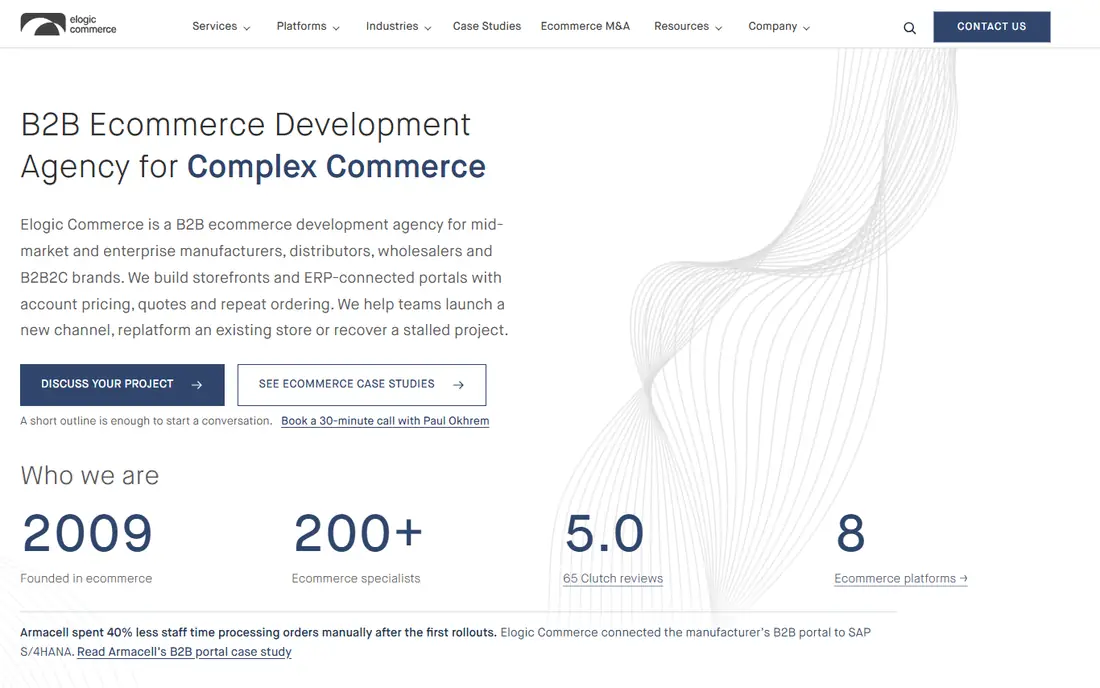
Elogic Commerce suits complex B2B, B2B2C and ERP-integrated stores where catalog rules, pricing tiers and system integrations matter more than a simple storefront. Its services cover Adobe Commerce and Magento, plus Shopify Plus, BigCommerce, Salesforce Commerce Cloud and headless builds, with published cases covering ERP, PIM, order management and CRM integration. That depth helps a distributor or manufacturer whose store must reflect real inventory, pricing and fulfillment rules.
The catch is budget. A complex integration program needs a larger budget and a longer timeline than a starter Shopify store, and a small direct-to-consumer brand may find a Shopify-focused studio faster and cheaper. Ask for three cases that match your platform, integrations and business model, and check who will lead your project day to day.
- Adobe Commerce and Magento depth
- ERP, PIM and CRM integrations
- B2B experience
- Minimum budgets suit larger projects
- Less fit for a simple starter store
Codal suits brands that want strong engineering on Shopify or BigCommerce, with design, development and data work under one roof. Its dual-platform position, as a Shopify partner and a BigCommerce partner, helps brands that have not yet chosen a platform, or that need a migration with complex integrations. The agency also works on UX research and analytics, which helps a store improve conversion after launch, not just at launch.
The trade-off is price and fit. Codal pricing suits mid-sized and enterprise brands, and a very small store may not need its full service range. Ask for the team proposed for your store, the platform recommendation rationale, and the post-launch support plan. A strong agency should explain why a platform fits your catalog and integrations, not just sell its preferred stack.
- Strong dual-platform partner status
- Design and engineering depth
- Enterprise experience
- Premium pricing
- Smaller stores may get less senior focus
Coalition Technologies suits ecommerce brands that want design, SEO and conversion work treated as one system, not three separate services. Its large case history covers Shopify, BigCommerce, Magento and custom builds, with a focus on page structure, category navigation, checkout flow and search performance. The month-to-month contract model, where offered, lets a client judge results without a long lock-in, which is a useful signal of confidence.
The catch is breadth. A full-service agency can spread attention across many services, so a buyer should confirm who leads design, who leads development, and how success is measured. Ask for cases in your industry, with comparable catalog size and traffic, and agree on conversion and revenue metrics before launch, not after.
- Large ecommerce track record
- SEO and conversion focus
- Month-to-month model
- Broad service range can dilute focus
- Pricing is project-based
Absolute Web suits Shopify and Shopify Plus brands that want a focused studio with clear pricing floors for builds and migrations. Its Shopify depth covers custom themes, migrations, app integrations and ongoing support, and its public review count gives buyers a large base of past clients to check. For a brand committed to Shopify, that focus often means faster launches and fewer platform surprises.
The limit is platform range. A brand that needs Adobe Commerce, BigCommerce B2B or a headless build should compare Absolute Web with a multi-platform agency such as Elogic or Codal. Also note the minimum budgets, which exclude the smallest stores. Ask for Shopify cases that match your catalog, integrations and order volume, and confirm the support plan after launch.
- Shopify Plus focus
- Clear build and migration pricing floors
- Many client reviews
- Shopify focus limits other platforms
- Minimum budgets exclude tiny stores
OuterBox suits larger ecommerce brands that want scale, with a large team covering design, development, SEO and paid media. Its long history and staff depth help brands with large catalogs, high traffic and complex marketing needs, where a store must perform under peak load and across many channels. A single agency for design, build and growth can also simplify coordination for a busy internal team.
The drawback is process and priority. A large agency works best with a clear internal owner on the client side, and smaller brands may get less senior attention than enterprise accounts. Ask for the project lead, the team mix, and the communication cadence, and check cases with a similar catalog size and revenue stage. Scale is only a benefit if it reaches your project.
- Large team and long history
- Design, development and marketing under one roof
- Scale experience
- Larger agency process
- Smaller brands may feel less priority
Groove Commerce suits brands that want one partner from design and build through marketing and ongoing support. Its lifecycle model covers store design, development, email and search marketing, and maintenance, which helps a brand that lacks a large internal team. Shopify and BigCommerce are its core platforms, with a track record of long client relationships that suggest stable support.
The catch is scope and platform fit. A brand that wants only a build, without ongoing marketing, may pay for services it does not need, and a brand on Adobe Commerce or a headless stack should look elsewhere. Ask for a breakdown of build versus ongoing costs, and confirm what happens if you later move support in-house. A lifecycle partner should make handover possible, not painful.
- Design, build, marketing and support lifecycle
- Shopify and BigCommerce focus
- Long client relationships
- Full lifecycle model suits some budgets less well
- Platform range is narrower than multi-platform firms
Netalico suits mid-sized brands that want a smaller, close-knit studio for a Shopify, BigCommerce or Magento store, with migration and long-term support as core services. Its cases cover beauty, home goods, food and beverage and sports, and its team structure gives clients direct access to senior people. For a brand that values a stable partner and clear communication, that size can be an advantage.
The limit is very large or complex B2B programs, where a larger agency such as Elogic or Codal may offer deeper integration teams. Ask for migration cases that match your current platform and catalog, the support response times, and the plan for peak trading periods. A smaller studio should be judged on its last three comparable stores, not on its total project count.
- Shopify, BigCommerce and Magento focus
- Migration and support strength
- Small-team attention
- Smaller team than enterprise agencies
- Less suited to very large B2B programs
DigitalSuits suits brands that want a design-led Shopify or Shopify Plus store, with migration, custom theme work and headless options where they fit. Its work covers fashion, consumer goods and other direct-to-consumer brands, with QA and AI integration features in recent projects. For a brand that cares most about store design, speed and conversion on Shopify, that focus is a clear fit.
The drawback is platform range and scale. A brand on BigCommerce B2B or Adobe Commerce should compare DigitalSuits with a multi-platform agency, and a very large enterprise program may need a bigger team. Ask for Shopify cases in your industry, the theme and app approach, and the post-launch support terms. Design quality should be judged on live stores, not just mockups.
- Shopify and Shopify Plus design focus
- Migration and headless experience
- QA depth
- Shopify focus limits other platforms
- Smaller studio scale
How we picked these
We compared official service ranges, platform partner status, published cases, review counts and support models for agencies that build ecommerce websites. We favored agencies with a current, active site, comparable past stores, and a clear platform focus, whether single-platform or multi-platform. We did not rank agencies by a single score, because platform fit, catalog size and integrations change the right choice more than any league table.
We also favored agencies that publish pricing floors or clear scoping processes, since opaque pricing is a common ecommerce project risk. An agency that cannot explain its platform recommendation, name its project lead or show comparable live stores is a warning sign, whatever its portfolio claims.
How to choose an ecommerce development company
Start with platform, catalog and integrations, not design alone. Note your product count, variants, pricing rules, inventory system, payment providers, shipping carriers and accounting tools, and ask each agency how it would handle those specifics. A good agency will challenge your platform choice with reasons, while a weak one will agree with whatever you suggest.
Next, compare scope, timeline and support in writing. Each proposal should list design, development, integrations, data migration, testing, launch and post-launch support, with owners and dates. Ask who owns the code and theme, how updates are handled, and what support response times apply during peak trading. A store that cannot be updated safely after launch will cost more than a slightly higher build price.
Finally, check live stores, not just screenshots. Visit stores the agency built, test them on mobile, check load speed and checkout flow, and ask a past client about communication, delays and support quality. Agree on conversion, speed and revenue metrics before launch, so success is measured, not assumed. A good agency welcomes that scrutiny.
Frequently asked questions
What is the best company for ecommerce website development?
It depends on your platform and project size. Elogic Commerce suits complex B2B and integration-heavy builds, Codal suits Shopify and BigCommerce engineering, and Absolute Web or DigitalSuits suit Shopify-focused stores. Choose the agency whose last three cases look most like your project, on the same platform and at a similar scale.
How much does an ecommerce website cost?
It varies widely with platform, catalog size, design scope and integrations, which is why we list prices as See website. A simple Shopify store costs far less than a B2B Adobe Commerce build with ERP integration. Ask for a detailed scope with a build price and a separate support price, and check what platform license fees are extra.
Should I choose Shopify, BigCommerce or Adobe Commerce?
Shopify suits many direct-to-consumer brands for speed and ease of use, BigCommerce suits B2B and catalog-heavy brands with strong built-in features, and Adobe Commerce suits complex, custom B2B programs. The right choice depends on catalog rules, integrations, budget and internal team skills. Ask each agency to justify its recommendation for your specific needs.
How long does an ecommerce build take?
A simple store can launch in weeks, while a complex build with integrations and migration can take several months. Design, data migration, integration testing and content loading usually take more time than coding alone. Agree on a phased plan, with a working staging store early, so problems surface before launch week.
Do I need ongoing support after launch?
Yes, in most cases, since platforms, apps and payment rules change, and stores need updates, security patches and performance checks. Agree on support hours, response times and update terms in the contract, and confirm who owns the code and theme. A store without a support plan will degrade quickly, especially during peak trading.
Sources
See where you really rank - block by block
ProMapRanker scans Google Maps across a grid of your service area. Simple monthly plans from $19, white-label on every plan.
Start freeKeep reading
 zscaler alternatives
Best Zscaler Alternatives in 2026
Looking for zscaler alternatives? We compare 9 SASE and zero trust platforms on architecture, data protection, pricing, and fit for your network and team.
Read → zapier alternatives free
Best Zapier Alternatives Free in 2026
Nine automation tools for zapier alternatives free in 2026, all with genuinely free tiers, plus free plan limits, starting prices and upgrade paths explained.
Read → which platform is best for online reputation
Which Platform Is Best for Online Reputation in 2026
Wondering which platform is best for online reputation? We compare 8 review, listing, and response tools for small and multi-location businesses and agencies.
Read →