 ProMapRanker
Best Ecommerce Shipping Companies in 2026


Multichannel sellers at scale · Pricing starts at: $14.99 per month
Key takeaways
- ShipStation suits multichannel sellers that need automation and batch labels at scale.
- Shippo and Pirate Ship suit small sellers that want low-cost labels without a large subscription.
- Easyship suits sellers with a large share of international orders, thanks to courier comparison and duty estimates.
- Veeqo suits Amazon and multichannel sellers that want shipping features at no subscription cost.
- EasyPost suits developer-led teams that want to build shipping into their own product or checkout.
Quick comparison
| Pick | Great for | Pricing starts at | Free tier | |
|---|---|---|---|---|
| ShipStation | Multichannel sellers at scale | $14.99 per month | Free trial | Visit |
 Shippo | Small to mid-sized stores | Free | Yes | Visit |
 Easyship | International ecommerce | Free | Yes | Visit |
 Pirate Ship | Low-volume USPS and UPS labels | Free | Yes | Visit |
 Veeqo | Amazon and multichannel sellers | Free | Yes | Visit |
 EasyPost | Developer-led shipping | See website | Yes | Visit |
 ShippingEasy | Small businesses with email tools | $19.99 per month | Free trial | Visit |
 AfterShip | Tracking and post-purchase experience | $9 per month | Yes | Visit |
 Sendcloud | European and cross-border shipping | See website | Yes | Visit |
The best ecommerce shipping companies
This list covers shipping software and services that help online stores buy labels, compare carrier rates, print in bulk, track orders, and handle returns. Some are label tools, some are full order platforms, and one is an API, so the right pick depends on order volume, carrier mix, and how much automation a store needs. Postage itself is always extra, on top of any subscription.
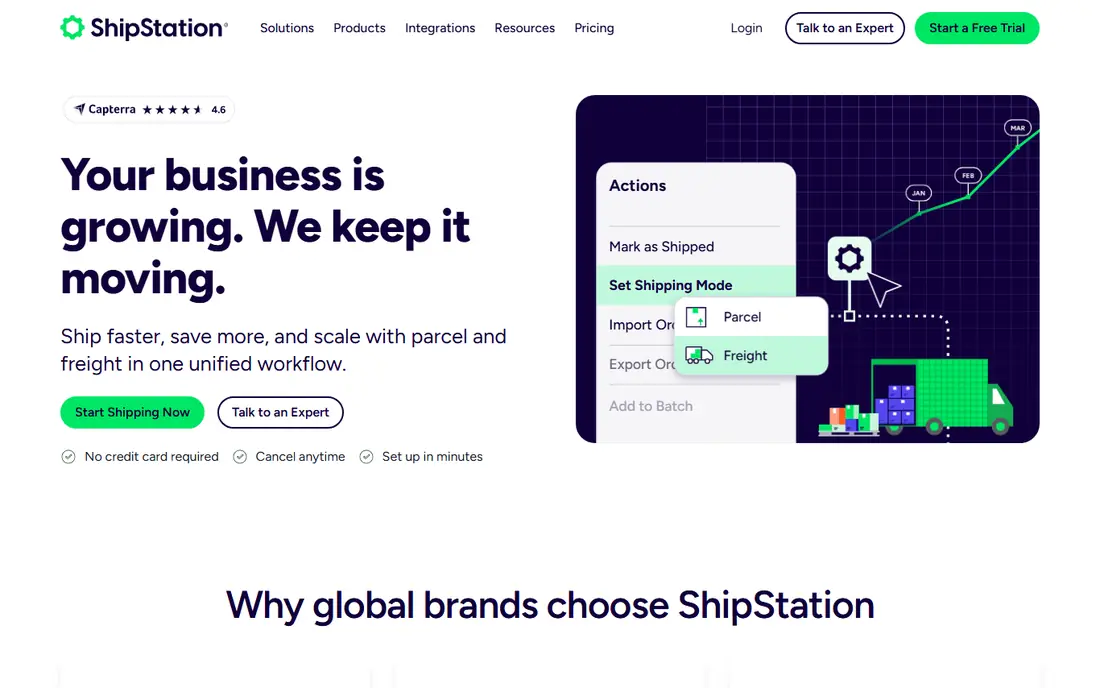
ShipStation is the workhorse for stores selling on several channels at once. Orders from Shopify, Amazon, Etsy, eBay, and other stores flow into one queue, where batch labels, automation rules, and carrier rate shopping cut the time spent on each order. That structure matters once a store passes a few hundred orders a month, because manual label buying becomes the bottleneck.
The cost is complexity and price growth. A new seller with twenty orders a month may find setup heavy, and the subscription rises as shipment volume grows. For a growing multichannel store, though, ShipStation is often the platform that scales without a switch, which is worth the early setup effort.
- Wide carrier and store integrations
- Batch labels and automation rules
- Branded tracking and returns tools
- Setup can feel heavy for a new seller
- Subscription rises with shipment volume
- API access needs higher plans

Shippo is the simplest route to discounted labels for a small or mid-sized store. A free tier covers low volume, paid Pro plans start at $19 per month, and API access is included on all plans, which helps developers and growing stores alike. Label buying, rate comparison, and tracking are straightforward, without a long setup process.
Advanced warehouse control is thinner than ShipStation, and automation rules are more basic on lower plans. For a store that mainly needs labels, rates, and tracking, that simplicity is a plus, while a store with complex warehouse workflows may outgrow Shippo sooner.
- Free tier for low volume
- Discounted carrier rates
- API access on all plans
- Simple label workflow
- Warehouse and inventory tools are limited
- Advanced automation needs a paid plan
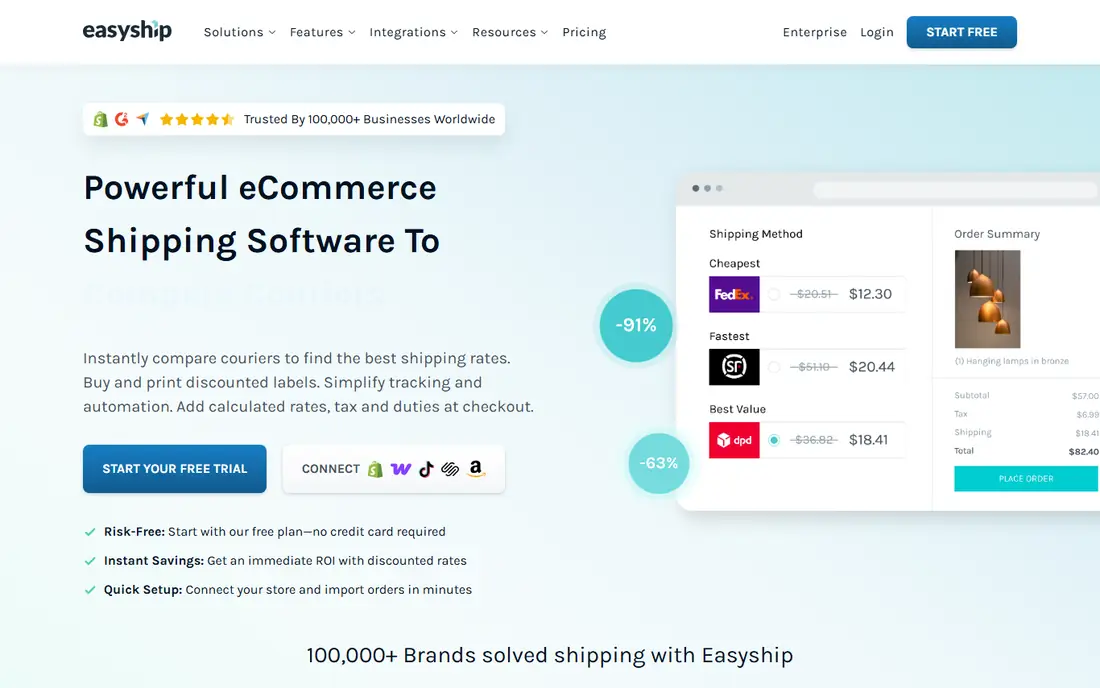
Easyship is the pick when a large share of orders crosses a border. It compares courier options, shows estimated duties and taxes, and helps with customs paperwork, which reduces surprise costs for international buyers. That visibility at checkout can cut cart abandonment, because buyers see the full landed cost before paying.
Domestic-only sellers may find Easyship less focused than a US-first tool, and paid plans start at $29 per month for higher volume. For a store where thirty percent or more of orders go abroad, the international tools justify the setup, while a purely domestic store may prefer Shippo or Pirate Ship.
- Courier comparison across many services
- Duties and tax estimates at checkout
- Customs paperwork support
- Domestic workflows feel less focused than ShipStation
- Paid plans start at $29 per month
Pirate Ship is the free tool for small sellers who ship with USPS and UPS. There is no subscription, labels are bought at discounted rates, and the workflow is simple enough for a side business or a new store. For a seller shipping a few dozen parcels a month, it can be the cheapest option by a clear margin.
The limits are carrier choice and integrations. Pirate Ship does not cover FedEx or DHL, has no API, and offers few store integrations compared with ShipStation or Shippo. A seller who needs FedEx, international couriers, or automated order imports will need a different tool, but a USPS and UPS seller may never need more.
- Free with no subscription
- Discounted USPS and UPS rates
- Simple label buying for small sellers
- Only USPS and UPS
- No API
- Few store integrations and no inventory tools
Veeqo suits Amazon and multichannel sellers who want shipping software without a subscription. Core shipping features are free, with no cap on users or shipment volume for that core use, and integrations cover Amazon, Shopify, and other major channels. Discounted carrier rates help small sellers compete on delivery cost without paying a monthly fee first.
Paid tiers add advanced features, so a growing store should check which tools sit behind a paywall before relying on them. For a seller comfortable inside the Amazon ecosystem or selling across several channels, Veeqo is a strong free starting point that can scale.
- Shipping features free with no user or volume cap on core use
- Amazon and multichannel integrations
- Discounted carrier rates
- Some advanced features sit in paid tiers
- Support and feature depth vary by plan
EasyPost is the API-first choice for teams building shipping into their own product, marketplace, or checkout. Its APIs cover rate shopping, label buying, address validation, tracking, and returns, across many carriers, with a pay-per-label model that suits variable volume. Developers get a consistent interface rather than a separate integration per carrier.
That strength is also its limit. EasyPost is not a ready-made order dashboard for a non-technical seller, and building on it needs developer time. Teams that want a visual order queue should choose ShipStation or Shippo, while teams building custom shipping logic should start with EasyPost.
- API-first design
- Many carriers
- Rate shopping, address validation, and tracking APIs
- Pay-per-label model
- Needs developer time to build on
- No full order management interface like ShipStation
ShippingEasy suits small businesses that want shipping plus customer email in one subscription. Orders can be imported, labels printed in bulk, and follow-up emails sent from the same platform, which reduces the number of tools a small team must manage. Carrier coverage includes the major US carriers, so most domestic sellers are covered.
The entry price, at $19.99 per month, is higher than free tools such as Shippo and Pirate Ship, and automation depth is thinner than ShipStation. For a small store that values the email tools and a simple workflow, that trade-off is fair, while a store that only needs labels should start free elsewhere.
- Simple label and order workflow
- Email marketing tools included
- USPS, UPS, FedEx, and DHL support
- Higher entry price than free rivals
- Advanced automation is thinner than ShipStation
AfterShip is best known for tracking, not labels, and that focus matters for stores drowning in "where is my order" messages. Branded tracking pages, delivery notifications, and returns tools give buyers a clear post-purchase experience, which can cut support tickets and repeat purchases lost to poor tracking. Label buying is available on paid plans, with entry pricing from $9 per month.
A store that mainly needs cheap labels should look at Shippo or Pirate Ship first, because AfterShip's strength is what happens after the label is bought. For a growing brand that cares about repeat orders and support load, AfterShip pairs well with a label tool, or serves as a combined tracking and returns layer.
- Branded tracking pages
- Returns and exchanges tools
- Wide carrier tracking coverage
- Label tools on paid plans
- Shipping labels are not its main strength
- Full value needs a paid plan for higher volume
Sendcloud suits stores selling into Europe or shipping from a European base. It offers carrier options across European markets, checkout rate display, a returns portal, and tracking tools in one platform, which helps a store that deals with several national carriers. That European depth is its main advantage over US-first tools.
US sellers should check coverage carefully, because Sendcloud's strength is European, not domestic US shipping. Pricing also varies by country and volume, so get a quote for your actual shipping lanes before comparing it with ShipStation or Easyship. For a European or cross-border store, it is a strong shortlist entry.
- Strong European carrier coverage
- Checkout shipping options
- Returns portal and tracking tools
- US coverage is thinner than US-first tools
- Pricing varies by country and volume
How we picked these
We compared official feature pages, pricing pages, and carrier coverage for ecommerce shipping software and services that work in October 2026, and we favored tools with clear pricing or a free tier, broad carrier support, and a track record with small and mid-sized sellers. We left out pure carrier services that do not offer store software, and we treated postage as separate from subscription cost throughout. We did not claim hands-on testing, and we marked prices as See website where vendor pricing varies by country or volume.
How to choose a shipping tool for a small business
Start with two numbers: how many orders you ship per month, and how many cross a border. Under thirty domestic orders, a free tool such as Pirate Ship or Shippo's free tier is usually enough. Over a few hundred orders, or across several sales channels, a paid platform such as ShipStation or Veeqo saves more time than it costs, and international volume points toward Easyship or Sendcloud.
Compare the all-in cost, not just the subscription
A free tool with higher postage can cost more than a paid tool with better carrier discounts, once volume rises. Model a month of real orders, including box sizes, weights, destinations, and return rates, and compare postage plus subscription across two tools. Watch for per-label fees on your own carrier accounts, dimensional weight surcharges, and residential delivery fees, because those items change the total fast.
Test automation with real orders
Import a week of real orders into a trial and test batch labels, automation rules, and tracking notifications. Check how the tool handles split shipments, out-of-stock items, and returns, because those edge cases cause most daily friction. A tool that looks clean on ten orders can struggle at two hundred, so a real-order test is worth more than a demo.
Keep the buyer experience in mind
Branded tracking, clear delivery estimates, and an easy returns process affect repeat orders as much as label price. AfterShip and similar tracking tools help here, and even a simple tool should send tracking updates buyers can follow without contacting support. A slightly higher label cost can pay for itself if it cuts support messages and lost repeat sales.
Frequently asked questions
What is the best shipping company for ecommerce?
ShipStation is the best ecommerce shipping company for multichannel sellers at scale, while Shippo and Pirate Ship are best for small sellers that want low-cost labels. Easyship is best for international orders, Veeqo is best for Amazon sellers, and EasyPost is best for developer-led teams. The best pick depends on order volume and carrier mix.
What is the best small business shipping software?
Shippo and Pirate Ship are the best small business shipping software options for low volume, because both offer free starting tiers with discounted rates. Veeqo is also free for core shipping, while ShippingEasy suits small stores that want email tools as well. Start free, then move to ShipStation when automation and batch volume justify a subscription.
Is ShipStation or Shippo better?
ShipStation is better for growing multichannel businesses that need advanced automation, multi-warehouse support, and batch processing at scale. Shippo is better for smaller operations that want simple labels, API access on every plan, and a free tier. ShipStation starts at $14.99 per month, while Shippo starts free, so volume and automation needs usually decide the winner.
How much does ecommerce shipping software cost?
Costs range from free for Pirate Ship, Shippo's free tier, and Veeqo's core shipping, to $14.99 per month for ShipStation, $19 per month for Shippo Pro, and $19.99 per month for ShippingEasy. Postage is always extra, and per-label fees, carrier discounts, and volume tiers change the total. Model a real month of orders before choosing on price alone.
Can shipping software handle international orders?
Yes, Easyship and Sendcloud are built for international shipping, with courier comparison, duty estimates, and customs paperwork support. ShipStation, Shippo, and EasyPost also support international labels and tracking, though their international tools vary by carrier. Check duty, tax, and customs coverage for your specific destination countries before committing.
Sources
See where you really rank - block by block
ProMapRanker scans Google Maps across a grid of your service area. Simple monthly plans from $19, white-label on every plan.
Start freeKeep reading
 zscaler alternatives
Best Zscaler Alternatives in 2026
Looking for zscaler alternatives? We compare 9 SASE and zero trust platforms on architecture, data protection, pricing, and fit for your network and team.
Read → zapier alternatives free
Best Zapier Alternatives Free in 2026
Nine automation tools for zapier alternatives free in 2026, all with genuinely free tiers, plus free plan limits, starting prices and upgrade paths explained.
Read → which platform is best for online reputation
Which Platform Is Best for Online Reputation in 2026
Wondering which platform is best for online reputation? We compare 8 review, listing, and response tools for small and multi-location businesses and agencies.
Read →