 ProMapRanker
Best Ecommerce Fulfillment Services in 2026


Scaling DTC brands who want a wide network · Pricing starts at: See website
Key takeaways
- Most leading providers price by custom quote, so a like for like quote on your real order mix matters more than a published rate card.
- Warehouse location decides delivery speed: a distributed network helps two day delivery, while a single site suits low volume brands.
- Subscription and kitting strengths differ sharply, so brands with bundles or boxes should shortlist on that skill, not on general claims.
- Returns handling and inventory visibility are easy to overlook in a demo, yet they drive support tickets after launch.
Quick comparison
| Pick | Great for | Pricing starts at | Free tier | |
|---|---|---|---|---|
| ShipBob | Scaling DTC brands who want a wide network | See website | No | Visit |
 ShipMonk | Subscription and bundle brands who need kitting | See website | No | Visit |
 Red Stag Fulfillment | Brands selling heavy, bulky or high value goods | See website | No | Visit |
 Stord | Omnichannel brands who want a wider supply chain platform | See website | No | Visit |
 Flexport | Importers who want freight plus domestic fulfilment | See website | No | Visit |
 ShipHero | Tech led brands who want software driven fulfilment | See website | No | Visit |
 eFulfillment Service | Small US startups who want no minimums | See website | No | Visit |
 DCL Logistics | Tech and consumer brands with complex kitting | See website | No | Visit |
The best ecommerce fulfillment services
We compared official feature pages, pricing pages and public documentation for each option below. Our pick for most readers is the option that balances cost, control and ease of use, but the right choice still depends on your size, your assets and how much work you want to manage yourself.

Our first look at this option starts with who it suits best. ShipBob is the broadest choice for scaling direct to consumer brands, with a large fulfilment network and strong Shopify integration. Its strength is reach: distributed stock can cut delivery times for customers in different regions without building your own warehouses.
Ask for a quote based on your actual SKU count, order volume and return rate, since those inputs move the total more than any headline rate. The catch is price structure: receiving, storage and fulfilment are billed separately, so compare the total quote for your order mix, not one line item. Read the fee page and the exit rules before you commit any funds or sign a contract.
- Large network across US and other markets
- Shopify and marketplace integrations
- Inventory and order dashboard
- Custom quote pricing
- Receiving and storage billed separately
- Minimums may apply for some programmes

This is the option to shortlist first if your main concern is control. ShipMonk suits brands built on subscriptions, bundles and kits, where assembly accuracy matters as much as shipping speed. Its strength is operational focus: kitting, subscription handling and multi channel order flow are core to the service, not add ons.
Send a sample bundle and a subscription schedule during evaluation, so accuracy and timing are tested on real work. The catch is minimums: a volume tied monthly minimum can be a poor fit for a brand with sharp seasonal swings, so check how it handles quiet months. Check the current terms on the vendor site before you decide, since terms change often.
- Subscription box and kitting strengths
- Multi channel integrations
- Automation heavy workflows
- Monthly minimum tied to volume in many cases
- Pricing varies by SKU mix
- Onboarding needs accurate inventory data
Red Stag Fulfillment
Great for: Brands selling heavy, bulky or high value goods
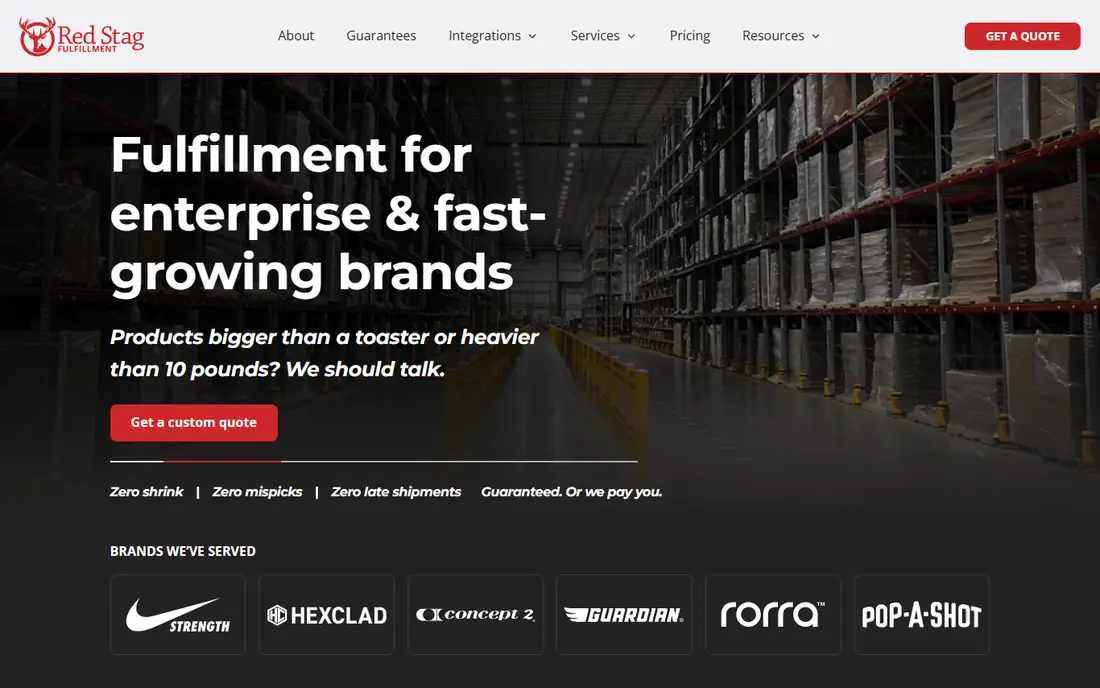
For readers who want a clear starting point, this option gives one. Red Stag is the specialist for heavy, bulky and high value products, where damage and mispicks cost far more than a standard parcel. Its strength is accuracy and protection: guarantees and careful packaging are built around goods that cannot be replaced cheaply.
If your products are light and standard, a general provider may be cheaper; if they are heavy or fragile, Red Stag earns its premium. The catch is network size: with fewer sites than the largest providers, two day reach may be narrower, so check delivery times for your customer map. Ask for a demo or a written quote so the final cost is clear before you commit.
- Accuracy guarantees with money back terms
- Care for heavy and fragile items
- Strong packaging protection
- Fewer warehouse locations than the largest networks
- Monthly minimum spend may apply
- Less suited to tiny order counts
We put this option on the list because it solves a specific problem well. Stord is a cloud supply chain platform that combines fulfilment with wider logistics tools, suited to brands selling across several channels. Its strength is breadth: orders from your store, marketplaces and retail can flow through one system instead of several separate tools.
Shortlist Stord when channel growth and supply chain visibility are already problems, not just future plans. The catch is scope: a small brand that only needs pick, pack and ship may pay for platform depth it does not use yet. Compare it side by side with one other option on this list before you choose.
- Multi node US network plus wider supply chain tools
- Omnichannel order handling
- Freight and fulfilment under one roof
- Custom quote pricing
- Platform breadth may be more than a small brand needs
- Integration scope needs scoping
If you value simplicity over a long feature list, start here. Flexport, which acquired Shopify Logistics including Deliverr, suits importers who want freight and domestic fulfilment from one provider. Its strength is the joined up chain: ocean and air freight, customs context and last mile fulfilment can be planned together.
If you only ship domestic stock and never import, a domestic only provider may be simpler and cheaper. The catch is the minimum: a reported minimum monthly fulfilment spend makes it a poor fit for very small brands, so confirm the current threshold in writing. Test the core workflow with a small amount first, then scale up if it works for you.
- Global freight plus US fulfilment network
- Prep services
- End to end supply chain visibility
- Minimum monthly fulfilment spend reported since early 2026
- Freight led model may suit domestic only brands less
- Quote based pricing
This option earns its place through a focused job it does well. ShipHero appeals to brands that want software to drive warehouse work, with strong multi channel sync and inventory visibility. Its strength is system depth: order, inventory and warehouse data stay in sync, which helps teams that manage many SKUs across channels.
Test the dashboard with your real SKU and channel mix, since a clean demo with ten products hides the hard parts. The catch is people: software depth helps most when your operations team can use it well, so a very small team may not get full value at first. Confirm the limits, fees and support hours on the official site before you sign up.
- Software led warehouse operations
- Multi channel sync
- Inventory visibility across sites
- Pricing is quote based
- Software depth needs a capable ops team
- Network fit depends on your sites
For teams that want depth rather than breadth, this one stands out. eFulfillment Service is a clear small brand option, with no order minimums, no setup fees and no long term contracts stated on its site. Its strength is low friction: a new brand can start without a volume commitment or a long contract, which keeps early risk low.
For a brand testing demand, that trade-off is often worth it; for a brand promising two day delivery nationwide, it is not. The catch is reach: shipping from one Michigan warehouse means delivery times will vary by customer location, so check times for your main markets. Keep a note of the cancellation terms so you are not caught out later.
- No order minimums and no setup fees stated
- No long term contracts stated
- Single Michigan warehouse with simple pricing
- Single warehouse limits two day national reach
- Smaller network than large providers
- Service scope is narrower
We included this option for readers with a narrower, well defined need. DCL Logistics suits consumer electronics and tech brands where kitting, configuration and careful handling matter. Its strength is complex work: multi item kits, bundles and retail style prep are handled as core operations, not as exceptions.
Send your hardest kit, not your easiest product, during evaluation, since that is where fulfilment quality shows. The catch is price clarity: with a custom quote and no published per order rate, you need a detailed quote to compare DCL fairly. Run a short trial with real work before you move a full workload onto it.
- Complex kitting and fulfilment experience
- US sites plus wider coverage
- FBA prep support
- Custom quote pricing with no published per order rate
- Enterprise leaning setup
- Smaller brands may find onboarding heavy
How we picked these
We started from the topic itself and kept only options that exist and work in October 2026 and that truly fit the need in the title. We read official pricing and feature pages, app store listings where relevant, and public reviews, and we left out options whose pricing or core claims we could not check. Where a price was not published, we wrote See website rather than guessing a number.
We also weighed who each option suits, what it does well, and where it falls short. A well known name did not earn a place on its own, and a smaller option earned one when its fit was clear. We did not claim hands-on testing we did not do, and we note limits plainly so you can judge the trade-off for yourself.
How to choose an ecommerce fulfillment service
Start with your customer map and your product. List where most orders go, how heavy and fragile your goods are, and how many SKUs you hold. A distributed network helps national two day delivery, a specialist helps heavy goods, and a kitting expert helps bundles. Choosing on price alone often leads to a provider that is cheap for standard parcels and weak for your actual products.
Next, get a total quote on real numbers: monthly orders, average items per order, SKU count, storage volume, return rate and peak month volume. Ask about receiving fees, storage tiers, pick fees, packaging, returns handling and account management, since each can change the total. Finally, test onboarding with a small stock transfer before you move all inventory, and confirm how inventory counts, damage claims and support response times are handled in writing.
Frequently asked questions
How much does ecommerce fulfillment cost?
Most providers price by custom quote, based on receiving, storage, pick and pack, shipping and returns. Published per order figures from roundups often exclude one or more of those lines, so request a total quote on your real order mix. A provider that looks cheap on pick fees may be expensive on storage or receiving.
Should I choose one warehouse or a distributed network?
It depends on delivery promises and order volume. One warehouse is simpler and cheaper for low volume brands, while a distributed network cuts transit time for national customers. Map your orders by region first: if most customers sit in one area, one well placed site may already give fast delivery.
What is the difference between a 3PL and Shopify Fulfillment?
A third party logistics provider, or 3PL, is an outside firm that stores and ships your goods. Shopify Fulfillment is a fulfilment network linked to Shopify, now tied to Flexport after its acquisition of Shopify Logistics. A 3PL can serve many platforms, while a platform tied network may fit best if you sell mainly on that platform.
Do fulfillment services handle returns?
Most do, but the depth varies. Some only receive and restock returns, while others inspect, grade, repack and report return reasons. If returns are a large share of your orders, ask for the exact inspection and restock process, and for return shipping cost handling, before you sign.
How long does it take to switch fulfillment providers?
Switching usually takes weeks, not days, because inventory must transfer, SKUs must map, integrations must be tested and staff must learn new processes. Plan a phased move with a small stock transfer first, and keep your old provider running until the new one proves accuracy on live orders.
Sources
See where you really rank - block by block
ProMapRanker scans Google Maps across a grid of your service area. Simple monthly plans from $19, white-label on every plan.
Start freeKeep reading
 zscaler alternatives
Best Zscaler Alternatives in 2026
Looking for zscaler alternatives? We compare 9 SASE and zero trust platforms on architecture, data protection, pricing, and fit for your network and team.
Read → zapier alternatives free
Best Zapier Alternatives Free in 2026
Nine automation tools for zapier alternatives free in 2026, all with genuinely free tiers, plus free plan limits, starting prices and upgrade paths explained.
Read → which platform is best for online reputation
Which Platform Is Best for Online Reputation in 2026
Wondering which platform is best for online reputation? We compare 8 review, listing, and response tools for small and multi-location businesses and agencies.
Read →