 ProMapRanker
Best Ecom Fulfillment Companies in 2026

Key takeaways
- Ecom fulfilment is judged on network, software and total landed cost together, since a fast network with poor inventory data still creates stockouts.
- ShipBob suits Shopify-first brands that need distributed stock, while Flowspace suits mid-market omnichannel brands that need order routing across channels.
- Stord suits larger, complex brands, while ShipMonk suits direct-to-consumer brands with subscription and kitting needs.
- Fulfilment pricing depends on volume, storage, pick and pack and shipping, so compare on total landed cost, not headline rates.
Quick comparison
| Pick | Great for | Pricing starts at | Free tier | |
|---|---|---|---|---|
 ShipBob | Shopify-first DTC brands | See website | No | Visit |
 Flowspace | Mid-market omnichannel brands | See website | No | Visit |
 Stord | Complex larger brands | See website | No | Visit |
 ShipMonk | DTC and subscription brands | See website | No | Visit |
 ShipHero Fulfillment | Hybrid warehouse brands | See website | No | Visit |
 Fulfillment by Amazon | Amazon-first sellers | See website | No | Visit |
 Flexport | International and marketplace brands | See website | No | Visit |
 ShipNetwork | Distributed US brands | See website | No | Visit |
 Red Stag Fulfillment | Heavy and high-value ecom goods | See website | No | Visit |
The best ecom fulfillment companies
Ecom fulfilment covers storage, pick and pack, shipping, returns and the software that connects a store to a warehouse network. We compared official service pages, network footprints, channel integrations and public reviews for the providers below, focusing on Shopify and marketplace selling, omnichannel routing, and the needs of brands at different sizes. A plain note first: fulfilment pricing depends on volume, storage, pick and pack and shipping, so compare on total landed cost, not headline rates.
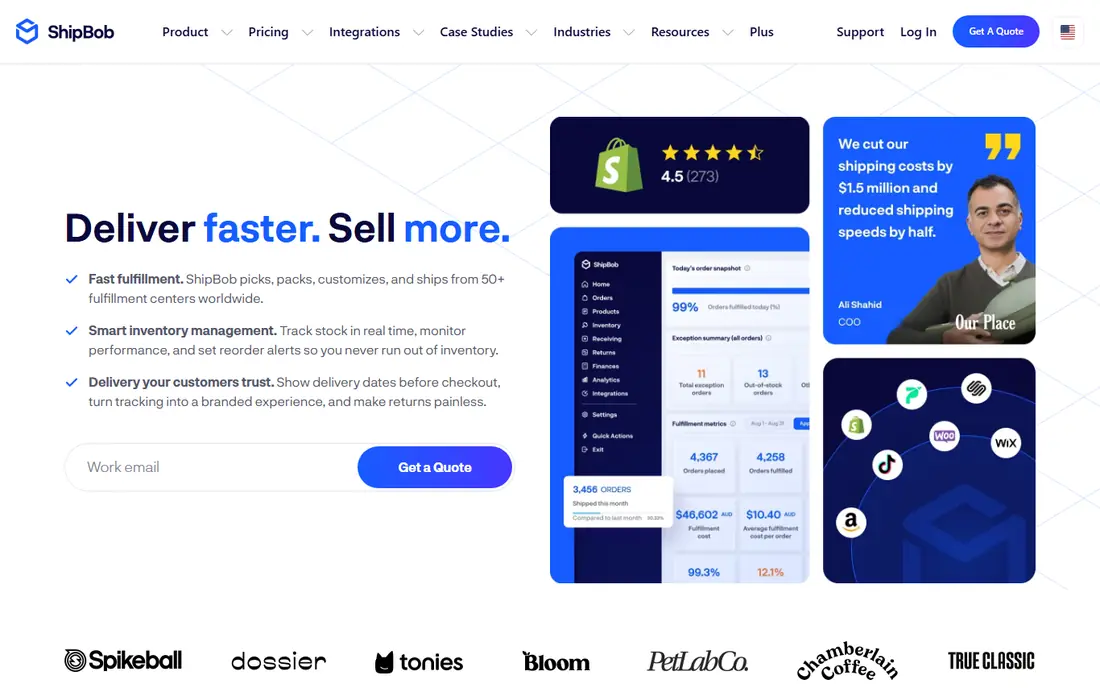
ShipBob is the most common shortlist entry for a Shopify-first brand that wants faster delivery without building warehouses. Its network spreads stock across regions, its software pulls orders from Shopify, Amazon and other channels, and its forecasting tools help a brand plan replenishment before peaks. That combination suits direct-to-consumer brands that have proven demand and want to scale delivery speed.
Total cost needs a full quote, since pick, pack, storage, receiving and shipping are separate lines. Brands with very low volume should check minimums and implementation fees, and brands with complex kitting should test that workflow early. ShipBob fits growing DTC brands that value network reach and Shopify depth.
- Wide US and international network
- Strong Shopify and multichannel integrations
- Inventory forecasting tools
- Quote-based pricing
- Multi-node stock adds forecasting work
- Support tiers vary by plan
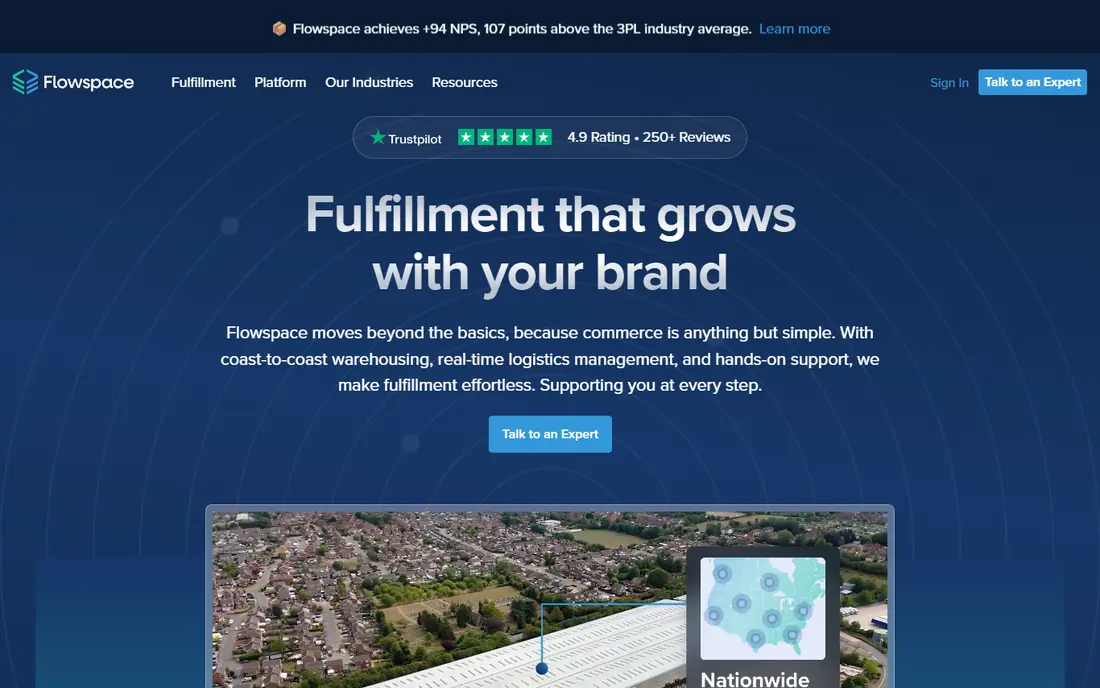
Flowspace suits a mid-market brand selling direct, through retail and through marketplaces at the same time. Its order management system routes each order to the best fulfilment node, and its Shopify sync keeps inventory and order status aligned across channels. Daily itemised billing, as described on its site, helps finance teams see costs clearly rather than waiting for a monthly lump sum.
Complexity is the trade-off. A small brand with one channel and one simple product may not need order routing, and the sales process will take longer than a self-serve signup. Flowspace fits brands whose channel mix has outgrown a single-warehouse approach.
- Order management and routing across channels
- Shopify sync
- Distributed fulfilment network with daily itemised billing claims
- Quote-based pricing
- More complex than a single-warehouse provider
- Smaller brand profile than ShipBob
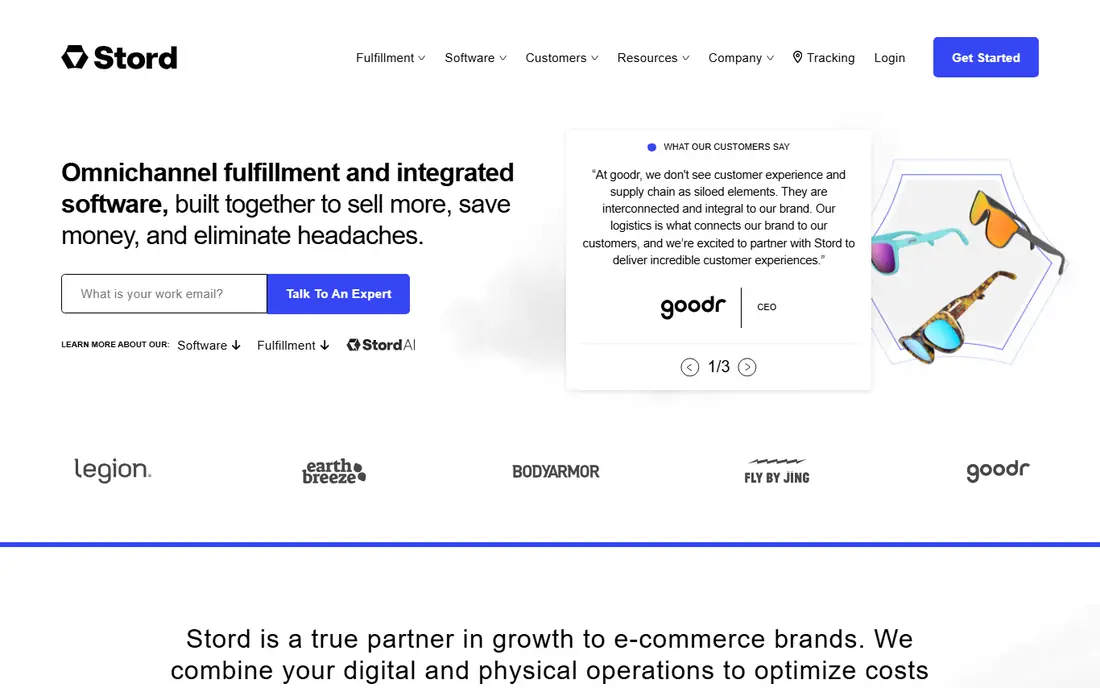
Stord suits larger brands with complex needs, including retail compliance, business-to-business orders alongside direct orders, and returns that must be processed at scale. Its platform combines order management, warehousing and transport visibility, which helps a brand that has outgrown a simple third-party warehouse. Integrated returns reduce the manual work of handling exchanges and restocking.
Small brands should look elsewhere. Stord pricing and onboarding assume a larger operation, and a small catalogue will not use its depth. It fits brands that already ship at scale and need one system to coordinate several channels and fulfilment partners.
- Omnichannel order management
- Integrated returns
- Multichannel inventory visibility for larger brands
- Enterprise-leaning pricing and onboarding
- Overkill for small brands
- Complexity needs internal ownership
ShipMonk suits direct-to-consumer brands built around subscriptions, bundles and repeat orders. Its software handles recurring shipments and kit assembly, and real-time sync keeps store inventory aligned with warehouse stock. Returns support helps brands in categories where exchanges are common.
A monthly minimum means very small brands should confirm fit before starting. Complex catalogues also need careful setup to avoid mispicks. ShipMonk fits DTC brands that will use its subscription and kitting depth, rather than brands shipping one simple product.
- Subscription and kitting strength
- Real-time sync with store platforms
- Returns support
- Monthly minimum applies
- Complex catalogues need careful setup
- Support is shared on many plans
ShipHero is best understood as a warehouse software platform with a fulfilment network, rather than a pure hands-off provider. Brands that run their own warehouse, or a hybrid of own and outsourced sites, get detailed picking, packing, receiving and returns workflows with Shopify sync. That control appeals to operators who want to keep a hand on warehouse processes.
Brands that want to hand off everything and never think about warehouse workflows may find ShipHero more involved than a fully managed provider. Pricing also varies by whether the brand uses software, fulfilment or both. ShipHero fits hybrid operators that value warehouse control alongside outsourced capacity.
- Warehouse software plus fulfilment network
- Shopify integration
- Detailed picking, packing and returns workflows
- Software-led model needs warehouse expertise for hybrid use
- Pricing varies by model
- Not a simple hands-off choice for every brand
Fulfillment by Amazon, known as FBA, suits sellers whose main channel is Amazon and who want Prime delivery without building a network. Amazon stores, picks, packs and ships orders, handles customer service for those orders, and gives listings Prime eligibility. Multi-channel fulfilment also lets sellers ship non-Amazon orders from Amazon stock, though fees apply.
Control is limited. Branded packaging, custom inserts and post-purchase emails are restricted, and inventory performance rules can trigger storage surcharges when stock moves slowly. FBA fits Amazon-first sellers who accept those limits in exchange for Prime speed and scale.
- Prime eligibility for listed inventory
- Huge warehouse network
- Customer service and returns handling included for Amazon orders
- Storage fees and inventory performance rules can bite
- Limited branded packaging and post-purchase control
- Multi-channel fees add up
Flexport suits brands that combine international freight with US fulfilment, since it can move goods across borders and then fulfil domestic orders from US warehouses. Its Deliverr heritage adds marketplace fulfilment, including Walmart and Amazon badge support, which matters for brands that sell heavily on marketplaces. That end-to-end scope helps brands that previously juggled a freight forwarder and a warehouse separately.
Domestic-only brands with simple needs may find Flexport more complex than necessary. Pricing is programme-based, so a full quote is needed. Flexport fits brands with an international supply chain and a marketplace-heavy sales mix.
- Freight, customs and destination fulfilment in one provider
- Marketplace badge support through its Deliverr heritage
- Multichannel fulfilment
- More complex than a domestic-only warehouse
- Pricing is programme-based
- Smaller domestic-only brands may not need the freight depth
ShipNetwork suits US brands that want stock distributed across several hubs for faster delivery, without needing a global network. Its accuracy claims and platform integrations cover the core needs of a mid-volume ecom brand, and its hub model helps on delivery speed to different US regions. That focus makes it a practical alternative to ShipBob for US-centred brands.
Minimums and quoted pricing mean small brands should check fit early. International coverage is thinner than ShipBob, so brands with strong overseas sales may need a second provider. ShipNetwork fits mid-volume US brands that prioritise domestic speed and accuracy.
- Multiple US hubs
- Accuracy guarantee claims
- Integrations with major ecom platforms
- Higher volume minimums reported
- Quote-based pricing
- Less international depth than ShipBob
Red Stag suits ecom brands whose products break the standard parcel model, including heavy equipment, furniture parts and high-value goods. Its two US facilities focus on careful handling, and its guarantees cover mispicks, shrinkage and late shipments in financial terms. For a brand where one damaged shipment can cost a customer, that handling is worth a premium.
Lightweight, low-value parcels are a poor fit, since general providers will be cheaper. Red Stag fits ecom brands whose products are heavy, bulky, fragile or valuable enough to justify specialist fulfilment.
- No weight limit advertised
- Financially backed accuracy guarantees
- Strong for fragile, heavy and high-value ecom items
- Premium pricing
- Minimums around 200 orders a month reported
- Poor value for cheap lightweight parcels
How we picked these
We compared official service pages, network footprints, channel integrations, pricing models and public reviews, and we favoured providers with a live ecom fulfilment offering in October 2026. Where pricing is quoted, we wrote See website instead of inventing a per-order figure. Fulfilment pricing depends on volume, storage, pick and pack and shipping, so total landed cost, not headline rates, should drive the final choice.
How to choose an ecom fulfilment partner on total cost and service
Start with your channel mix and product profile, then shortlist providers that match both. A Shopify-first brand, a marketplace-heavy brand and a heavy-goods brand need different networks, even when their order counts look similar. Ask each provider for a full fee schedule built from your real order, storage and return numbers.
Run a trial with real orders before moving all stock. Check pick accuracy, packaging, tracking updates, delivery times by region and returns handling. Confirm service levels, mispick remedies and exit terms in writing. A provider that performs well on a trial is a safer bet than one that only looks good in a sales deck.
Questions to ask before signing
Ask how inventory counts are done, how discrepancies are resolved, and how fast stock can be returned if you leave. Ask what happens during peak weeks, and whether capacity is reserved or shared. Get peak surcharges, return fees and storage tiers in writing before comparing headline pick fees.
Frequently asked questions
What is the difference between ecom fulfilment and ShipBob alone?
Ecom fulfilment is the service category, covering storage, pick and pack, shipping and returns for online stores. ShipBob is one provider in that category, alongside ShipMonk, Flowspace, Stord and others. Compare providers on network, software and total cost, not on brand familiarity alone.
Which ecom fulfilment company is best for Shopify stores?
ShipBob and Flowspace both offer strong Shopify sync, with ShipBob suiting Shopify-first direct brands and Flowspace suiting mid-market omnichannel brands. ShipMonk also suits Shopify brands with subscription or kitting needs. Test the Shopify integration with real orders before committing.
How much does ecom fulfilment cost?
Cost depends on order volume, items per order, product size and weight, storage volume, shipping zones and return rates. Most providers price by quote, so a total landed cost built from your own numbers is the only reliable comparison. Headline pick fees alone will mislead.
Should I use Fulfillment by Amazon or a third-party provider?
FBA suits Amazon-first sellers who want Prime speed and scale and who accept limited branding control. A third-party provider suits brands that sell across many channels and want branded packaging and more control. Some brands use both, with FBA for Amazon and a third party for direct orders.
Can ecom fulfilment handle international shipping?
Yes, but coverage varies. ShipBob and Flexport offer international networks, while US-focused providers may need a partner for overseas delivery. Confirm duties, customs handling and delivery times for each destination country before promising international shipping to customers.
How do I switch ecom fulfilment providers without disruption?
Plan the switch around a quiet period, move a test batch first, and keep buffer stock at the old provider until the new one proves accuracy. Confirm data export, inventory transfer and returns handling in advance. A phased move beats a single-day cutover for most brands.
Sources
See where you really rank - block by block
ProMapRanker scans Google Maps across a grid of your service area. Simple monthly plans from $19, white-label on every plan.
Start freeKeep reading
 worlds best local seo company
8 Worlds Best Local SEO Companies for Map Pack Growth in 2026
Compare the worlds best local seo company options for Google Business Profile work, citations, reviews, and multi-location rankings and reporting in 2026.
Read → world's best web hosting company
World's Best Web Hosting Company in 2026
Searching for the world's best web hosting company? We compared 10 hosts on price, renewal rates, speed, and support to help you choose well today in 2026.
Read → who's got the best nanny tax services
Who's Got the Best Nanny Tax Services in 2026
We answer who's got the best nanny tax services, comparing full filing, back taxes, software, and pricing so families can handle nanny taxes correctly.
Read →