 ProMapRanker
Best Earthquake App in 2026: 8 Apps Compared


Early warning in the US West Coast states · Pricing starts at: Free
Key takeaways
- MyShake is the strongest early warning option in California, Oregon and Washington, where ShakeAlert coverage applies.
- QuakeFeed, LastQuake and My Earthquake Alerts suit users who want worldwide maps and custom alerts.
- Earthquake Network adds crowdsourced and sensor-based detection, which can help in areas with thinner official coverage.
- Use official government alerts alongside any app, and keep phone emergency alerts turned on.
Quick comparison
| Pick | Great for | Pricing starts at | Free tier | |
|---|---|---|---|---|
| MyShake | Early warning in the US West Coast states | Free | Yes | Visit |
 QuakeFeed | Worldwide maps and custom alerts on iPhone | Free | Yes | Visit |
 LastQuake | Verified info and felt reports from seismologists | Free | Yes | Visit |
 Earthquake Network | Crowdsourced and sensor-based alerts | Free | Yes | Visit |
 My Earthquake Alerts | Simple worldwide alerts and maps | Free | Yes | Visit |
 Earthquake Alert | Real-time worldwide notifications | Free | Yes | Visit |
 Earthquake Plus Alerts and Tracker | Worldwide tracking with tsunami warnings | Free | Yes | Visit |
 SASSLA | Early warning alerts in Mexico | Free | Yes | Visit |
The best earthquake apps
No app can predict earthquakes. That point matters, because any app that claims to tell you when a quake will happen should not be trusted. The apps below cover alerts after detection, maps of recent activity, safety information and felt reports. They draw on seismic networks and, in some regions, early warning systems that can give seconds of warning after a quake has started, not a forecast days ahead.

It fits people in the US West Coast states who want an official early warning app. MyShake delivers ShakeAlert powered early warnings in California, Oregon and Washington, where the system is live. In practice, that means the MyShake experience is shaped by its early warning in the us west coast states focus, not by trying to cover every possible use case at once.
Outside those states, it still offers earthquake information, but it cannot give the same early warning. That trade-off is worth weighing before you commit, because the right choice depends more on how you will use it week to week than on any single feature. Check the current plan details on the official site before you sign up, since pricing and feature limits change. If that balance sounds right, MyShake is worth a closer look. If not, another entry here may match your routine better.
- ShakeAlert powered early warnings
- Developed with UC Berkeley
- Felt reports
- Early warning coverage is limited to California, Oregon and Washington
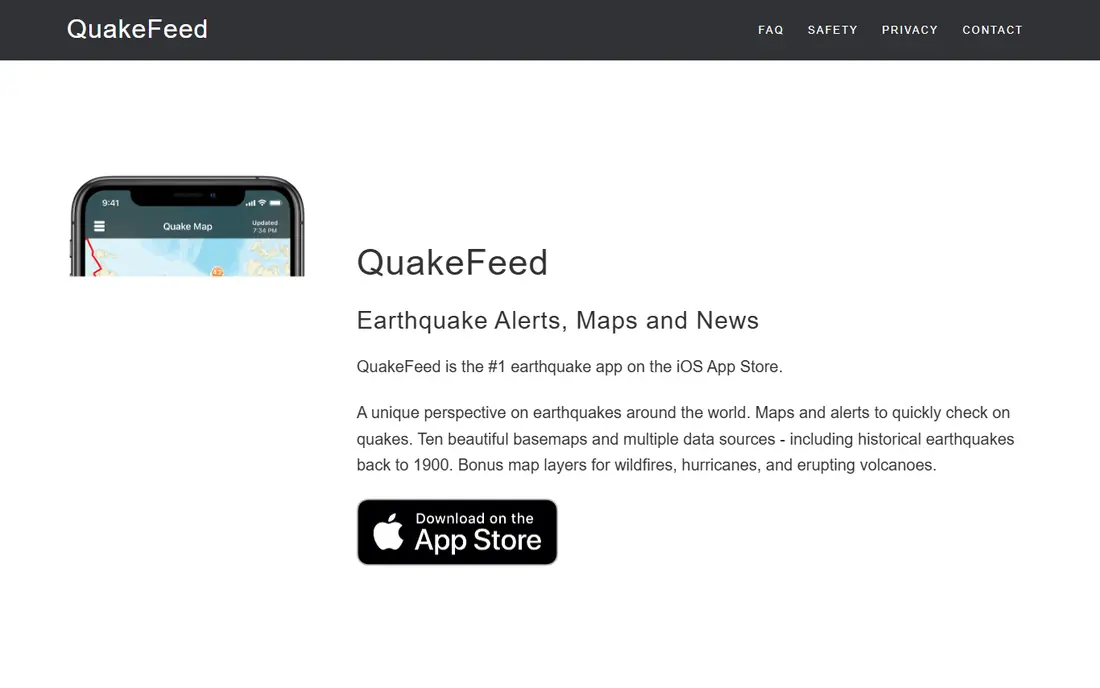
QuakeFeed gives iPhone users detailed worldwide earthquake maps, custom alerts and hazard layers. It fits iPhone users who want detailed maps and control over which quakes trigger an alert. In practice, that means the QuakeFeed experience is shaped by its worldwide maps and custom alerts on iphone focus, not by trying to cover every possible use case at once.
The depth of options is a strength for enthusiasts and a lot to learn for casual users. We would still put it on a shortlist for readers who match the use case above, but it is not the pick for everyone. Compare it directly with the next options on this list before deciding. If that balance sounds right, QuakeFeed is worth a closer look. If not, another entry here may match your routine better.
- Worldwide maps
- Custom filters by region and magnitude
- Fault lines and 3D globe
- IPhone focused
- Interface can feel crowded for new users

For readers who fit this profile, it fits users who want trusted information during and after a widely felt earthquake. LastQuake is run for the public by seismologists and gives verified earthquake information plus felt reports from users. In practice, that means the LastQuake experience is shaped by its verified info and felt reports from seismologists focus, not by trying to cover every possible use case at once.
It is best as an information and safety app, not as a replacement for a regional early warning system. The limits matter less if you mainly need the core job done well, and more if you want every extra feature in one place. Read the plan page carefully before you commit. If that balance sounds right, LastQuake is worth a closer look. If not, another entry here may match your routine better.
- Data from the European-Mediterranean Seismological Centre
- Felt reports
- Safety advice
- Some features are Europe focused
- Early warning is not its main job
It fits travellers and residents in seismic areas who want fast, community-based alerts. Earthquake Network uses phone sensors and user reports alongside network data to issue alerts. In practice, that means the Earthquake Network experience is shaped by its crowdsourced and sensor-based alerts focus, not by trying to cover every possible use case at once.
Crowdsourced detection can help where sensor networks are thin, but it is not the same as an official early warning system. That trade-off is worth weighing before you commit, because the right choice depends more on how you will use it week to week than on any single feature. Check the current plan details on the official site before you sign up, since pricing and feature limits change. If that balance sounds right, Earthquake Network is worth a closer look. If not, another entry here may match your routine better.
- Smartphone sensor and crowdsourced detection
- Real-time alerts
- Emergency chat in affected zones
- Alert quality can vary by region and phone coverage
- Not a government early warning system
My Earthquake Alerts is a straightforward app for worldwide earthquake tracking and push alerts. It fits users who want a simple, customisable alert app without extra hazard layers. In practice, that means the My Earthquake Alerts experience is shaped by its simple worldwide alerts and maps focus, not by trying to cover every possible use case at once.
It does not try to be an early warning system, so it suits information and monitoring rather than seconds-ahead warnings. We would still put it on a shortlist for readers who match the use case above, but it is not the pick for everyone. Compare it directly with the next options on this list before deciding. If that balance sounds right, My Earthquake Alerts is worth a closer look. If not, another entry here may match your routine better.
- Worldwide tracking
- Push alerts
- Custom magnitude and location settings
- Historical data
- Paid Pro version needed for some features
- Design is functional rather than polished
For readers who fit this profile, it fits users who want fast worldwide notifications with simple controls. Earthquake Alert delivers real-time notifications from multiple seismic sources, with maps and custom thresholds. In practice, that means the Earthquake Alert experience is shaped by its real-time worldwide notifications focus, not by trying to cover every possible use case at once.
It is an information app, so users in early warning regions should still use an official early warning option alongside it. The limits matter less if you mainly need the core job done well, and more if you want every extra feature in one place. Read the plan page carefully before you commit. If that balance sounds right, Earthquake Alert is worth a closer look. If not, another entry here may match your routine better.
- Real-time notifications worldwide
- Interactive maps
- Custom magnitude thresholds
- Feature set varies by platform
- Some features need a paid upgrade
Earthquake Plus Alerts and Tracker
Great for: Worldwide tracking with tsunami warnings
It fits users who want worldwide tracking plus volcanic and tsunami context in one app. Earthquake Plus Alerts and Tracker combines data from several sources, including USGS and EMSC, with tsunami warnings. In practice, that means the Earthquake Plus Alerts and Tracker experience is shaped by its worldwide tracking with tsunami warnings focus, not by trying to cover every possible use case at once.
The range of data is useful, but users should set magnitude and location filters to avoid too many alerts. That trade-off is worth weighing before you commit, because the right choice depends more on how you will use it week to week than on any single feature. Check the current plan details on the official site before you sign up, since pricing and feature limits change. If that balance sounds right, Earthquake Plus Alerts and Tracker is worth a closer look. If not, another entry here may match your routine better.
- Data from USGS, EMSC and other sources
- Tsunami warnings
- Time-lapse views
- Interface has many layers for new users
- Alert settings need care to avoid noise
SASSLA is a regional app for Mexico that works with the Mexican seismic alert system. It fits residents and visitors in Mexico who want regional early warning information. In practice, that means the SASSLA experience is shaped by its early warning alerts in mexico focus, not by trying to cover every possible use case at once.
It is a regional tool, so travellers should use it alongside a worldwide tracker when they leave Mexico. We would still put it on a shortlist for readers who match the use case above, but it is not the pick for everyone. Compare it directly with the next options on this list before deciding. If that balance sounds right, SASSLA is worth a closer look. If not, another entry here may match your routine better.
- Mexican seismic alert system integration
- Regional early warning focus
- Safety information
- Mexico focused
- Not useful as a worldwide tracker outside Mexico
How we picked these
We compared official app pages, seismic agency pages and app store listings, and we kept only apps that are live in October 2026 and clearly focused on earthquake alerts or information. We favoured apps that use official seismic data and that do not claim prediction. We did not claim hands-on testing during a real earthquake, and we marked pricing as See website where an app store price could not be verified from the vendor site.
How to set up earthquake alerts that actually help
Turn on official alerts first. On Android and iPhone, built-in earthquake alerts and government emergency alerts can reach you without a third-party app. In California, Oregon and Washington, ShakeAlert powered options include MyShake and built-in system alerts. Add a third-party app for maps and detail, not as your only warning.
Set alert thresholds to match your area. A worldwide alert for every small quake will train you to ignore notifications. Set a higher magnitude for distant quakes and a lower one for quakes near your home, work and family. Review the settings after a month.
Know what to do when an alert arrives. Drop, cover and hold on during shaking, move away from windows and heavy objects, and do not run outside during strong shaking. After shaking stops, check for hazards, follow local official advice, and use the app for information, not for rumours.
Check the data source. Apps that name their seismic sources, such as USGS or EMSC, are easier to trust than apps that hide where their data comes from. If an app claims to predict earthquakes, do not use it for safety decisions.
Frequently asked questions
Can any app predict earthquakes?
No. No app, service or person can reliably predict the time, place and size of an earthquake in advance. Early warning systems give seconds of warning after a quake has started, which is different from prediction.
What is the best earthquake app for California?
MyShake is the strongest choice in California, because it uses ShakeAlert powered early warnings. Keep built-in system alerts turned on as well.
What is the best earthquake app for worldwide tracking?
QuakeFeed, LastQuake and My Earthquake Alerts all offer worldwide maps and custom alerts. Choose based on your phone, your region and how much map detail you want.
Should I rely only on an earthquake app?
No. Keep government emergency alerts turned on, follow local official advice, and have a household plan for shaking, power loss and aftershocks.
Do earthquake apps work without an internet connection?
Most need a connection to receive new alerts and maps. Built-in system alerts and pre-downloaded safety information are more useful when connectivity is poor.
Sources
See where you really rank - block by block
ProMapRanker scans Google Maps across a grid of your service area. Simple monthly plans from $19, white-label on every plan.
Start freeKeep reading
 zscaler alternatives
Best Zscaler Alternatives in 2026
Looking for zscaler alternatives? We compare 9 SASE and zero trust platforms on architecture, data protection, pricing, and fit for your network and team.
Read → zapier alternatives free
Best Zapier Alternatives Free in 2026
Nine automation tools for zapier alternatives free in 2026, all with genuinely free tiers, plus free plan limits, starting prices and upgrade paths explained.
Read → which platform is best for online reputation
Which Platform Is Best for Online Reputation in 2026
Wondering which platform is best for online reputation? We compare 8 review, listing, and response tools for small and multi-location businesses and agencies.
Read →