 ProMapRanker
Best Ear Training App in 2026

Structured courses for students and teachers · Pricing starts at: $5.99 per month
Key takeaways
- EarMaster is the most structured course on this list, while Functional Ear Trainer is the most focused free tool for hearing notes inside a key.
- Perfect Ear and Complete Ear Trainer give the widest free drill banks, which suits players who want daily practice without a subscription.
- Tenuto pairs best with music theory study, since its drills cover notation and instruments as well as listening.
- Producers who want mixing ear training should look at SoundGym, since most music apps focus on notes and chords instead.
- Short daily practice beats long rare sessions, so pick the app whose exercises you will actually repeat.
Quick comparison
| Pick | Great for | Pricing starts at | Free tier | |
|---|---|---|---|---|
| EarMaster | Structured courses for students and teachers | $5.99 per month | Yes | Visit |
 Perfect Ear | Broad free drills in intervals, chords and rhythm | Free | Yes | Visit |
 ToneGym | Daily games and contests for musicians | See website | Yes | Visit |
 Functional Ear Trainer | Hearing notes in a key | Free | Yes | Visit |
 Tenuto | Theory drills alongside listening | $4.99 one-time | No | Visit |
 Earpeggio | Polished interval and chord practice on iOS | Free | Yes | Visit |
 Complete Ear Trainer | Large free exercise bank | Free | Yes | Visit |
 MyEarTraining | Fine control over custom drills | Free | Yes | Visit |
 SoundGym | Audio and mixing ear training | See website | Yes | Visit |
 Teoria | Free web-based ear and theory exercises | Free | Yes | Visit |
The best ear training app
We compared these apps on exercise range, structure, platform, price and free access, using vendor pages and app store listings. Every app here is live in October 2026, and prices are vendor stated where published.

EarMaster is the closest thing on this list to a course. It offers thousands of lessons across intervals, chords, melody, rhythm and sight-singing, with microphone input for singing and clapping answers and MIDI input for keyboard answers. Teachers like the cloud edition for classes, since it adds assignments and progress tracking.
The trade-off is weight. EarMaster covers more than a casual player needs, and its academic framing can feel slow if you only want five minutes of interval drills. For students working toward exams, or teachers setting coursework, that structure is exactly the point.
- Large structured curriculum
- Sight-singing and rhythm included
- School and cloud options
- Interface feels academic
- Full access needs a subscription
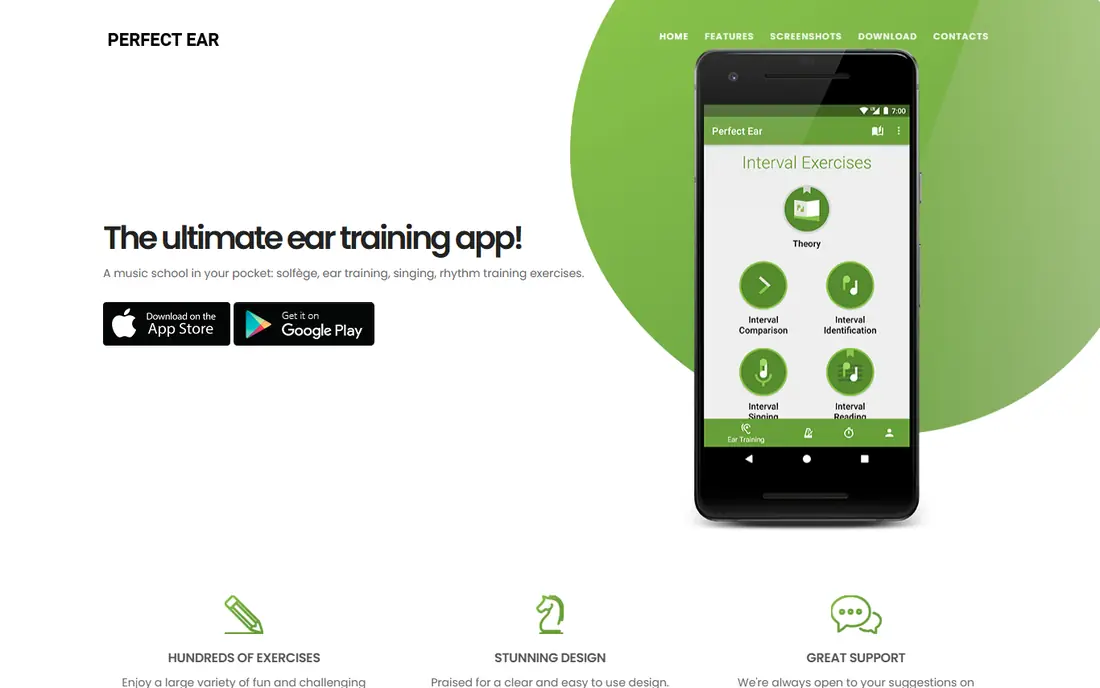
Perfect Ear packs intervals, scales, chords, rhythm and sight-reading into one app, with guided courses for beginners and custom exercises for advanced players. The free version goes a long way, which is why many players start here and only pay later, if ever.
New users may find the menu crowded, since so many trainers sit side by side. Spend ten minutes picking one course path and one drill type, and the app becomes far easier to use. For breadth at no cost, Perfect Ear is hard to beat.
- Wide exercise range
- Rhythm trainer included
- Generous free version
- Interface is dense at first
- Paid upgrade needed for full content

ToneGym turns practice into a daily game. Each day brings a set of exercises covering intervals, chords, rhythm and scales, and players earn coins and compete in contests. That game layer helps people who know they should practice but keep putting it off.
ToneGym runs mainly through the web, so check that the format suits your phone or computer habits before paying. Pricing has been reported at different levels in third party sources, so we list it as See website and advise checking the current vendor page. For motivation, though, its daily loop is a real strength.
- Daily workouts and games
- Contests and leaderboards
- Theory school included
- Paid pricing varies by source, so check the vendor site
- Web focused
Functional Ear Trainer teaches one skill deeply: hearing scale degrees in the context of a key, rather than hearing isolated intervals. You learn to recognize a note by its role in the key, which transfers directly to playing by ear and transcribing songs. The method is plain, the app is free, and sessions are short.
The limit is scope. There is no chord progression trainer and no rhythm course here, so most players will pair it with another app for those skills. As a focused second tool, or as a first step for players who feel stuck on isolated interval drills, it is excellent.
- Free
- Focused method for hearing notes in context
- Simple to use
- No chord progression work
- Narrow compared with full course apps
Tenuto comes from the team behind musictheory.net, and it shows. Alongside ear training drills for notes, intervals, scales and chords, it offers notation, keyboard and fretboard exercises, plus music calculators. Players who are studying theory as well as listening get both kinds of drill in one paid app.
Tenuto is iOS only, and there is no free version to try first, though the one-time price is low. It also lacks the in-key method of Functional Ear Trainer, so it suits theory students more than players who only want to learn songs by ear.
- 24 customizable exercises
- Covers notation, keyboard and fretboard
- One-time purchase
- No free tier
- IOS only
- No functional ear training mode
Earpeggio is a polished iOS trainer for intervals, chords, chord progressions and scales, with a difficulty ramp that feels well judged for beginners and intermediate players. Statistics show where you are weak, so practice time goes to the right drills instead of random exercises.
The main limits are platform and paywall depth. Android users need another app on this list, and the free tier covers the basics while deeper material sits behind a paid tier. For iPhone and iPad players who want a clean daily trainer, Earpeggio is a safe first pick.
- Clean design
- Intervals, chords, progressions and scales
- Clear progress stats
- IOS only
- Deeper material needs a paid tier
Complete Ear Trainer offers a large bank of interval, chord and scale exercises with an easy mode that does not require reading a staff. That matters for self-taught players who play by ear and do not read notation yet. The free version covers a wide range of drills.
The interface looks older than Earpeggio or ToneGym, and there is less game motivation built in. If you care more about drill volume than polish, that trade is easy to accept, and the app remains a strong free choice.
- Large drill bank
- Easy mode for beginners
- No staff reading required
- Interface looks dated
- Less game-like than newer apps
MyEarTraining appeals to players who know exactly what they want to drill. You can set which intervals, chords or scales appear, how questions are asked, and how difficulty rises, which makes it useful for targeting a weak spot before an exam or a gig. The free tier covers the core drills.
The design is plain, and the app has been quieter on updates than some rivals, so check that it runs well on your current device. For control freaks in the best sense, players who want to design their own practice, it is a useful tool.
- Highly customizable drills
- Interval, chord and scale control
- Free to start
- Smaller update history in recent months
- Interface is plain
SoundGym trains a different ear than the rest of this list. Instead of notes and chords, its games train frequency, EQ, compression, panning and level judgment, which are the listening skills a mix engineer needs. Producers who can already play but cannot hear why a mix sounds muddy will get more from SoundGym than from another interval app.
It is not a substitute for music ear training, and the free tier is limited, with full access behind a subscription. Pair SoundGym with a music trainer if you both play and produce, and use it alone if mixing is your main goal.
- EQ, compression and frequency games
- Wide exercise variety
- Built for producers
- Not a music theory trainer
- Full access needs a paid plan
Teoria is a free website with ear training exercises for intervals, chords and scales, plus tutorials on music theory and analysis. It runs in any browser, so it suits school computers, shared devices, or players who do not want another app install.
The site design is older and there is no app with synced progress, so it works best as a study companion rather than a daily habit tracker. For a free, no-install starting point, especially alongside theory lessons, Teoria still earns its place.
- Free
- Runs in a browser with no install
- Theory tutorials alongside drills
- Older web design
- No mobile app progress tracking
How we picked these
We compared official product pages and app store listings for apps that are live in October 2026, covering music ear training and audio ear training as two related but distinct needs. We favored apps with a clear exercise focus, a working free tier or low one-time price, and a track record of use by musicians. Where third party sources disagreed on a price, we used See website rather than repeating an unverified figure.
How to choose and how to practice
Match the app to the skill you lack. If you cannot pick out a melody, start with Functional Ear Trainer or Earpeggio. If you read music and want exam-ready breadth, EarMaster or Tenuto fit better. If mixing is the gap, SoundGym is the only app here built for that job, and a music app will not fill it.
Practice in short daily blocks. Five to ten minutes of focused drills, with the same exercise repeated over several days, builds recognition faster than a single long session. Use a real instrument or your voice for some answers, since singing or playing a note back checks that you truly hear it, not just that you can tap the right button.
Track one weak area at a time. Most apps show stats or let you pick drill types, so choose a single interval or chord type that keeps failing, drill it for a week, then move on. That steady loop is how ear training turns into playing by ear on real songs.
Frequently asked questions
What is the best free ear training app?
Perfect Ear, Complete Ear Trainer, Functional Ear Trainer and Teoria are all free to start and cover core interval and chord work. Earpeggio is also free on iOS for basic drills. The best free pick depends on your device and on whether you want a course, a drill bank, or an in-key method.
What is the best app for ear training for beginners?
Earpeggio and Complete Ear Trainer suit beginners well, since both offer an easy mode and a gentle difficulty ramp. Perfect Ear adds guided courses for new players. Start with one app, pick one drill type, and practice daily rather than collecting several apps at once.
Which ear training app is best for singers?
EarMaster suits singers best on this list, since it includes sight-singing with microphone input alongside interval and melody work. Functional Ear Trainer also helps singers hear notes in a key, which supports singing harmonies and learning songs by ear.
Can ear training software replace a teacher?
Software can build recognition and drill speed, but it does not hear your tone, correct your technique, or plan a full course for you. Use an app for daily drills and a teacher for feedback, repertoire and exam preparation, and the two together work better than either alone.
Do I need a MIDI keyboard for ear training?
No. Most apps accept taps, clicks or sung answers. A MIDI keyboard helps on EarMaster and some other trainers, since playing an answer on keys mirrors real playing, but it is an optional extra, not a requirement for progress.
Sources
See where you really rank - block by block
ProMapRanker scans Google Maps across a grid of your service area. Simple monthly plans from $19, white-label on every plan.
Start freeKeep reading
 zscaler alternatives
Best Zscaler Alternatives in 2026
Looking for zscaler alternatives? We compare 9 SASE and zero trust platforms on architecture, data protection, pricing, and fit for your network and team.
Read → zapier alternatives free
Best Zapier Alternatives Free in 2026
Nine automation tools for zapier alternatives free in 2026, all with genuinely free tiers, plus free plan limits, starting prices and upgrade paths explained.
Read → which platform is best for online reputation
Which Platform Is Best for Online Reputation in 2026
Wondering which platform is best for online reputation? We compare 8 review, listing, and response tools for small and multi-location businesses and agencies.
Read →