 ProMapRanker
Best Domain Name Service in 2026

Key takeaways
- The best domain name services differ most on renewal price, free privacy, and checkout upsells, not on the first-year promo price.
- Cloudflare Registrar is our pick for lowest long-term cost, because it sells at cost with no markup and includes free privacy, with the trade-off that you must use its DNS.
- Namecheap is our pick for most beginners, because it pairs fair pricing with free privacy for life and support that non-technical owners can actually use.
- Porkbun and Spaceship suit buyers who want transparent, low renewals without a maze of add-ons at checkout.
- Turn on registrar lock, two-factor authentication, and auto-renewal before you point a domain at a live site, since losing a domain is far costlier than any saving.
Quick comparison
| Pick | Great for | Pricing starts at | Free tier | |
|---|---|---|---|---|
 Namecheap | Beginners and all-round value | See website | No | Visit |
 Cloudflare Registrar | At-cost pricing and security | See website | No | Visit |
 Porkbun | Transparent low renewals | See website | No | Visit |
 GoDaddy | Largest registrar and support | See website | No | Visit |
 Squarespace Domains | Clean management | See website | No | Visit |
 Hover | No upsells at checkout | See website | No | Visit |
 Dynadot | Investors and bulk portfolios | See website | No | Visit |
 NameSilo | Bulk buyers and free add-ons | See website | No | Visit |
 Spaceship | Low register and renew combo | See website | No | Visit |
 IONOS | Low-cost entry with hosting | See website | No | Visit |
The best domain name services
A domain name service, usually called a registrar, is where you buy and manage the domain name for a website or email address. Prices, privacy, DNS tools, and support differ more than most buyers expect, and the renewal price matters far more than a cheap first year. The services below are the best domain name services for most buyers in 2026, judged on total cost, clarity, and control.

Namecheap is our pick for most beginners because it balances fair pricing, free privacy, and a dashboard that non-technical owners can learn quickly. WhoisGuard privacy, which hides personal contact details from public WHOIS records, is free for life on eligible domains, and that alone saves a recurring fee many registrars still charge. Support is available around the clock, which matters when a DNS change goes wrong on a launch day.
The honest catch is renewal pricing. Namecheap renewals cost more than at-cost registrars such as Cloudflare, and checkout will offer hosting, email, and SSL add-ons that a buyer should review before accepting. Those add-ons can be useful, but they are not required to register a domain. For a first domain or a small business that values support and simplicity, Namecheap remains the safest all-round choice.
- Free WhoisGuard privacy for life on eligible domains
- Familiar dashboard
- Wide extension choice and support options
- Renewal prices run higher than at-cost registrars
- Checkout includes add-on offers
- Some advanced tools sit behind higher tiers
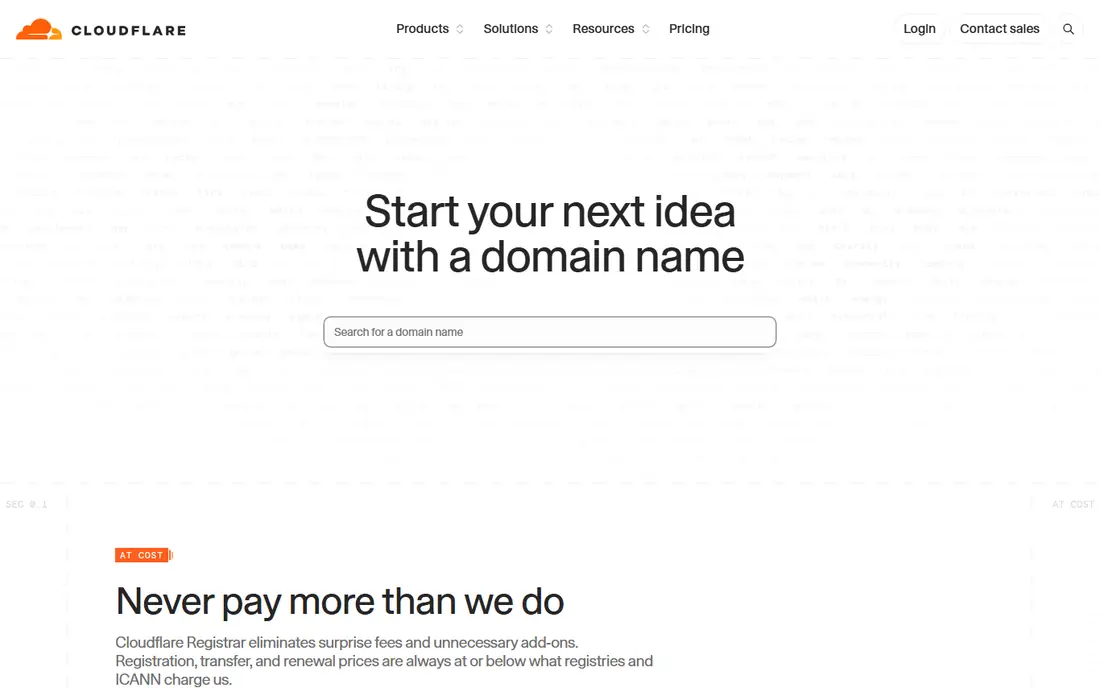
Cloudflare Registrar sells domains at cost, with no markup over the wholesale registry fee, and includes free WHOIS privacy. For a portfolio or a domain held for many years, that at-cost model produces the lowest long-term total, since there is no renewal jump to absorb each year. Buyers also gain access to Cloudflare DNS and security tools, which are strong for performance and protection.
The trade-off is control. Cloudflare requires domains to use its nameservers, so buyers who want a different DNS provider should look elsewhere, and there are no flashy first-year promos to chase. The dashboard also assumes more technical comfort than Namecheap. For buyers who value low lifetime cost and strong DNS, and who are happy inside the Cloudflare system, this is our pick for lowest cost.
- At-cost pricing with no markup
- Free privacy
- Strong DNS and security tools in the wider Cloudflare platform
- You must use Cloudflare nameservers
- No first-year promo pricing
- Best for buyers already comfortable with DNS
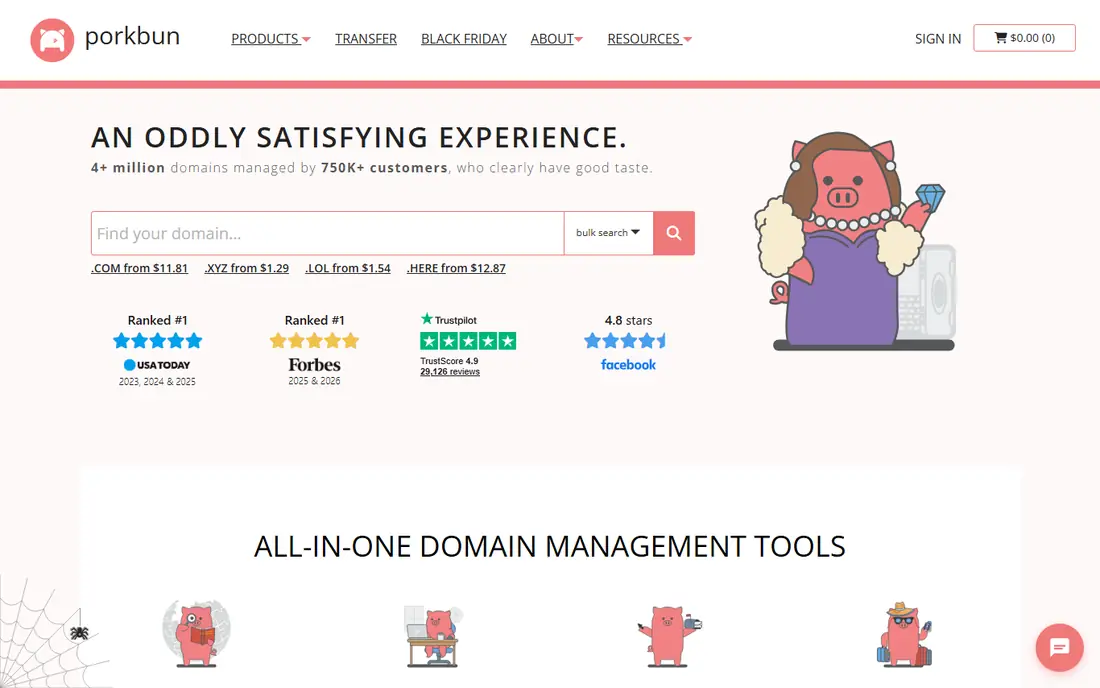
Porkbun is a favorite among developers and careful buyers because its pricing is transparent and its renewals stay low, without the first-year promo followed by a steep renewal that larger registrars use. Free WHOIS privacy and free SSL certificates are included, and checkout is refreshingly free of aggressive add-on offers. The extension range is wide, which suits buyers who want something beyond a standard .com.
The catch is polish. The interface, while functional, feels less refined than Namecheap or Squarespace, and support is a smaller operation than GoDaddy. Buyers who want bundled hosting and a single vendor for everything may also find Porkbun narrower. For a buyer who checks renewal prices first and hates checkout pressure, Porkbun is one of the best domain name services available.
- Transparent pricing with low renewals
- Free WHOIS privacy and SSL certificates
- Very few upsells at checkout
- Interface feels quirky to some users
- Support is smaller than the largest registrars
- Fewer bundled hosting options
GoDaddy is the largest domain registrar, and its scale brings real advantages: a very wide choice of extensions, phone support around the clock, and a large aftermarket for buying and selling domains. For a beginner who wants to call someone for help, or for a buyer hunting a specific extension, GoDaddy is easy to find and easy to use. It also bundles hosting, email, and website tools for buyers who want one vendor.
The honest limits are price clarity and upsells. First-year promos look cheap, but renewals are commonly far higher, and checkout presents many add-ons that can inflate the total if accepted without reading. Buyers should check the renewal price before paying, not after. GoDaddy suits buyers who value scale and phone support and who will read the renewal terms carefully.
- Widest extension selection
- 24/7 phone support
- Large marketplace for buying and selling domains
- First-year promos can mislead on renewal cost
- Checkout upsells are frequent
- Renewals run higher than at-cost rivals
Squarespace Domains, which took over Google Domains customers, offers clean domain management with free privacy and a simple dashboard that suits non-technical owners. For a business already building a site on Squarespace, keeping the domain in the same account removes DNS friction and keeps billing in one place. The experience is calm: few upsells, clear settings, and straightforward DNS controls.
The catch is price and depth. Squarespace renewals sit in the middle of the market, not at the at-cost level, and bulk buyers or domain investors will find fewer portfolio tools than at Dynadot or NameSilo. It is also most convenient inside Squarespace. For a small business that wants a clean, honest registrar and may build on Squarespace, this is a strong, low-stress choice.
- Clean, simple management
- Free privacy
- Natural fit for Squarespace websites and former Google Domains customers
- Renewal pricing is mid-range, not the cheapest
- Fewer bulk and investor tools
- Best inside the Squarespace system
Hover is built around a simple promise: register a domain without a maze of upsells, and manage it in a clean interface. Free WHOIS privacy is included, support includes phone help, and checkout shows the domain price without pushing hosting, email, and security bundles at every step. For buyers who have been burned by a checkout that doubled the total, that calm experience is worth a small premium.
The trade-off is price and breadth. Hover renewals run slightly higher than Porkbun, Spaceship, or Cloudflare, and buyers who want bundled hosting will need a second vendor. The extension range is solid but not the largest. For a buyer who values a quiet checkout and clear pricing over the absolute lowest renewal, Hover is an excellent pick.
- No upsell pressure at checkout
- Free WHOIS privacy
- Clean interface with phone support
- Prices run slightly higher than the cheapest rivals
- Fewer bundled services
- Extension range is solid but not the widest
Dynadot suits domain investors and bulk buyers, with low renewals, bulk management tools, API access, and free privacy. Portfolio holders can manage, renew, and price many domains from one dashboard, and the pricing stays predictable across years, which matters when a portfolio runs into the hundreds. The extension range is wide, including many niche and new extensions.
The catch is audience. Dynadot assumes a buyer who knows domains, so beginners may find the interface more technical and the guidance less hand-holding than Namecheap or Hover. It is not trying to be a website builder or a hosting bundle. For investors and portfolio holders who manage domains at scale, Dynadot is one of the best domain name services for cost and control.
- Low renewals and bulk tools
- Free privacy
- API access and portfolio management for larger holders
- Interface is more technical than beginner registrars
- Support style suits experienced buyers
- Fewer hand-holding features
NameSilo is a registrar aimed at bulk buyers, with free add-ons such as WHOIS privacy, domain parking, and email forwarding, plus discount tiers that lower prices as a portfolio grows. That combination suits buyers who hold many domains and want predictable costs without paying separately for every add-on. Portfolio tools keep renewal and management work manageable at scale.
The honest limits are polish and single-domain price. The interface is functional rather than beautiful, and a buyer registering one domain may find a lower renewal elsewhere. Support is also smaller than at GoDaddy or Namecheap. For bulk holders who value free add-ons and discount tiers, NameSilo is a solid, no-nonsense choice.
- Free add-ons including privacy and parking
- Discount tiers for bulk holders
- Straightforward portfolio tools
- Interface is functional rather than polished
- Renewals are mid-range for single domains
- Support is smaller than the largest rivals
Spaceship, from the company behind Namecheap, aims at the lowest combined registration and renewal cost, with free privacy and a modern interface. For a buyer comparing five-year cost rather than first-year promos, Spaceship often wins on the combined figure, since both the first year and the renewal stay low. The interface is clean and modern, and the backing of an established registrar group adds confidence.
The catch is youth. Spaceship is a newer brand, so its track record is shorter than Namecheap or GoDaddy, and some legacy features are still catching up. Support depth is also still growing. For a price-focused buyer who is comfortable with a newer brand backed by an established group, Spaceship is one of the best value picks in this list.
- Low registration and renewal combination
- Free privacy
- Modern interface from the team behind Namecheap
- Newer brand with a shorter track record
- Fewer legacy features than Namecheap
- Support depth still growing
IONOS is a large hosting and domain provider that suits small businesses wanting a domain, hosting, email, and SSL from one vendor at a low entry price. The extension range is very wide, with 500-plus options, and a personal consultant is offered on some plans, which can help a non-technical owner get started. For a business that wants one bill and one support team, that bundle has real appeal.
The honest limit is renewal pricing. First-year domain prices are low, but renewals rise to a standard rate, so buyers should check the renewal figure before committing a brand to the name. Checkout also includes bundle offers to review. For a small business that will host with IONOS anyway, the domain is a convenient, low-cost add-on.
- Low-cost first-year entry
- 500-plus extensions
- Bundled hosting, email, and SSL for small businesses
- Renewals rise after the first year
- Checkout includes bundle offers
- Best value when used with IONOS hosting
How we picked these
We compared official registrar pages, pricing pages, and public renewal and privacy terms for domain services active in October 2026. We favored registrars with a current product, clear renewal pricing or a stated pricing route, free privacy options, and a real support channel. We left out registrars with unclear ownership or no current product, and we judged first-year promos as a minor factor beside renewal price, privacy, and checkout clarity.
How to register a domain without regret
Check the renewal price first, then the first-year price, and estimate the five-year total for one domain before you buy. A $1 first year that renews at $20 costs more over five years than a $10 domain that renews at $10, and that gap grows with every domain you hold. Confirm that WHOIS privacy is free and included, not a paid add-on, and check transfer rules, including the 60-day transfer lock that can apply after registration or a contact change.
Next, secure the domain on day one. Turn on registrar lock, enable two-factor authentication on your registrar account, set a strong unique password, and turn on auto-renewal with a payment method that will not expire unnoticed. Point DNS only after those steps, and keep a record of the registrar, the renewal date, and the account email somewhere safe. A domain lost to expiry or theft can take a website and email down together, so these few minutes are the most valuable part of the whole purchase.
Frequently asked questions
What is the best domain name service for most people?
Namecheap is our pick for most beginners, because it pairs fair pricing with free privacy for life and support that non-technical owners can use. Cloudflare Registrar is our pick for lowest long-term cost, since it sells at cost with no markup, though it requires Cloudflare nameservers. Porkbun and Spaceship suit buyers who want low, transparent renewals without checkout pressure.
What are the best domain name services for low renewal prices?
Cloudflare Registrar, Porkbun, Spaceship, and Dynadot lead on low renewals, since they avoid the steep renewal jump that follows many first-year promos. Compare the five-year total, not the first-year price, and confirm that privacy is free. A registrar that looks cheap in year one but renews high will cost more over the life of a business domain.
Is WHOIS privacy free?
It is free at most registrars in this list, including Namecheap, Cloudflare, Porkbun, Squarespace Domains, Hover, Dynadot, NameSilo, and Spaceship, though terms vary by extension. Some extensions restrict privacy by registry rule, and a few registrars still charge for it on certain plans, so confirm privacy for your exact extension at checkout. Privacy hides personal contact details from public WHOIS records, which reduces spam and unwanted contact.
Can I transfer a domain to another registrar later?
Yes, in most cases you can transfer a domain after any initial lock period, commonly 60 days after registration or a major contact change, by removing the domain lock and obtaining an authorization code. Keep the domain lock off only during the transfer, and confirm email access on the admin contact, since transfer approval often goes there. A transfer usually adds a year to the registration, though terms vary by extension and registrar.
Should I buy hosting from the same company as my domain?
It can be convenient, since billing and support sit in one place, and IONOS and GoDaddy suit buyers who want that bundle. Keeping domain and hosting separate, however, makes it easier to move hosting later without touching the domain, which is a real advantage if hosting quality falls. Either approach works, but do not let a hosting bundle stop you from checking the domain renewal price on its own.
Sources
See where you really rank - block by block
ProMapRanker scans Google Maps across a grid of your service area. Simple monthly plans from $19, white-label on every plan.
Start freeKeep reading
 zscaler alternatives
Best Zscaler Alternatives in 2026
Looking for zscaler alternatives? We compare 9 SASE and zero trust platforms on architecture, data protection, pricing, and fit for your network and team.
Read → zapier alternatives free
Best Zapier Alternatives Free in 2026
Nine automation tools for zapier alternatives free in 2026, all with genuinely free tiers, plus free plan limits, starting prices and upgrade paths explained.
Read → which platform is best for online reputation
Which Platform Is Best for Online Reputation in 2026
Wondering which platform is best for online reputation? We compare 8 review, listing, and response tools for small and multi-location businesses and agencies.
Read →