 ProMapRanker
Best DME Billing Software in 2026

Key takeaways
- No major DME billing vendor publishes a clear price, so expect a demo and a quote, and ask for the full cost including clearinghouse and implementation fees.
- Brightree remains the broadest choice for large home medical equipment providers, with deep clinical and business coverage.
- NikoHealth and Bonafide are the modern challengers, with NikoHealth focused on intake, billing and resupply in one cloud system, and Bonafide focused on contract and payer auditing.
- TIMS and Universal Software Solutions suit providers that want deployment flexibility or a long-established independent partner.
Quick comparison
| Pick | Great for | Pricing starts at | Free tier | |
|---|---|---|---|---|
 Brightree | Large HME and DME providers | See website | No | Visit |
 NikoHealth | Modern providers wanting one cloud system | See website | No | Visit |
 Bonafide | Providers needing payer contract auditing | See website | No | Visit |
 WellSky | Enterprises standardising on post-acute tools | See website | No | Visit |
 TIMS | Independent providers wanting a stable ERP | See website | No | Visit |
 Universal Software Solutions | Providers wanting hosted or on-premise choice | See website | No | Visit |
 Fastrack | DME providers wanting a focused billing system | See website | No | Visit |
 DMEWorks | Smaller providers wanting affordable billing | See website | No | Visit |
 Prochant | Providers wanting outsourced billing support | See website | No | Visit |
The best dme billing software
Durable medical equipment billing is different from general medical billing. It involves recurring rentals, resupply orders, prior authorisations, documentation checks and payer rules that change by product and by state. Good DME billing software should therefore connect intake, orders, inventory, delivery and billing, so a claim is built from the same record as the delivery, not retyped later. The tools below cover that work in different ways. We compared official product pages, pricing information and public reviews, and we list pricing as See website where vendors do not publish it. This article is general information, not billing or legal advice, and payer rules should be checked with your own compliance team.

Brightree, now part of ResMed, is the most widely used platform for home medical equipment and DME providers. It covers intake, orders, inventory, delivery, billing and revenue cycle work in one system, with claims management built to reduce errors before submission. For respiratory-heavy providers, links to device compliance data help connect resupply and billing to actual patient use.
The main cautions are commercial, not functional. Pricing is quote-based, billing is often licensed as a distinct layer from other services, and public reviews note contract notice periods that can lock a provider in if a renewal date is missed. Large providers with dedicated billing staff will get the most from its depth. Smaller providers should compare the total contract cost and the notice terms before signing.
- Broad HME and DME coverage from intake to billing
- Strong claims and payer workflows
- Deep device and resupply links
- Pricing is not published
- Implementation and contract terms need careful review
- System can feel complex for small teams
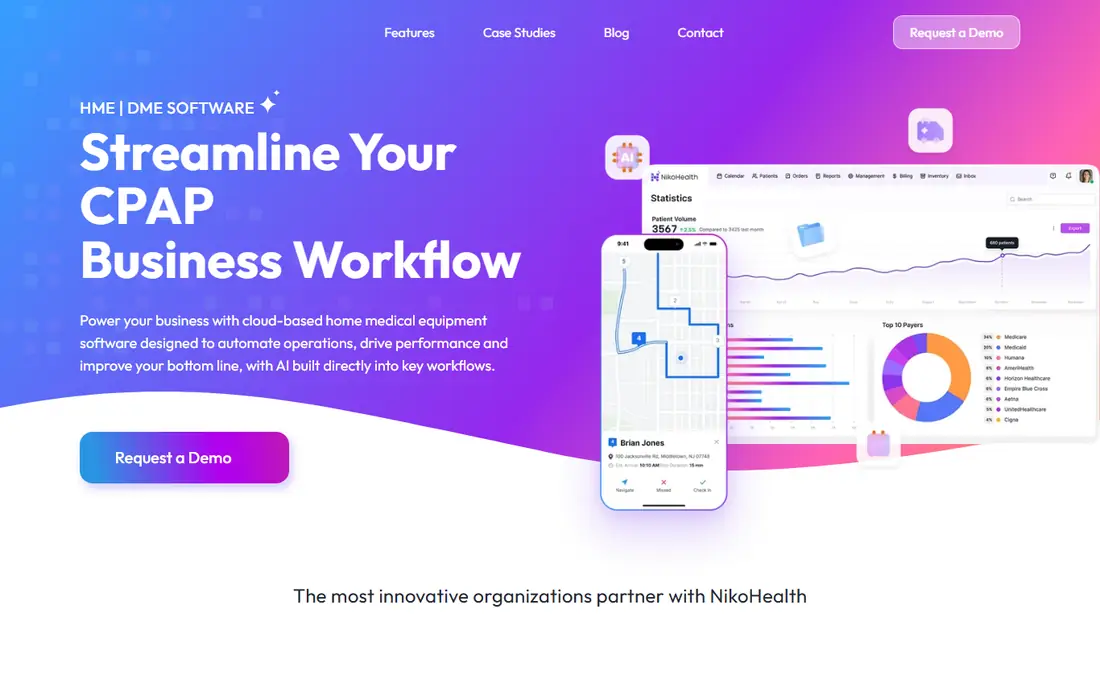
NikoHealth is a modern, cloud-based DME platform that covers billing and revenue cycle management, orders, patient records, inventory, documentation, resupply, delivery, scheduling and analytics. Its billing tools include claims, payments, denials, authorisations, recurring rentals, patient responsibility, automated remittance posting and eligibility checks. The point of that breadth is that billing staff see the same order and delivery record as operations staff.
Reviewers describe a flat-rate pricing model, but the vendor does not publish a simple monthly rate, so we list it as See website. Migration from an older system still takes weeks to months for a mid-size operation, depending on data volume and open orders. For a provider that wants a current cloud system without piecing together separate tools, NikoHealth is a strong first demo.
- Cloud system covering intake, billing, inventory and resupply
- Automated remittance and denial workflows
- Flat-rate pricing model described by reviewers
- Pricing is not published on its own site
- Newer vendor than Brightree
- Migration still takes planning and time
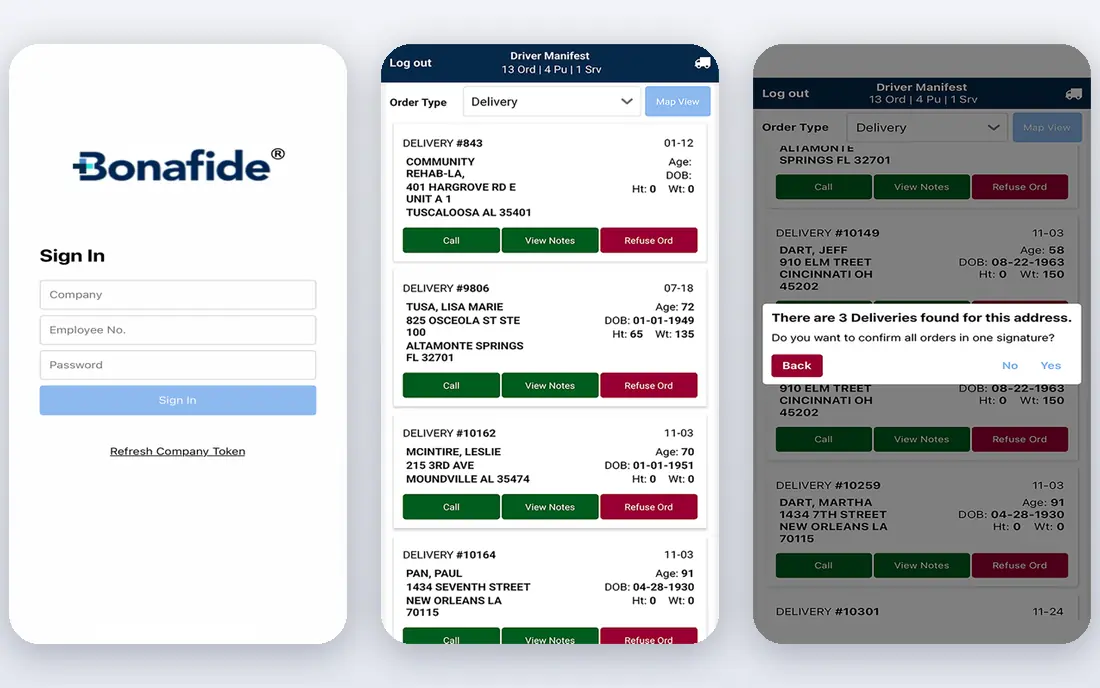
Bonafide, now under WellSky, is a DME enterprise resource system with billing tools built to scrub claims, validate coding, reduce denials and audit payer payments against contract terms. That last point is useful and often skipped: it checks that payers actually paid what the contract agreed, which can surface underpayments that a simple denial dashboard misses. A facility and hospice portal adds a channel for orders from care settings.
The trade-offs are familiar for this market. Pricing is quote-based, and because Bonafide is now part of a larger group, buyers should ask directly how billing development is resourced going forward. For providers managing many payer agreements, the contract-auditing layer alone can justify a demo.
- DME ERP plus facility and hospice portal
- Claim scrubbing and denial tools
- Contract auditing against payer terms
- Pricing is not published
- Now part of WellSky, so roadmap questions are fair
- Implementation needs care
WellSky is a large post-acute care software company whose portfolio includes home health, hospice and DME-related tools, including Bonafide. For an enterprise that already uses WellSky products in other parts of the business, standardising billing and operations on the same vendor can simplify vendor management, support and data sharing. That portfolio effect is the main reason to consider WellSky as a whole rather than as a single product.
It is less clear as a single-product choice. Buyers should confirm exactly which WellSky product covers their DME billing workflows, what is included in the quote, and how it links to their existing systems. Pricing is quote-based. For a large enterprise with a standardisation goal, WellSky belongs on the shortlist. For a small independent provider, a focused DME vendor may be simpler.
- Broad post-acute software portfolio
- Enterprise depth and support
- Useful if you already use other WellSky tools
- Pricing is not published
- Portfolio breadth can mean a longer sales process
- Product fit varies by segment
TIMS, from Computers Unlimited, is a long-tenured DME and HME enterprise system covering intake, orders, inventory, delivery and billing. Its appeal is stability and independence: providers that want a partner with a long track record in DME, rather than a newer cloud startup, often shortlist TIMS for that reason. Some third-party listings mention a starting figure around $250 per month, but the vendor does not publish a clear rate card, so we list it as See website.
The interface and workflow feel more traditional than NikoHealth, and a team used to modern cloud software may notice that in daily use. For a provider that values a proven DME system and a steady vendor relationship over the newest interface, TIMS is a solid, conservative choice.
- Long-established DME ERP
- Intake through billing in one system
- Deployment flexibility described by reviewers
- Pricing is not published clearly
- Interface feels older than cloud-first rivals
- Implementation still takes time
Universal Software Solutions
Great for: Providers wanting hosted or on-premise choice
Universal Software Solutions, often shortened to USS, offers DME software with a choice of hosted or on-premise deployment, which suits providers with specific IT or data control requirements. It covers the core DME chain from orders and inventory through delivery and billing, with integration options for external systems. That flexibility is useful for a provider that does not want to be forced into a single cloud model.
The drawback is choice itself. Deployment, hosting and integration decisions add to the sales and setup process, and pricing is quote-based. Providers should ask what is included in hosting, support and updates for each deployment option. For a team with clear IT requirements, that flexibility is a plus. For a team that wants a simple cloud subscription, a cloud-only vendor may be easier.
- Hosted or on-premise deployment options
- DME billing, inventory and delivery coverage
- API and integration options
- Pricing is not published
- Smaller public profile than Brightree
- Setup choices add complexity
Fastrack is a DME software system covering billing, orders, rentals and related operations for home medical equipment providers. It is positioned as a focused alternative to the largest enterprise platforms, with workflows built around DME claim rules, recurring rentals and resupply rather than adapted from general medical billing. That DME-first design is what separates it from a general practice billing tool.
Public pricing and feature detail is thinner than for Brightree or NikoHealth, so a demo with your own payer mix and product types is essential. Pricing is quote-based. For a mid-size provider that wants a DME-focused system without an enterprise portfolio, Fastrack is worth including in demos.
- Focused DME billing and operations system
- Claims, rentals and resupply workflows
- Long DME history
- Pricing is not published
- Public information is thinner than for larger rivals
- Demo is essential to judge fit
DMEWorks is aimed at smaller DME providers that want affordable, all-inclusive billing software without an enterprise system. Its pitch is simplicity: billing, claims and related workflows in one package, priced for a smaller operation rather than a large multi-location enterprise. That scope can be a benefit, since a small team does not have to learn or pay for features built for a much larger company.
The limits follow from that scope. Large providers with complex payer contracts, multiple locations and deep reporting needs will likely outgrow it, and pricing is not published clearly enough to list here. Ask for a written quote that includes clearinghouse costs and support. For a small provider starting or replacing a basic billing tool, DMEWorks is a practical option to test.
- All-inclusive billing focus for smaller providers
- Lower cost positioning than enterprise platforms
- Simpler scope
- Pricing is not published clearly
- Feature depth is lower for large enterprises
- Fewer public reviews to check
Prochant is different from the other tools here, because it is primarily a DME billing service rather than software you run yourself. It provides billing, claims, denial management and accounts receivable support for DME providers, using its own processes and systems on the provider's behalf. That model suits a provider that struggles to hire and retain billing staff, or that wants billing expertise without building a large in-house team.
The trade-off is control. Service quality, reporting and data visibility depend on the agreement, so ask how often you receive reports, how denials are worked, and how you can access your own billing data. Pricing is quote-based and depends on volume and scope. If you want software your own team runs, choose one of the platforms above. If you want billing handled for you, Prochant is a legitimate alternative to compare.
- DME billing expertise as a service
- Claims, denial and AR support
- Useful when hiring billing staff is hard
- This is a service, not just software
- Pricing is quote-based
- Control and visibility depend on the service agreement
How we picked these
We compared official product pages, pricing information and public reviews for DME billing software and services that are still sold and supported in October 2026. We kept only tools built for DME and HME work, with recurring rentals, resupply and payer documentation in mind, and we left out general medical billing tools that do not handle DME rules natively. Where a vendor did not publish a price, we wrote See website instead of copying an estimate.
We also mixed large platforms, modern cloud tools and a billing service, because DME providers range from single-location shops to large enterprises. The write-ups state the size and model fit for each option, so a buyer can rule out tools that are too large, too narrow or the wrong model for their team.
What to check before you buy
Start with your payer mix and your hardest products. Ask each vendor to show a claim for a recurring rental, a resupply order and a product that needs prior authorisation, including how documentation is checked before submission. A system that only demos a simple one-time sale will hide the work that causes most denials.
Next, ask about denials, remittance and contract auditing as one workflow. Find out how denials are grouped and worked, how remittance posts automatically, and how underpayments against contract terms are flagged. Also ask about clearinghouse fees, implementation time and who migrates your open orders, since those costs and delays are often left out of a headline quote.
Finally, check contract terms in writing, including length, notice period, data export and what happens to open claims if you leave. Public reviews of this market warn about notice windows that can extend a contract by a full year, so mark renewal dates before you sign. A trial or a reference call with a provider of similar size and payer mix is worth more than a feature checklist.
Frequently asked questions
What is the best DME billing software?
Brightree is the broadest choice for large providers, while NikoHealth is a strong modern alternative for providers that want one cloud system. The best choice depends on size, payer mix and whether you want software your team runs or a billing service. Demo at least two options with your own claim types before deciding.
What is the top DME billing software for small providers?
DMEWorks and Fastrack are worth testing for smaller providers, because their scope and cost positioning suit a smaller team. NikoHealth can also suit a growing small provider that wants a cloud system it can grow into. Ask for a written quote that includes clearinghouse and support costs, since those change the total.
Does DME billing software handle recurring rentals and resupply?
Yes, the DME-focused tools here are built for recurring rentals and resupply, unlike general medical billing software. Check that rental billing, resupply scheduling and patient eligibility are linked to the same order record. If resupply is handled in a separate spreadsheet, denials and missed orders become more likely.
How much does DME billing software cost?
No major vendor in this list publishes a clear price, so pricing is quote-based and depends on volume, users and services. Expect to pay for the software, clearinghouse access and implementation, and ask for a full first-year figure. A low software quote can rise once clearinghouse, support and migration fees are added.
Should I outsource DME billing instead of buying software?
Outsourcing suits a provider that cannot hire or retain billing staff, or that wants billing expertise without building a team. Buying software suits a provider that wants direct control of claims, denials and reporting. Prochant is a service option to compare against software platforms, and the right choice depends on staff, volume and how much control you want to keep.
Sources
See where you really rank - block by block
ProMapRanker scans Google Maps across a grid of your service area. Simple monthly plans from $19, white-label on every plan.
Start freeKeep reading
 zscaler alternatives
Best Zscaler Alternatives in 2026
Looking for zscaler alternatives? We compare 9 SASE and zero trust platforms on architecture, data protection, pricing, and fit for your network and team.
Read → zapier alternatives free
Best Zapier Alternatives Free in 2026
Nine automation tools for zapier alternatives free in 2026, all with genuinely free tiers, plus free plan limits, starting prices and upgrade paths explained.
Read → which platform is best for online reputation
Which Platform Is Best for Online Reputation in 2026
Wondering which platform is best for online reputation? We compare 8 review, listing, and response tools for small and multi-location businesses and agencies.
Read →