 ProMapRanker
How to Pick Direct Mail Automation Software

Direct answer
If you need sales teams pairing gifts with mail, Sendoso is the first tool to look at here. Alternatives: PostGrid for teams needing mail plus address verification in one API, and Thanks.io for handwritten-style mail with no minimums. The remaining 5 options are covered below with prices and limits.
Key takeaways
- This list starts with Sendoso, which is built for sales teams pairing gifts with mail.
- PFL is the one to check for enterprise tactile marketing and ABM.
- No starting price is published for Sendoso, PebblePost and PFL; expect a quote.
- A free plan is available from 4 of the 8 tools: PostGrid, Lob, Click2Mail, Postalytics.
- Check the limits for Lob before you commit: per-piece rates are highest on the free plan.
Quick comparison
| Pick | Great for | Pricing starts at | Free tier | |
|---|---|---|---|---|
 Sendoso | Sales teams pairing gifts with mail | See website | No | Visit |
 PostGrid | Teams needing mail plus address verification in one API | Free Starter tier; per-piece from ~$0.86/postcard | Yes | Visit |
 Thanks.io | Handwritten-style mail with no minimums | Postcards from $0.64/piece (print and postage included) | No | Visit |
 Lob | Engineering teams mailing at scale | Free Developer plan; premium from $260/mo (Startup) | Yes | Visit |
 Click2Mail | Operational mail with no subscription | No platform fee; 6x11 postcards from $0.73 per piece | Yes | Visit |
 PebblePost | Programmatic mail from web behavior | See website | No | Visit |
 Postalytics | Marketers running CRM-triggered campaigns | Free plan; premium from $199/mo (Marketer) | Yes | Visit |
 PFL | Enterprise tactile marketing and ABM | See website | No | Visit |
Direct Mail Automation Software profiles
This ProMapRanker guide covers 8 options for direct mail automation software. Each profile lists a starting price, free plan details, strengths and drawbacks, so you can drop poor fits quickly.
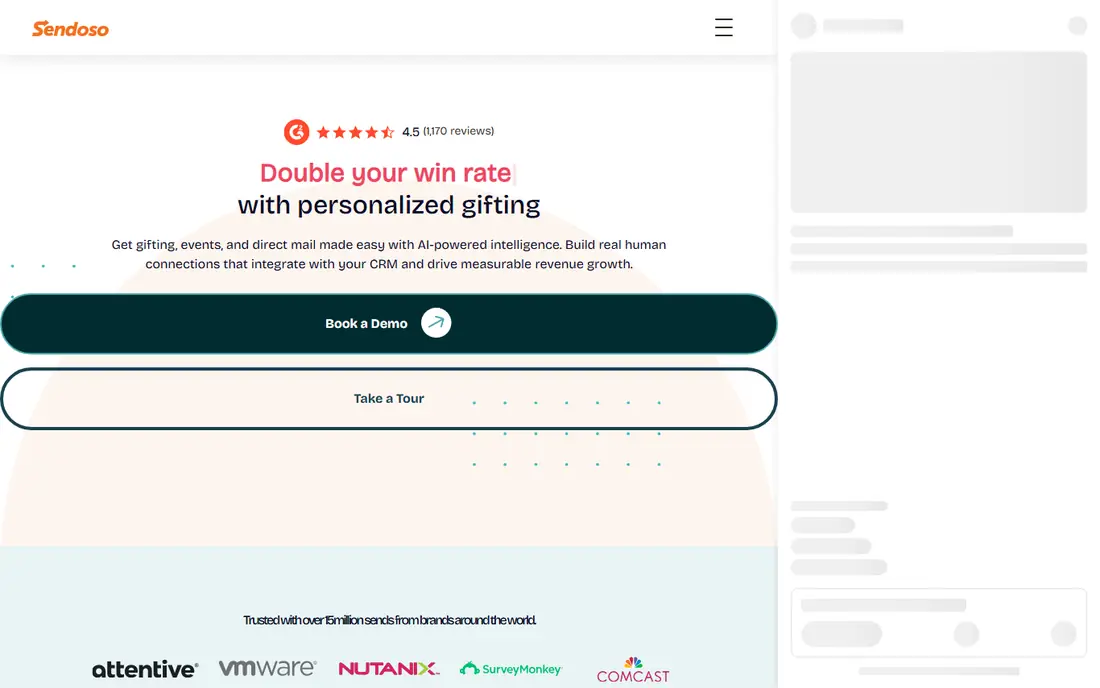
Sendoso is aimed squarely at sales teams pairing gifts with mail. Sendoso is a sending system rather than a pure direct mail tool. Beyond that, pricing is demo-gated, which tells you the target customer.
Watch-outs: No published pricing.
Reasons to shortlist it: direct mail; handwritten notes in one product.
If your use case is "send a thoughtful package to fifty target accounts," Sendoso is very good. As for the details, if your use case is "mail twenty thousand postcards per month at the lowest per-piece cost," the API systems will be less expensive and more straightforward. The Salesforce integration is a genuine strength: sends and engagement data flow back into the CRM for pipeline reporting. Sendoso does not show a starting price in this comparison, so check the vendor site for current pricing. No free plan comes with Sendoso.
- Address confirmation boosts deliverability
- Merges gifting
- Per-send costs add up on large campaigns
In short, PostGrid is for teams needing mail plus address verification in one API. Its address verification API checks US, Canadian, and international addresses against postal standards, which cuts down on undeliverable pieces that cost you full postage.
Worth adding: the Enterprise plan switches to custom volume pricing with a dedicated account manager. The starting price for PostGrid: Free Starter tier. You can start on PostGrid without paying.
The main drawbacks: Per-piece rates sit above some competitors.
Highlights: Print and mail API plus address verification APIs in one account.
- Verifies addresses in 245+ countries
- Free level permits up to 500 mailings per month
- Address verification plans are billed separately
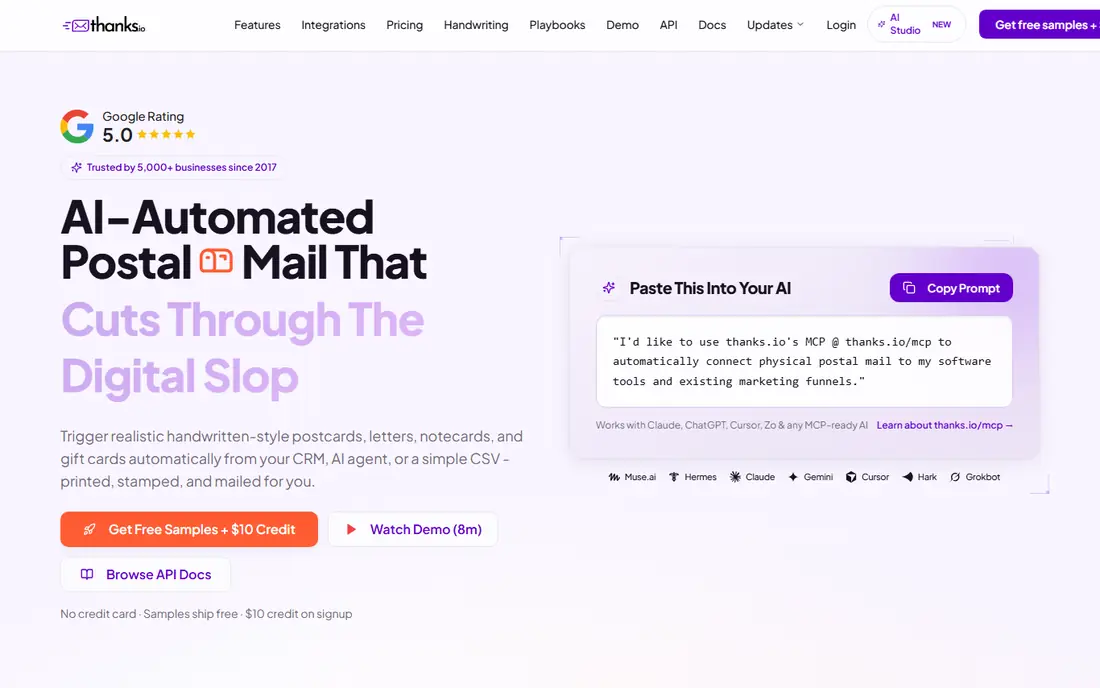
Thanks.io is designed for handwritten-style mail with no minimums. Thanks.io stands out by making small sends painless. In practice, teams and agencies sending over 1,000 pieces per month can ask for custom rates and get a dedicated account manager.
The main drawbacks: No free tier, though there is no system fee either.
The differentiator is the handwritten look. Beyond that, integrations include Zapier, Make, HubSpot, Salesforce, and Shopify, plus a REST API. On top of that, there are no minimums, no monthly system fee. Pricing is published plainly: postcards from $0.64 a piece, letters from $0.79, and premium folded notecards from $1.49, with print, handwriting rendering, and US postage all included. In practice, prices were last updated on its site in July 2026. On cost, Thanks.io starts like this: Postcards from $0.64/piece. Thanks.io has no free tier.
- Handwritten-style postcards, letters, notecards
- No minimums
- Handwritten style limits design adaptability
Think of Lob for engineering teams mailing at scale. Test keys simulate the full mail lifecycle at no cost, so you can build and debug without printing a single piece.
If you mail thousands of pieces per month, those gaps add up quick. Entry price for Lob: Free Developer plan. Lob includes a free tier.
Trade-offs to know: HIPAA mailings and custom envelopes need Enterprise. Strengths: Postal IQ routing picks efficient USPS entry points.
- CCPA workflows
- Nationwide print delivery network
- Monthly product fees start at $260
Click2Mail was built for operational mail with no subscription. A 6x11 postcard begins at $0.73, and smaller 4.25x6 postcards run lower. Support runs Monday through Friday, 9 AM to 8 PM Eastern, at 866-665-2787.
What users get: priority mail choices.
The main drawbacks: The interface displays its age.
The company has been operating since 2003, which matters when you are trusting someone with compliance mail. As for the details, there is no software fee at all; you pay only when mail goes out. In practice, the product range is broad: postcards, letters, certified mail with proof of delivery, EDDM neighborhood saturation, flyers, booklets, and reply mail. Click2Mail pricing: No platform fee. You can start on Click2Mail without paying.
- No subscription fees and no minimum volumes
- Next-day mailing for most products
- Campaign automation is thinner than marketer-first tools
Choose PebblePost for programmatic mail from web behavior. PebblePost invented the programmatic direct mail category: it watches digital intent signals and mails postcards to people who browsed but did not buy, typically within a day or two of the visit.
In practice, there is no pricing page, no free level, and no dashboard you can register for on your own; everything runs through custom deals. This comparison lists no price for PebblePost; ask the vendor. PebblePost has no permanent free option.
Trade-offs to know: Publishes no pricing.
- Positions mail as backed by real transaction data
- Deals are structured around performance
- Custom deals imply meaningful minimums
Postalytics targets marketers running CRM-triggered campaigns. The free plan is genuinely handy for pilots, but check the per-piece math before you scale: it carries the highest per-piece rates of any level.
What users get: Built for marketers.
Drawbacks to consider: Free plan has the highest per-piece cost (about $1.05 for a 6x9 postcard). Postalytics is the friendliest choice for a marketing team that wants direct mail to behave like email automation. Postalytics pricing: Free plan. Postalytics includes a free tier.
- Unlimited IMB tracking plus personalized QR codes and pURLs
- HubSpot and Salesforce integrations
- Full Salesforce integration needs the $399/mo Pro and Agency plans
In short, PFL is for enterprise tactile marketing and ABM. Everything about the offering points upmarket. Worth adding: mid-market and enterprise teams running ABM will find the most to like here.
Trade-offs to know: Enterprise sales process.
It plugs into the marketing automation tools enterprise teams already run, so mail becomes a step inside existing campaign workflows instead of a separate project. Smaller companies will get quicker answers and lower costs from self-serve products. This comparison lists no price for PFL; ask the vendor. There is no free plan with PFL.
- Tactile marketing product designed for ABM
- Long enterprise track record
- Far more than a small team needs for entry-level postcard campaigns
Our selection method
For each of the 8 tools we noted price, free plan or trial, fit for direct mail automation software and the main limit, using vendor pages and documentation. Where a price is missing, the vendor does not list one publicly or ties it to a quote. Always confirm before budgeting. Position on the page reflects fit for a typical buyer first, with price clarity and free access breaking ties. Treat it as a guide, not a ruling.
Things to verify first
- Ask Sendoso, PebblePost and PFL for a written quote, since no starting price is shown.
- Look at free plan limits closely: PostGrid, Lob, Click2Mail and Postalytics have one, and the caps decide whether it is usable for real work.
- Read the limits listed for Sendoso first: no published pricing.
- Verify that exporting from Click2Mail is possible on your plan and covers all your records.
- Get the contract term, renewal terms and any onboarding fees from Lob in writing.
Frequently asked questions
How are the tools for direct mail automation software ordered?
The order follows typical fit for direct mail automation software, with Sendoso first and PFL last, then price clarity and free access. It is editorial judgement, not a score, so another team could rank the tools differently.
Is direct mail automation HIPAA compliant?
Some systems support it. If you mail in healthcare, confirm the vendor will sign a business associate agreement and ask which plan level compliance features need before you commit.
Do these tools publish their prices?
Not all of them. Sendoso, PebblePost and PFL publish no starting price, so expect a quote request for those. The rest, PostGrid included, show a starting price, though seats and billing terms still change the final cost.
How long does direct mail take to arrive?
Production plus USPS delivery normally runs 5 to 12 business days for standard mail. Lob cites two to three days to get a piece printed and into the mail stream, and systems that print near the destination, like Lob's print delivery network, trim transit time.
Is Sendoso the right pick for everyone comparing direct mail automation software?
No single tool suits every team. Sendoso comes first because it fits sales teams pairing gifts with mail, while PostGrid suits teams needing mail plus address verification in one API and Thanks.io suits handwritten-style mail with no minimums. Match the tool to your own size, budget and workflow before deciding.
Can I try these options before paying?
Often, yes. PostGrid, Lob, Click2Mail and Postalytics have a free plan. Use your own data and a real task during the test, and check what the free tier or trial limits before you rely on it.
Sources
See where you really rank - block by block
ProMapRanker scans Google Maps across a grid of your service area. Simple monthly plans from $19, white-label on every plan.
Start freeKeep reading
 zscaler alternatives
Best Zscaler Alternatives in 2026
Looking for zscaler alternatives? We compare 9 SASE and zero trust platforms on architecture, data protection, pricing, and fit for your network and team.
Read → zapier alternatives free
Best Zapier Alternatives Free in 2026
Nine automation tools for zapier alternatives free in 2026, all with genuinely free tiers, plus free plan limits, starting prices and upgrade paths explained.
Read → which platform is best for online reputation
Which Platform Is Best for Online Reputation in 2026
Wondering which platform is best for online reputation? We compare 8 review, listing, and response tools for small and multi-location businesses and agencies.
Read →