 ProMapRanker
Best Digital Experience Platform in 2026


Large enterprise content teams · Pricing starts at: See website
Key takeaways
- Adobe Experience Manager, Sitecore, and Optimizely suit large teams that need governance, personalization, and multi-site control.
- Contentful and Contentstack suit teams building with a headless, API-first approach across websites and apps.
- Acquia, Liferay, Kentico, and Pimcore suit organizations that want content, commerce, and portals in fewer systems.
- Most enterprise digital experience platforms are priced on request, so budget talks need a demo and a scope, not just a price page.
- WordPress VIP suits teams that want WordPress at enterprise scale with stronger security and support.
Quick comparison
| Pick | Great for | Pricing starts at | Free tier | |
|---|---|---|---|---|
| Adobe Experience Manager | Large enterprise content teams | See website | No | Visit |
 Optimizely | Experimentation-led personalization | See website | No | Visit |
 Sitecore | Composable enterprise experiences | See website | No | Visit |
 Acquia | Drupal-based digital experiences | See website | No | Visit |
 Contentful | Headless content delivery | See website | Yes | Visit |
 Contentstack | Modern headless CMS teams | See website | Yes | Visit |
 Liferay | B2B multi-site portals | See website | No | Visit |
 Kentico | Governed hybrid-headless delivery | See website | No | Visit |
 Pimcore | Unified product and content data | See website | No | Visit |
The best digital experience platforms
A digital experience platform, often called a DXP, brings together content management, personalization, and delivery across websites, apps, and portals. These nine cover the main buying paths, from enterprise suites to headless content tools.
Adobe Experience Manager is the enterprise content platform inside Adobe Experience Cloud, and it suits large organizations that manage many sites, brands, and languages from one system. Content governance, workflows, and asset management are central, and it pairs naturally with Adobe analytics and marketing tools. Teams that already use Adobe products get the most from that shared ecosystem.
The cost is the main barrier. Pricing is quoted, implementation is a project rather than a signup, and the platform rewards teams with dedicated developers and content operations staff. Smaller teams will find it heavy and expensive. For a global enterprise with strict governance needs, it remains a leading choice.
- Deep Adobe ecosystem
- Strong content governance
- Large-scale multi-site support
- Pricing on request
- Implementation needs skilled teams

Optimizely combines content management with experimentation and personalization, which suits teams that improve pages by testing rather than by opinion. Marketers can run experiments, target segments, and roll out winning variants, while developers keep control over delivery. That testing loop is the reason many midsize and large teams shortlist it.
Pricing is quoted, and the platform only pays off when a team actually runs tests and acts on results. A team that publishes pages and never experiments will pay for power it does not use. For organizations with steady traffic and a habit of testing headlines, layouts, and offers, Optimizely is a strong fit.
- Strong testing and experimentation
- Personalization at scale
- Broad CMS options
- Pricing on request
- Full value needs testing discipline
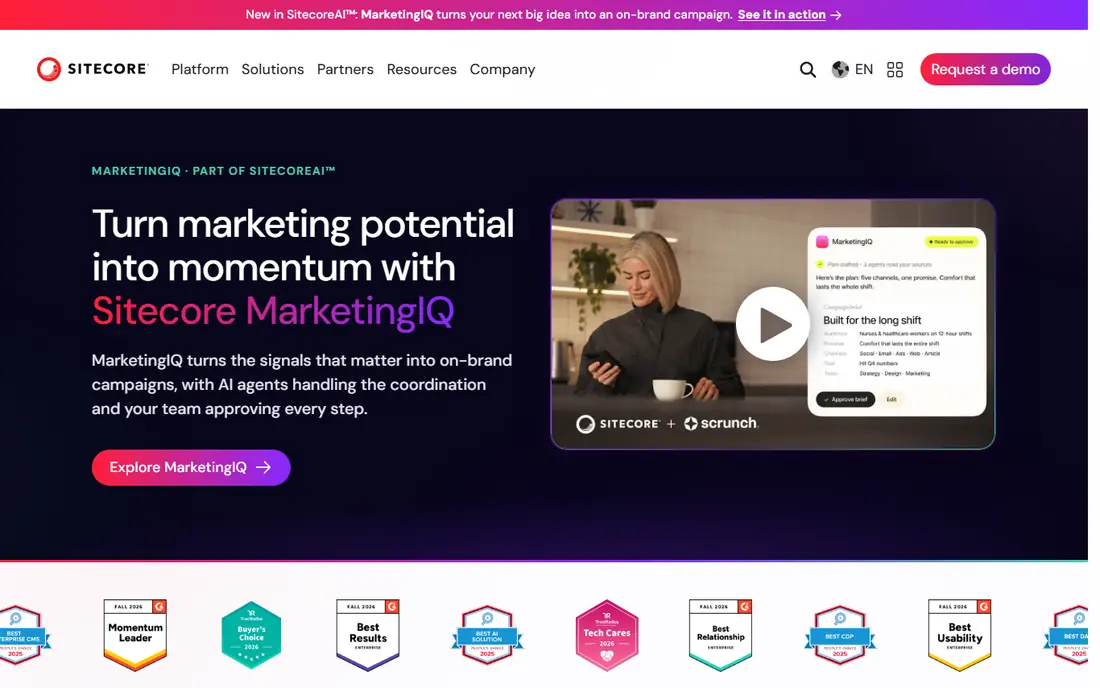
Sitecore offers a composable set of products covering content, personalization, digital asset management, and commerce connections, which large teams can adopt in stages rather than all at once. Multi-site governance and personalization are strengths, and the platform is built for organizations with many touchpoints and strict brand control.
The trade-off is complexity. Choosing which Sitecore products to use, and how they connect, needs architecture work and a clear scope. Pricing is quoted, so a realistic budget needs a vendor conversation. For enterprises that want a modular path rather than a single monolithic suite, Sitecore is a credible leader.
- Composable suite with personalization and DAM
- Multi-site governance
- Enterprise scale
- Pricing on request
- Suite complexity needs planning
Acquia provides cloud hosting, site management, and marketing tools built around Drupal, which makes it the natural DXP choice for organizations already committed to Drupal. Built-in monitoring, performance tools, and security controls help large Drupal estates stay stable, and multi-site management is a core strength rather than an add-on.
Teams not using Drupal will find less reason to choose Acquia over a neutral DXP. Pricing is quoted, and the full platform suits midsize to large organizations rather than small sites. For universities, government bodies, and enterprises running Drupal at scale, Acquia is a practical and proven path.
- Built for Drupal at scale
- Monitoring and performance tools
- Strong hosting and security
- Best value for Drupal teams
- Pricing on request
Contentful is a headless content platform that stores structured content and delivers it through APIs to websites, apps, and other channels. Developers like the API-first model and the ability to pair it with any front end, while editors work in a clean content studio. A free plan lets small teams and prototypes start without a sales call.
The entry paid tier is listed in the hundreds of dollars per month range, so teams should check current pricing before budgeting, which is why we list See website here for the paid start. Contentful also suits teams comfortable with structured content models; editors used to page-based editing need a short adjustment period. For omnichannel teams, it is one of the clearest headless choices.
- API-first structured content
- Free plan to start
- Strong developer experience
- Paid plans rise with scale
- Editors need a structured-content mindset
Contentstack is another headless leader, with a focus on modern developer tooling, software kits, and migration support for teams moving off older systems. Content modeling is flexible, delivery is API-driven, and the platform supports websites, apps, and other digital channels from one content hub. A free tier supports evaluation and small projects.
Larger use is priced on request, so enterprise budgets need a quote. Like Contentful, it works best when developers and editors agree on content models up front. Teams building a composable stack with separate front ends, search, and commerce tools will find Contentstack a natural content layer.
- Modern headless tooling
- SDKs and migration help
- Flexible content modeling
- Pricing on request for larger use
- Needs developer involvement
Liferay Digital Experience Platform suits organizations that need portals, intranets, and customer sites rather than simple marketing pages. Multi-site management, single sign-on, document and asset tools, and B2B account features make it a fit for manufacturers, distributors, and service firms with logged-in customer experiences.
The platform is enterprise-priced and quoted, and portal projects need careful requirements work before build starts. A team that only needs a marketing website will find it heavier than needed. A team that needs many sites, roles, and personalized portal content from one platform will find Liferay a strong match.
- Strong portal and multi-site features
- Single sign-on and asset tools
- B2B focus
- Pricing on request
- Portal projects need planning
Kentico, now focused on its Xperience platform, offers a hybrid-headless approach that lets teams use traditional page editing, headless delivery, or a mix of both. Built-in commerce, marketing, and AI-assisted features reduce the need for extra tools, and governance controls suit regulated or brand-sensitive organizations. That flexibility helps teams that are not ready to go fully headless.
Pricing is quoted, and the ecosystem is smaller than Adobe or Sitecore, which can matter for niche integrations. For midsize and large teams that want one governed platform with room to move toward headless delivery over time, Kentico is a balanced choice.
- Hybrid-headless model
- Built-in commerce and AI features
- Governed delivery
- Pricing on request
- Smaller ecosystem than the largest suites
Pimcore brings product information management, digital asset management, and content management into one open platform, which suits retailers, manufacturers, and distributors with messy product data. Clean product data feeds websites, marketplaces, and catalogs from one source, which reduces errors and duplicate work across channels.
Enterprise support and cloud options are priced on request, and implementation needs data and development work up front. Teams with simple content needs will find it more than required. Teams whose main problem is product data spread across spreadsheets and legacy systems will find Pimcore addresses the root issue, not just the website layer.
- Unifies product data, assets, and content
- Open-source core
- Strong for commerce content
- Pricing on request for enterprise use
- Needs implementation skill
How we picked these
We compared vendor feature pages, pricing pages, and public reviews for platforms that combine content management with delivery, personalization, or portal features in October 2026. We kept only platforms in active use today, covered headless, suite, and portal approaches, and marked enterprise pricing as See website where vendors do not publish a standard price.
How to choose a digital experience platform
Start by naming the job the platform must do. A marketing site, a customer portal, a headless app backend, and a product-data hub are different jobs, and a platform that excels at one may be weak at another. List the channels, languages, and sites you must support, and check whether each shortlisted platform handles them without heavy custom work.
Next, weigh team skills and total cost. A headless platform needs developers, a suite needs content operations, and a portal needs requirements work. Add implementation, training, hosting, and integration costs to the license or subscription quote, and ask for a realistic timeline. A platform that takes a year to launch may miss the business need it was bought to serve.
Finally, run a proof of concept on a real slice of work, such as one site, one product range, or one portal section. Test editor experience, publishing speed, personalization rules, and performance under load. Talk to reference customers with a similar scale and stack. The best DXP is the one your team can run well after launch, not just the one with the longest feature list.
Frequently asked questions
What is a digital experience platform?
A digital experience platform is software that helps an organization create, manage, personalize, and deliver content across websites, apps, portals, and other channels. It usually combines content management with tools for assets, personalization, search, and analytics.
What are the best digital experience tools for a headless build?
Contentful and Contentstack are strong headless choices, because both store structured content and deliver it through APIs to any front end. They suit teams building websites and apps from separate front-end, search, and commerce parts.
How much does a digital experience platform cost?
Most enterprise platforms in this list are priced on request, because cost depends on sites, traffic, users, and modules. Headless tools may offer a free plan for small use, with paid tiers rising with scale. Expect a quoted budget for any enterprise DXP.
Is a DXP the same as a CMS?
No. A content management system handles content creation and publishing, while a DXP adds personalization, multi-channel delivery, portals, commerce connections, and analytics around that content. Many DXPs include a CMS as one part of a larger system.
Which DXP is best for B2B portals?
Liferay is a strong pick for B2B portals, because it supports multi-site delivery, single sign-on, asset management, and account-based experiences. Acquia and Sitecore also suit portal and multi-site work, depending on whether the team uses Drupal or wants a composable suite.
Sources
See where you really rank - block by block
ProMapRanker scans Google Maps across a grid of your service area. Simple monthly plans from $19, white-label on every plan.
Start freeKeep reading
 zscaler alternatives
Best Zscaler Alternatives in 2026
Looking for zscaler alternatives? We compare 9 SASE and zero trust platforms on architecture, data protection, pricing, and fit for your network and team.
Read → zapier alternatives free
Best Zapier Alternatives Free in 2026
Nine automation tools for zapier alternatives free in 2026, all with genuinely free tiers, plus free plan limits, starting prices and upgrade paths explained.
Read → which platform is best for online reputation
Which Platform Is Best for Online Reputation in 2026
Wondering which platform is best for online reputation? We compare 8 review, listing, and response tools for small and multi-location businesses and agencies.
Read →