 ProMapRanker
Best Dental Software in 2026

Key takeaways
- Dentrix remains the largest installed base, while Dentrix Ascend gives practices that like Dentrix workflows a cloud route.
- Open Dental offers strong value for cost-conscious practices, and tab32 offers published cloud pricing for solo dentists and small groups.
- Curve Dental, Denticon, and CareStack suit cloud-first practices and multi-location groups that need centralized management.
- Pricing is often quoted rather than published, so ask for the total monthly cost including claims, imaging, and support before signing.
- This is general information only. Check your compliance, data security, and state requirements before choosing software that holds patient records.
Quick comparison
| Pick | Great for | Pricing starts at | Free tier | |
|---|---|---|---|---|
 Dentrix | established practices | See website | No | Visit |
 Dentrix Ascend | cloud version of Dentrix workflows | See website | No | Visit |
 Eaglesoft | Patterson-supplied practices | See website | No | Visit |
 Open Dental | cost-conscious practices | $199 per month | No | Visit |
 Curve Dental | cloud-first practices | See website | No | Visit |
 Denticon | multi-location groups | See website | No | Visit |
 CareStack | growing groups, one system | See website | No | Visit |
 tab32 | solo and small cloud practices | $125 per month | Free trial | Visit |
 DentiMax | software plus imaging hardware | See website | No | Visit |
The best dental software programs
We compared scheduling, charting, billing, insurance claims, imaging, and patient communication, using vendor pages and current practice management guides. Most vendors quote pricing by practice size, so we use published prices where they exist and "See website" where they do not.
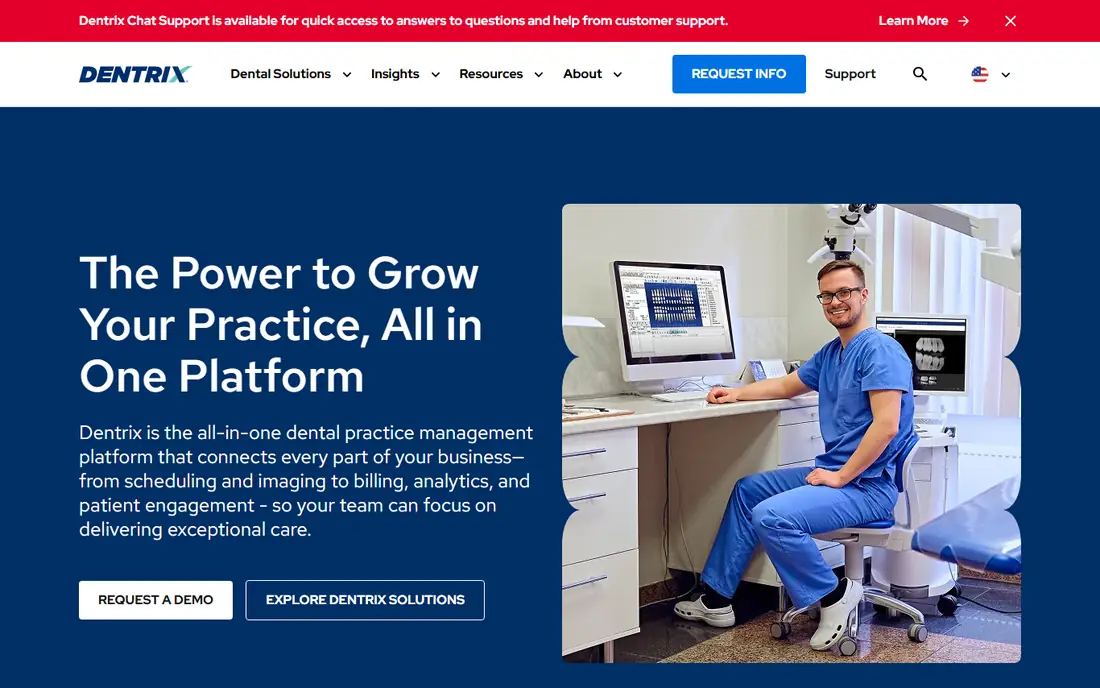
Dentrix, from Henry Schein One, is the most widely installed dental practice management system in North America, and its depth is the reason many established practices stay with it. It handles scheduling, charting, treatment planning, billing, and insurance claims in one desktop application, and most front-office staff in the US have either used it or worked alongside it. That familiarity makes hiring and training easier, and the add-on ecosystem covers imaging, patient communication, and analytics.
The drawbacks are age and delivery. Dentrix is a desktop system, so remote access needs extra setup, and the interface feels older than cloud rivals. Pricing is quoted by practice size and modules, so the total can climb as you add features. Practices that want Dentrix workflows in the cloud should look at Dentrix Ascend below, while practices happy with a desktop system will find Dentrix hard to replace.
- Deepest feature set for scheduling, billing, and claims
- Huge ecosystem of add-ons and trained staff
- Strong multi-location support
- Desktop, Windows-based system
- Older interface
- Pricing is quoted and can rise with modules
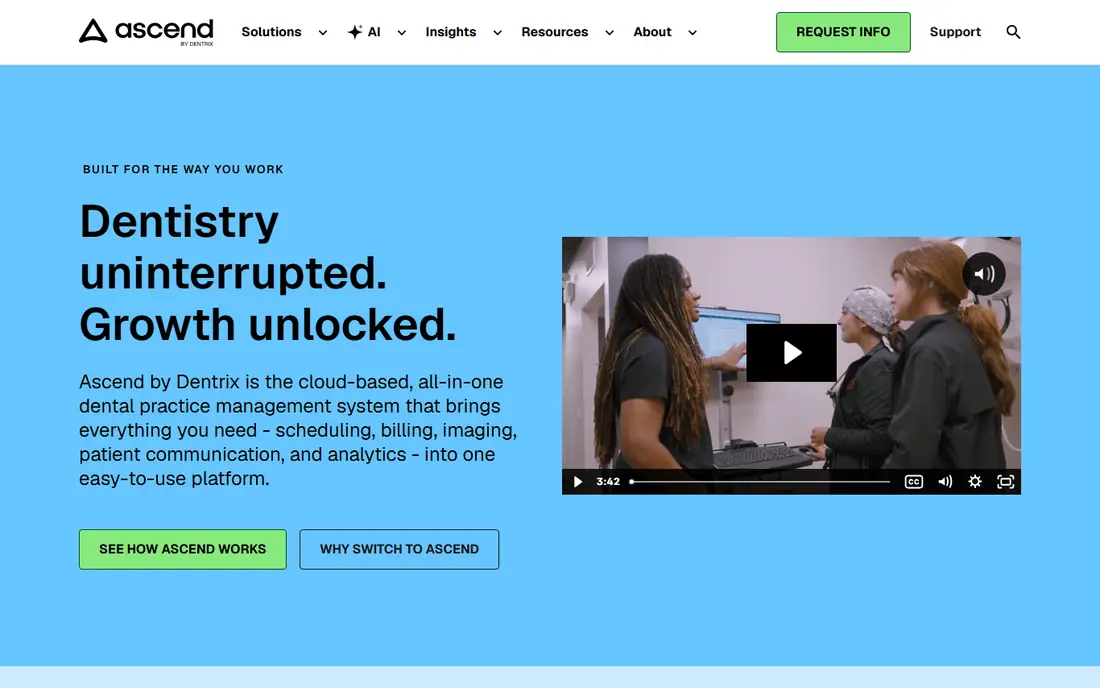
Dentrix Ascend brings Dentrix-style practice management to the cloud, so staff can work from any location with a browser, without managing a local server. It covers scheduling, charting, billing, and claims, with automatic updates and cloud backups handled by the vendor. For a practice that likes Henry Schein One's approach but wants to drop server maintenance, Ascend is the natural upgrade path.
Ascend is not a pixel-for-pixel copy of desktop Dentrix, so some workflows and third-party integrations differ. Pricing is also quoted rather than published, which makes direct comparison harder. Budget time for data migration and staff training, and test your imaging and claims workflows during a trial or pilot before you commit the whole practice.
- Cloud access from any browser
- Dentrix-style workflows
- Automatic updates and backups
- Pricing is quoted
- Some Dentrix desktop features differ in the cloud version
- Migration needs planning
Eaglesoft, from Patterson Dental, is a long-standing desktop practice management system known for straightforward scheduling and reporting. Practices that already buy supplies and equipment through Patterson often value having one vendor for software, support, and supplies. The interface is easy to learn for front-office teams, and its billing and claims tools cover the daily work of a general practice.
Eaglesoft does not publish pricing, so you will need a quote, and its desktop delivery means remote access and IT maintenance need more attention than a cloud system. Practices opening a second location, or moving to remote front-office work, may prefer a cloud platform. For a single-location practice that wants a proven desktop system with Patterson support, Eaglesoft remains a credible choice.
- Intuitive scheduling and navigation
- Strong reporting
- Close integration with Patterson Dental supply and support
- Desktop system
- Pricing is not published
- Fewer cloud-native features than newer rivals
Open Dental is the value pick in this list. Its published pricing is $199 per month per location for the first 12 months, then $149 per month, which undercuts most quoted rivals by a wide margin. The software covers scheduling, charting, billing, claims, and reporting, with flexible customization and a strong focus on letting practices control their own data. That combination suits solo dentists and small groups who want full practice management without a large monthly bill.
The trade-off is polish and IT work. Open Dental is desktop-based, so you manage servers, backups, and updates, or pay for help to do so. The interface is functional rather than modern, and some patient communication features need third-party add-ons. If your team is comfortable with desktop software and wants to keep costs low, Open Dental is hard to beat on value.
- Low, published pricing
- Practices own their data
- Flexible customization and strong reporting
- Desktop-based, so IT setup is on you
- Interface is functional rather than polished
- Support is paid after the first period structure
Curve Dental, also known as Curve Hero, is a mature cloud practice management platform that suits practices ready to leave servers behind. Staff can access schedules, charts, and billing from any browser, updates arrive automatically, and the interface feels modern next to desktop systems. Curve also highlights AI-assisted features for documentation and workflow, which can save chairside time when used carefully.
Pricing is quoted by practice size, so you cannot compare Curve directly on a published rate without a sales conversation. Some advanced features also sit in higher tiers or add-ons. For a single-location practice that wants cloud access, a clean interface, and room to grow, Curve is one of the strongest cloud options, alongside tab32 and Dentrix Ascend.
- Mature cloud platform
- Access from anywhere
- AI-assisted features and modern interface
- Pricing is quoted
- Add-on costs can add up
- Migration from desktop systems needs care
Denticon, from Planet DDS, is built for dental service organizations and multi-location groups that need one system across many offices. It centralizes scheduling, billing, reporting, and patient records, so group leaders can compare locations, standardize workflows, and manage claims from one place. Cloud delivery removes the need for servers at each site, which matters as a group grows.
Denticon is not aimed at solo practices. Pricing is quoted, and the total reflects its enterprise scope, so a single office will usually get better value from Open Dental or tab32. Implementation across many locations also needs a rollout plan for data, training, and imaging. For a growing group, Denticon's centralized control is its main advantage.
- Centralized management for groups and DSOs
- Cloud delivery
- Strong reporting across locations
- Pricing is quoted and enterprise-level
- Overkill for a solo practice
- Implementation needs planning
CareStack positions itself as an all-in-one cloud platform for growing practices and groups, combining scheduling, charting, billing, claims, and patient engagement in one system. That breadth reduces the number of separate tools a practice must manage, and its analytics help group leaders track production, collections, and schedule performance. Cloud delivery also simplifies multi-location access.
As with other enterprise cloud platforms, pricing is quoted rather than published, so budget for a sales process and a careful scope review. Moving to CareStack from a desktop system is a full change, not a simple upgrade, so plan for training and data migration. Practices that want one vendor for most daily workflows, with room to add locations, will find CareStack worth a demo.
- One connected system for practice management and patient engagement
- Cloud delivery
- Analytics for groups
- Pricing is quoted
- Learning curve for a full system change
- Some features need higher tiers
tab32 is a cloud practice management platform with unusually transparent pricing for this market. Its Alpine tier starts at $125 per month in year one for up to three providers, rising to $225 per month from year two, and a 14-day free trial lets you test the system before paying. The platform covers scheduling, charting, billing, and patient communication in a modern browser interface, without server management.
The year-two price rise is the main catch, so compare the long-term cost, not just the first-year rate. tab32 also has a smaller third-party ecosystem than Dentrix, and very large groups may need Denticon or CareStack instead. For a solo dentist or a small group that wants cloud software with a published price and a trial, tab32 is one of the clearest choices available.
- Published cloud pricing
- Modern cloud interface
- 14-day free trial
- Price rises from year two
- Smaller ecosystem than Dentrix
- Some advanced group features are limited
DentiMax offers practice management software alongside dental imaging sensors and software, which suits practices that want one vendor for both. Buying software and imaging together can simplify support, because one company handles the chart, the image, and the hardware connection. DentiMax covers scheduling, charting, billing, and claims, with imaging tools built for daily clinical use.
Pricing is quoted, and the total depends heavily on whether you buy imaging hardware as part of the deal, so ask for software-only and bundled prices separately. DentiMax is also less cloud-first than Curve or tab32, so check remote access if that matters to you. For a practice refreshing both software and imaging, the single-vendor route is a practical advantage.
- Practice management plus imaging from one vendor
- Sensor and imaging hardware options
- US-based support
- Pricing is quoted
- Imaging bundles change the total cost
- Smaller cloud footprint than pure cloud rivals
How we picked these
We compared vendor pages and current practice management guides, focusing on scheduling, charting, billing, claims, imaging, and deployment model. We favored systems with active US practices, clear product pages, and a distinct fit by practice size, from solo offices to multi-location groups. We did not claim hands-on clinical testing, and we used published prices where vendors publish them, with "See website" where pricing is quoted.
What to check before you buy dental software
A demo can look smooth, but daily use depends on claims, imaging, and support. Check these areas before you sign a contract.
Claims, imaging, and integrations
Ask which clearinghouses and imaging systems the software supports, and whether claims, eligibility checks, and electronic remittances are included in the monthly price or charged separately. Test your most common workflows, such as a new patient, a crown, and an insurance claim, during a trial. A system that handles scheduling well but struggles with your imaging setup will frustrate the clinical team every day.
Data, security, and compliance
Patient records need strong access controls, backups, and audit trails, and your practice remains responsible for HIPAA compliance even when a vendor hosts the data. Ask where data is stored, how backups work, how you export your data if you leave, and what happens to records if the contract ends. Get the answers in writing, and check them against your state and practice requirements.
Total cost and contract terms
Ask for the full monthly cost, including support, claims, imaging, texting, and any per-provider fees, plus implementation and training charges. Check contract length, renewal terms, and price rises after year one, since tab32 and Open Dental both change price after an initial period. A cheaper headline rate can cost more once add-ons are included.
Frequently asked questions
Which dental software is best for a small practice?
Open Dental and tab32 are the strongest small-practice picks in this list. Open Dental offers the lowest long-term published price, while tab32 offers a modern cloud system with a free trial. Choose Open Dental if you are comfortable with desktop software and IT, and tab32 if you want cloud access without managing servers.
What is the top dental practice management software for groups?
Denticon and CareStack lead for multi-location groups, because both centralize reporting, billing, and patient records across offices. Dentrix also supports multi-location practices, especially those already in the Henry Schein One ecosystem. Groups should pilot one location first, then roll out the system office by office.
What is the best dental management software for cloud access?
Curve Dental, Dentrix Ascend, tab32, and CareStack all offer cloud access, with different strengths. Curve suits single-location cloud practices, Ascend suits Dentrix users moving to the cloud, and tab32 suits solo and small practices. Compare imaging support and claims workflows, not just the cloud label, before choosing.
How much does dental software cost?
Published prices in this list range from $125 per month for tab32 in year one, to $199 per month for Open Dental in year one, while most other vendors quote by practice size. Third-party estimates for quoted systems often range from a few hundred to over $1,000 per month depending on providers, locations, and modules. Always ask for a total quote that includes claims, imaging, and support.
Do dental software programs include patient texting and online booking?
Many do, but the details vary. Some include texting and online booking in the core price, while others charge for patient communication as an add-on. Ask exactly what is included, whether two-way texting is supported, and whether online forms and reminders are part of the plan you are buying.
Can I switch dental software without losing patient records?
Usually yes, but the quality of the migration matters. Ask what migrates, including charts, images, perio data, ledgers, and documents, and what stays behind as a PDF or archive. Budget weeks for migration, testing, and training, and keep your old system readable until you have verified the new records.
Sources
- https://www.dentrix.com
- https://www.dentrixascend.com
- https://www.eaglesoft.net
- https://www.opendental.com
- https://www.curvedental.com
- https://www.planetdds.com
- https://www.carestack.com
- https://www.tab32.com
- https://www.dentimax.com
- https://rankite.com/blog/best-dental-practice-software
- https://dentalpracticeinsider.org/dental-practice-management-software/
See where you really rank - block by block
ProMapRanker scans Google Maps across a grid of your service area. Simple monthly plans from $19, white-label on every plan.
Start freeKeep reading
 outreach alternatives
Outreach Alternatives in 2026
Compare outreach alternatives for 2026, from Salesloft and Apollo to HubSpot and Lemlist, with pricing, channels, features, limits, and honest trade-offs.
Read → best web conference tools
Best Web Conference Tools in 2026
Compare the best web conference tools for meetings, webinars and team calls, with current pricing, free plans and honest limits for each option here today.
Read → best voice cloning tools
Best Voice Cloning Tools in 2026
Compare the best voice cloning tools in 2026, from ElevenLabs and Descript to Resemble and Cartesia, with consent rules, pricing, licenses, and limits.
Read →