 ProMapRanker
Best DeFi Staking Platforms in 2026

Key takeaways
- Liquid staking keeps your assets usable while they earn rewards, but it adds smart contract and price risk on top of staking risk.
- Ethereum options dominate for depth and DeFi use, while Solana options suit holders who want MEV linked rewards.
- Restaking can add yield, yet it also adds slashing and protocol layers that need careful reading.
- Fees are taken from rewards on most protocols, so compare the net rate, not the headline rate.
Quick comparison
| Pick | Great for | Pricing starts at | Free tier | |
|---|---|---|---|---|
 Lido | ETH holders who want liquid staking | Free | Yes | Visit |
 Rocket Pool | ETH holders who value decentralisation | Free | Yes | Visit |
 Jito | Solana holders who want MEV linked rewards | Free | Yes | Visit |
 Marinade Finance | Solana holders who want choice of staking styles | Free | Yes | Visit |
 Aave | DeFi users who want staking plus lending | Free | Yes | Visit |
 EigenLayer | ETH holders who accept restaking risk for extra yield | Free | Yes | Visit |
 Ether.fi | ETH holders who want non-custodial restaking | Free | Yes | Visit |
 Everstake | Holders who want many networks in one place | Free | Yes | Visit |
The best defi staking platforms
We compared official feature pages, pricing pages and public documentation for each option below. Our pick for most readers is the option that balances cost, control and ease of use, but the right choice still depends on your size, your assets and how much work you want to manage yourself.
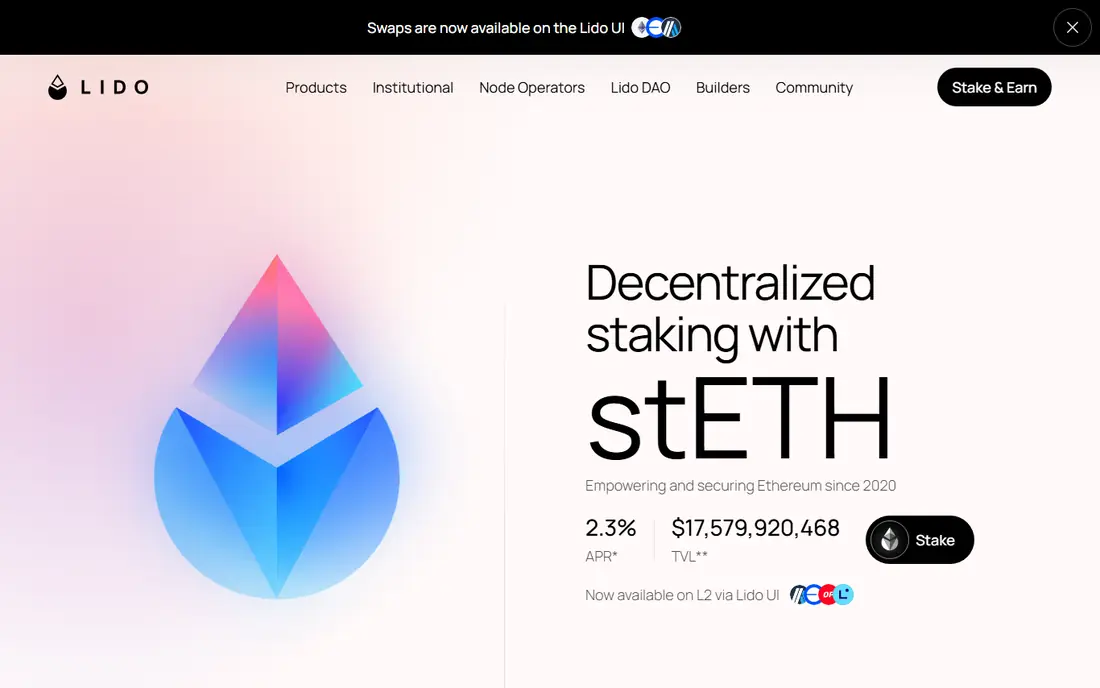
Our first look at this option starts with who it suits best. Lido lets ETH holders stake and receive stETH, a liquid token that tracks the staked position and can be used in other DeFi apps. Its main strength is depth: stETH is widely accepted, so holders are less likely to be stuck with a token no app supports.
Community staking modules have widened the validator set over time, which helps decentralisation, but it does not remove risk. The trade-off is concentration and contract risk, since a bug or a market shock can affect stETH pricing even when the underlying stake is sound. Read the fee page and the exit rules before you commit any funds or sign a contract.
- No minimum stake in most cases
- StETH works across many DeFi apps
- Large, well documented protocol
- ETH only for the main product
- Protocol and smart contract risk remains
- Fee taken from rewards

This is the option to shortlist first if your main concern is control. Rocket Pool is built around a distributed set of node operators rather than a small closed set, which appeals to holders who care about decentralisation. Buying rETH gives liquid exposure without running a validator, and rETH value tends to rise with rewards rather than paying out separately.
Node operation itself needs collateral and technical work, so most readers will use rETH rather than run a node. The catch is market pricing: rETH can trade at a discount or premium to its redemption value, so the exit price is not always exact. Check the current terms on the vendor site before you decide, since terms change often.
- Permissionless node operators
- RETH stays liquid
- No large minimum for rETH holders
- ETH only
- RETH can trade away from its underlying value
- Gas costs apply on Ethereum

For readers who want a clear starting point, this option gives one. Jito is the Solana focused choice in this list, built to pass staking rewards plus MEV related revenue to JitoSOL holders. Its appeal is the extra income stream: transaction ordering revenue is shared with holders rather than kept only by validators.
JitoSOL can be used across Solana DeFi, which keeps the position usable, but that use adds further protocol risk if you lend or trade it. The catch is variability, since MEV income rises and falls with network activity and is never a fixed return. Ask for a demo or a written quote so the final cost is clear before you commit.
- JitoSOL stays liquid
- MEV revenue can lift rewards
- Solana native design
- SOL only
- MEV income varies
- Smart contract and network risk remains
We put this option on the list because it solves a specific problem well. Marinade gives Solana holders two paths: liquid staking through mSOL, or native staking that avoids some smart contract exposure. Its native staking work, including a stake auction marketplace and downtime protection features, is a real point of difference for larger holders.
For most casual holders, mSOL is the simpler route, while native staking suits those who want to stay closer to the base network. The catch is complexity: the two paths have different risks and reward mechanics, so read which one you are actually using. Compare it side by side with one other option on this list before you choose.
- Liquid staking with mSOL
- Native staking option
- Validator auction features for native stakers
- SOL only
- Liquid token can trade away from parity
- DeFi use adds risk
If you value simplicity over a long feature list, start here. Aave is best known as a lending protocol, and its staking module lets AAVE holders stake to support protocol safety and earn rewards. Its strength is context: holders already using Aave lending can manage staking and borrowing in one familiar place.
Treat Aave staking as a complement to a lending strategy, not as a replacement for a dedicated liquid staking protocol. The catch is scope: this is not a one stop staking service for every proof of stake coin, and lending positions carry liquidation risk of their own. Test the core workflow with a small amount first, then scale up if it works for you.
- Well established lending markets
- Staking module for AAVE holders
- Broad asset support
- Staking is centred on AAVE, not a general multi asset staking service
- Lending adds liquidation risk
This option earns its place through a focused job it does well. EigenLayer lets holders restake ETH or liquid staking tokens so the same capital helps secure extra services, known as actively validated services. Its idea is efficient: security that already exists on Ethereum is reused instead of building a new validator set from scratch.
This is a choice for experienced holders who read service terms closely, not a first staking step for a new holder. The catch is layered risk: a fault in an extra service can lead to slashing, and the more layers you stack, the harder the risk is to judge. Confirm the limits, fees and support hours on the official site before you sign up.
- Restaking extends ETH security to new services
- Liquid restaking tokens keep positions usable
- Slashing risk from extra services
- Layered protocol risk
- Yields vary and are not guaranteed
For teams that want depth rather than breadth, this one stands out. Ether.fi positions itself as a non-custodial liquid restaking option, so holders keep control of their keys while staking ETH and receiving eETH. Its strength is the combination: liquid staking plus restaking in one token, without handing custody to a central party.
Check which restaking services your eETH exposure touches before you treat the headline yield as a plain staking return. The catch is that restaking still adds risk, and a liquid restaking token can trade away from its underlying value in stressed markets. Keep a note of the cancellation terms so you are not caught out later.
- Non-custodial design
- EETH stays liquid
- Restaking options built in
- ETH only
- Restaking adds slashing and protocol risk
- Newer model than plain staking
We included this option for readers with a narrower, well defined need. Everstake is a validator and staking service that covers many networks, which suits holders who do not want a separate provider for each coin. Its strength is breadth: one provider for a portfolio spread across several proof of stake chains, with public validator performance to check.
Read the network specific page for each coin you stake, rather than assuming the same terms apply across the whole list. The catch is variation: unbonding times, minimums and reward rates differ by network, so a rule that works for one coin may not work for another. Run a short trial with real work before you move a full workload onto it.
- Supports many proof of stake networks
- Validator service with public track record
- Non-custodial staking in many cases
- Yields and lock periods vary by network
- Some networks need longer unbonding
- Interface can feel technical
How we picked these
We started from the topic itself and kept only options that exist and work in October 2026 and that truly fit the need in the title. We read official pricing and feature pages, app store listings where relevant, and public reviews, and we left out options whose pricing or core claims we could not check. Where a price was not published, we wrote See website rather than guessing a number.
We also weighed who each option suits, what it does well, and where it falls short. A well known name did not earn a place on its own, and a smaller option earned one when its fit was clear. We did not claim hands-on testing we did not do, and we note limits plainly so you can judge the trade-off for yourself.
How to choose a DeFi staking platform
Start with the chain you already hold. An Ethereum protocol does not help a Solana holder, and a Solana protocol does not help an Ethereum holder, so chain fit narrows the list faster than any yield table. Then decide if you need liquidity: if you may need to sell or use the position soon, a liquid token matters, but if you can wait through unbonding, native staking may be simpler and carry fewer layers of risk.
Next, compare net rewards, not headline rates. Fees taken from rewards, gas costs, validator performance and token price gaps all change what you actually keep. A high advertised rate that depends on volatile MEV or incentive tokens is not the same as a steady base staking return. Finally, read the slashing and exit rules. Restaking and lending can lift returns, but each extra layer adds a way to lose money, so only add a layer you understand.
This is not financial advice. Staking carries risk, including loss of funds through slashing, smart contract faults, token price falls and lock periods. Only stake funds you can afford to lose, keep your wallet keys safe, and check the current terms on the protocol site before you act.
Frequently asked questions
What is the difference between staking and liquid staking?
In plain staking, your coins are locked with a validator and you earn network rewards, but you cannot use them until unbonding ends. In liquid staking, you receive a token that represents your staked position, and that token can be traded or used in DeFi while rewards accrue. The liquid token adds smart contract risk and can trade away from its underlying value.
Is DeFi staking safe?
No staking option is fully safe. Risks include slashing when validators misbehave, bugs in smart contracts, price falls in the staked asset, and delays when you try to exit. Non-custodial options reduce custody risk but do not remove protocol risk, so position size and careful reading matter more than any single safety claim.
Do I need a minimum amount to stake?
It depends on the protocol and the path. Liquid staking tokens on Lido, Rocket Pool, Jito and Marinade generally have no large minimum, while running your own validator needs far more capital and technical work. Check the protocol page for the exact route you plan to use, since minimums differ between liquid, native and node operation routes.
What fees do DeFi staking platforms charge?
Most protocols take a share of rewards rather than charging an upfront subscription, and network gas fees apply on top for deposits and withdrawals. The share varies by protocol and can change, so compare the net reward rate on the day you stake. We list starting price as Free where there is no subscription, but that does not mean staking is cost free.
Can I lose money by staking?
Yes. Your staked asset can fall in price, rewards can drop, a validator can be slashed, a smart contract can fail, and a liquid token can trade below its redemption value. Restaking and lending add further layers of risk. Treat advertised yields as variable estimates, not promises, and never stake borrowed funds or money you need soon.
Sources
See where you really rank - block by block
ProMapRanker scans Google Maps across a grid of your service area. Simple monthly plans from $19, white-label on every plan.
Start freeKeep reading
 zscaler alternatives
Best Zscaler Alternatives in 2026
Looking for zscaler alternatives? We compare 9 SASE and zero trust platforms on architecture, data protection, pricing, and fit for your network and team.
Read → zapier alternatives free
Best Zapier Alternatives Free in 2026
Nine automation tools for zapier alternatives free in 2026, all with genuinely free tiers, plus free plan limits, starting prices and upgrade paths explained.
Read → which platform is best for online reputation
Which Platform Is Best for Online Reputation in 2026
Wondering which platform is best for online reputation? We compare 8 review, listing, and response tools for small and multi-location businesses and agencies.
Read →