 ProMapRanker
Best DeFi Apps in 2026: 9 Platforms Compared

Key takeaways
- The best DeFi apps split by job: Uniswap and Curve for swaps, Aave and Compound for lending, and Lido for liquid staking.
- Every protocol here is free to open and use, but network fees, swap fees, and smart contract risk still apply.
- Stablecoin swaps, lending, and borrowed-funds trading carries different risks, so match the tool to the risk you actually understand.
- Verify token contract addresses before any swap, since fake tokens are a common trap on open exchanges.
Quick comparison
| Pick | Great for | Pricing starts at | Free tier | |
|---|---|---|---|---|
 Uniswap | Token swaps and liquidity | Free to use | Yes | Visit |
 Aave | Lending and borrowing | Free to use | Yes | Visit |
 Compound | Simple algorithmic lending | Free to use | Yes | Visit |
 Curve Finance | Stablecoin swaps | Free to use | Yes | Visit |
 Lido | Liquid staking | Free to use | Yes | Visit |
 Sky | Minting stablecoins against collateral | Free to use | Yes | Visit |
 PancakeSwap | Low-fee multi-chain swaps | Free to use | Yes | Visit |
 Balancer | Custom liquidity pools | Free to use | Yes | Visit |
 Yearn Finance | Automated yield strategies | Free to use | Yes | Visit |
The best DeFi apps
This is not financial advice, and crypto carries risk, including the risk of losing funds to price moves, liquidations, and smart contract bugs. The apps below are decentralized finance protocols, not banks, and deposits are not insured. We compared official protocol documentation and current 2026 protocol guides, and we kept only protocols that are live and widely used in October 2026.
Uniswap is the best-known decentralized exchange, and for most people it is the starting point for DeFi. You trade against a liquidity pool rather than another person, so a swap completes when the pool has the token you want. Concentrated liquidity lets providers choose a price range for their funds, which can raise fee earnings inside that range but also raises exposure when the price moves out of it.
The honest catch is that ease of use does not remove risk. Always confirm a token contract address through a trusted source before swapping, since anyone can create a token with a familiar name. Network fees also change with congestion, so a small swap can cost more in fees than it is worth at busy times. For straightforward swaps on well-known tokens, Uniswap remains our pick for most people.
- Deep liquidity across many tokens
- Simple swap interface
- Available on several chains
- Network fees vary with congestion
- Liquidity providers face impermanent loss
- Fake tokens exist
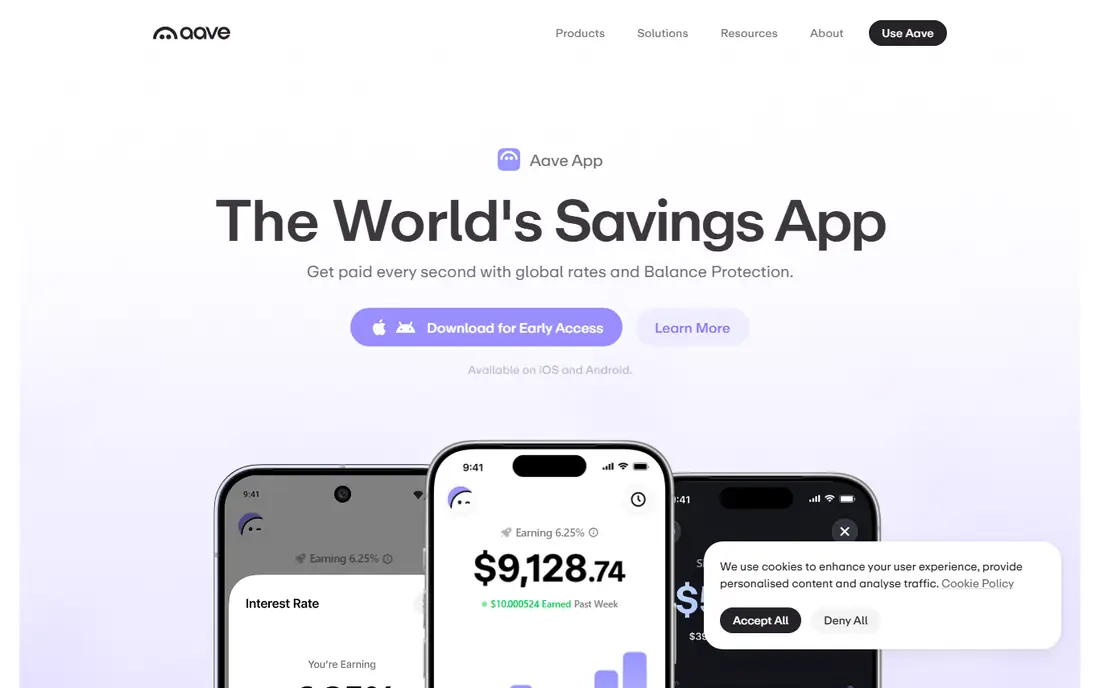
Aave is a lending protocol built from smart contracts that let users supply crypto to shared pools and earn interest, or borrow by posting more collateral than they draw. Interest rates move with how much of a pool is in use, so returns and borrowing costs both change over time. It also supports flash loans, which are advanced, uncollateralized loans that must be repaid in the same transaction.
Borrowing is where the risk concentrates. If your collateral falls below the required threshold, your position can be liquidated and you pay a penalty. Keep a wide safety margin, watch your health factor, and avoid borrowing close to the maximum. For lenders and borrowers who understand those mechanics, Aave is the most complete lending market in this list.
- Large lending markets across chains
- Variable and stable rate options
- Long track record
- Borrowers face liquidation risk
- Rates move with demand
- Interface assumes crypto knowledge
Compound helped popularize algorithmic money markets, where supply and borrow rates move with utilization and no person sets them by hand. You supply an asset, receive a token that represents your position, and earn interest as borrowers pay to use the pool. The model is deliberately simpler than Aave, with fewer assets and fewer features.
That simplicity is both the appeal and the limit. Traders who want many assets or advanced rate choices will outgrow Compound, but beginners who want a clear lending market may prefer it. Rates can still swing, and borrowers still face liquidation if collateral value falls. Use it for straightforward lending and borrowing, not for complex strategies.
- Simple money-market model
- Rates set by supply and demand
- Long-running protocol
- Fewer supported assets than Aave
- Supply rates vary
- Liquidation risk for borrowers
Curve Finance is built for swaps between assets that should hold the same value, such as stablecoins and staked ether derivatives. Its pricing curve is tuned to keep slippage low for those pairs, which makes it the default venue for large stablecoin trades. Liquidity providers earn fees, but they also face impermanent loss when pool prices move apart.
Curve is less friendly for a first-time user than Uniswap, and its pools require more care to understand. Check which pool you are joining, what assets it holds, and how balanced it is before depositing. For traders moving size between stablecoins, or for liquidity providers focused on stable pairs, Curve is hard to beat.
- Low slippage on stablecoin trades
- Deep stablecoin pools
- Useful for large stable swaps
- Pool imbalance can raise risk
- Interface is less beginner friendly
- Yields vary by pool
Lido lets you stake ether and receive a token that represents your staked position, which you can trade or use as collateral elsewhere in DeFi. That solves the usual staking trade-off, where staked funds are locked away and cannot be used. You avoid running your own validator, and you keep a liquid token while your stake earns rewards.
The receipt token can trade at a discount to the underlying asset, and staking rewards change over time, so returns are not fixed. Lido also takes a share of staking rewards as a fee, which is how the protocol is funded. For ether holders who want staking exposure without locking funds or running infrastructure, Lido is the most widely used option.
- Stake ether while staying liquid
- Receipt token usable elsewhere in DeFi
- No validator setup
- Receipt token can trade below the staked asset value
- Staking rewards vary
- Smart contract risk
Sky is the protocol formerly known as MakerDAO, and it runs the stablecoin system behind DAI and its newer Sky Dollar. Users lock collateral in a vault to mint stablecoins against it, and token holders vote on collateral types and rates through on-chain governance. The system is designed to keep the stablecoin close to its target value through collateral rules and stability fees.
Minting stablecoins against volatile collateral is not a safe way to borrow without risk. If collateral value falls sharply, the vault can be liquidated. The rebrand from MakerDAO to Sky can also confuse newcomers, so confirm you are on the official site before connecting a wallet. For users who understand collateralized debt positions, Sky remains the reference stablecoin protocol.
- Established stablecoin system
- Collateral-backed minting
- On-chain governance
- Liquidation risk if collateral falls
- Governance and rate changes
- Rebrand can confuse newcomers
PancakeSwap started on BNB Chain and now runs across several chains, offering swaps, liquidity pools, and staking in one interface. Its main draw is cost: trades on BNB Chain usually carry lower network fees than the same trade on Ethereum at busy times. That makes it attractive for smaller swaps and for users who trade often.
The same openness that makes PancakeSwap useful also fills it with low-quality and copycat tokens. Check contract addresses, read pool details, and treat high advertised yields with care, since they often fall as more funds arrive. For cost-conscious traders comfortable with multi-chain wallets, PancakeSwap is a strong second exchange alongside Uniswap.
- Lower network fees on BNB Chain
- Swaps, pools, and staking in one app
- Broad token coverage
- Many low-quality tokens listed
- Yields vary sharply
- Bridge and chain choices add complexity
Balancer lets liquidity providers build pools with custom weights, such as a pool weighted toward one asset rather than a simple fifty-fifty split. That turns a pool into something closer to a managed portfolio, with fees earned as traders swap through it. Pool creators can also set fees within the protocol rules, which gives more control than a fixed-fee exchange.
Complexity is the price. A custom pool can behave very differently from a standard pool, and beginners can misjudge how weights affect returns and impermanent loss. Balancer suits users who already understand automated market makers and want portfolio-style exposure. If you only need a simple swap, Uniswap or PancakeSwap will serve you better.
- Custom pool weights and asset mixes
- Portfolio-style pools
- Flexible fee settings
- Complex for beginners
- Custom pools carry varied risk
- Smaller liquidity than Uniswap on many pairs
Yearn Finance runs vaults that automate yield strategies, moving deposited funds between lending and liquidity opportunities according to a strategy. You deposit into a vault and receive a token representing your share, rather than managing each position yourself. That automation appeals to users who want yield exposure without tracking every protocol daily.
Automation does not remove risk, and it can hide it. A vault strategy may use several protocols, each with its own contract risk, and fees reduce the return you actually receive. Yields also vary with market conditions and can fall quickly. Treat Yearn as a tool for experienced users who understand the underlying strategies, and start with an amount you can afford to lose.
- Automated vault strategies
- One deposit into a managed strategy
- Long-running protocol
- Strategy risk is hard to see at a glance
- Fees apply
- Yields vary and can fall
How we picked these
We compared official protocol documentation and current 2026 DeFi guides, and we kept only protocols that are live, widely used, and clearly documented in October 2026. We covered the main DeFi jobs, lending, swaps, stablecoins, staking, and yield, rather than listing nine versions of the same exchange. Where a protocol charges a fee or takes a share of rewards, we describe the mechanism in general terms rather than quoting a rate that changes daily.
How to use DeFi more safely
Start small, and treat your first deposits as learning money. Use a wallet you control, keep your seed phrase offline and private, and never enter it on a website. Confirm every contract address, double-check the network before sending funds, and revoke token approvals you no longer need. Keep borrowing conservative, with a wide margin above liquidation thresholds, and avoid borrowing until you understand liquidation mechanics fully.
What to check before any deposit
Read the protocol documentation for the exact asset you plan to use, and check whether the protocol has published audits. Look at how a position can be liquidated, what fees apply, and whether rewards are paid in a volatile token. If you cannot explain how you would exit a position in a falling market, do not enter it yet. This is not financial advice, and you should not deposit funds you cannot afford to lose.
Frequently asked questions
What is the best DeFi app?
The best DeFi app depends on your goal. Uniswap suits token swaps, Aave suits lending and borrowing, Curve suits stablecoin swaps, and Lido suits liquid staking. Most active DeFi users combine two or three protocols rather than trying to do everything in one app.
What is the best DeFi platform for beginners?
Uniswap and Aave are the most common starting points, because both are widely documented and heavily used. Start with small swaps on Uniswap to learn wallet mechanics, then study lending on Aave before supplying or borrowing anything. Avoid borrowed-funds trading and complex yield vaults until the basics feel familiar.
What is the best DeFi app for lending?
Aave is our pick for lending, thanks to its range of markets, multi-chain availability, and long track record. Compound is a simpler alternative if you want a smaller set of assets and a clearer money-market model. In both cases, supply rates vary, and borrowers face liquidation risk.
Are DeFi apps safe?
DeFi apps carry real risks, including smart contract bugs, price volatility, liquidations, and fake tokens. Established protocols with audits and long histories reduce some risk, but they do not remove it. Use reputable protocols, verify addresses, keep positions modest, and never treat DeFi deposits as insured savings.
Do DeFi apps charge fees?
Most DeFi apps are free to open, but you still pay network fees for each transaction, plus swap fees or protocol fees on trades and strategies. Network fees vary with congestion and chain, so the same swap can cost very different amounts at different times. Check the fee shown in your wallet before confirming any transaction.
What is the best platform for DeFi staking?
Lido is the most widely used liquid staking option for ether, since it gives you a tradable receipt token while your stake earns rewards. Other staking options exist on other chains, and each carries its own validator and contract risks. Compare reward mechanics, fees, and how easily you can exit before choosing.
Sources
See where you really rank - block by block
ProMapRanker scans Google Maps across a grid of your service area. Simple monthly plans from $19, white-label on every plan.
Start freeKeep reading
 zoho inventory alternatives
6 Alternatives to Zoho Inventory, Compared on Price and Fit
Zoho Inventory alternatives: 6 tools compared on price, free plans and fit. Katana leads the list for manufacturers. Fit and flaws are laid out for each entry.
Read → zoho crm alternatives
Best Zoho CRM Alternatives (2026)
Need Zoho CRM alternatives? We compare 7 tools on cost, free access and who each suits. Every pick gets a straight assessment. Built for quick decisions.
Read → zelle alternatives
Best Zelle Alternatives in 2026
Compare the best Zelle alternatives for sending money to friends, paying sellers and moving funds abroad, with honest notes on fees, speed and safety in 2026.
Read →