 ProMapRanker
Best Decision Intelligence Software in 2026


Governed enterprise analytics · Pricing starts at: See website
Key takeaways
- Pyramid is the broadest decision intelligence platform in this list, combining data preparation, analytics and data science in one governed environment.
- Tellius is the strongest fit for teams whose recurring question is why a metric changed, thanks to automated root cause and driver analysis.
- Aera fits operational teams that need continuous decisions and execution, not just dashboards that describe what already happened.
- Peak and Quantexa suit organizations with a specific decision problem, such as demand planning or entity resolution, rather than general reporting.
- Every platform here is enterprise and quote based, so a pilot on one real decision matters more than a feature checklist.
Quick comparison
| Pick | Great for | Pricing starts at | Free tier | |
|---|---|---|---|---|
| Pyramid Decision Intelligence Platform | Governed enterprise analytics | See website | Free trial | Visit |
 Tellius | Automated root cause analysis | See website | No | Visit |
 Aera Decision Cloud | Continuous operational decisions | See website | No | Visit |
 Peak | AI decision products for business teams | See website | No | Visit |
 Quantexa | Entity resolution and decision context | See website | No | Visit |
 Board | Planning and decision workflows | See website | No | Visit |
 Sisu | Automated metric diagnosis | See website | No | Visit |
 Diwo | Decision intelligence for business users | See website | No | Visit |
The best decision intelligence software
Decision intelligence goes one step beyond business intelligence. A dashboard shows what changed. A decision intelligence platform tries to explain why it changed, forecast what happens next, and recommend an action with the trade offs attached. The platforms below cover that range, from governed analytics to operational decision automation.
Pyramid Decision Intelligence Platform
Great for: Governed enterprise analytics
Pyramid unifies data preparation, business analytics and data science in a single environment, which is why it is often described as a decision intelligence platform rather than a dashboard tool. Business users can explore governed data, analysts can build models and what if scenarios, and data scientists can work in the same platform without moving data between separate tools. That shared environment reduces the common problem where each team trusts a different number.
The platform offers AI guided analysis, direct query performance across relational, OLAP, data lake and file sources, and deployment on premises or in public, private, hybrid or multicloud setups. Interactive dashboards, reports and embedded analytics help teams share findings, while governance controls keep definitions consistent. The main catch is scope. Pyramid rewards organizations that invest in data modeling and governance, and smaller teams that only need a few dashboards may find it more platform than they need.
Pyramid fits mid sized and large enterprises that want one governed analytics stack for many teams. If your problem is conflicting metrics and scattered tools, Pyramid is a strong consolidation candidate.
- Data prep, analytics and data science in one platform
- Governed self service
- Flexible deployment
- Quote based enterprise pricing
- Needs data governance effort to get full value
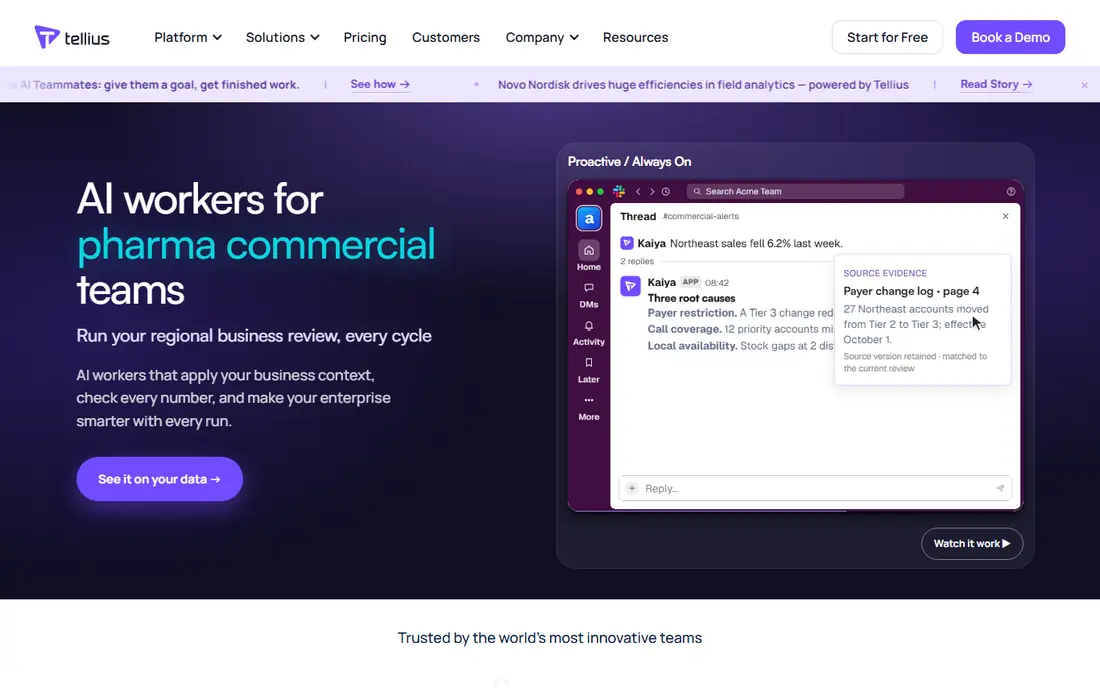
Tellius is built for the question that follows every bad metric, which is what caused it. Its AI agent can investigate a prompt or a recurring mission, test drivers across connected data, and rank findings by impact, turning a vague revenue drop or churn rise into a short list of likely causes. Guided Insights cover segment drivers, cohorts, trend drivers, anomalies and outliers, so analysts spend less time hunting and more time checking the answer.
Search results include visible SQL for transparency, which helps analysts trust and verify an automated finding before they present it. Tellius also turns findings into visualizations, briefings or shareable analysis, so the insight reaches decision makers in a usable form. The limit is data readiness. Tellius works best on modeled views, so teams without a warehouse or a clean data model will need to invest in that foundation first.
Tellius fits analytics teams that repeatedly explain metric changes for sales, revenue, churn or operations. If root cause work eats your week, Tellius may return more time than a new dashboard would.
- Automated driver and root cause analysis
- AI agent investigation
- Visible query transparency
- Quote based pricing
- Needs modeled data views to work well
Aera Decision Cloud focuses on operational decisions that repeat daily, such as inventory, supply, demand and service decisions. Instead of producing a report that a human must act on later, Aera aims to sense change, recommend or automate a decision, and track the outcome so the next decision improves. That continuous loop is the core difference between decision intelligence for operations and traditional reporting.
The platform is designed for enterprises with complex operations, where small decision improvements across many transactions add up to real value. It supports scenario guidance, optimization and execution workflows, although the exact modules depend on the use case and deployment. The trade off is program effort. Aera is not a self serve dashboard purchase. It needs data integration, decision design and change management, and it suits organizations ready to treat decision making as a managed process.
Aera fits supply chain, manufacturing, retail and service operations teams that make high volume decisions every day. If your bottleneck is acting on data fast enough, Aera is worth a serious look.
- Decision to execution orientation
- Continuous optimization
- Operational use cases
- Quote based enterprise pricing
- Implementation is a program, not a quick install
Peak builds AI powered decision products for commercial and operational teams, with a focus on decisions such as pricing, demand, inventory and customer value. Rather than selling a generic analytics toolkit, Peak packages models, data and workflows around a business outcome, so a team can see how a recommendation connects to revenue, margin or availability. That outcome focus helps non technical leaders judge value without needing to understand model details.
The platform is designed for mid sized and large companies that have enough data to train and sustain models, and that want AI embedded in daily decisions rather than in occasional analysis. The main limit is use case fit. Peak works best when a company can name the decision, the data and the success metric up front. Teams that only want general reporting will find a broader analytics platform a better fit.
Peak fits retail, manufacturing, consumer goods and distribution teams with clear commercial decisions to improve. If you can name the decision you want to automate or support, Peak is a strong candidate for a pilot.
- Decision intelligence applications for commercial teams
- AI models tied to business outcomes
- Managed platform
- Quote based pricing
- Fit depends on a defined commercial use case
Quantexa helps organizations make better decisions by connecting scattered data into a unified view of people, companies, accounts and other entities. Its entity resolution and graph analytics reveal relationships that a single system would miss, such as shared addresses, devices, accounts or counterparties. That context matters for risk, fraud, compliance and customer decisions, where a partial view can lead to a wrong approval or a missed threat.
The platform supports decision intelligence use cases in financial services, insurance, government and other data heavy sectors, with tools for investigation, scoring and workflow. The trade off is integration effort. Quantexa needs clean, governed data from several sources to deliver its full value, and the project should be scoped with data owners from the start. It is not a quick dashboard purchase.
Quantexa fits enterprises that make high stakes decisions about entities, such as onboarding, lending, claims or investigations. If your decisions suffer because data sits in silos, Quantexa addresses that root cause directly.
- Connects data into a single entity view
- Decision context for risk and compliance
- Graph analytics
- Quote based enterprise pricing
- Needs data integration and governance work
Board combines business planning, forecasting and analytics in one platform, so teams can model a decision, test what if scenarios and track the plan in the same place. Finance, sales, supply and operations teams can work from shared assumptions instead of reconciling separate spreadsheets, which reduces the version control problems that slow planning cycles. The platform supports budgeting, forecasting, reporting and decision workflows for enterprises.
That breadth helps organizations that want planning and analysis to feed each other, rather than living in separate tools. The main catch is organizational effort. A Board project needs agreement on drivers, definitions and ownership across departments, and that alignment takes time even when the software itself is capable. Teams that only need dashboards will not use the planning depth.
Board fits finance led enterprises and companies with complex planning cycles across departments. If your decisions are planning decisions, Board is a natural shortlist entry.
- Planning, forecasting and analytics in one platform
- What if modeling
- Enterprise governance
- Quote based pricing
- Planning projects need business and finance alignment
Sisu automates the diagnosis of why a key metric changed, ranking the drivers and segments behind the movement so analysts do not need to slice data manually for hours. It connects to cloud data warehouses, monitors metrics, and surfaces the factors that explain a change, with enough detail for a team to check the result. That speed matters for product, growth and operations teams that track metrics daily and need answers before the next meeting.
Sisu fits teams that already use a modern data stack and want automated analysis on top of it, rather than a full replacement for their existing business intelligence tool. The limit is scope. Sisu is strongest at diagnosis, not at building every dashboard or planning model a company might need, so many teams use it alongside a broader analytics platform.
Sisu fits data driven product, marketing and operations teams that ask why a metric moved several times a week. If diagnosis is the bottleneck, Sisu is a focused and practical choice.
- Automated diagnosis of metric changes
- Driver ranking
- Fast time to insight
- Quote based pricing
- Works best with cloud data warehouses
Diwo positions itself as a decision intelligence platform for business users, not just data teams. It helps teams define a decision, explore scenarios, weigh trade offs and reach a recommendation in a structured workflow, without requiring every user to write queries or build models. That business friendly design can speed adoption in organizations where managers want to participate in analysis but do not use technical tools daily.
The platform suits mid sized companies and business units that need better decisions on pricing, assortment, operations or planning, but do not have a large data science team. The trade off is market presence. Diwo is less established than Pyramid, Board or Quantexa, so buyers should check references, support coverage and roadmap fit during a pilot, and confirm integration with their existing data sources.
Diwo fits business teams that want structured decision support without a heavy technical rollout. If ease of use for managers is the deciding factor, Diwo deserves a trial alongside a larger platform.
- Business user friendly decision workflows
- Scenario and recommendation support
- Faster adoption
- Quote based pricing
- Smaller brand presence than Pyramid or Board
How we picked these
We compared official product pages, vendor documentation and reputable platform comparisons for tools that describe themselves as decision intelligence platforms or that deliver its core functions, which are automated insight, root cause analysis, forecasting and recommended actions. We kept only platforms that exist and work in October 2026 and that go beyond static dashboards. Where pricing was not published by the vendor, we wrote See website rather than repeating a third party estimate as a fact. We favored a mix of governed analytics, root cause, operational decision and planning platforms so readers can match the tool to their decision type.
What to check before you pay
Start with one decision, not a platform wishlist. Name the decision, who makes it, how often, what data it needs, and how you will know the outcome improved. A pilot that improves that one decision is worth more than a demo that shows fifty features. Ask each vendor to run the pilot on your data and your decision, and to show how a recommendation is explained, challenged and audited.
Next, check data readiness honestly. Decision intelligence needs modeled, governed data, and a platform will not fix messy definitions or missing history on its own. Confirm which sources connect natively, how definitions are governed, and who owns the data model after go live. Also check how recommendations are explained. A score without a reason is hard to trust, hard to audit and hard to defend when a decision goes wrong.
Finally, compare total effort, not just license cost. Implementation, data work, training and change management often cost more than the first year license, especially for enterprise platforms. Ask for a pilot timeline, a named implementation team and references from a company with a similar decision and a similar data stack.
Frequently asked questions
What is the best decision intelligence software?
Pyramid is the broadest platform in this list, Tellius leads for root cause analysis, and Aera leads for continuous operational decisions. The best choice depends on whether your main need is governed analytics, explaining metric changes, or automating repeated operational decisions.
What is the best decision intelligence platform for explaining metric changes?
Tellius and Sisu are the strongest fits here, because both automate driver analysis and rank the factors behind a change. Tellius adds an AI agent investigation workflow, while Sisu focuses on fast automated diagnosis on cloud data warehouses.
How is decision intelligence different from business intelligence?
Business intelligence mainly describes what happened through dashboards and reports. Decision intelligence adds why it happened, what is likely to happen next, and which action is recommended, with trade offs and audit trails. Many platforms combine both, but the recommendation and execution layer is the key difference.
Do small businesses need decision intelligence software?
Most small businesses do not need an enterprise decision intelligence platform. A good analytics tool, clean data and a clear decision process usually cover the need. Decision intelligence becomes worth the cost when decisions repeat at scale, involve many variables, or carry high financial or operational risk.
What data do I need for decision intelligence?
You need modeled, governed data from the systems that drive the decision, such as sales, inventory, finance or customer data, with consistent definitions and enough history to test patterns. Vendors can help with modeling, but they cannot replace ownership of definitions inside your company.
Is decision intelligence software the same as AI analytics?
Not quite. AI analytics is a broad term for using AI in analysis, while decision intelligence is a specific approach that connects insight to a decision, a recommendation and an outcome. A tool can offer AI analytics without offering structured decision workflows, so check for recommendation, scenario and audit features during a trial.
Sources
See where you really rank - block by block
ProMapRanker scans Google Maps across a grid of your service area. Simple monthly plans from $19, white-label on every plan.
Start freeKeep reading
 zscaler alternatives
Best Zscaler Alternatives in 2026
Looking for zscaler alternatives? We compare 9 SASE and zero trust platforms on architecture, data protection, pricing, and fit for your network and team.
Read → zapier alternatives free
Best Zapier Alternatives Free in 2026
Nine automation tools for zapier alternatives free in 2026, all with genuinely free tiers, plus free plan limits, starting prices and upgrade paths explained.
Read → which platform is best for online reputation
Which Platform Is Best for Online Reputation in 2026
Wondering which platform is best for online reputation? We compare 8 review, listing, and response tools for small and multi-location businesses and agencies.
Read →