 ProMapRanker
7 Best Database Software for Intuitive Development Options for 2026


Open-source all-in-one backend · Pricing starts at: $15 per month (Pro plan)
Direct answer
Start with Appwrite if you need open-source all-in-one backend. Neon fits serverless Postgres with database branching; Convex fits Reactive TypeScript backends. The other 4 tools in the list cover narrower or pricier cases.
Key takeaways
- Number one here is Appwrite, a fit for open-source all-in-one backend.
- The lowest published monthly entry price here is $5 per month, from PlanetScale.
- What to know about Appwrite first: smaller ecosystem than Supabase or Firebase.
- Firebase fits Google-backed mobile and web apps.
- 6 of the 7 tools have a free plan, including Appwrite, Neon, Convex and Supabase.
Quick comparison
| Pick | Great for | Pricing starts at | Free tier | |
|---|---|---|---|---|
| Appwrite | Open-source all-in-one backend | $15 per month (Pro plan) | Yes | Visit |
 Neon | Serverless Postgres with database branching | $19 a month (Launch plan) | Yes | Visit |
 Convex | Reactive TypeScript backends | Free; pay-as-you-go (Starter plan) | Yes | Visit |
 Supabase | Full-stack apps on Postgres | $25 a month (Pro plan) | Yes | Visit |
 Upstash | Serverless Redis, caching and queues | Free; pay-as-you-go (fixed plans from $10/month) | Yes | Visit |
 PlanetScale | MySQL teams needing branching and sharding | $5 per month (single-node Postgres) | No | Visit |
 Firebase | Google-backed mobile and web apps | Free; pay-as-you-go (Blaze plan) | Yes | Visit |
Database Software for Intuitive Development compared in detail
Choosing database software for intuitive development usually comes down to price, fit and limits. This ProMapRanker guide sets 7 tools side by side on those three points, with the facts kept short and checkable.
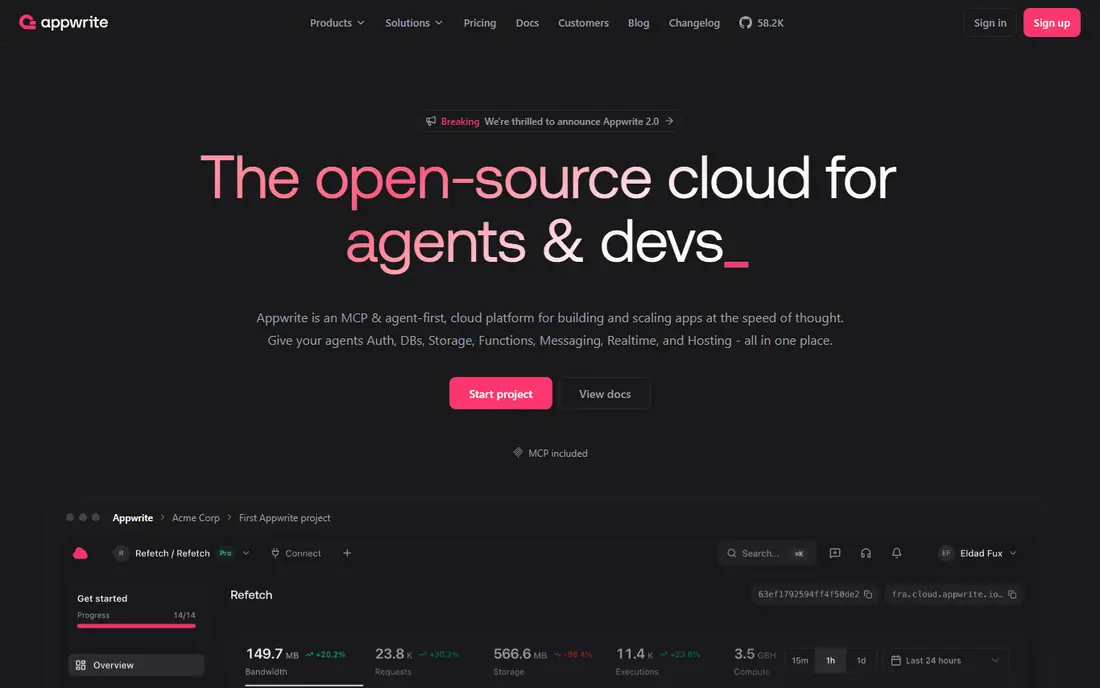
Appwrite targets open-source all-in-one backend. Appwrite is the most direct open-source rival to Supabase.
Where it is weaker: TablesDB is Postgres-based but the system is less SQL-native.
The cloud product has a free level and a Pro plan at $15 a month, undercutting Supabase on headline price. Also, Appwrite wins for teams that want an all-in-one backend with a genuine exit choice. What you pay to start with Appwrite: $15 per month. Appwrite has a free plan.
- 500,000+ developers and a large community
- Auth, databases, storage, functions
- Smaller ecosystem than Supabase or Firebase
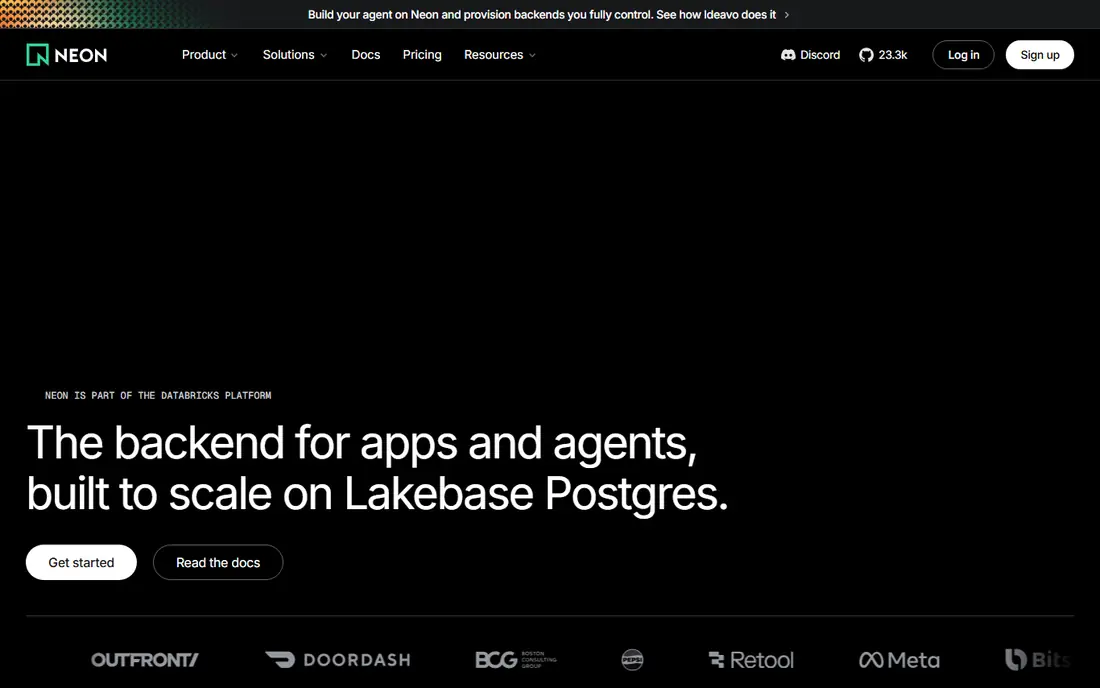
Neon is aimed squarely at serverless Postgres with database branching. The standout feature is branching: every pull request gets a copy-on-write database snapshot, which makes preview environments with real data almost free. The free level bundles 100 projects with ample compute hours and 1 GB of storage per project.
What to check first: Part of Databricks now, so roadmap watchers should pay attention; Postgres only.
In daily use, Neon is now part of the Databricks system, though it still operates as its own product at neon.tech. As for the details, compute scales to zero when idle and wakes in milliseconds. So a side project with 0.8 GB of data costs essentially nothing whereas it sleeps. In practice, if you need auth, storage or realtime alongside the database, you will wire those yourself or pick Supabase. Neon is Postgres and only Postgres, delivered serverless. On cost, Neon starts like this: $19 per month. Neon includes a free tier.
- Database branching hands every pull request its own database
- True scale-to-zero Postgres with usage-based billing
- No bundled auth or storage
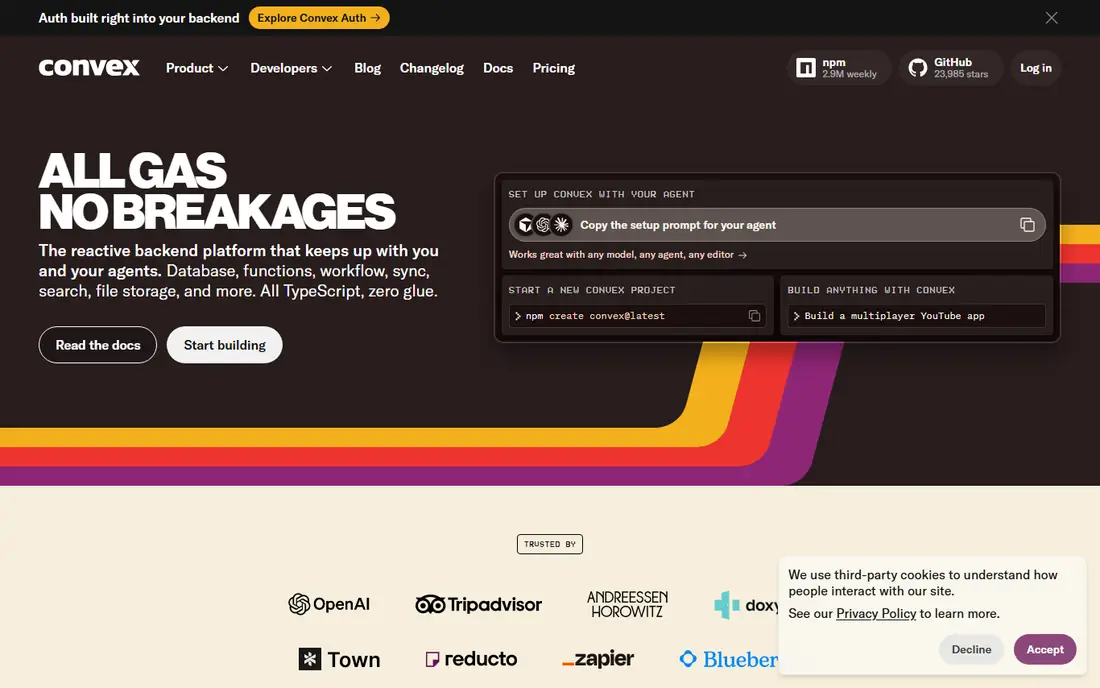
Convex was built for Reactive TypeScript backends. If your team lives in Python, Go or another stack, the developer experience advantage fades.
Watch-outs: Smaller community than the incumbents.
Queries are reactive: when data changes, subscribed clients update automatically, with no websocket code and no cache invalidation to run. In daily use, Convex is made for teams that write TypeScript and want the database to feel like part of the app. Convex starts at: Free. Convex includes a free tier.
- Reactive queries that update clients automatically, with end-to-end TypeScript type safety
- Database, functions
- TypeScript-centric, so other stacks are second-class
Supabase was built for full-stack apps on Postgres. Most developers picking a backend in 2026 start with Supabase, and the reason is consolidation. As for the details, Pro at $25 a month removes the inactivity pause and brings daily backups, which matters the day your free project naps during a demo.
What Supabase does well: Open source with self-hosting choice.
What to check first: Bundled services are overkill if you only need a database.
If you want Postgres without the system bundle, Neon is the purer pick. Beyond that, the free level handles 500 MB of database storage, 1 GB of file storage and 50,000 monthly active users for auth, which carries prototypes and side projects comfortably. Worth adding: per-project billing means every project carries its own compute cost, and the jump from Pro to the $599 Team level is steep for startups that require compliance features. As for the details, the honest catch is pricing shape. Starting cost for Supabase: $25 per month. Supabase offers a free plan.
- Auto-generated REST and GraphQL APIs from your schema
- Real Postgres plus auth, storage, realtime
- Pro billing is per project, which layers on up for numerous projects
In short, Upstash is for serverless Redis, caching and queues. Upstash is not where you store your core relational data. It is the companion layer: Redis-compatible caching, vector search for embeddings, full-text search, message queues and durable workflows, all serverless with per-request pricing.
Upsides: messaging and workflows with per-request pricing.
The main drawbacks: Not a primary database for relational workloads. Pair Upstash with a primary database like Neon or Supabase: the primary holds your source of truth, Upstash manages caching, queues and search. As a standalone primary store it does not fit. Upstash pricing: Free. Upstash includes a free tier.
- Serverless Redis, Vector, Search
- Free level with no credit card
- The product lineup keeps expanding, which can confuse new users
PlanetScale was built for MySQL teams needing branching and sharding. PlanetScale invented the developer-friendly branching workflow for databases, and it remains the reference implementation. For everyday use, PlanetScale suits teams with production MySQL workloads and strict schema discipline, not developers looking for a free place to start.
The main drawbacks: No free level since 2024; you pay from day one.
The Vitess heritage gives it horizontal sharding for workloads that outgrow a single node. The product now spans MySQL via Vitess, Postgres including a sharded Postgres choice, and single-node databases from $5 a month for development and small projects. PlanetScale cost at the entry level: $5 per month. PlanetScale has no permanent free option.
- Database branching for safe schema workflows
- Zero-downtime schema changes with no table locks
- MySQL-first heritage may not suit Postgres teams
Firebase is built with Google-backed mobile and web apps in mind. Firestore provides you a realtime document database, and around it sit auth, hosting, cloud functions, crash reporting and analytics, all in one console with one billing account. Worth adding: the Spark plan is free for modest usage, and Blaze is pay-as-you-go.
Honest limits: Firestore is NoSQL, so relational data models fight the grain.
So you pay for what you consume instead of for servers. The document model is the tradeoff. The starting price for Firebase: Free. Firebase includes a free tier.
- Venmo and NPR
- Ample Spark free level for getting started
- Costs can spike with unoptimized read patterns at scale
What went into this list
ProMapRanker used vendor pricing pages and product documentation as the base, then compared plans, free access and documented limits for 7 tools. Seat minimums, billing terms and add-ons can move the real cost, so the starting prices here are a guide and not a quote. Position on the page reflects fit for a typical buyer first, with price clarity and free access breaking ties. Treat it as a guide, not a ruling.
Questions to settle before buying
- Prices are a starting point; PlanetScale shows $5 per month to start, so verify what your seat count would cost.
- Check what the free option really includes: Appwrite, Neon, Convex and others offer a free plan, and usage caps differ.
- Before choosing Appwrite, weigh its main limit: smaller ecosystem than Supabase or Firebase.
- Ask Neon whether prices are locked for the first term and what happens at renewal.
- Read the plan comparison for Convex carefully; key features often start on a higher tier.
Frequently asked questions
What is the cheapest option for database software for intuitive development in this list?
On published monthly entry prices, PlanetScale is the lowest here at $5 per month. Entry price is only part of the cost, because seats, add-ons and billing terms can change the total.
Is Appwrite the right pick for everyone comparing database software for intuitive development?
No single tool suits every team. Appwrite comes first because it fits open-source all-in-one backend, while Neon suits serverless Postgres with database branching and Convex suits Reactive TypeScript backends. Match the tool to your own size, budget and workflow before deciding.
Do these tools publish their prices?
Yes. Every tool from Appwrite to Firebase shows a starting price, though seats, add-ons and billing terms still change the final cost.
Is Postgres or MongoDB better for a new app?
MongoDB wins for document-shaped data that evolves rapidly and for teams that think in objects instead of tables. The honest answer is that most new apps do fine on either; pick the one your team already knows.
Do I need a separate database for caching and search?
Not always, but commonly. Postgres takes care of basic full-text search, and every database here caches to some degree. Upstash earns its place when you need Redis-compatible caching, vector search for AI features, or message queues that your primary database does not do well. Add it when you feel the pain, not before.
What happened to Fauna?
Fauna ended its database service in May 2025. If you are migrating off it, the closest modern equivalents are Supabase for the document-relational model with Postgres, or Convex for the serverless TypeScript-first experience. Export your data before any remaining migration windows close.
Sources
See where you really rank - block by block
ProMapRanker scans Google Maps across a grid of your service area. Simple monthly plans from $19, white-label on every plan.
Start freeKeep reading
 zscaler alternatives
Best Zscaler Alternatives in 2026
Looking for zscaler alternatives? We compare 9 SASE and zero trust platforms on architecture, data protection, pricing, and fit for your network and team.
Read → zapier alternatives free
Best Zapier Alternatives Free in 2026
Nine automation tools for zapier alternatives free in 2026, all with genuinely free tiers, plus free plan limits, starting prices and upgrade paths explained.
Read → which platform is best for online reputation
Which Platform Is Best for Online Reputation in 2026
Wondering which platform is best for online reputation? We compare 8 review, listing, and response tools for small and multi-location businesses and agencies.
Read →