 ProMapRanker
Best Data Pipeline Software Reviews in 2026

Key takeaways
- Fivetran is our pick for hands-off managed pipelines, with a large connector library and a free tier up to 500,000 monthly active rows.
- Airbyte suits teams that want open-source control plus a low-cost cloud start, with a $10 per month minimum on Standard.
- Hevo and Stitch are simpler managed options for smaller teams, with Hevo paid plans from $265 per month and Stitch from $100 per month.
- AWS Glue fits teams already on AWS, but it needs more engineering skill than a managed connector tool.
- dbt Cloud and Apache Airflow cover transformation and orchestration, which are different jobs from ingestion, so many teams use them together with a connector tool.
Quick comparison
| Pick | Great for | Pricing starts at | Free tier | |
|---|---|---|---|---|
 Fivetran | Hands-off managed pipelines | Free | Yes | Visit |
 Airbyte | Open-source control and cloud scale | $10 per month | Yes | Visit |
 Hevo Data | Simple no-code pipelines | $265 per month | Yes | Visit |
 Stitch | Simple ELT for small teams | $100 per month | Yes | Visit |
 AWS Glue | AWS-native ETL jobs | $0.44 per DPU-hour | No | Visit |
 dbt Cloud | SQL transformation after loading | See website | Yes | Visit |
 Apache Airflow | Orchestration of complex pipelines | Free | Yes | Visit |
 Matillion | Warehouse-native transformation | See website | No | Visit |
 Informatica | Enterprise data integration | See website | No | Visit |
The best data pipeline software
Data pipeline software moves data from apps and databases into a warehouse, cleans it, and keeps it fresh for reporting. The tools below cover ingestion, transformation, and orchestration, and they suit different team sizes.
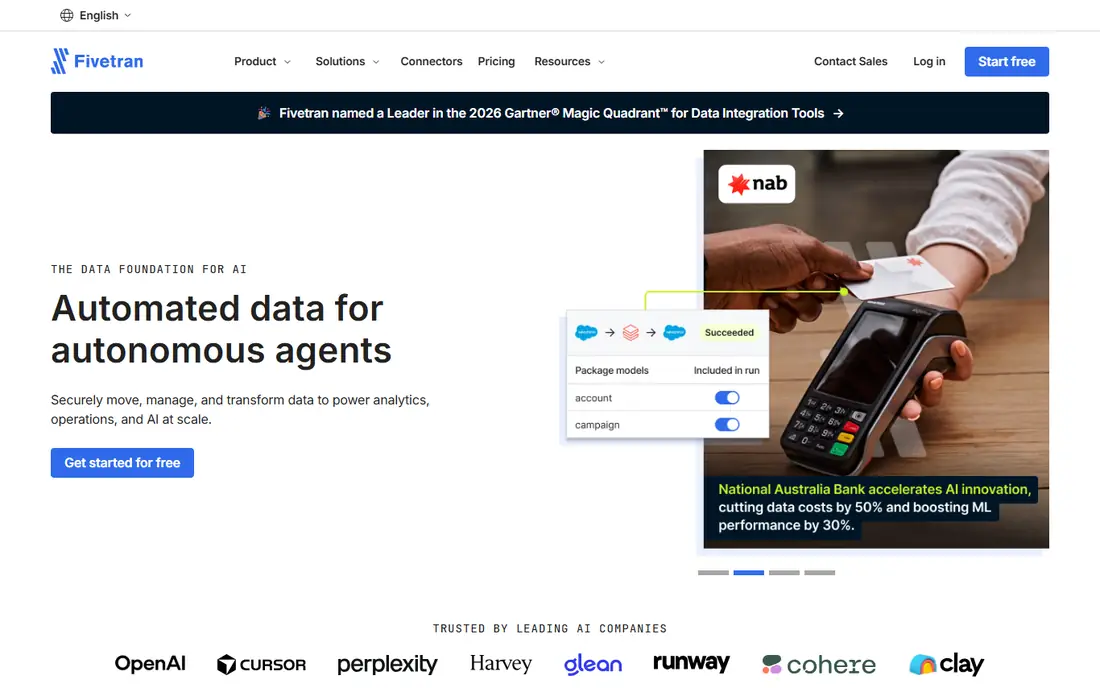
Fivetran is the tool we recommend first when a team wants pipelines that need little daily care. You connect a source such as Salesforce or Postgres, pick a warehouse destination, and Fivetran handles extraction, loading, schema changes, and retries. That hands-off design is valuable for small data teams, where every hour spent fixing a broken connector is an hour not spent on analysis. The free tier covers evaluation and small projects.
The main risk is cost at scale. Fivetran bills by monthly active rows per connection, with a $5 minimum per connection, so a growing set of sources can raise the bill faster than expected. Real-time sync is limited to higher tiers, and complex transformation still belongs in dbt or another tool. If reliability matters more than the lowest bill, Fivetran is a strong choice.
- Large connector library
- Automated schema handling
- Free tier up to 500,000 monthly active rows
- Usage-based pricing can rise fast
- Real-time sync needs higher tiers
- Transformation is basic
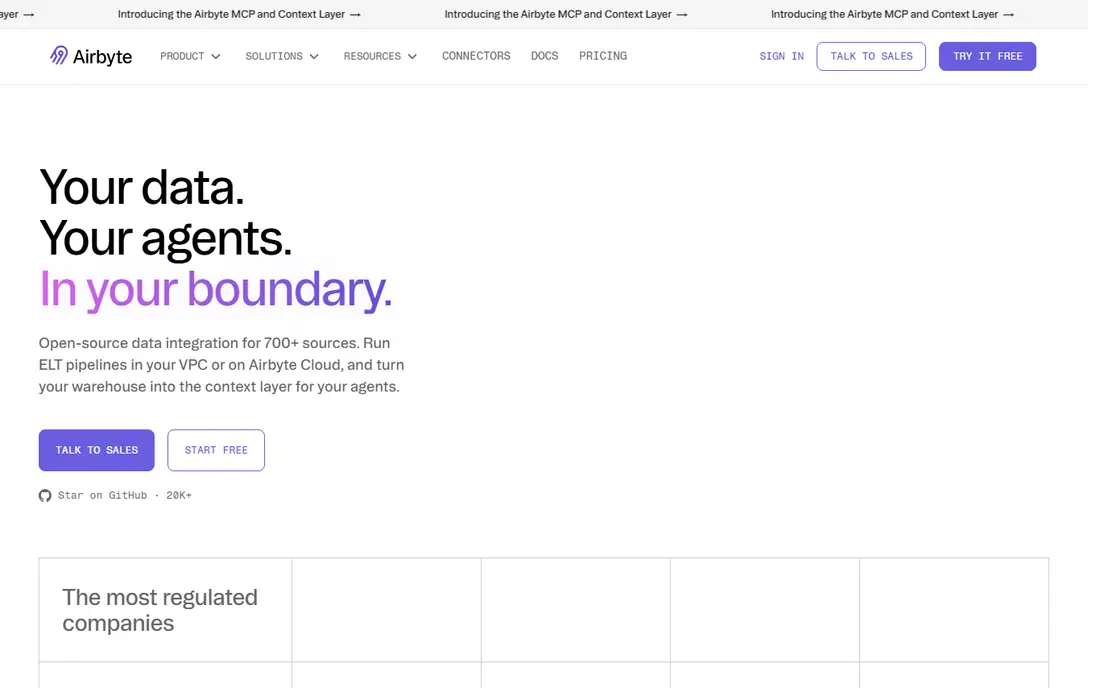
Airbyte gives teams a choice that Fivetran does not: run the open-source version yourself, or pay for Airbyte Cloud. Self-hosting costs no licence fee, though you pay for infrastructure and maintenance. Cloud Standard starts at $10 per month with volume-based credits, which makes it easy to test without a sales call. The connector catalog is broad, and community connectors extend it further.
The trade-off is effort and pricing shape. Self-hosted Airbyte needs setup and ongoing care, which can outweigh the licence saving for a small team. On Cloud, failed syncs still consume credits, and the jump to annual capacity plans is large. Airbyte suits engineering-led teams that want control and can manage that trade-off.
- Large open-source connector catalog
- Self-hosting option
- Low-cost cloud entry point
- Self-hosting needs engineering time
- Cloud costs rise with volume
- Large gap to annual capacity plans
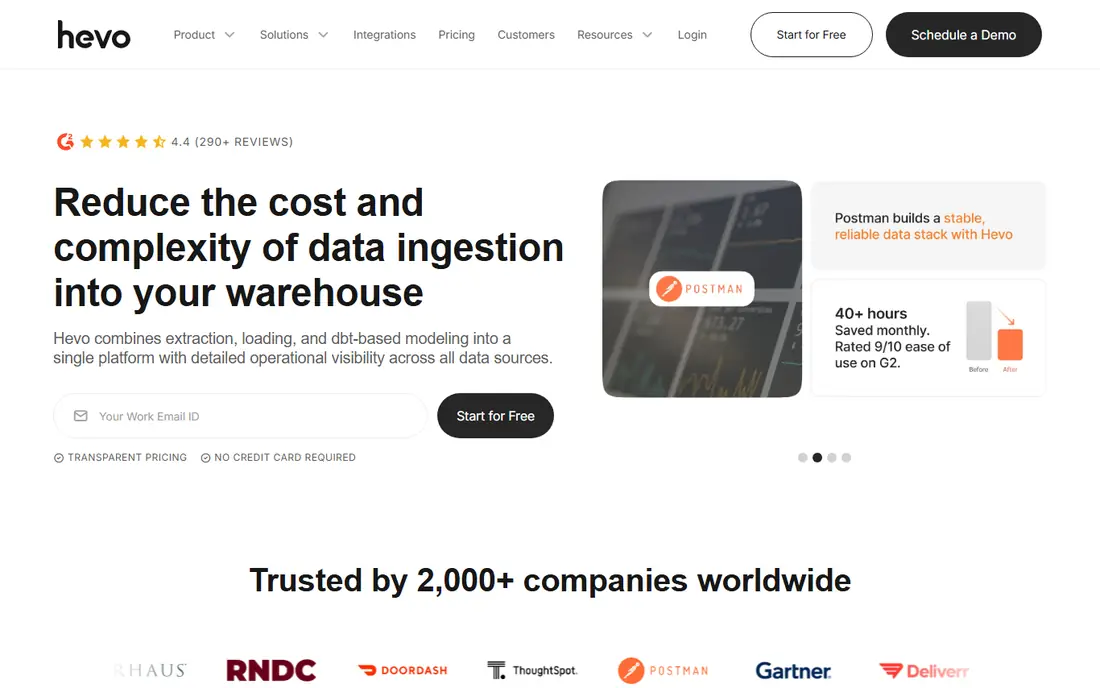
Hevo is a good middle ground between a simple connector tool and a full engineering platform. Pipelines are set up without code, sources and destinations are easy to browse, and built-in transformation covers common cleaning steps. Real-time replication on many sources helps teams that need fresh dashboards rather than overnight loads. A free tier lets you test a small pipeline before paying.
Pricing is event-based, so tables that update very often will generate more events and a higher bill. Hevo is cloud-only, which may not suit teams with strict on-premise rules. For a mid-sized team that wants managed pipelines without hiring a data engineer for every source, Hevo is a practical pick.
- No-code setup
- Real-time replication on many sources
- Built-in transformation
- Event-based pricing can rise with frequent updates
- Cloud-only deployment
- Enterprise features need higher tiers
Stitch remains useful for teams that want the simplest possible ELT setup. You connect a source, pick a destination, and let Stitch replicate rows on a schedule. The free tier covers up to 5 million rows per month, and paid plans start at $100 per month. For a small team with a handful of stable sources, that simplicity is enough.
The honest catch is direction. Stitch is now part of the Qlik Talend Cloud family and is in maintenance mode, so new connectors and features are limited. Teams planning a long-term, growing pipeline should weigh that against the low entry price. Stitch still earns a place for simple, stable workloads where ease matters most.
- Very easy setup
- Row-based tiers are easy to understand
- Free tier up to 5 million rows per month
- Product is in maintenance mode
- Fewer new connectors
- Limited transformation
AWS Glue fits teams that already run on AWS and have engineers comfortable with Spark. It is serverless, so you do not manage clusters, and it connects naturally to S3, Redshift, Athena, and other AWS services. Jobs can be written in Python or Scala, scheduled, and monitored inside AWS. For an AWS-native stack, Glue avoids adding another vendor to the data path.
It is not a simple connector tool. Setting up crawlers, jobs, and permissions takes AWS knowledge, and poorly sized jobs can waste DPU-hours. Non-technical teams will find Fivetran or Hevo faster to adopt. Choose Glue when your data already lives on AWS and your team can own the engineering work.
- Serverless Spark ETL on AWS
- Deep AWS service integration
- Scales with job size
- Needs AWS and Spark skill
- Costs vary with job design
- Less friendly for non-engineers
dbt Cloud does a different job from Fivetran, and it pairs well with it. After data lands in the warehouse, dbt lets analysts write SQL models, test them, document them, and run them on a schedule. Version control and a clear project structure make transformation work easier to review and maintain than a pile of ad hoc queries. A free developer tier helps individuals and small teams learn the workflow.
It does not move data from source apps into the warehouse, so you still need an ingestion tool for that step. Teams without SQL experience will face a learning curve, though the SQL focus is also why analysts like it. Use dbt Cloud as the transformation layer, with Fivetran, Airbyte, or Hevo handling ingestion.
- SQL-based transformation with version control
- Testing and documentation built in
- Strong warehouse support
- Not an ingestion tool
- Needs SQL skill
- Paid plans are quote-based for larger teams
Apache Airflow is the orchestration layer for teams with complex, multi-step pipelines. You define workflows in Python, schedule them, retry failed tasks, and watch dependencies across systems. It can call ingestion tools, transformation jobs, and machine learning steps in one place. As open-source software, Airflow itself is free, and managed services such as Astronomer offer hosted versions for teams that do not want to run it.
Airflow is not a plug-and-play connector tool. Running it in production needs infrastructure, monitoring, and Python skill, and the setup time is real. Smaller teams may find a managed pipeline tool plus dbt enough. For engineering teams with branching, scheduled, and interdependent jobs, Airflow remains the standard choice.
- Open-source orchestration
- Python-based workflows
- Large community and provider library
- Needs infrastructure and maintenance
- Setup time is significant
- Not a connector library by itself
Matillion suits teams that want to build pipelines visually inside their cloud warehouse. Its builder lets engineers and analysts design jobs, push transformation work down into Snowflake, BigQuery, or Databricks, and manage data flows without writing every step by hand. That warehouse-native approach can be efficient, since data does not need to move through a separate processing cluster.
Pricing is quote-based, so budgeting needs a sales conversation, and the design is centred on the warehouse rather than broad multi-cloud ingestion. Teams with a single warehouse and a visual workflow preference will like Matillion. Teams that need many SaaS connectors with no code may prefer Fivetran or Hevo first.
- Visual pipeline builder
- Push-down transformation in the warehouse
- Strong cloud warehouse support
- Quote-based pricing
- Warehouse-centric design
- Less suited to multi-cloud ingestion
Informatica Intelligent Data Management Cloud is the enterprise option in this list. It covers ingestion, integration, data quality, governance, and master data in one platform, with connectors for a wide range of databases, apps, and legacy systems. Large organisations with strict governance, audit, and compliance needs will find features here that smaller tools do not offer. Security and lineage tools support regulated industries.
That breadth comes with cost and complexity. Pricing is quote-based, implementation often takes longer, and small teams may find the platform heavier than they need. Informatica earns its place for enterprise programmes where governance and scale matter more than a quick self-serve start. Smaller teams should start with Fivetran, Airbyte, or Hevo.
- Very broad connectivity
- Data quality and governance features
- Enterprise-grade security
- Quote-based pricing
- Longer implementation
- Complex for small teams
How we picked these
We compared official pricing pages, documentation, and current 2026 reporting on connector coverage, pricing models, and product direction. We kept tools that are live and supported in October 2026, and we separated ingestion, transformation, and orchestration so readers can see which job each tool actually does. We favoured tools with a free tier or a low entry price, and we flagged quote-based enterprise pricing rather than inventing a number. We did not include Flowise, which reached end of life on 31 August 2026, since it is not a live data pipeline product for this list.
What to check before you buy
Start by listing your sources, destinations, and freshness needs. A tool with a connector for every source matters more than a long feature list, since a missing connector means custom code. Check whether you need batch loads, near-real-time sync, or both, and test with your largest table, not just a small sample. Pricing should be modelled on your real row, event, or credit volume, not on the entry tier alone.
Ingestion, transformation, or both
Many teams need two tools: one to move data, and one to transform it. Fivetran, Airbyte, Hevo, and Stitch focus on ingestion. dbt Cloud focuses on transformation. Airflow focuses on orchestration. Buying one tool and expecting it to do all three jobs well is a common source of disappointment, so map each job before you sign.
Cost traps to watch
Usage pricing can rise with deletes, history mode rows, failed syncs, and frequent updates, depending on the vendor. Set usage alerts, review the bill monthly in the first quarter, and ask what happens on a full resync after a schema change. A free tier is useful for testing, but it does not predict the bill at production volume.
Frequently asked questions
What is the best data pipeline software for a small team?
Fivetran or Hevo are good starting points for a small team, because both offer managed connectors with little maintenance. Fivetran suits teams that want reliability and a free tier to test, while Hevo suits teams that want no-code setup and real-time replication. Start with one source and a small warehouse project before committing to a larger plan.
Which data pipeline software platforms are best for engineers?
Airbyte and Apache Airflow suit engineering-led teams, since both offer control, open-source options, and Python-friendly workflows. Airbyte covers ingestion with a large connector catalog, while Airflow covers orchestration of complex jobs. Many engineering teams use both, with dbt Cloud handling transformation in between.
Is Fivetran better than Airbyte?
Fivetran is better for hands-off reliability, while Airbyte is better for control and lower entry cost. Fivetran manages connectors, schema changes, and retries with less work from your team, but its usage pricing can rise fast. Airbyte lets you self-host for no licence fee, but you take on maintenance. Choose by team skill and by how much operational work you want to own.
What is the difference between ETL and ELT?
In ETL, data is transformed before it is loaded into the warehouse. In ELT, data is loaded first and then transformed inside the warehouse, often with dbt. Most tools in this list follow ELT, since modern warehouses handle transformation well. The practical difference is where cleaning happens, and which team owns that step.
Do I need a data pipeline tool if I use dbt?
Yes, in most cases, because dbt transforms data that is already in the warehouse but does not ingest it from source apps. You still need a tool such as Fivetran, Airbyte, or Hevo to move data from Salesforce, Postgres, or files into the warehouse. Some teams write their own ingestion scripts, but that work grows quickly as sources are added.
Sources
See where you really rank - block by block
ProMapRanker scans Google Maps across a grid of your service area. Simple monthly plans from $19, white-label on every plan.
Start freeKeep reading
 who has the best home internet service
Who Has the Best Home Internet Service in 2026
Who has the best home internet service in 2026? Compare fiber, cable, and 5G providers on speed, price, data caps, and availability at your address today.
Read → visio alternatives
Best Visio Alternatives in 2026
Compare 9 Visio alternatives for flowcharts, org charts, and network diagrams, with free plans, pricing, and the best pick for teams and solo users in 2026.
Read → top 10 logistics software
Top 10 Logistics Software in 2026
We compared the top 10 logistics software tools for transport, warehousing, visibility and shipping, for shippers, carriers and 3PL teams in 2026 today.
Read →