 ProMapRanker
Best Data Observability Tools in 2026


Large teams needing full platform coverage · Pricing starts at: See website
Key takeaways
- Data observability is about trust in tables, not just pipeline success: freshness, volume, schema, and distribution checks catch the failures tests miss.
- Monte Carlo remains the broadest full platform, but its enterprise pricing puts it out of reach for many small teams.
- Open source tools such as Soda Core, Elementary, and Great Expectations cover a lot for teams willing to run and maintain them.
- Per table and per monitor pricing models make costs hard to compare, so size any quote by the tables you actually need monitored.
- dbt teams get the fastest start from dbt native tools, while multi platform estates need cross system lineage.
Quick comparison
| Pick | Great for | Pricing starts at | Free tier | |
|---|---|---|---|---|
| Monte Carlo | Large teams needing full platform coverage | See website | No | Visit |
 Bigeye | Teams wanting granular metric monitoring | See website | No | Visit |
 Soda | Teams wanting checks as code | Free | Yes | Visit |
 Metaplane | Datadog users and mid sized warehouses | See website | No | Visit |
 Anomalo | Teams wanting automated anomaly detection | See website | No | Visit |
 Sifflet | European and mid market data teams | See website | No | Visit |
 Acceldata | Enterprises with complex pipelines | See website | No | Visit |
 Elementary | dbt teams wanting observability inside dbt | Free | Yes | Visit |
 Great Expectations | Teams wanting a mature validation framework | Free | Yes | Visit |
The best data observability tools
When a dashboard shows wrong numbers, the pipeline often reports success. Data observability tools exist for that gap: they watch freshness, volume, schema changes, and value patterns, then alert an owner before bad data reaches a decision. We compared nine tools that data teams use in 2026, from full platforms to open source frameworks. Our pick for most established teams is Monte Carlo, with Soda and Elementary as the strongest lower cost starting points.

Monte Carlo is the company that popularised the term data observability, and its platform still sets the reference point. It connects warehouses, BI tools, and pipelines, traces lineage across them, and alerts owners when freshness, volume, or schema drifts from normal. For a large estate with many teams and many dashboards, that end to end view is the main reason to choose it.
The cost and complexity are real barriers. Pricing is quote based and aimed at enterprises, and the breadth of the platform takes time to learn and to tune. Smaller teams may pay for coverage they never use. If your data estate spans several platforms and bad data carries real business risk, Monte Carlo is the safest full platform bet.
- Deep lineage
- Broad integrations
- Incident workflows
- Anomaly detection
- Enterprise pricing only
- Steep learning curve
- Costly for small teams
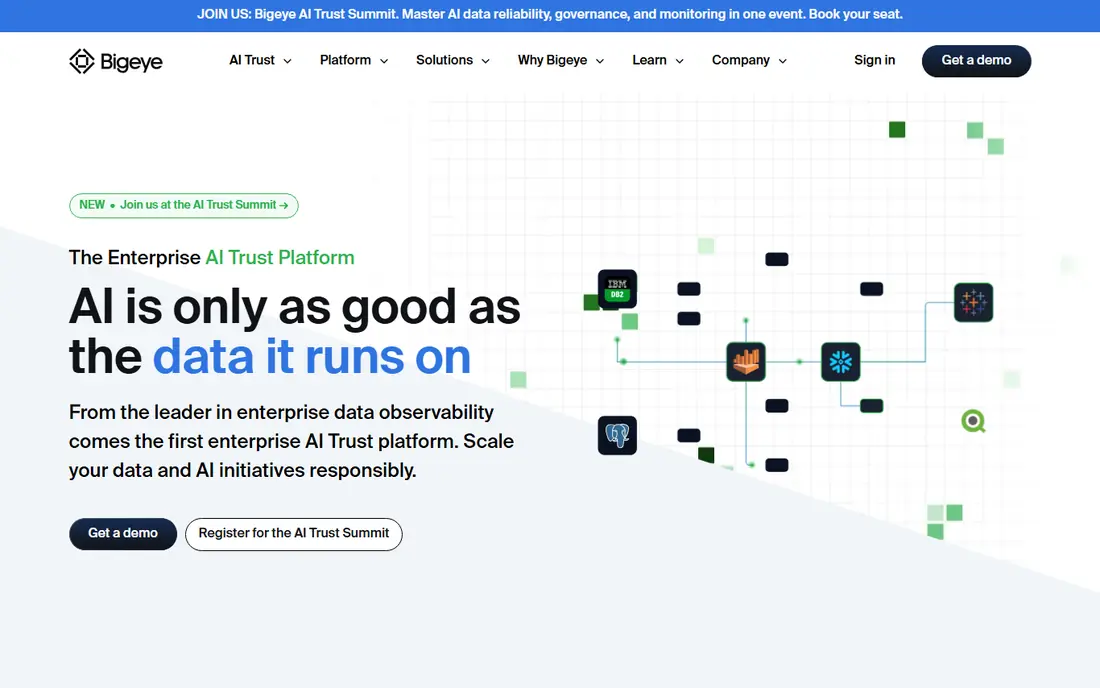
Bigeye focuses on monitoring at the metric level, which suits teams that already know which numbers matter most. Its rule engine lets analysts define checks with care, rather than relying only on learned baselines, and it supports the major warehouses. That control appeals to teams with strict reporting requirements.
The trade off is effort. Granular rules need maintenance as models change, and pricing is quoted rather than published, so budgeting takes a sales conversation. Bigeye is best for teams that want precise control over what gets checked and are willing to invest time in defining those checks well.
- Flexible rule engine
- Metric level monitoring
- Broad warehouse support
- Quote based pricing
- Setup needs data modelling care
- Smaller community than leaders
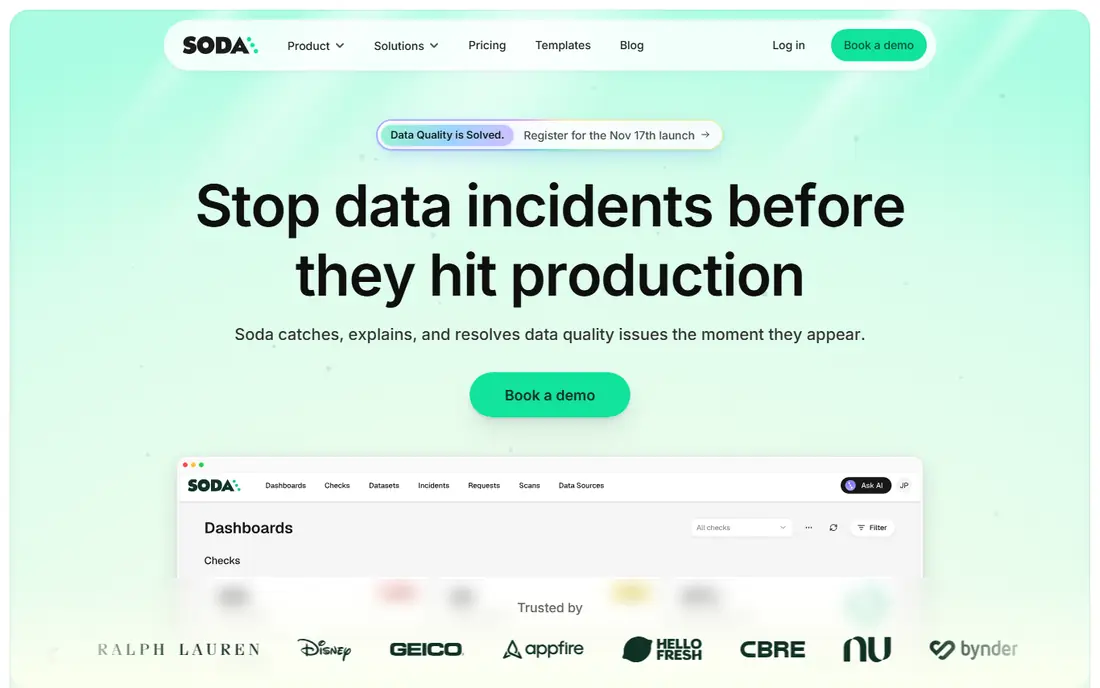
Soda takes a code first approach: analysts write data quality checks in SodaCL, version them with their models, and run them in CI and CD. That fits teams that already treat data pipelines like software, since checks live beside the code they guard. The open source core is free to try, and Soda Cloud adds collaboration and monitoring.
Read the licence and the cloud terms before you commit, since Soda Core uses the Elastic Licence rather than a standard open source licence, and some features sit only in Cloud. Teams that dislike writing checks by hand may prefer a platform that learns baselines automatically. For code minded data teams, Soda is a disciplined and practical choice.
- SodaCL checks as code
- Open source core
- CI and CD friendly
- Cloud option
- Cloud pricing is custom
- Soda Core licence is not a standard open source licence
- Cloud features differ from core
Metaplane, now part of Datadog, is known for a clear interface and column level lineage that shows exactly which fields feed a dashboard. That precision helps when a single column change breaks a report and nobody knows where it came from. Slack alerts and anomaly detection keep the daily workflow close to where data teams already work.
Pricing is not fully self serve, and warehouse coverage should be checked against your stack before a trial. Datadog ownership may suit teams already on Datadog, but it also means the roadmap follows a larger company. For mid sized teams that value clarity and lineage, Metaplane is a strong contender.
- Column level lineage
- Strong interface
- Slack alerts
- Anomaly detection
- Pricing is quote based for many teams
- Warehouse coverage varies
- Datadog ownership changes roadmap questions
Anomalo watches tables without requiring a long list of hand written rules. It learns what normal looks like for each table and flags shifts in volume, distribution, or schema, then points toward a likely cause. That approach catches problems nobody thought to test for, which is exactly the gap observability is meant to close.
The cost is that learned baselines need history before they become reliable, and teams that want exact rules may find the automation less transparent. Pricing is quoted, so small teams should trial it against a clear set of tables first. If unknown unknowns are your main worry, Anomalo is a good fit.
- Unsupervised anomaly detection
- Root cause hints
- Warehouse native checks
- Quote based pricing
- Less control than rule based tools
- Needs history to learn baselines
Sifflet combines observability with catalog features, so teams can find a table, see its lineage, and check its health in one place. That combination suits mid market teams that do not want separate tools for discovery and monitoring. Its incident workflows help owners respond in an organised way rather than through scattered messages.
It is less widely adopted than Monte Carlo, so community examples and third party integrations are thinner. Pricing is quoted, and a proper rollout needs time to connect sources and define owners. For teams that want catalog and observability together without enterprise scale, Sifflet is worth a close look.
- Full observability plus catalog features
- Lineage
- Incident management
- Quote based pricing
- Smaller ecosystem than leaders
- Implementation takes planning
Acceldata covers both data and pipeline observability, which matters when a failure could sit in either layer. It watches data quality alongside pipeline performance and compute use, giving platform teams one view of why a job slowed or a table went stale. Large enterprises with Spark and multi cloud estates are its natural audience.
That breadth brings enterprise pricing and a heavier setup, so it is not a sensible first tool for a small team with one warehouse. Buying is sales led and implementation needs platform time. If you run complex pipelines at scale and need data and compute in one picture, Acceldata belongs on the shortlist.
- Pipeline and data observability combined
- Compute insights
- Broad platform coverage
- Enterprise pricing and complexity
- Heavy for small teams
- Sales led buying
Elementary runs inside your dbt project, which is its great strength for dbt teams. It adds anomaly detection and monitoring as dbt tests, so data quality lives where models already live and no separate system needs running. The open source version is free, and the cloud version adds collaboration and alerting.
The limit is scope: it only covers dbt supported warehouses, and it will not watch sources or BI tools outside dbt. Teams without dbt will get little from it. For a dbt centred team that wants observability without another platform to maintain, Elementary is the most natural starting point.
- Dbt native
- Anomaly tests inside dbt
- Open source
- No separate infrastructure
- Limited to dbt supported warehouses
- Cloud features are paid
- Needs dbt expertise
Great Expectations, often called GX, is a mature open source framework for defining what good data should look like. Analysts write expectations for values, ranges, and patterns, then run them as part of pipelines or as standalone checks. Its community and documentation are extensive, and it connects to many data sources through SQLAlchemy.
It is a validation framework rather than a complete observability platform, so lineage, alerting, and incident workflows need extra work or the paid cloud version. That effort pays off for teams that want maximum control and already run Python based pipelines. If you want turnkey anomaly detection, pair GX with a monitoring platform instead of relying on it alone.
- Mature framework
- Huge community
- Flexible expectations
- Many data sources
- Setup and maintenance effort
- Cloud version is paid
- Not a full observability platform alone
How we picked these
We compared vendor documentation, pricing pages, and public reviews for tools that monitor data freshness, volume, schema, distribution, and lineage. We favoured tools with live products in October 2026 and clear coverage of major warehouses, and we excluded tools whose main job is application monitoring rather than data quality. Where pricing is quoted rather than published, we say so instead of guessing a figure.
How to choose a data observability tool for your stack
Start by listing the tables that feed decisions, not every table you own. Monitoring everything is expensive under per table or per monitor pricing, and it creates alert noise that teams learn to ignore. Check lineage coverage next: a tool that cannot trace a dashboard back to its source tables will not help when a report breaks. Then test alert quality on a small set of tables for two weeks, and count false alarms beside real catches. Finally, confirm who owns each alert. A tool without a named owner for every monitored table becomes a dashboard nobody watches, however good its detection may be.
Frequently asked questions
What is the best data observability software?
Monte Carlo is the broadest full platform for large, multi system estates. For dbt teams, Elementary is the fastest start, and for code first teams, Soda offers strong control at a lower entry cost. The best choice depends on your stack and team size.
What is the top rated data observability software for small teams?
Small teams usually do better with Soda Core, Elementary, or Great Expectations, since the open source entry point costs no licence fee. The trade off is engineering time to run and maintain them, so budget that time honestly.
What is the best data observability platform for lineage?
Monte Carlo and Metaplane stand out for lineage, with Metaplane offering column level detail that helps trace a single field. Check that your warehouses and BI tools are supported before you commit to either.
How much do data observability tools cost?
Costs vary widely. Open source tools are free to use but need maintenance time, while managed platforms often charge per table, per monitor, or by quote. Size any quote by the tables you actually need monitored, not your total table count.
Do I need data observability if I already use dbt tests?
dbt tests catch the rules you wrote, but they miss problems nobody anticipated, such as a partial load that still passes. Observability adds learned baselines and lineage, so the two work best together rather than as replacements.
Sources
See where you really rank - block by block
ProMapRanker scans Google Maps across a grid of your service area. Simple monthly plans from $19, white-label on every plan.
Start freeKeep reading
 outreach alternatives
Outreach Alternatives in 2026
Compare outreach alternatives for 2026, from Salesloft and Apollo to HubSpot and Lemlist, with pricing, channels, features, limits, and honest trade-offs.
Read → best web conference tools
Best Web Conference Tools in 2026
Compare the best web conference tools for meetings, webinars and team calls, with current pricing, free plans and honest limits for each option here today.
Read → best voice cloning tools
Best Voice Cloning Tools in 2026
Compare the best voice cloning tools in 2026, from ElevenLabs and Descript to Resemble and Cartesia, with consent rules, pricing, licenses, and limits.
Read →