 ProMapRanker
6 Best Data Management Platforms for Healthcare Options for 2026


Data teams building a governed healthcare data cloud · Pricing starts at: From 2 dollars per credit on demand, usage-based (third-party reported); Business Critical edition from 4 dollars per credit for HIPAA workloads
Direct answer
This list puts Snowflake first for data teams building a governed healthcare data cloud on a general-purpose system. Databricks fits healthcare and life sciences teams running analytics, machine learning, and AI at scale; IMO Health fits Health tech vendors and data teams that require clinical terminology. The remaining 3 options are covered below with prices and limits.
Key takeaways
- Snowflake sits first on this list: data teams building a governed healthcare data cloud on a general-purpose system.
- Health Catalyst fits large health systems and academic medical centers running outcomes-improvement programs.
- Before buying IMO Health, weigh this: narrow scope: a terminology and clinical context layer instead of a full warehouse or analytics suite, so buyers still need a separate product for storage and reporting.
- Databricks stands alone as the one tool in this list with a free plan.
Quick comparison
| Pick | Great for | Pricing starts at | Free tier | |
|---|---|---|---|---|
| Snowflake | Data teams building a governed healthcare data cloud | From 2 dollars per credit on demand, usage-based (third-party reported); Business Critical edition from 4 dollars per credit for HIPAA workloads | Free trial (30 days) | Visit |
 Databricks | Healthcare and life sciences teams running analytics | From 0.15 dollars per Databricks Unit, usage-based (third-party reported); cloud infrastructure billed separately | Yes | Visit |
 IMO Health | Health tech vendors and data teams that require clinical terminology | Quote | No | Visit |
 Veradigm | Ambulatory practices and health IT vendors | Quote for the data platform; EHR plans reported from 149 dollars per month (third-party reported) | No | Visit |
 Innovaccer | Health systems and payers unifying clinical | Quote | No | Visit |
 Health Catalyst | Large health systems and academic medical centers running outcomes-improvement programs | Quote, enterprise subscriptions reported at 500,000 dollars or more per year (third-party reported) | No | Visit |
The best data management platforms for healthcare
ProMapRanker put together this guide to data management platforms for healthcare for readers who want a clear shortlist without reading every vendor page. It compares 6 tools on starting price, free plans, who each one suits and where each one falls short.
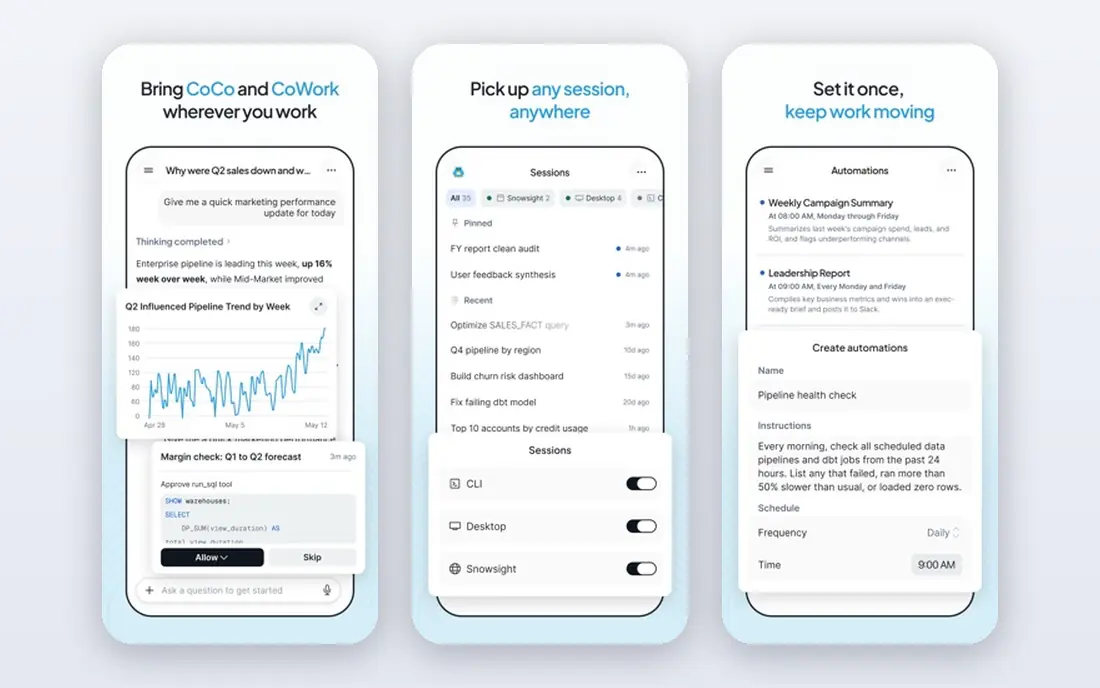
Snowflake makes the most sense for data teams building a governed healthcare data cloud on a general-purpose product. Snowflake is a general-purpose cloud data system with a dedicated healthcare and life sciences offering.
Best features of Snowflake: GDPR compliance.
What to check first: Usage-based billing is hard to predict without careful workload management.
It brings together EHR, claims, genomics, and imaging data into a single governed cloud, supports secure data sharing without copying data, and carries HIPAA and HITRUST certifications. Snowflake cost at the entry level: From 2 dollars per credit on demand, usage-based. On free options: Free trial (30 days).
- Published usage-based pricing with a free trial
- Solid data sharing and marketplace
- Healthcare teams must build or buy the healthcare data model themselves

Pick Databricks if this describes you: healthcare and life sciences teams running analytics, machine learning, and AI at scale. Databricks is a unified data and AI product built on the lakehouse architecture, and its healthcare offering applies that foundation to clinical, claims, genomic, and imaging data.
Beyond that, healthcare use cases bundle predictive risk models, genomics pipelines that process entire genomes in hours, and administrative automation over claims and EHR data. On cost, Databricks starts like this: From 0.15 dollars per Databricks Unit, usage-based. You can start on Databricks without paying.
Where it is weaker: costs are hard to predict since Databricks and cloud infrastructure arrive as two separate bills.
- Lakehouse architecture brings together warehousing, engineering, AI
- Capable genomics and unstructured data handling
- Steep ramp-up time for teams without Spark expertise
IMO Health
Great for: Health tech vendors and data teams that require clinical terminology
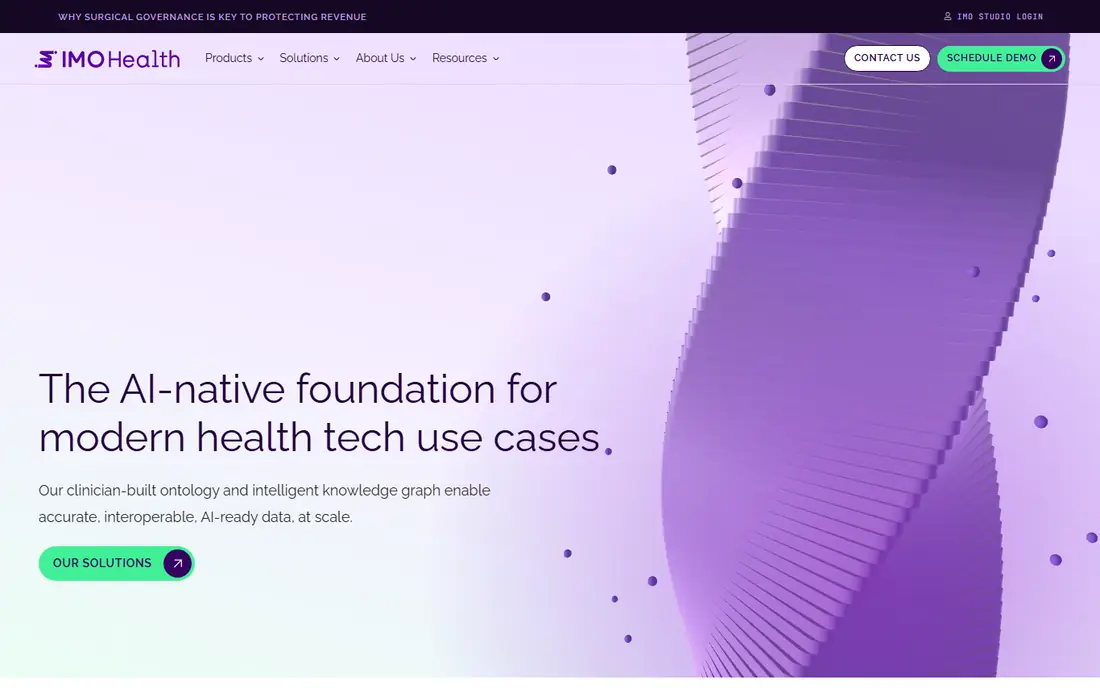
IMO Health was built for Health tech vendors and data teams that require clinical terminology, coding, and data normalization. IMO Health supplies the clinical terminology layer underneath numerous healthcare data products, and now sells that layer straight as the IMO Health Platform.
Its knowledge graph maps clinician language to standard codes across ICD-10-CM, SNOMED CT, LOINC, and RxNorm, and it reports 25 percent more specific encounters and 92 percent fewer manual data quality tasks. IMO Health does not publish a starting price; ask for a quote. There is no free plan with IMO Health.
- Supports 100 percent of USCDI requirements through version 4
- Maintenance-free code set updates
- Narrow scope: a terminology and clinical context layer instead of a full warehouse or analytics suite, so buyers still need a separate system for storage and reporting
Veradigm was built for ambulatory practices and health IT vendors needing EHR data, e-prescribing, and diagnostic connectivity. Its life sciences offering supplies research-ready EHR data on more than 150 million patient records.
Its Diagnostic Ordering and Results Network links to more than 500 labs and radiology centers through a single API. The Veradigm Connect developer program gives you tiered subscriptions, open APIs, and a sandbox for health IT vendors. Veradigm starts at: Quote for the data platform. Veradigm has no permanent free option.
Where it is weaker: add-on modules stack up costs.
- Ambulatory EHR network with research-ready data on more than 150 million patient records
- Open developer portal with FHIR APIs
- Primarily an EHR and network company, so buyers must assemble modules instead of buying one unified data layer
Think of Innovaccer for Health systems and payers unifying clinical, claims, and operational data on one system. Innovaccer raised a 275 million dollar Series F round in January 2025, according to Wikipedia.
Innovaccer sells by quote instead of a published price. Innovaccer does not include a free plan.
Honest limits: the product fits large organizations with staff to run a data unification program.
- Unified data model across clinical, claims, financial
- Solid population health and value-based care tooling
- Quote-only pricing hides the real cost until late in the sales process
Health Catalyst
Great for: Large health systems and academic medical centers running outcomes-improvement programs
Think of Health Catalyst for large health systems and academic medical centers running outcomes-improvement programs. Its Ignite system ingests clinical, claims, and operational data into governed, measurement-ready datasets, paired with analysts and improvement advisors who run quality and cost programs against it.
Trade-offs to know: implementations are long services-led projects.
The company reports more than 2.8 billion dollars in client-validated outcomes, more than 1,100 healthcare organizations as customers, and 390 documented case studies. Starting cost for Health Catalyst: Quote, enterprise subscriptions reported at 500,000 dollars or more per year. Health Catalyst does not include a free plan.
- Governed healthcare data model with a built-in analytics library
- Proven across more than 50 integrated delivery networks
- Enterprise pricing puts it out of reach for small providers
Pricing patterns for data management platforms for healthcare
Most healthcare data management products cost six figures per year or more, and nearly all of them quote each engagement rather than publishing a list price. Snowflake and Databricks are the exceptions, publishing usage-based rates: Snowflake charges from 2 dollars per compute credit on demand, and Databricks charges from 0.15 dollars per Databricks Unit, with cloud infrastructure billed separately.
A plain look at data management platforms for healthcare
A healthcare data management product brings together clinical, claims, financial, and operational data into one governed layer built around healthcare standards for example FHIR and HL7, so health systems, payers, and research teams can run analytics, reporting, and AI on trusted data. It differs from a generic data product since it understands healthcare formats: EHR extracts, HL7 v2 messages, FHIR resources, X12 claims, and code sets like ICD-10 and SNOMED CT. A general-purpose tool can store those files, but it will not know that a problem list entry, a claim line.
A lab result can all describe the same patient event. They also deal with the compliance layer healthcare demands: HIPAA controls, business associate agreements, and audit trails. In practice, if your team also needs to review the systems that produce the data, our guides to the best EMR and EHR software and the best HIPAA compliance software handle those adjacent choices.
Choosing data management platforms for healthcare: what matters
Check terminology handling: the product should map local codes to ICD-10, SNOMED CT, and LOINC, and support current USCDI requirements without manual maintenance. In daily use, teams that run billing data should also review our guide to the top 10 medical billing software. Teams that act on the data should review our guide to the best patient engagement system.
Selection criteria
For each of the 6 tools we noted price, free plan or trial, fit for data management platforms for healthcare and the main limit, using vendor pages and documentation. Treat prices as a snapshot: vendors change plans often, so check the vendor site for the figure that applies today. The order reflects how well each tool fits the most common buying scenario for data management platforms for healthcare, then price clarity, then free plan access. It is a starting point, not a verdict.
Pre-purchase checklist
- Ask IMO Health and Innovaccer for a written quote, since no starting price is shown.
- Test the free plan from Databricks against your real workload before relying on it.
- Use real work to test the free trial from Snowflake, rather than a demo project.
- Read the limits listed for Snowflake first: usage-based billing is hard to predict without careful workload management, and healthcare teams must build or buy the healthcare data model themselves.
- Get the contract term, renewal terms and any onboarding fees from IMO Health in writing.
- Map your must-have features to a specific Databricks plan before you compare prices.
Frequently asked questions
Can I try these tools before paying?
Often, yes. Databricks has a free plan and Snowflake offers a free trial. Use your own data and a real task during the test, and check what the free tier or trial limits before you rely on it.
How are the tools for data management platforms for healthcare ordered?
Snowflake sits first and Health Catalyst last because the order follows typical fit for data management platforms for healthcare, then price clarity and free access. It is a judgement call, so read each profile for fit and limits.
Do these tools publish their prices?
Not all of them. IMO Health and Innovaccer publish no starting price, so expect a quote request for those. The rest, Snowflake included, show a starting price, though seats and billing terms still change the final cost.
Which product is a good match for population health analytics?
The first pick on this list is Snowflake, because it suits data teams building a governed healthcare data cloud on a general-purpose product. Databricks is better for healthcare and life sciences teams running analytics, machine learning, and AI at scale, and IMO Health for Health tech vendors and data teams that require clinical terminology, coding, and data normalization. Check price and limits against your own needs before choosing.
Which options for data management platforms for healthcare have a free plan?
Databricks is the only tool in this list with a free plan. Free plans usually cap users, projects or features, so check the limits on the vendor page. One other tool offers a trial instead.
Sources
See where you really rank - block by block
ProMapRanker scans Google Maps across a grid of your service area. Simple monthly plans from $19, white-label on every plan.
Start freeKeep reading
 zscaler alternatives
Best Zscaler Alternatives in 2026
Looking for zscaler alternatives? We compare 9 SASE and zero trust platforms on architecture, data protection, pricing, and fit for your network and team.
Read → zapier alternatives free
Best Zapier Alternatives Free in 2026
Nine automation tools for zapier alternatives free in 2026, all with genuinely free tiers, plus free plan limits, starting prices and upgrade paths explained.
Read → which platform is best for online reputation
Which Platform Is Best for Online Reputation in 2026
Wondering which platform is best for online reputation? We compare 8 review, listing, and response tools for small and multi-location businesses and agencies.
Read →