 ProMapRanker
Best Data Integration Pipeline Tools in 2026

Key takeaways
- Fivetran and Airbyte lead for managed and open source ELT, with broad connector catalogs for warehouses.
- Hevo Data and Stitch suit smaller teams that want no-code setup and predictable starting tiers.
- Estuary Flow stands out for streaming and low-latency sync, while Matillion suits warehouse-native transforms.
- Price by rows, events, or volume at your real scale, since entry tiers rarely reflect a full production workload.
Quick comparison
| Pick | Great for | Pricing starts at | Free tier | |
|---|---|---|---|---|
 Fivetran | Managed ELT at scale | Free | Yes | Visit |
 Airbyte | Open source ELT flexibility | Free | Yes | Visit |
 Hevo Data | No-code ELT for small teams | Free | Yes | Visit |
 Stitch | Simple SaaS to warehouse loads | $100 per month | Free trial | Visit |
 Matillion | Warehouse-native transforms | See website | Free trial | Visit |
 Estuary Flow | Streaming CDC pipelines | Free | Yes | Visit |
 Skyvia | Budget cloud sync and ETL | Free | Yes | Visit |
 AWS Glue | Serverless ETL inside AWS | See website | No | Visit |
 Azure Data Factory | ETL inside Microsoft Azure | See website | No | Visit |
The best data integration pipeline tools
We compared connector coverage, change data capture, sync speed, transform options, and pricing models, and we kept only tools that move data into warehouses, lakes, or apps today.
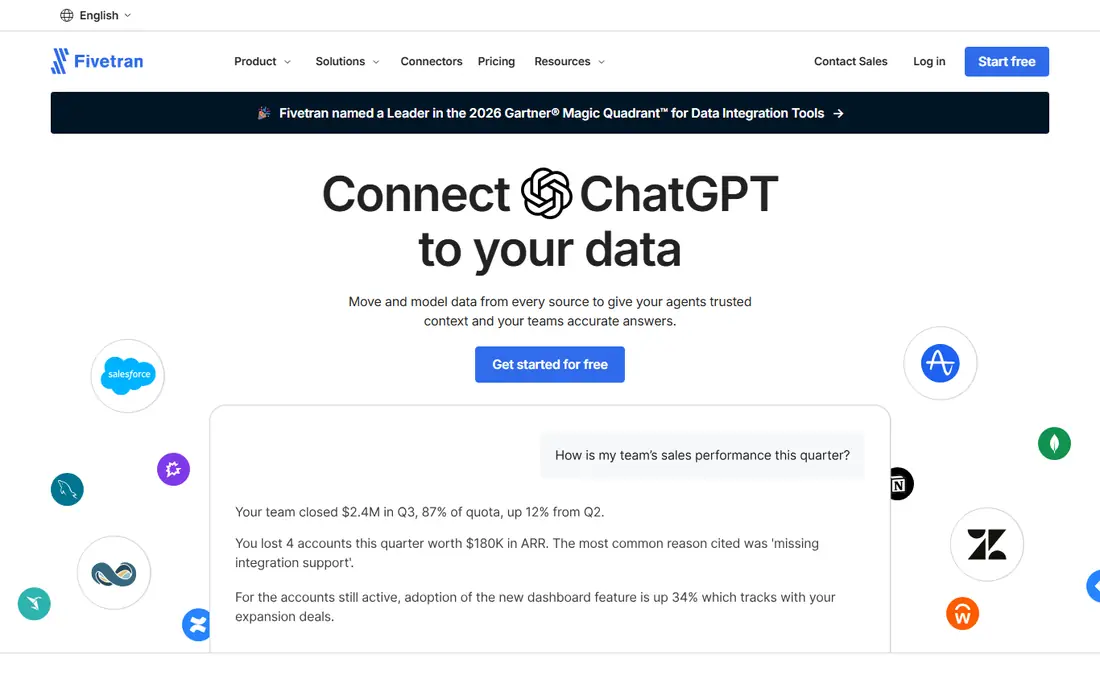
Fivetran suits teams that want pipelines to run with little upkeep. Connectors sync SaaS apps, databases, and files into Snowflake, BigQuery, Databricks, and other warehouses, with schema changes handled in the background. Change data capture keeps warehouse data fresh without manual extracts, and a free tier covers up to a set volume of monthly active rows.
The cost model needs care. Pricing follows monthly active rows and connections, so a growing source can raise the bill faster than a flat-fee tool. Teams that need heavy in-pipeline transforms may pair Fivetran with a transform tool. For managed reliability and connector depth, Fivetran remains the benchmark many teams compare against.
- Large managed connector catalog
- Automated schema handling
- Change data capture on many sources
- Usage-based pricing can rise fast at scale
- Transform options are narrower than warehouse-native tools
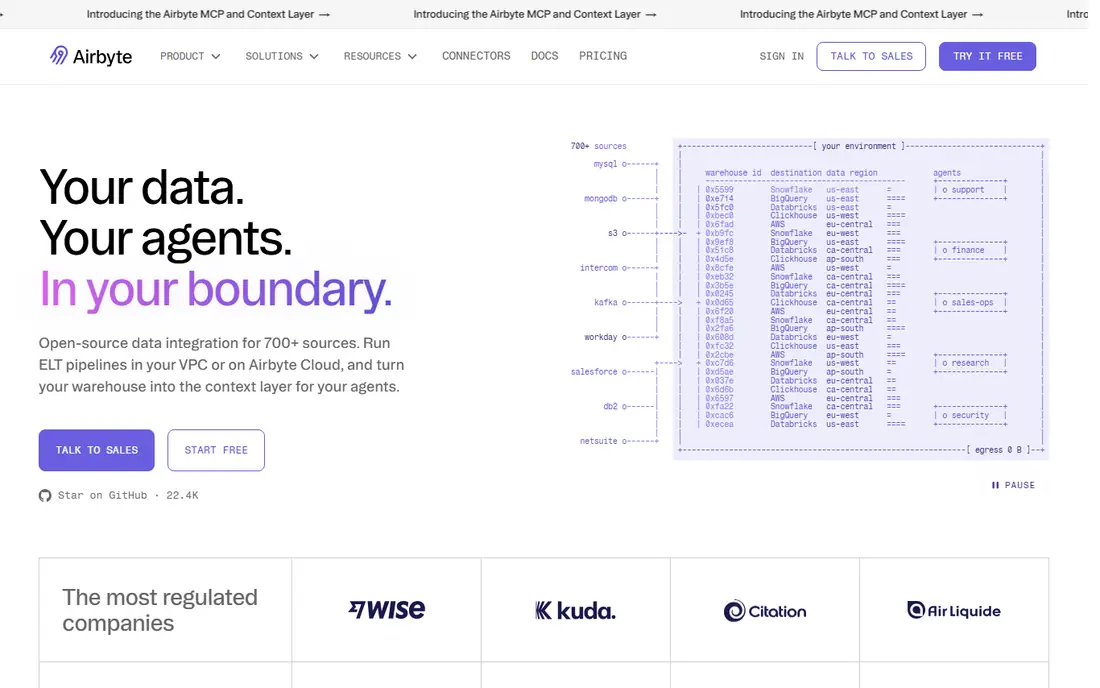
Airbyte fits data teams that want open code and the freedom to build custom connectors. The self-hosted version costs no licence fee, which helps teams with strict data rules or custom sources. Airbyte Cloud offers managed sync for teams that prefer not to run infrastructure, with Standard and Plus tiers for different volumes.
Self-hosting trades licence savings for operator time, including upgrades, monitoring, and scaling. Cloud pricing also scales with rows and credits, so model costs at production volume. For teams that value connector choice and code control, Airbyte gives a flexible middle path between fully managed and fully custom pipelines.
- Open source self-hosted option
- Large community connector catalog
- Cloud plans for managed use
- Self-hosting needs operations work
- Cloud costs scale with volume
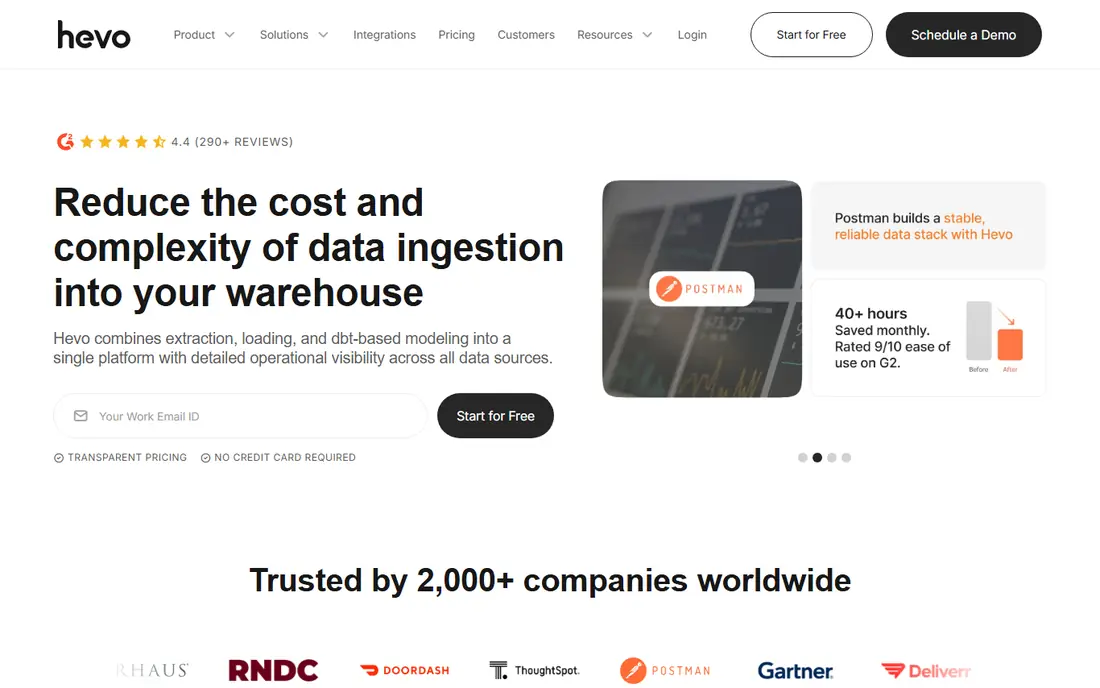
Hevo Data suits small and mid-size teams that need to move SaaS and database data into a warehouse without writing pipeline code. Setup is guided, schema mapping is automatic, and change data capture keeps data current on many sources. A free tier covers up to one million events a month, which is enough to prove a pipeline before paying.
Event-based pricing means high-churn sources can push a team into a higher tier sooner than expected. Advanced transforms also sit on paid plans, often through Python or dbt. For a no-code team that wants fast setup and clear monitoring, Hevo is an easy shortlist pick.
- No-code pipeline setup
- Automatic schema mapping
- Real-time and change data capture options
- Event tiers can cap growth
- Advanced transforms need Python or dbt on paid plans
Stitch, part of Talend, fits teams that want simple, scheduled extract and load without a complex platform. Common SaaS sources connect quickly, data lands in a warehouse on a schedule, and row tiers make early costs easy to forecast. For a small analytics team with stable sources, that simplicity is a benefit.
Transform depth is the limit. Stitch does not offer the in-pipeline transform range of Matillion or dbt-based workflows, and change data capture is limited on some sources. Teams that need streaming or heavy transforms should look elsewhere. For straightforward SaaS to warehouse loads, Stitch stays dependable and easy to run.
- Simple setup for common SaaS sources
- Predictable row tiers
- Reliable scheduled replication
- Limited transform options
- Change data capture coverage is narrower than rivals
Matillion suits teams that already run a cloud warehouse and want transforms to run inside it. Visual workflows, push-down SQL, and Python support let analysts build pipelines that scale with the warehouse, rather than moving data through a separate engine. That design keeps large transforms fast and close to the data.
Pricing is quote-based and credit-driven, which makes a quick comparison harder. Teams without a cloud warehouse will get less from Matillion than teams on Snowflake, BigQuery, or Databricks. For warehouse-centered teams, the transform depth and visual design are strong reasons to shortlist it.
- Visual pipeline design for Snowflake, BigQuery, and Databricks
- Push-down transforms
- Python support
- Quote-based pricing
- Warehouse-native design suits cloud warehouses best
Estuary Flow fits teams that need fresh data in seconds or minutes, not hours. Streaming change data capture moves database changes into warehouses and lakes with low latency, and derivations let teams shape data in flight with SQL or TypeScript. A free tier covers small volumes, which helps teams test streaming before committing.
Pricing follows data volume and connector count, so high-volume sources need a cost model before launch. The connector catalog is also smaller than the largest managed tools. For real-time dashboards, fraud checks, or operational analytics, Estuary gives a streaming-first option that batch tools do not match.
- Streaming change data capture with low latency
- SQL and TypeScript derivations
- Free tier for small volumes
- Per-GB and per-connector pricing needs modeling
- Smaller connector catalog than Fivetran
Skyvia suits small teams and solo analysts who need cloud sync, replication, and basic ETL without enterprise cost. The no-code builder covers common SaaS, database, and file sources, and a free tier handles small datasets. Reverse ETL on suitable plans also lets teams send warehouse data back into business apps.
Enterprise teams may find governance, transform depth, and connector breadth thinner than Fivetran or Matillion. High-volume workloads should also be modeled, since volume tiers drive cost. For budget-conscious teams with standard sources, Skyvia gives a practical entry point.
- Free tier for small datasets
- No-code ETL and sync
- Reverse ETL options on some plans
- Depth is lighter than enterprise tools
- High-volume pricing needs checking
AWS Glue fits teams already built on AWS that need serverless ETL without managing clusters. Visual jobs, Spark jobs, and Python jobs move data between S3, databases, and Redshift, with schema discovery through the Glue Data Catalog. Pay-per-use pricing means idle pipelines cost little, which suits variable workloads.
The limit is ecosystem lock-in. Glue works best inside AWS, and complex jobs need Spark or Python skills. Teams on Azure or Google Cloud will get more from a cloud-neutral tool. For AWS-centered data teams, Glue keeps pipelines close to storage and compute.
- Serverless Spark ETL inside AWS
- Automated schema discovery
- Native links to S3, Redshift, and Athena
- AWS-only focus
- Spark and Python skills needed for complex jobs
Azure Data Factory suits Microsoft-centered teams that need visual ETL and orchestration inside Azure. Pipelines move data from on-premises and cloud sources into Azure SQL, Synapse, Data Lake, and Databricks, with scheduling, monitoring, and data flows built in. The visual designer helps analysts build pipelines without writing code for common patterns.
Teams outside Azure will find less value, and usage-based pricing for integration runtimes and data flows needs modeling at scale. Complex transforms may also move to Databricks or Synapse for best performance. For Azure teams, Data Factory is the natural pipeline and orchestration choice.
- Visual pipeline designer
- Broad Azure and on-premises connectors
- Integration with Synapse and Databricks
- Azure-centered design
- Usage pricing needs modeling for large jobs
How we picked these
We compared official connector lists, pricing pages, and documentation for each tool. We kept only tools that build and run data pipelines today, and we favored clear change data capture, warehouse support, and monitoring. We did not claim hands-on testing, and we left out pure transform-only tools that do not move data from sources on their own.
How to choose a pipeline tool
Start with source and destination. List every source system, its change rate, and the warehouse or lake where data must land. That list rules out tools that lack a key connector or a needed change data capture method. Then decide on latency. Batch sync every few hours suits reporting, while streaming suits operational dashboards and alerts.
Next, model cost at real volume. Convert each vendor meter, whether rows, events, credits, or gigabytes, into a monthly figure at your expected scale, not the trial scale. Test failure handling too, since a pipeline that silently drops rows is worse than a slow one. Check alerting, backfill, schema change handling, and data export before you commit.
Build for upkeep
Pipelines need owners, docs, and tests. Name an owner for each pipeline, record source rules, and set alerts for failed syncs and row-count drops. That upkeep work matters more than the first setup, since sources change often and silent breaks are common.
Frequently asked questions
What is the best data pipeline for data integration platforms?
Fivetran leads for managed pipelines, Airbyte leads for open source flexibility, and Hevo Data leads for no-code small-team setup. The best choice depends on connector needs, latency, and team skill. Model cost at production volume before you choose.
What is the best data integration platform pipeline for real-time data?
Estuary Flow leads for streaming change data capture with low latency in this list. Hevo Data also offers real-time options on suitable plans. Confirm latency with your actual source and warehouse, since real-time claims vary by connector.
What are the best data integration tools and pipelines for small teams?
Hevo Data, Stitch, and Skyvia give small teams the simplest start, with free tiers or low entry prices. Airbyte self-hosted can also work for a technical small team. Pick the tool that covers your sources first, then compare price.
How do ELT and ETL differ?
ETL transforms data before loading it into a warehouse, while ELT loads raw data first and transforms it inside the warehouse. ELT suits cloud warehouses with strong compute, while ETL suits teams that need clean data before it lands. Many tools in this list support both patterns in part.
How much do data pipeline tools cost?
Costs vary by meter, whether rows, events, credits, or compute hours, and by volume. Free tiers cover small workloads, while production pipelines often run from a few hundred to several thousand dollars a month. Model your row or event volume before you compare headline prices.
Sources
See where you really rank - block by block
ProMapRanker scans Google Maps across a grid of your service area. Simple monthly plans from $19, white-label on every plan.
Start freeKeep reading
 zscaler alternatives
Best Zscaler Alternatives in 2026
Looking for zscaler alternatives? We compare 9 SASE and zero trust platforms on architecture, data protection, pricing, and fit for your network and team.
Read → zapier alternatives free
Best Zapier Alternatives Free in 2026
Nine automation tools for zapier alternatives free in 2026, all with genuinely free tiers, plus free plan limits, starting prices and upgrade paths explained.
Read → which platform is best for online reputation
Which Platform Is Best for Online Reputation in 2026
Wondering which platform is best for online reputation? We compare 8 review, listing, and response tools for small and multi-location businesses and agencies.
Read →