 ProMapRanker
Best Data Governance Platforms in 2026

Key takeaways
- Collibra is our pick for regulated enterprises that need formal stewardship and policy enforcement, while Alation suits analytics teams that want discovery people actually use.
- Atlan is the strongest modern pick for cloud-native teams, with faster setup than legacy suites, though its policy tools are still maturing.
- Enterprise governance pricing is usually quoted and often reaches six figures a year, so budget for implementation and data quality tools on top of the platform.
- DataHub is the best starting point for small teams, since the open-source core is free and covers catalog and lineage basics.
Quick comparison
| Pick | Great for | Pricing starts at | Free tier | |
|---|---|---|---|---|
 Collibra | Regulated enterprise governance | See website | No | Visit |
 Alation | Discovery-led governance | See website | No | Visit |
 Atlan | Cloud-native data teams | See website | No | Visit |
 Informatica | Large multi-cloud estates | See website | No | Visit |
 Microsoft Purview | Microsoft-centred organisations | See website | No | Visit |
 data.world | Knowledge-graph governance | See website | No | Visit |
 OvalEdge | Mid-market governance at lower cost | See website | No | Visit |
 DataHub | Open-source catalog and governance | Free | Yes | Visit |
The best data governance platforms
We compared the platforms below on catalog, lineage, glossary, policy workflows, data quality, adoption, and pricing model.
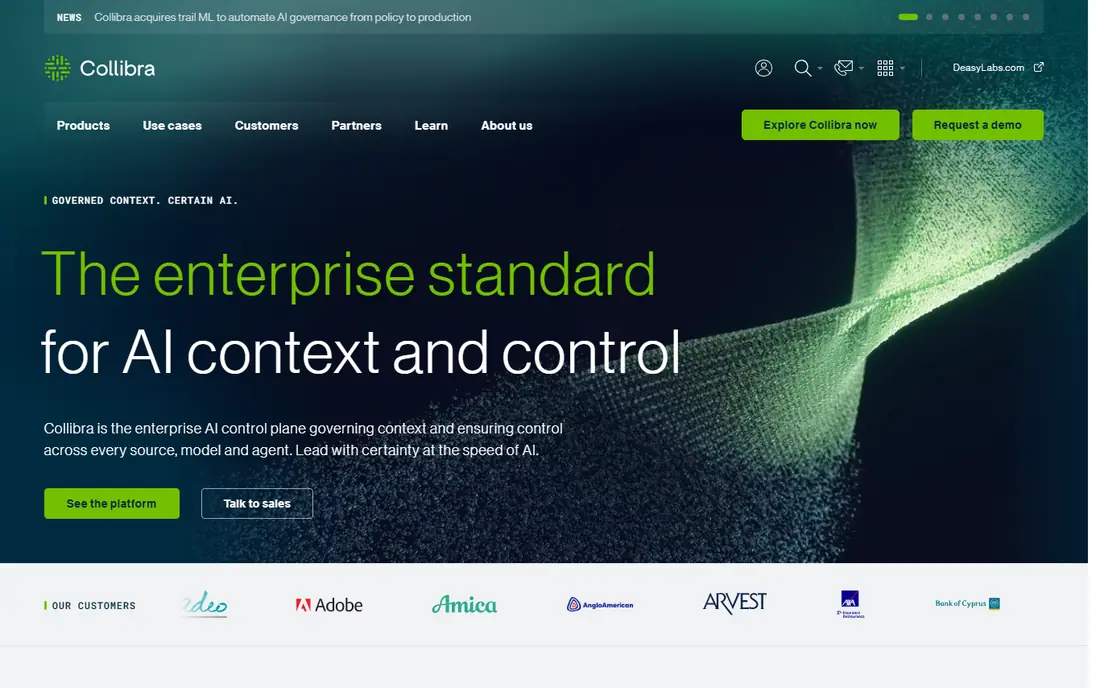
Collibra is the governance-first leader for banks, insurers, healthcare organisations, and government teams. Its strength is formal process: configurable approval chains, policy enforcement, business glossaries linked to policies, and audit trails that show who approved what and when. A native data quality module, built from an earlier acquisition, adds rule-based quality checks inside the same platform.
The trade is time and cost. Implementation often takes six to twelve months with partner help in third-party comparisons, and pricing is quoted, with marketplace listings around $170,000 for a 12-month term in recent comparisons. Adoption can also lag if analysts find the interface heavy. If regulation and auditability drive your program, Collibra is the benchmark. If speed matters more, look at Atlan or Alation first.
- Deepest stewardship and policy workflows
- Strong glossary and audit trails
- Native data quality module
- Long implementation
- Steep learning curve
- Enterprise pricing

Alation takes the opposite approach to Collibra: start with discovery people want to use, then layer governance on top. Search, behavioural signals, and collaborative curation help analysts find trusted tables, understand columns, and see lineage before they build a report. That analyst focus usually drives faster adoption, which matters because an empty catalog helps no one, however strong its policy tools are.
The limit is formal governance depth. Stewardship workflows and approval chains are adequate but lighter than Collibra, so heavily regulated teams may need extra process outside the tool. Pricing is quoted, with marketplace listings from around $60,000 for a 12-month term in recent comparisons, plus implementation costs. For analytics-led teams with a maturing program, Alation is a strong balance of usability and control.
- Strong search and discovery
- Analyst-friendly interface
- Column-level lineage for warehouse stacks
- Stewardship workflows are lighter than Collibra
- Enterprise pricing still high
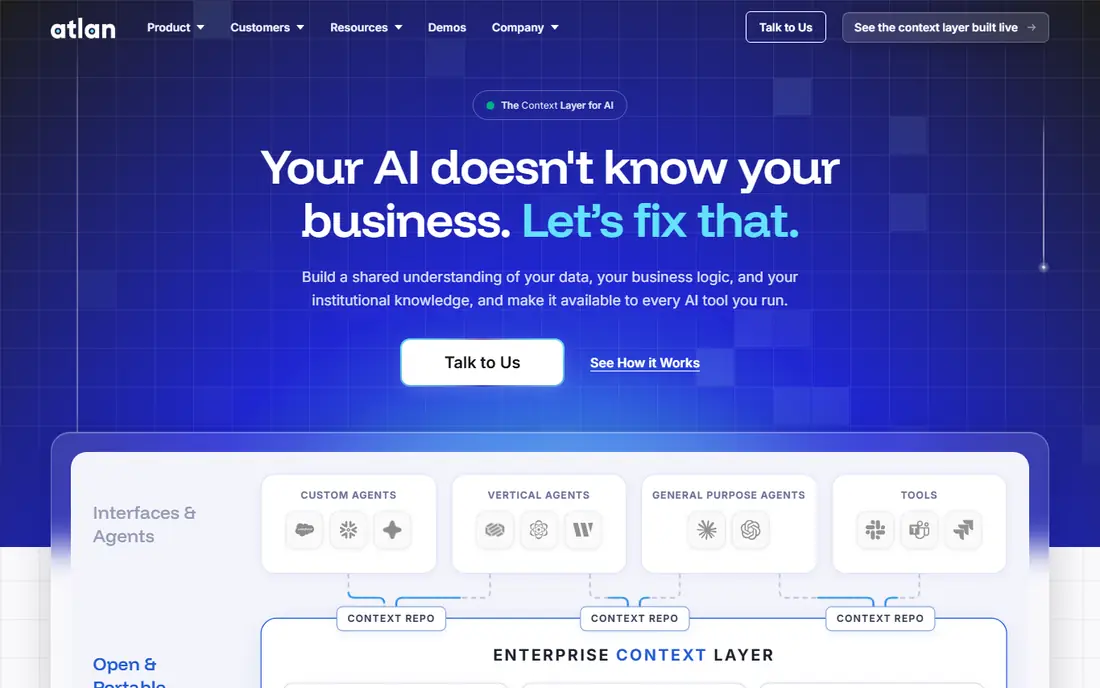
Atlan is the modern pick for cloud-native data teams. Its interface feels closer to a collaboration tool than a legacy enterprise suite, with shared documentation, lineage, and stewardship playbooks that analysts, engineers, and business managers can all use. Implementation is faster than Collibra in third-party comparisons, often measured in weeks to first value rather than months, which helps teams that need results before a long rollout.
The catch is governance maturity. Policy automation and compliance workflows are growing but do not yet match Collibra for regulated use cases, so a bank or insurer should test those features carefully. Pricing is quoted and scales by sources and users, with third-party estimates from around $30,000 a year. For a mid-market or cloud-first team, Atlan is the best blend of adoption and governance.
- Modern, collaborative interface
- Fast time to value
- Strong lineage for modern stacks
- Policy engine is less mature than Collibra
- Pricing is quoted
Informatica, now part of Salesforce, suits large enterprises with complex, multi-cloud data estates. Its governance and catalog tools sit alongside integration, quality, and master data products, so a team can govern data that moves across many systems from one vendor. Lineage, quality rules, and policy tools cover the breadth a large estate needs, and the AI engine helps automate classification and documentation.
The platform is complex, and usage-based pricing can be hard to forecast without a clear model of consumption. Small teams will find it heavy and costly. For a large enterprise already using Informatica for integration, adding its governance tools is a natural step. For a standalone governance buy, compare Collibra and Alation first.
- Broad data management coverage
- Strong lineage and quality tools
- Multi-cloud support
- Complex platform
- Usage-based pricing can be hard to forecast
Microsoft Purview suits organisations already centred on Microsoft 365 and Azure. It brings data governance, catalog, lineage, and compliance views into the Microsoft ecosystem, so teams can govern data in Azure, Microsoft 365, and connected sources without a separate vendor platform. Consumption-based pricing means costs follow usage, which can suit teams with variable workloads.
The limit is ecosystem fit. Purview works best inside Microsoft, and teams with large non-Microsoft stacks may need extra connectors or a second tool. Setup also needs Microsoft expertise to get permissions, scanning, and policies right. If your data lives mainly in Azure and Microsoft 365, Purview is a strong, cost-flexible pick. If your stack is mixed, compare a vendor-neutral platform.
- Native fit for Microsoft 365 and Azure
- Unified governance and compliance view
- Consumption pricing
- Best inside the Microsoft stack
- Setup needs Microsoft expertise
data.world takes a knowledge-graph approach to governance, which suits teams with complex relationships between datasets, business terms, and policies. Instead of a flat list of tables, the catalog models how data, owners, and rules connect, which helps when a single field feeds many reports and decisions. Collaboration tools let business and data teams discuss definitions and ownership in context.
Pricing is quoted for enterprise use, with third-party estimates from around $90,000 a year, so it is not a small-team purchase. The graph model also takes learning for teams used to a simple catalog list. For organisations where relationships and business context matter as much as lineage, data.world is a distinctive and credible option.
- Knowledge-graph approach to catalog and governance
- Strong collaboration
- Good for complex relationships
- Enterprise pricing
- Graph model needs learning for some teams
OvalEdge suits mid-market teams that want governance without legacy pricing. Catalog, classification, lineage, and governance tools ship in the base subscription in vendor comparisons, rather than as separate add-ons, and deployment is faster than enterprise suites. That combination helps a team with a real governance need but a limited budget and a small data team.
The trade is ecosystem size. OvalEdge has fewer integrations and partners than Collibra or Alation, so check connector coverage for your warehouses, BI tools, and ETL systems before buying. Pricing is quoted by module and user count, with third-party estimates well below legacy suites. For a mid-market team, OvalEdge is worth a demo next to Atlan.
- Catalog, classification, and lineage in the base subscription
- Lower price than legacy suites
- Faster deployment
- Smaller ecosystem than Collibra or Alation
- Quoted pricing by module
DataHub is the best starting point for small teams and for any team that wants to test governance without a vendor contract. The open-source core covers data catalog, lineage, ownership, and search, and it integrates with common warehouses, BI tools, and transformation tools. A managed cloud service exists for teams that want support without self-hosting, though that service is quoted.
Self-hosting is the main cost. You need engineering time to deploy, upgrade, and maintain DataHub, and governance workflows are lighter than Collibra. Still, for a team building its first catalog, or for a larger team that wants an open foundation, DataHub gives real value at zero licence cost. Start here if budget is tight, and move to a commercial platform only when a clear gap appears.
- Free open-source core
- Catalog, lineage, and ownership
- Managed cloud option for teams that want support
- Self-hosting needs engineering time
- Enterprise features need the managed service
How we picked these
We compared vendor pages and third-party catalog and governance comparisons for platforms that serve data governance in October 2026. We included governance-first suites, discovery-led catalogs, a modern cloud-native platform, a Microsoft-native option, a knowledge-graph option, a mid-market option, and an open-source option, since governance needs vary by regulation, stack, and budget. Where vendors do not publish pricing, we wrote See website and treated third-party estimates as context only.
How to choose a governance platform
Start with the problem, not the feature list
List the decisions governance must support: regulatory reporting, trusted analytics, privacy compliance, or data quality. A regulated reporting program needs Collibra-style workflows, while a trusted analytics program needs Alation or Atlan-style discovery. Buying the longest feature list rarely fixes the actual problem.
Pilot on one domain first
Pick one business domain, such as customer or finance data, and run a pilot that covers catalog, lineage, ownership, and one policy workflow. Measure whether analysts find and trust data faster, and whether stewards can approve changes without bottlenecks. A pilot on one domain exposes adoption and data quality gaps before a company-wide rollout.
Check connectors and data quality honestly
Test connectors against your real warehouses, BI tools, and pipelines, not demo data. Check whether lineage is column-level for your stack, whether quality rules run where your data lives, and whether classification covers your sensitive data types. A platform that cannot see your stack cannot govern it.
Frequently asked questions
What are the best data governance tools for enterprises?
Collibra and Alation are the strongest enterprise picks, with Collibra best for regulated governance and Alation best for discovery-led adoption. Informatica suits large multi-cloud estates, while Microsoft Purview suits Microsoft-centred organisations. The best enterprise tool depends on regulation, stack, and adoption risk.
What are the best data governance platforms for small teams?
DataHub is the best small-team pick, since the open-source core is free. Atlan and OvalEdge suit growing teams that want a modern or mid-market commercial platform without legacy cost. Start with a clear domain pilot, rather than buying an enterprise suite for a small team.
What is the best data governance software for cloud data?
Atlan is the best cloud-native pick, with fast setup and strong lineage for modern stacks. Alation also suits cloud data warehouses well, while Microsoft Purview suits Azure-centred teams. Check connector coverage for your specific warehouses before you choose.
How much do data governance platforms cost?
Costs vary widely. DataHub is free as open source, mid-market tools may start in the tens of thousands a year, and enterprise suites often reach six figures a year plus implementation. Most vendors quote pricing, so get a written total that includes implementation, data quality, and support.
What is the difference between a data catalog and data governance?
A data catalog helps people find, understand, and trust data through search, documentation, and lineage. Data governance adds policies, ownership, stewardship workflows, and quality controls on top of that catalog. Most platforms in this list combine both, but the balance differs: Alation leans catalog-first, while Collibra leans governance-first.
Can I use open-source tools for data governance?
Yes. DataHub and OpenMetadata are open-source options that cover catalog, lineage, and basic governance, with managed services for teams that want support. Open source suits teams with engineering time and a clear domain pilot, while commercial platforms suit teams that need vendor support and formal workflows.
Sources
See where you really rank - block by block
ProMapRanker scans Google Maps across a grid of your service area. Simple monthly plans from $19, white-label on every plan.
Start freeKeep reading
 outreach alternatives
Outreach Alternatives in 2026
Compare outreach alternatives for 2026, from Salesloft and Apollo to HubSpot and Lemlist, with pricing, channels, features, limits, and honest trade-offs.
Read → best web conference tools
Best Web Conference Tools in 2026
Compare the best web conference tools for meetings, webinars and team calls, with current pricing, free plans and honest limits for each option here today.
Read → best voice cloning tools
Best Voice Cloning Tools in 2026
Compare the best voice cloning tools in 2026, from ElevenLabs and Descript to Resemble and Cartesia, with consent rules, pricing, licenses, and limits.
Read →