 ProMapRanker
7 Best Data Engineering Platforms for Integration Options for 2026


Live streaming integration with exactly-once semantics · Pricing starts at: See website
Key takeaways
- Estuary sits first on this list: live streaming integration with exactly-once semantics.
- For small teams that require straightforward, steady ELT, Stitch is worth a look.
- A fair warning about dbt: it is the T in ELT, not a full integration system.
- Estuary, Stitch and the 5 others all sell by quote; expect sales conversations before you see a price.
- A free plan is offered by 7 of the 7 tools, including Estuary, dbt, Matillion and Hevo Data.
Direct answer
Estuary comes first here, mainly for live streaming integration with exactly-once semantics. Alternatives: dbt for transforming warehouse data with SQL and software engineering practices, and Matillion for cloud data teams that want visual and code-based pipelines together. The other 4 tools in the list cover narrower or pricier cases.
Quick comparison
| Pick | Great for | Pricing starts at | Free tier | |
|---|---|---|---|---|
| Estuary | Live streaming integration with exactly-once semantics | See website | Yes | Visit |
 dbt | Transforming warehouse data with SQL and software engineering practices | See website | Yes | Visit |
 Matillion | Cloud data teams that want visual and code-based pipelines together | See website | Yes | Visit |
 Hevo Data | Small and mid-sized teams that want no-code pipelines quick | See website | Yes | Visit |
 Fivetran | Teams that want managed connectors with minimal maintenance | See website | Yes | Visit |
 Airbyte | Teams that want open-source integration they can self-host | See website | Yes | Visit |
 Stitch | Small teams that require straightforward, steady ELT | See website | Yes | Visit |
The 7 tools in detail
If you are comparing data engineering platforms for integration, this page covers 7 tools in one place: what each is best for, what it costs to start, whether it has a free plan, and the main limit to know about.
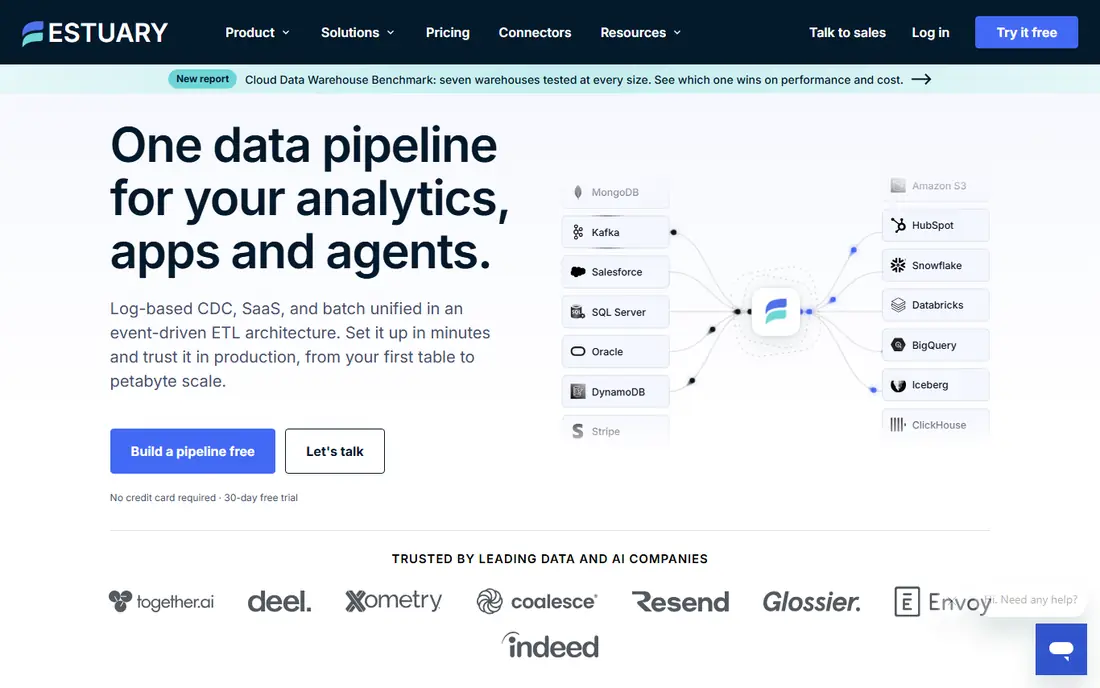
Estuary is designed for live streaming integration with exactly-once semantics. Estuary is made for live data integration, capturing change data from databases and streaming it to destinations with exactly-once guarantees.
Where Estuary stands out: Ample free level.
Downsides: Newer vendor. In daily use, for use cases where freshness matters, fraud detection, operational analytics, live personalization, batch ELT is not enough. The free level is ample, and the open-core model hands transparency into how it works. This comparison lists no price for Estuary; ask the vendor. A free plan is available with Estuary.
- Live CDC and streaming
- Exactly-once delivery guarantees
- Streaming model differs from batch ELT thinking
dbt
Great for: Transforming warehouse data with SQL and software engineering practices

dbt targets transforming warehouse data with SQL and software engineering practices. dbt, from dbt Labs, is the transformation layer of the modern data stack. Analysts and analytics engineers write SQL models that dbt runs in the warehouse, with testing, documentation, and version control borrowed from software engineering.
The main drawbacks: not a full integration system.
It turned analytics work from scattered queries into maintainable code. Also, together they form the classic ELT stack. dbt does not show a starting price in this comparison, so check the vendor site for current pricing. dbt has a free plan.
- Huge community
- Version control, testing
- It is the T in ELT
Matillion
Great for: Cloud data teams that want visual and code-based pipelines together
Matillion is designed for cloud data teams that want visual and code-based pipelines together. Its Data Productivity Cloud extends the model to AI-assisted pipeline building.
The main drawbacks: Tied to the cloud data product model.
Pricing for Matillion is not stated here, so ask the vendor for current figures. Matillion offers a free plan.
- Solid orchestration
- Purpose-built for cloud warehouses
- Pricing complexity at scale
Hevo Data targets small and mid-size teams that want no-code pipelines quick. Hevo Data supplies no-code data pipelines targeted at teams that require integration working this week, not this quarter.
Honest limits: Less depth for complicated transformations.
In daily use, complicated transformation logic eventually pushes teams toward dbt alongside Hevo. Worth adding: for startups and SMBs without data engineers, that accessibility is the entire point. Hevo Data shows no starting price here, so confirm the cost on the vendor site. Hevo Data has a free plan.
- Live sync choices
- Approachable pricing
- Smaller ecosystem than leaders
Choose Fivetran for teams that want managed connectors with minimal maintenance. For teams with many SaaS sources, that eliminates a constant source of breakage. More specifically, when a source API layers on or changes fields, Fivetran adapts the destination tables without manual intervention.
Drawbacks to consider: Less control over transformation logic.
As for the details, pricing is consumption-based, so costs scale with data volume and sync frequency. In practice, the pitch is straightforward: your team stops babysitting pipelines. For everyday use, Fivetran is the reference point for managed ELT. It provides hundreds of pre-built connectors that extract data from SaaS applications, databases, and files, load it into your warehouse, and keep schemas updated as sources change. Pricing for Fivetran is not stated here, so ask the vendor for current figures. You can start on Fivetran without paying.
- Huge connector library with automatic schema handling
- Managed reliability and monitoring
- Usage-based pricing can grow with data volume
Airbyte is designed for teams that want open-source integration they can self-host. Teams can self-host the system at no cost, paying only for their own infrastructure, or use Airbyte Cloud as a managed service.
Rather than paying per row synced, you pay for compute, which fits high-volume pipelines that would be pricey on pure consumption pricing. Airbyte does not show a starting price in this comparison, so check the vendor site for current pricing. You can start on Airbyte without paying.
The main drawbacks: Managed cloud pricing adds up at scale.
- Open-source core with a large connector catalog
- Active community
- Self-hosting means operating infrastructure
Choose Stitch for small teams that require straightforward, reliable ELT. Stitch, part of Qlik, is the straightforward ELT choice: pick sources, pick a warehouse, and data flows.
Where it falls short: Smaller connector library than Fivetran.
Teams that outgrow it normally hit connector coverage or transformation limits, at which point Fivetran or Airbyte plus dbt is the typical upgrade path. Check the vendor site for Stitch pricing; none is listed in this comparison. Stitch includes a free tier.
- Straightforward setup
- Owned by Qlik with decent support
- Restricted transformation features
Notes on data engineering platforms for integration
Every dashboard, ML model, and AI feature relies on data arriving steadily from source systems into somewhere it can be used. For everyday use, the last decade shifted the field from ETL to ELT. Also, cheap cloud storage and feature-rich warehouses made it practical to load raw data first and transform it later, inside the warehouse, with SQL-based tools.
Choosing well matters since migration is painful. Pick for your actual sources, volumes, and team skills, not for a feature list.
How we chose
Pricing pages, product documentation and feature lists were the main sources, and every entry carries at least one honest drawback. Seat minimums, billing terms and add-ons can move the real cost, so the starting prices here are a guide and not a quote. The order reflects how well each tool fits the most common buying scenario for data engineering platforms for integration, then price clarity, then free plan access. It is a starting point, not a verdict.
A buyer's checklist
- Confirm the entry price with every vendor: no tool from Estuary to Stitch shows a fixed starting price.
- Look at free plan limits closely: Estuary, dbt, Matillion and others have one, and the caps decide whether it is usable for real work.
- Read the limits listed for Estuary first: newer vendor.
- Involve the people who will use Matillion daily; a short pilot beats a long feature checklist.
- Find out what support Airbyte includes on your plan, and whether onboarding help costs extra.
Frequently asked questions
Which options for data engineering platforms for integration have a free plan?
7 of the 7 tools have a free plan, including Estuary, dbt, Matillion and Hevo Data. Free plans usually cap users, projects or features, so check the limits on the vendor page.
Do these tools publish their prices?
No. None of the tools, from Estuary to Stitch, shows a fixed starting price here, so budget time for quotes.
Is Estuary the right pick for everyone comparing data engineering platforms for integration?
No single tool suits every team. Estuary comes first because it fits real-time streaming integration with exactly-once semantics, while dbt suits transforming warehouse data with SQL and software engineering practices and Matillion suits cloud data teams that want visual and code-based pipelines together. Match the tool to your own size, budget and workflow before deciding.
How are the tools for data engineering platforms for integration ordered?
Estuary sits first and Stitch last because the order follows typical fit for data engineering platforms for integration, then price clarity and free access. It is a judgement call, so read each profile for fit and limits.
Sources
See where you really rank - block by block
ProMapRanker scans Google Maps across a grid of your service area. Simple monthly plans from $19, white-label on every plan.
Start freeKeep reading
 zscaler alternatives
Best Zscaler Alternatives in 2026
Looking for zscaler alternatives? We compare 9 SASE and zero trust platforms on architecture, data protection, pricing, and fit for your network and team.
Read → zapier alternatives free
Best Zapier Alternatives Free in 2026
Nine automation tools for zapier alternatives free in 2026, all with genuinely free tiers, plus free plan limits, starting prices and upgrade paths explained.
Read → which platform is best for online reputation
Which Platform Is Best for Online Reputation in 2026
Wondering which platform is best for online reputation? We compare 8 review, listing, and response tools for small and multi-location businesses and agencies.
Read →