 ProMapRanker
Best Data Discovery Software in 2026


Finding trusted data across the business · Pricing starts at: See website
Key takeaways
- Alation is our pick for teams whose main problem is finding trusted data, while Atlan suits modern data teams that want active metadata and collaboration.
- Collibra and Microsoft Purview suit enterprises with strong governance and compliance needs, but both need more setup and governance staff than lighter tools.
- Secoda, Select Star and data.world offer faster starts for smaller teams, with Secoda and Select Star especially strong for quick catalog setup.
- OpenMetadata is the open-source option for engineering-led teams that can host and maintain it themselves.
- Budget for data ownership and stewardship time, not just licences, since a catalog without owners quickly becomes out of date.
Quick comparison
| Pick | Great for | Pricing starts at | Free tier | |
|---|---|---|---|---|
| Alation | Finding trusted data across the business | See website | No | Visit |
 Atlan | Modern data teams and active metadata | See website | Free trial | Visit |
 Collibra | Enterprise governance and compliance | See website | No | Visit |
 data.world | Data catalog with strong collaboration | See website | Free trial | Visit |
 Microsoft Purview | Microsoft and Azure-centered organizations | See website | Free trial | Visit |
 Secoda | Fast setup for smaller data teams | See website | Free trial | Visit |
 Select Star | Quick catalog setup with lineage | See website | Free trial | Visit |
 OpenMetadata | Engineering teams that want open source | Free | Yes | Visit |
 Informatica | Integrated governance, quality and catalog | See website | No | Visit |
The best data discovery software
Data discovery software helps people find, understand and trust data before they use it in a report or model. We compared official product pages, pricing pages and public product descriptions, and focused on search quality, lineage, governance features, connector coverage and setup effort.

Alation is built around a simple idea: analysts should be able to search for data the way they search the web, then see who owns it, how it is defined and whether it is trusted. Its catalog combines search, business glossaries, stewardship workflows and usage-based recommendations, which helps new analysts find the right table without asking a data engineer for help.
The main limits are price and scope. Alation pricing is custom, and deployment can take longer than lighter catalog tools, especially for organizations with many sources. Its data quality capabilities are also less developed than platforms that bundle quality and governance more deeply. For organizations whose core problem is discovery and adoption, Alation remains a strong first choice.
- Search-led catalog experience
- Stewardship and collaboration features
- Machine learning recommendations
- Pricing is custom
- Data quality features are less deep than some rivals
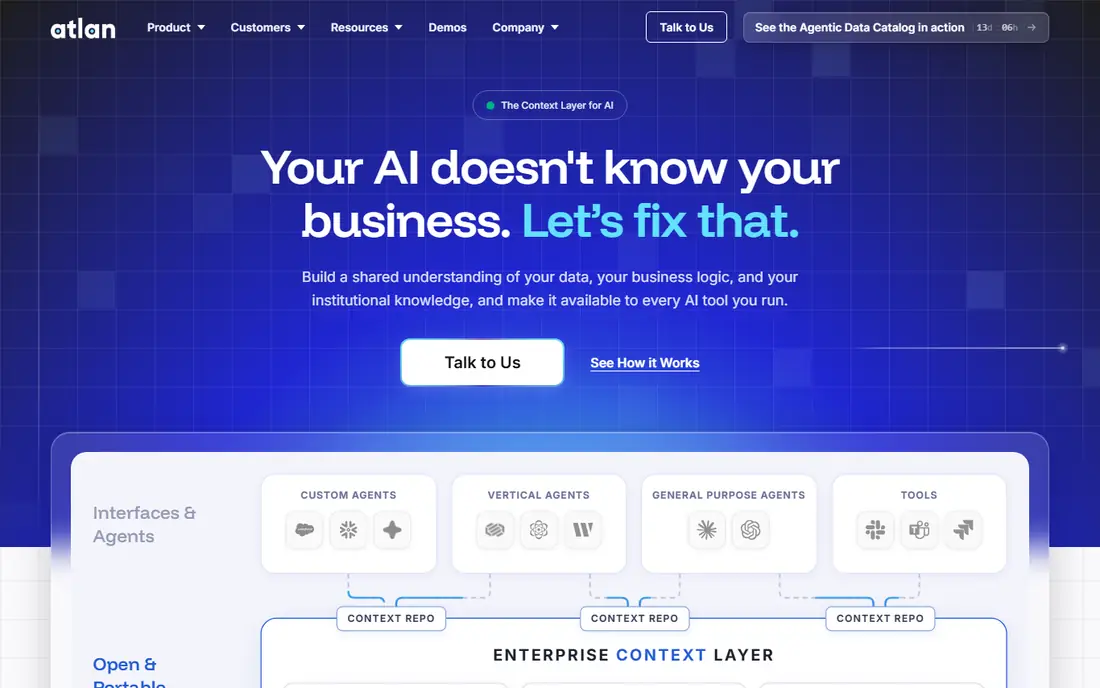
Atlan positions itself as an active metadata platform rather than a static catalog. It automates metadata enrichment, propagates tags along lineage paths and embeds governance context into tools data teams already use. That approach suits teams built around Snowflake, BigQuery, dbt and similar modern tools, where metadata changes often.
Atlan is less proven than Collibra for very heavy compliance programs, and pricing is custom beyond trial tiers. Teams should also confirm governance workflow depth for their regulatory needs before committing. For modern data teams that want a catalog people actually use day to day, Atlan is one of the strongest options.
- Active metadata and lineage
- Collaboration inside the catalog
- Wide connector coverage for modern stacks
- Less mature for heavy compliance workflows
- Pricing is custom for larger deployments
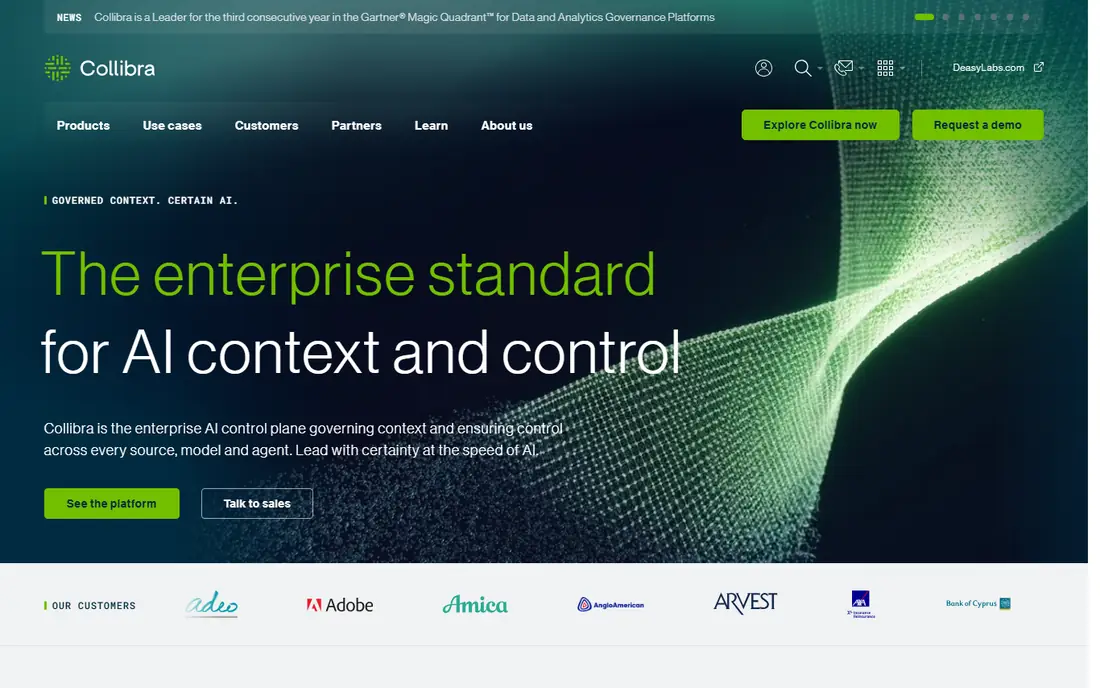
Collibra is the enterprise governance heavyweight on this list. It covers data catalog, lineage, policy management, stewardship workflows and data quality in a single platform, with customization for regulated industries. Large organizations with compliance duties under frameworks such as GDPR or SOX often choose Collibra because it can model policies and ownership at scale.
That depth brings complexity. Implementation takes time, pricing is premium, and the platform works best with dedicated governance staff. Smaller teams may find it more platform than they need, and adoption can suffer if business users find it hard to use. For large enterprises with serious governance requirements, Collibra is the safest enterprise pick.
- Deep governance, policy and lineage features
- Strong workflow customization
- Broad enterprise coverage
- Complex setup
- Premium pricing and dedicated staff needed
data.world builds its catalog on a knowledge graph, which helps connect datasets, definitions, people and business concepts in one view. Collaboration features such as discussion, questions and shared collections help analysts document tribal knowledge that would otherwise stay in chat threads or spreadsheets. That social layer is useful for organizations trying to build a data culture, not just a catalog.
Pricing is custom, and governance depth varies by deployment, so regulated teams should compare workflow and policy features directly against Collibra or Informatica. For teams that value collaboration and a connected view of data assets, data.world is a distinctive and practical choice.
- Knowledge-graph based catalog
- Collaboration and discussion features
- Discovery across sources
- Pricing is custom
- Some teams may need deeper governance workflows
Microsoft Purview combines data governance, compliance and risk management for organizations that already run on Microsoft 365 and Azure. Its data map scans sources, builds a catalog and applies classification and policy controls, while Purview compliance tools cover retention, eDiscovery and information protection in the same family. That unified view is a real advantage for Microsoft-centered teams.
Organizations with a mixed stack should check connector coverage and catalog depth for non-Microsoft sources before assuming Purview covers everything. Pricing also depends on which Purview features and data volumes are used, so finance teams should model it carefully. For Microsoft-first organizations, Purview is the natural starting point.
- Native Microsoft 365 and Azure integration
- Unified governance and compliance view
- Data map and catalog
- Best value inside Microsoft environments
- Non-Microsoft sources need extra checking
Secoda is designed for teams that want a usable catalog quickly. It offers search, lineage, documentation and AI-assisted features in an interface that business users can learn without long training. Smaller data teams often choose Secoda because setup is measured in days or weeks rather than months, and because it focuses on discovery rather than heavy governance programs.
The trade-off is enterprise depth. Very large organizations with complex policy, quality and compliance needs may outgrow Secoda or need a second governance tool. Pricing also varies by users and data sources, so teams should confirm the plan that covers their full stack. For small and mid-size teams, Secoda is one of the easiest catalogs to adopt.
- Fast setup and easy search
- AI search and documentation help
- Good support for smaller teams
- Less depth than enterprise governance platforms
- Pricing scales with users and sources
Select Star focuses on automated data discovery, lineage and documentation. It shows which tables are popular, how data flows between sources and dashboards, and what each asset means, which helps analysts avoid stale or unused tables. Setup is relatively fast, and the interface is built for analysts rather than only governance specialists.
As a smaller vendor, Select Star offers less enterprise governance depth than Collibra or Informatica, and teams should check connector coverage for their exact sources. For teams that want lineage and popularity insight without a large governance program, Select Star is a strong mid-market option.
- Automated lineage and popularity signals
- Fast setup
- Clear data documentation
- Smaller vendor than Alation or Collibra
- Governance features are lighter
OpenMetadata is an open-source metadata platform with data discovery, lineage, data quality checks and governance features. Engineering-led teams choose it because there is no licence cost, the code can be customized, and connector coverage is broad. It suits organizations that already run open-source infrastructure and have staff to maintain it.
The cost is effort, not licences. Teams must host, upgrade, secure and support the platform themselves, or pay a partner for help. Business-user polish and enterprise support also vary compared with commercial vendors. For teams with engineering capacity and a tight licence budget, OpenMetadata is the best open-source starting point.
- Open source with no licence cost
- Wide connector coverage
- Active community development
- Requires internal hosting and maintenance
- Support depends on team or paid partners
Informatica Enterprise Data Catalog sits inside the Intelligent Data Management Cloud, which also covers data integration, quality and governance. That breadth suits enterprises that want one vendor for catalog, quality and integration, rather than separate tools for each job. Its AI-assisted metadata and lineage features help large teams manage data across many systems.
Complexity is the main drawback. The platform can feel overwhelming for small teams, pricing is custom, and implementation needs planning. Teams that only need discovery should compare Alation or Atlan first. For enterprises already using Informatica for integration or quality, adding its catalog is a natural and coherent choice.
- Unified catalog, governance and quality platform
- Broad enterprise connectors
- AI-assisted metadata
- Complex platform
- Premium pricing and implementation effort
How we picked these
We compared official product pages, pricing pages and public product descriptions, and kept only tools that currently offer data discovery through a catalog, search, lineage or metadata platform. We included enterprise governance leaders, modern metadata platforms, fast-setup mid-market tools and one open-source option, so different team sizes and budgets are covered. We did not claim hands-on testing, and where pricing is custom we wrote See website rather than guessing a rate.
What to check before you choose
Start with the sources that matter most. List every database, warehouse, BI tool and file store your team uses, then check each vendor's connector coverage for those exact sources. A catalog that cannot scan a key source will leave a blind spot, no matter how good its search interface looks in a demo.
Next, test search and lineage with real questions. Ask how to find revenue data, who owns it, where it comes from and whether it is trusted, and see how many clicks each answer takes. Also check how lineage is generated, whether it covers column level, and how often metadata refreshes, since stale lineage misleads analysts.
Ownership, governance and adoption
Assign owners for key datasets before launch, and agree on how definitions, classifications and quality rules will be maintained. A catalog without owners becomes out of date quickly, and analysts will stop trusting it. Check stewardship workflows, approval processes and how business users can ask questions or suggest corrections.
Budget and rollout
Model licence cost, implementation services and internal staff time together. Enterprise platforms may need governance staff and longer rollouts, while lighter tools may need less setup but offer less compliance depth. Pilot with one business domain, such as finance or sales data, measure search success and adoption, and expand only when that pilot proves useful.
Frequently asked questions
What is the best data discovery software overall?
Alation is a strong overall pick for discovery and adoption, while Atlan suits modern data teams that want active metadata. Collibra is better for heavy governance, and Secoda or Select Star suit smaller teams that need a faster start.
What is the difference between data discovery and a data catalog?
A data catalog is the inventory of data assets, definitions and ownership. Data discovery is the broader activity of finding, understanding and trusting that data, which a catalog supports through search, lineage and recommendations. Most tools on this list combine both.
What is the best free data discovery tool?
OpenMetadata is the best free option, since it is open source with no licence cost. It requires hosting and maintenance, so teams without engineering capacity may find a paid trial from Secoda or Select Star more practical for a first catalog.
How long does it take to set up data discovery software?
Lighter tools such as Secoda, Select Star and Atlan can be useful in days or weeks for a limited set of sources. Enterprise platforms such as Collibra, Informatica and Alation often take longer, especially when many sources, policies and governance workflows are involved.
Do I need data discovery software if I already have a BI tool?
Yes, in most cases. BI tools show dashboards and reports, but they rarely explain where data came from, who owns it or whether it is trusted. A discovery tool fills that gap and helps analysts choose the right dataset before building a report.
Which data discovery tool is best for Microsoft environments?
Microsoft Purview is the natural choice for Microsoft 365 and Azure organizations, since it integrates natively with those services. Teams with mixed stacks should also compare Alation, Atlan and Collibra for broader connector coverage.
Sources
See where you really rank - block by block
ProMapRanker scans Google Maps across a grid of your service area. Simple monthly plans from $19, white-label on every plan.
Start freeKeep reading
 zoro.to alternatives
Best Zoro.to Alternatives in 2026
We compare the best zoro.to alternatives in 2026, listing only legal licensed anime streaming services, from Crunchyroll to free options for fans today.
Read → zip alternatives
Best Zip Alternatives in 2026
We compare the best zip alternatives for buy now, pay later in 2026, covering pay-in-4 plans, fees, spending limits, and credit reporting options today.
Read → yesware alternatives
Best Yesware Alternatives in 2026
Compare the best yesware alternatives for sales email tracking, templates, and sequences, with current pricing and honest tradeoffs for small sales teams.
Read →