 ProMapRanker
7 Strong Cybersecurity Threat Intel Software Options in 2026


Falcon users tracking named adversaries · Pricing starts at: See website
Direct answer
For Falcon users tracking named adversaries, CrowdStrike Falcon Adversary Intelligence is where this list starts. For a different need, Cyble covers dark web monitoring and brand protection and Recorded Future covers large teams wanting broad intel coverage. The full list of 7 tools follows, with prices and free plan facts.
Key takeaways
- The list opens with CrowdStrike Falcon Adversary Intelligence, aimed at Falcon users tracking named adversaries.
- GreyNoise is the one to check for SOCs drowning in internet scan noise.
- A free plan is available from 2 of the 7 tools: SOCRadar, GreyNoise.
- No starting price is shown for any of the 7 tools, CrowdStrike Falcon Adversary Intelligence and GreyNoise included, so plan time for sales calls.
- SOCRadar comes with a trade-off: less collection depth than top-tier vendors.
Quick comparison
| Pick | Great for | Pricing starts at | Free tier | |
|---|---|---|---|---|
| CrowdStrike Falcon Adversary Intelligence | Falcon users tracking named adversaries | See website | Free trial | Visit |
 Cyble | Dark web monitoring and brand protection | See website | No | Visit |
 Recorded Future | Large teams wanting wide intel coverage | See website | No | Visit |
 SOCRadar | Budget teams starting with threat intel | See website | Yes | Visit |
 Flashpoint | Dark web, fraud, and vulnerability intel | See website | No | Visit |
 Anomali | SOCs operationalizing threat feeds | See website | No | Visit |
 GreyNoise | SOCs drowning in internet scan noise | See website | Yes | Visit |
Cybersecurity Threat Intel Software compared in detail
Short on time? The summary and table above give the quick view of 7 tools for cybersecurity threat intel software, and the profiles that follow give the detail behind each entry.
CrowdStrike Falcon Adversary Intelligence
Great for: Falcon users tracking named adversaries
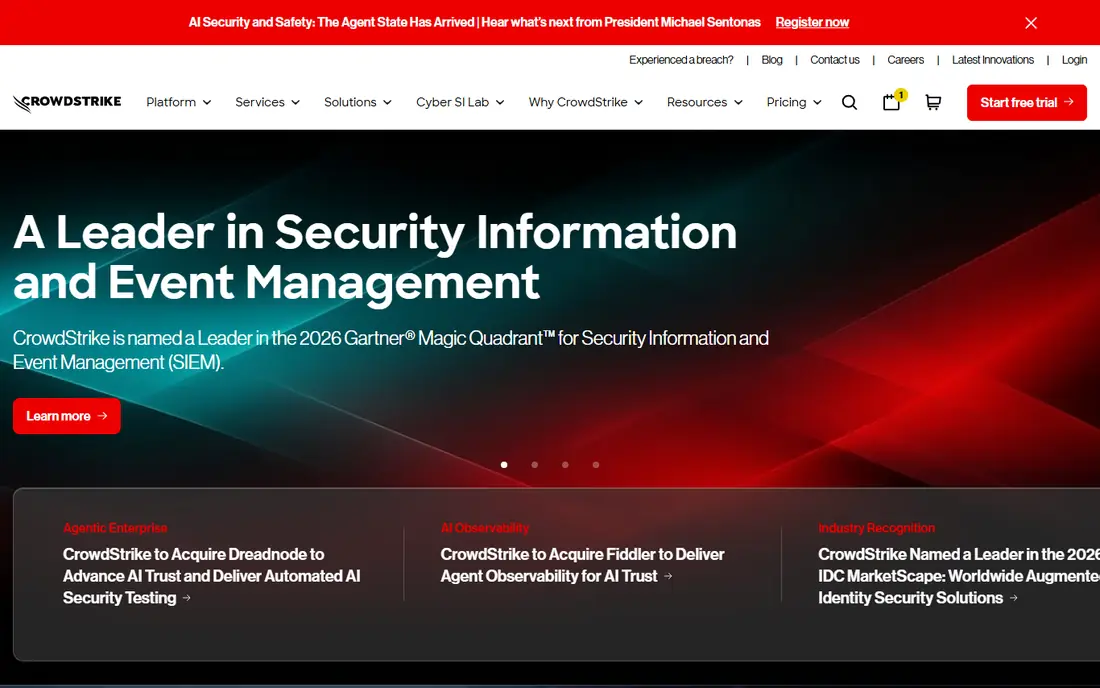
CrowdStrike Falcon Adversary Intelligence is designed for Falcon users tracking named adversaries. CrowdStrike's threat intelligence grows straight out of the intrusions its teams investigate. Beyond that, Falcon Adversary Intelligence profiles the named adversary groups targeting your industry, maps their tactics to the MITRE ATT&CK framework, and feeds that context into detections and hunting inside the Falcon system.
On top of that, when an alert fires, the analyst sees not just an indicator but the adversary behind it. Beyond that, if you do not, compare it against standalone products before committing. As for the details, the main limit is ecosystem lock-in: the intelligence is most actionable inside Falcon. Pricing for the intel module is bundled into product deals instead of published separately. As for the details, if you already run Falcon, adding adversary intelligence is straightforward. No starting price is listed for CrowdStrike Falcon Adversary Intelligence here; confirm pricing on the vendor site. As for free access: Free trial.
What to check first: Full value relies on the Falcon ecosystem.
- Tightly integrated with Falcon EDR and threat hunting
- System free trial available
- Intel pricing is bundled and opaque

Cyble is built with dark web monitoring and brand protection in mind. Cyble Vision serves as the threat intelligence product, surrounded by dark web monitoring, attack surface management, and takedown services.
Main advantages: Recognized as a Challenger in Gartner's 2026 CTI Magic Quadrant.
Beyond that, teams that want dark web monitoring and threat intel in one AI-driven system should put Cyble on the shortlist. Cyble does not show a starting price in this comparison, so check the vendor site for current pricing. Cyble has no free tier.
Limits to weigh: Pricing is quote-based.
- Vision TIP plus dark web
- AI-native architecture aimed at continuous correlation
- Younger vendor with a shorter track record than incumbents

Recorded Future works best for large teams wanting wide intel coverage. Insikt Group, its research arm, brings analyst-written reporting on top of the machine-collected data.
Drawbacks to consider: Enterprise pricing through sales only.
The system splits into four areas: cyber operations, digital risk protection, external risk, and payment fraud. This comparison lists no price for Recorded Future; ask the vendor. There is no free plan with Recorded Future.
- Intelligence Graph correlates technical
- Insikt Group layers on human analyst research
- The volume of data can overwhelm small teams
SOCRadar is designed for budget teams starting with threat intel. The premium system extends into full threat intelligence with automation, API integrations, and analyst support. Worth adding: SOCRadar is the rare threat intel vendor with a free level worth using.
Its free tools contain a dark web report that scans underground sources for your domain, an IOC radar for looking up domains, IPs, and hashes, and a country threat report. That is enough for a small team to get real value before spending anything, and setup takes hours instead of weeks. SOCRadar does not show a starting price in this comparison, so check the vendor site for current pricing. SOCRadar includes a free tier.
Honest limits: Less collection depth than top-tier vendors.
- Genuinely handy free tools including dark web reports and IOC lookup
- Asset-based pricing keeps costs aligned to coverage
- Free tools naturally lead toward the premium product
Flashpoint is designed for dark web, fraud, and vulnerability intel. Like its enterprise peers, it sells through demos and quotes instead of self-serve plans. The 4.8-out-of-5 user rating shown on its homepage recommends customers feel the data quality justifies the process.
Smaller teams should weigh whether they need this depth or would do fine with a narrower tool. Beyond classic cyber threat intel, Flashpoint handles vulnerability intelligence and physical security, which fits enterprises with converged security teams. Flashpoint's differentiator is collection. With access to petabytes of data from illicit forums, chat groups, and marketplaces that scrapers cannot reach, it sees fraud schemes, stolen credential sales, and ransomware chatter at the source. Pricing for Flashpoint is not stated here, so ask the vendor for current figures. Flashpoint has no permanent free option.
Drawbacks to consider: Quote-based enterprise pricing.
Where it shines: physical security.
- Spans cyber, vulnerability
- Deep primary-source collection from hard-to-reach adversary spaces
- Breadth can exceed what a small team needs
Think of Anomali for SOCs operationalizing threat feeds. For buyers, this means Anomali now competes both as a TIP and as a broader SOC system.
The main drawbacks: Enterprise sales motion.
In practice, Anomali made its name with ThreatStream, one of the original threat intelligence systems, and that DNA remains: ingest feeds from plenty of sources, deduplicate and enrich indicators, and push them into enforcement points automatically. Check the vendor site for Anomali pricing; none is listed in this comparison. Anomali does not include a free plan.
- Agentic AI for triage and investigation
- Large integration ecosystem
- System repositioning toward SOC may confuse TIP buyers
GreyNoise targets SOCs drowning in internet scan noise. GreyNoise solves a specific, painful problem: most of what hits your perimeter is background noise from mass scanners, and analysts waste hours triaging it. For everyday use, premium plans add blocklists, SIEM integrations, and deeper investigation features, with pricing quoted per deployment.
Where it falls short: Network-focused.
GreyNoise runs a global sensor network that observes internet-wide scanning, tags activity by CVE, tooling, and campaign in live, and tells you which alerts represent targeted threats compared with internet background radiation. GreyNoise is not a complete threat intelligence system; it is a specialized instrument that makes everything else in your SOC work better. The result is fewer false alarms and quicker triage. More specifically, pair it with a broader TIP instead of treating it as one. Check the vendor site for GreyNoise pricing; none is listed in this comparison. Free access exists with GreyNoise.
- Separates mass internet scanning from targeted attacks
- Global sensor network with live exploit tagging
- Not a full threat intel product
How we compared the tools
Each tool was reviewed on what its vendor publishes: price, plan limits, core features and stated drawbacks. We did not run hands-on tests. Prices and plan limits come from vendor pages and can change, so confirm them on the vendor site before you buy. The order reflects how well each tool fits the most common buying scenario for cybersecurity threat intel software, then price clarity, then free plan access. It is a starting point, not a verdict.
Pre-purchase checklist
- Ask each vendor, from CrowdStrike Falcon Adversary Intelligence to GreyNoise, for a written quote; none of them publishes a starting price.
- Check what the free option really includes: SOCRadar and GreyNoise offer a free plan, and usage caps differ.
- Use real work to test the free trial from CrowdStrike Falcon Adversary Intelligence, rather than a demo project.
- Before choosing CrowdStrike Falcon Adversary Intelligence, weigh its main limit: full value relies on the Falcon ecosystem.
- Pick one real project and run it in Recorded Future first; a small pilot shows fit faster than a checklist.
- Look at the renewal terms for Anomali: auto-renewal, notice periods and price changes can matter more than the first-year price.
Frequently asked questions
Can free threat intel tools replace a premium system?
What free tools cannot replace is curated analyst research, wide private collection, automatic operationalization across your stack, and support. Beyond that, treat free levels as a starting point or a supplement.
How does threat intelligence integrate with a SIEM?
Decent integrations also pull sightings back, so the intel system learns which indicators actually appeared in your environment and adjusts confidence scores.
Which options for cybersecurity threat intel software have a free plan?
SOCRadar and GreyNoise offer a free plan in this list. Free plans usually cap users, projects or features, so check the limits on the vendor page. One other tool offers a trial instead.
Do these tools publish their prices?
No. None of the tools, from CrowdStrike Falcon Adversary Intelligence to GreyNoise, shows a fixed starting price here, so budget time for quotes.
Is CrowdStrike Falcon Adversary Intelligence the right pick for everyone comparing cybersecurity threat intel software?
No single tool suits every team. CrowdStrike Falcon Adversary Intelligence comes first because it fits Falcon users tracking named adversaries, while Cyble suits dark web monitoring and brand protection and Recorded Future suits large teams wanting broad intel coverage. Match the tool to your own size, budget and workflow before deciding.
How long does it take to get value from a threat intel system?
Enterprise systems generally take four to twelve weeks including feed tuning, integration work, and analyst training. The biggest delay is normally internal: without someone assigned to use the intelligence, even the best system gathers dust.
Sources
See where you really rank - block by block
ProMapRanker scans Google Maps across a grid of your service area. Simple monthly plans from $19, white-label on every plan.
Start freeKeep reading
 zscaler alternatives
Best Zscaler Alternatives in 2026
Looking for zscaler alternatives? We compare 9 SASE and zero trust platforms on architecture, data protection, pricing, and fit for your network and team.
Read → zapier alternatives free
Best Zapier Alternatives Free in 2026
Nine automation tools for zapier alternatives free in 2026, all with genuinely free tiers, plus free plan limits, starting prices and upgrade paths explained.
Read → which platform is best for online reputation
Which Platform Is Best for Online Reputation in 2026
Wondering which platform is best for online reputation? We compare 8 review, listing, and response tools for small and multi-location businesses and agencies.
Read →