 ProMapRanker
Best Cyber Security Companies in 2026


Broad enterprise platform consolidation · Pricing starts at: See website
Key takeaways
- Palo Alto Networks offers the broadest platform, covering network, cloud and security operations in one vendor relationship.
- CrowdStrike and SentinelOne lead for endpoint detection and response, with cloud-native agents and fast incident response.
- Microsoft Security suits organisations already centred on Microsoft 365, Entra identity and Azure, where bundling lowers friction.
- Cloudflare and Zscaler suit distributed teams that need cloud-delivered protection without managing hardware at every site.
- Fortinet, Cisco Security, CyberArk and Okta each lead a distinct area, so the best company for cyber security depends on your weakest control.
Quick comparison
| Pick | Great for | Pricing starts at | Free tier | |
|---|---|---|---|---|
| Palo Alto Networks | Broad enterprise platform consolidation | See website | Free trial | Visit |
 CrowdStrike | Endpoint detection and response | See website | Free trial | Visit |
 Microsoft Security | Microsoft-centred organisations | See website | Free trial | Visit |
 Cisco Security | Network-centred security and zero-trust access | See website | Free trial | Visit |
 Fortinet | Distributed networks and branches | See website | Free trial | Visit |
 Cloudflare | Cloud-delivered app and network security | Free | Yes | Visit |
 Zscaler | Zero-trust access for users and branches | See website | Free trial | Visit |
 SentinelOne | Autonomous endpoint and cloud security | See website | Free trial | Visit |
 Okta | Identity and access management | Free | Yes | Visit |
The best cyber security companies
We compared official product pages, platform documentation and public company information for firms that sell to businesses in October 2026. Most enterprise pricing is quoted per organisation, so we wrote See website where no public starting price applies. Use this list to shortlist vendors by control area, then request a scoped quote and a trial in your own environment.
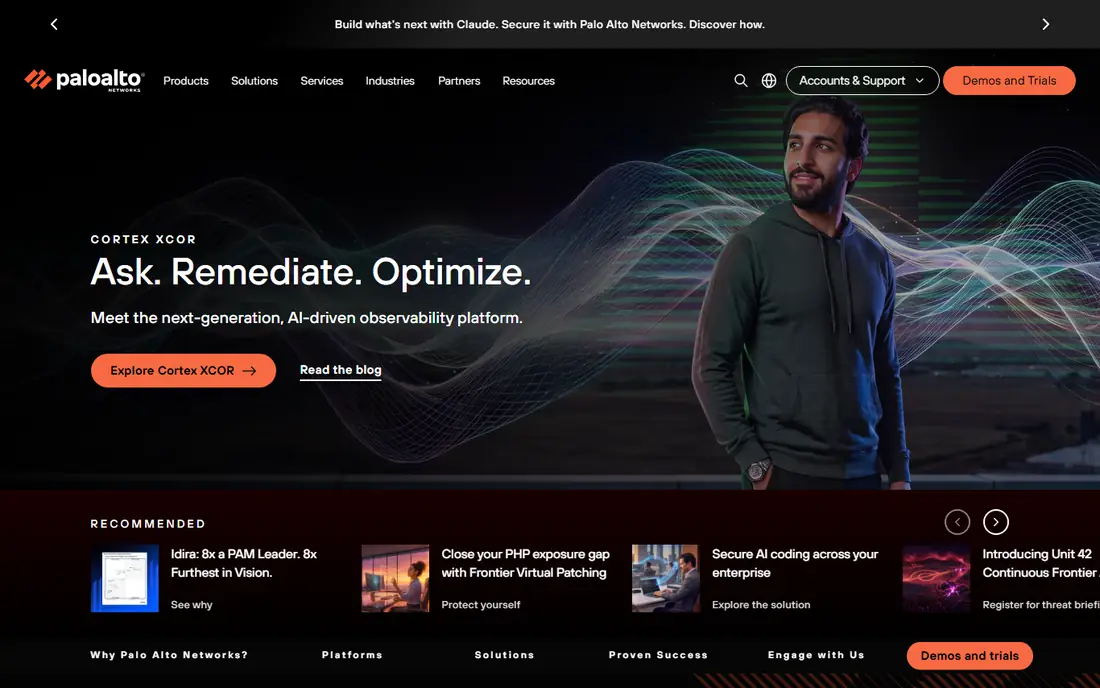
Palo Alto Networks is the default shortlist pick when a company wants fewer vendors. Its Strata network products, Prisma Cloud tools and Cortex operations products share threat data, which helps a security team see one incident across network, cloud and endpoint views. That shared view matters when an attack moves between systems.
The downside is scope. Buying a platform this broad needs careful scoping, or you may license modules that sit unused. Smaller businesses should ask for a narrow quote tied to their actual risks, such as firewall replacement or cloud workload protection, rather than the full platform at once.
- Covers network, cloud and security operations
- Strong threat intelligence
- Large partner and support network
- Enterprise pricing is complex
- Platform breadth can mean a long deployment
- Smaller firms may pay for features they never use
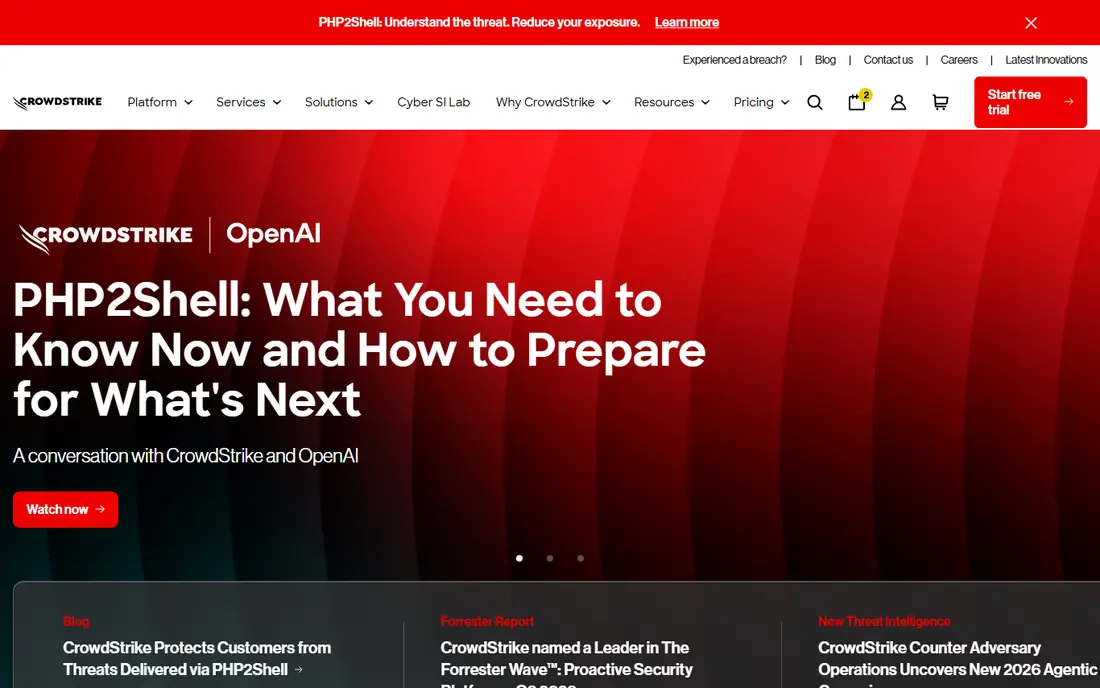
CrowdStrike built its name on endpoint security, and Falcon remains its core strength. A single lightweight agent collects endpoint data, and the cloud platform correlates it with threat intelligence to flag suspicious behaviour. Managed hunting services can help teams that lack a full security operations centre.
Pricing and module choice need attention. The base endpoint product is strong, but identity, cloud and next-generation SIEM features sit in separate modules. Ask the vendor to map each module to a risk you actually face, and test detection in a pilot group before a company-wide rollout.
- Cloud-native Falcon platform
- Strong threat intelligence
- Fast detection and managed hunting options
- Enterprise pricing
- Best value comes with wider Falcon modules
- Requires planning for large rollouts
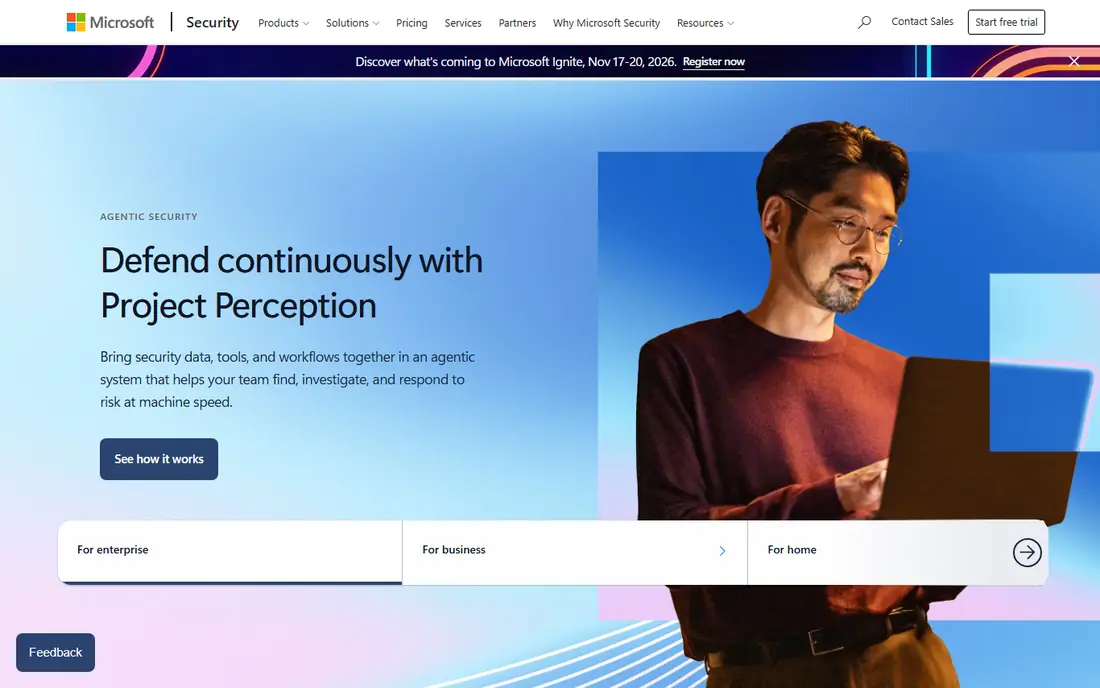
Microsoft Security makes most sense where Microsoft already runs email, identity and cloud workloads. Defender for Endpoint, Defender XDR, Sentinel and Entra identity share signals, so an alert in one product can inform action in another. For a team already paying for Microsoft 365, that integration can reduce tool sprawl.
Organisations centred on Google Workspace or other clouds may get less benefit. Licensing tiers also affect which features you actually receive, so compare the security features in your current Microsoft plan with the add-ons on offer. A licensing review before purchase prevents paying twice for overlapping controls.
- Deep integration with Microsoft 365 and Azure
- Defender XDR and Sentinel SIEM in one ecosystem
- Entra identity controls
- Best value needs Microsoft licensing
- Non-Microsoft environments need extra integration work
- Configuration complexity
Cisco Security suits organisations where the network is still the centre of control. Firewalls, secure access, Duo multi-factor authentication and XDR tools cover users, branches and cloud workloads from a network-first view. Teams with Cisco networking gear often find deployment and support simpler with the same vendor.
Buyers should map products to current architecture before committing. Cisco has grown through acquisition, so some products integrate more tightly than others. A proof of concept on your real network traffic will show whether the promised unified view holds up in practice.
- Strong network security heritage
- Duo identity and secure access tools
- Broad firewall and XDR portfolio
- Portfolio breadth can confuse buyers
- Legacy and cloud products need careful integration
- Enterprise quoting
Fortinet is a practical pick for companies with many branches, retail sites or operational technology networks. FortiGate appliances combine firewall, intrusion prevention and secure SD-WAN functions, which reduces the number of boxes at each site. FortiSASE extends similar protection to remote workers without backhauling all traffic.
The fabric concept works best when you adopt several Fortinet products together. Single-product buyers still get solid firewall performance, but they miss the shared telemetry benefit. Check management licensing and support tiers early, since those costs affect the total price more than the headline hardware price.
- FortiGate firewalls with strong price performance
- FortiSASE for remote users
- Security fabric across products
- Management learning curve
- Product range is large
- Enterprise features need higher tiers
Cloudflare stands out because you can start free. Its network sits in front of websites and applications, absorbing DDoS attacks and filtering web traffic before it reaches your servers. Cloudflare One adds zero-trust access, secure web gateway and private application access for distributed teams.
The free tier covers basics well, but serious business use usually needs a paid plan for advanced rules, logging and support. Changing DNS or proxy settings also needs care, since a misconfiguration can affect availability. For public-facing sites and remote teams, Cloudflare offers strong protection without hardware.
- Free tier for basic protection
- Strong DDoS and web application firewall
- Cloudflare One for zero-trust access
- Advanced zero-trust features need paid plans
- Some controls need DNS or proxy changes
- Enterprise pricing is quoted
Zscaler replaces the old model of connecting remote users through a central VPN. Users connect to the Zero Trust Exchange, which checks identity and policy before granting access to a specific application. That approach reduces exposure, since users never join the full corporate network just to reach one app.
Migration needs planning. Application access rules, data protection policies and logging must be designed for your real apps, not copied from a VPN setup. Teams that invest in that design often report simpler remote access afterwards, but rushed rollouts can block legitimate work.
- Zero Trust Exchange for internet and private access
- No need for traditional VPN in many cases
- Data protection tools
- Pricing is quoted
- Migration from VPN needs planning
- Policy design takes time to get right
SentinelOne appeals to teams that want automation to do more of the first response. Its agent can isolate a device, roll back changes and quarantine files without waiting for an analyst to act. Cloud workload and identity features extend that protection beyond laptops and servers.
As with other endpoint leaders, the full value depends on which modules you license. Identity protection, cloud security and AI SIEM features may sit outside the base price. Test automated response carefully in a pilot, since aggressive automation needs tuning to avoid disrupting legitimate software.
- Singularity platform for endpoint and cloud
- Automated response actions
- AI-assisted security operations tools
- Enterprise pricing
- Smaller partner network than the largest vendors
- Module choice affects total cost
Okta answers a different question from the endpoint and network vendors on this list. It controls who can sign in, what they can access, and how that access is reviewed. Single sign-on, adaptive multi-factor authentication and lifecycle management reduce password risk and simplify joining and leaving processes.
Okta alone does not replace endpoint or network security, so pair it with a detection product. Its free tier suits small teams testing identity, while larger organisations need paid plans for advanced governance and support. For companies with best cyber security concerns around stolen credentials, identity is often the highest-value first control.
- Strong single sign-on and multi-factor authentication
- Large app integration catalogue
- Access governance tools
- Identity-only focus, not full endpoint or network security
- Enterprise pricing for advanced governance
- Setup needs identity planning
How we picked these
We compared official product pages, platform documentation and public company information for vendors that operate at scale in October 2026. We favoured firms with a clear lead in at least one control area, including endpoint, network, cloud, identity and zero-trust access, rather than firms that only resell another vendor product. Enterprise pricing is usually quoted, so we did not invent starting prices. We also weighed integration breadth, managed service options and fit for small and mid-size buyers, not just large enterprises. We did not claim hands-on testing.
What to check before you sign
Start with your weakest control, not the vendor with the longest feature list. A company losing credentials needs identity controls first, while a company with exposed web apps needs application protection first. Map each shortlisted product to a specific risk, and ask the vendor to show detection or prevention for that risk in a trial.
Check total cost, including modules, management, logging retention and support tiers. Enterprise security pricing often looks modest until add-ons are included. Confirm data residency, incident response support and exit terms too, since switching a core security platform later is costly. A short pilot with real users and real traffic gives a clearer answer than a sales demo.
Frequently asked questions
Which are the best cyber security companies for a small business?
Cloudflare and Okta offer free tiers that suit small teams, while Microsoft Security suits small firms already on Microsoft 365. CrowdStrike, SentinelOne and Fortinet also serve smaller firms through managed partners, but pricing is quoted. Start with identity, patching and endpoint protection, then add network and cloud controls as you grow.
What is the best cybersecurity company for endpoint protection?
CrowdStrike and SentinelOne are the most cited endpoint leaders in this list, with cloud-native agents and automated response. Microsoft Defender also suits Microsoft-centred firms well. The right pick depends on your existing stack, your need for managed hunting, and how much automation your team wants to allow.
Are these companies with best cyber security also good for data protection?
Several vendors on this list include data protection features, including Zscaler, Palo Alto Networks and Microsoft Purview data security. No single product covers every data risk, though. Check data loss prevention, encryption and access controls for your specific data types, and confirm where logs and data are stored.
How much do enterprise cyber security companies cost?
Most enterprise vendors quote per organisation, per user or per device, and prices vary with modules and support tiers. Cloudflare and Okta publish free tiers, while the rest use quoted pricing. Request a scoped quote for the modules you need, and compare three-year total cost rather than the first-year headline price.
Should one vendor supply all security controls?
Consolidation can simplify management and improve shared threat data, which is why Palo Alto Networks, Microsoft and Cisco promote platform deals. A single vendor also creates dependence and may leave one weak control area. Many firms use a main platform plus a specialist for identity or endpoint, and that mix often works well.
Do I need a cyber security company if I already use antivirus software?
Traditional antivirus alone is not enough for most businesses today, since modern attacks use stolen credentials, cloud misconfiguration and phishing as well as malware. Endpoint detection, identity controls and patching together give stronger cover. A vendor trial can show gaps in your current setup before you commit to a purchase.
Sources
See where you really rank - block by block
ProMapRanker scans Google Maps across a grid of your service area. Simple monthly plans from $19, white-label on every plan.
Start freeKeep reading
 zendesk alternatives
Best Zendesk Alternatives in 2026
Compare the best Zendesk alternatives in 2026, from budget help desks to AI-first support tools, with current pricing, free plans, and honest trade-offs.
Read → wordpress alternatives
Best WordPress Alternatives in 2026
Looking for the best WordPress alternatives? We compare 8 free and paid options for blogs, business sites, stores, and developer-led projects in 2026.
Read → which real estate company has the best training
Best Real Estate Company Training in 2026
Compare which real estate company has the best training, from Keller Williams and eXp to Compass and Coldwell Banker, by program, mentor, and fit in 2026.
Read →