 ProMapRanker
Best Customs Clearance Software in 2026

Key takeaways
- Descartes and CargoWise lead for deep customs filing and multi-country compliance work.
- Magaya suits forwarders that also run warehousing, while Shipthis and Linbis suit smaller forwarders.
- Most enterprise customs pricing is quoted, so compare per-transaction and per-user models carefully.
- This is general information only, not legal or customs advice, and duties and rules vary by country and shipment.
Quick comparison
| Pick | Great for | Pricing starts at | Free tier | |
|---|---|---|---|---|
 Descartes | Customs depth and broker systems | See website | No | Visit |
 CargoWise | Large global forwarders | See website | No | Visit |
 Magaya Supply Chain | Forwarding plus warehousing | See website | No | Visit |
 E2open | Large importers and exporters | See website | No | Visit |
 Shipthis | Smaller forwarders with published pricing | See website | Free trial | Visit |
 GoFreight | Small to mid-size forwarders | See website | No | Visit |
 Logitude World | Cloud forwarding and customs | See website | Free trial | Visit |
 Linbis | Small forwarders on a budget | See website | Free trial | Visit |
The best customs clearance software
Customs clearance software prepares declarations, checks restricted parties, tracks duties and documents, and connects brokers, forwarders, and carriers. Rules, duties, and document needs vary by country and shipment, and no software can guarantee clearance. This is general information only, not legal or customs advice.
Descartes is known for customs content first. Tariff rates, denied-party lists, export controls, and regulatory rules are updated across jurisdictions, and its broker and forwarder systems use that content for filings. Visual Compliance screening helps teams check parties before a shipment moves.
The portfolio is modular, so costs stack as capabilities are added, and small firms may need help scoping the right modules. For a broker or forwarder where compliance accuracy is the main risk, Descartes content depth is a strong reason to choose it.
- Deep customs and regulatory content
- Broker and forwarder systems
- Denied-party screening tools
- Modular pricing adds up
- Setup can be complex for small firms
CargoWise is the standard platform for many large, multi-country forwarders. It covers customs declarations across many countries, with forwarding, warehousing, and accounting modules around the core. Published per-transaction Value Pack pricing gives smaller users a clearer cost model than a pure quote.
Implementation is a project, with training and process change to match. A small forwarder may find it heavier than needed. For a global operation that files in many countries, CargoWise breadth is hard to match.
- Very broad multi-country customs coverage
- Per-transaction pricing option
- Deep forwarding modules
- Implementation is substantial
- Learning curve for new users
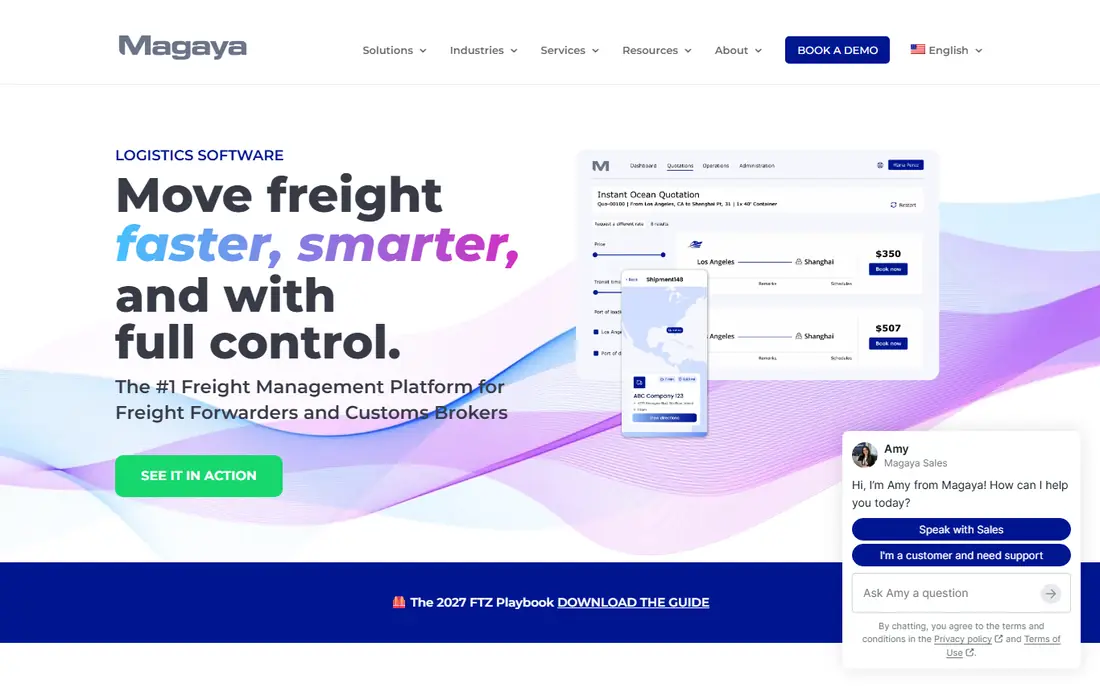
Magaya suits forwarders that also run warehouse operations. Shipments, warehouse stock, documents, accounting, and customs compliance sit in one platform, which reduces copying between systems. A customer portal lets clients track shipments and view documents without constant emails.
Pricing is quoted and based on users or workstations, with advanced modules priced separately, so get a full quote before comparing. For a forwarder-warehouse business, the combined workflow is the main benefit.
- Forwarding, warehousing, and accounting in one system
- Customs compliance modules
- Customer portal
- Quote-based pricing
- Add-on modules cost extra
E2open covers global trade management for large importers, exporters, and retailers, including import and export management, denied-party screening, duty management, and customs filings. Its network connects many partners across the supply chain, which helps firms with complex supplier and carrier relationships.
Pricing is enterprise and quoted, and implementation takes planning. Smaller firms will find it more than they need. For a large shipper that wants trade compliance inside a wider supply chain platform, E2open is a broad choice.
- Broad global trade management
- Import and export compliance
- Large partner network
- Enterprise pricing
- Implementation is substantial
Shipthis is one of the more accessible options for a small or mid-size forwarder. Pricing is published per user, a trial is offered, and forwarding, documentation, and customs declarations sit in a cloud system. That clarity helps a small firm budget without a long sales process.
Its ecosystem is smaller than the enterprise platforms, and very large multi-country operations may need deeper coverage. For a growing forwarder that wants to go live in weeks rather than months, Shipthis is a practical pick.
- Published per-user pricing
- Trial available
- Forwarding and customs in one cloud tool
- Smaller ecosystem than CargoWise
- Some advanced features are add-ons
GoFreight targets small to mid-size forwarders with a clean, modern interface. Quotes, shipments, documents, and accounting connect in one flow, and a customer portal gives clients visibility. Two-way QuickBooks links help finance teams avoid re-entering invoices.
Pricing requires a demo and quote, and buyers should confirm specific US customs filing features by name before signing. For a forwarder that values a clear interface and accounting links, GoFreight is worth a demo.
- Clean interface
- Accounting links including QuickBooks
- Customer portal included
- Quote-based pricing
- US customs features need confirmation in a demo
Logitude World is a cloud forwarding platform with customs and document tools for air, ocean, and road shipments. Its web-based setup suits teams that work across offices without installing desktop software. Pricing options are published, which helps initial budgeting.
Customs coverage and depth vary by country, so confirm the exact lanes and declaration types you file. Some capabilities are paid add-ons. For a cloud-first forwarder that needs broad modal coverage, Logitude is a solid option.
- Cloud based with published pricing options
- Air, ocean, and road support
- Document tools
- Customs depth varies by country
- Some features are paid add-ons
Linbis is aimed at small forwarders that need a clear price and a fast start. Published per-user pricing, a trial, and forwarding with accounting basics cover the core workflow for a small team. It avoids the long enterprise sales cycle that larger platforms require.
The feature set is narrower than CargoWise or Descartes, and firms with complex customs needs should test declaration coverage first. For a small forwarder that wants a budget-friendly, understandable system, Linbis is a good starting point.
- Published per-user pricing
- Trial without a card in some offers
- Forwarding and accounting basics
- Smaller feature set than enterprise tools
- Support hours may suit some regions better
How we picked these
We compared official product pages, published pricing where available, and recent comparisons of forwarder and customs platforms. We favoured tools that exist and work today, with customs filing or compliance features named by the vendor, and we used quote-based pricing honestly where no list price is published.
Choosing the right customs clearance tool
Start with your lanes and filing types. List the countries, ports, and declaration types you handle each month, then ask each vendor to confirm those exact filings in a demo. A tool that covers one country's forms well may be weak in another, and that gap only shows up under real volume.
Check screening and document handling next. Denied-party screening, tariff data, and document generation save time and reduce errors, but only if the data is current for your lanes. Test how a shipment moves from quote to declaration to invoice, and how errors are flagged before filing.
Confirm total cost, including users, modules, transactions, and implementation. A per-transaction model suits variable volume, while a per-user model suits a stable team. Keep a licensed broker or customs adviser involved, since software does not replace legal or customs advice, and rules can change with little notice.
A practical test before signing is a full shipment walkthrough. Give each vendor a real shipment type, including origin, destination, goods description, and value, and ask them to show the declaration, screening result, duty estimate, and document set it produces. Watch how errors are flagged and corrected, since a filing rejected late costs more than a slower filing caught early. Confirm who is responsible when a rule changes mid-shipment, and keep your broker involved in that test, since their experience will spot gaps a sales demo may not show.
Also check how the system handles changes after filing. Ask what happens when a shipment is amended, a document is corrected, or a tariff rate changes between booking and clearance, and who is notified at each step. A clear amendment trail and timely alerts prevent small corrections from becoming delays at the border. Confirm data retention and audit access too, since customs records may need to be produced long after a shipment has cleared, and a system that cannot retrieve them quickly creates risk.
Finally, keep a simple fallback for system outages. Know how filings will be prepared and sent if the platform is unavailable, and keep broker contact details and key shipment documents accessible outside the system. A short outage should delay work, not stop clearance entirely.
Frequently asked questions
What does customs clearance software do?
It prepares customs declarations, checks restricted parties, manages duties and documents, and tracks shipments through clearance. It connects brokers, forwarders, carriers, and clients in one workflow.
Can software guarantee my shipment clears customs?
No. Clearance depends on the goods, value, origin, documents, and the rules of each country, and authorities may inspect or query a shipment. Software reduces errors but cannot guarantee an outcome.
How much does customs software cost?
Enterprise tools are usually quoted, while smaller tools publish per-user prices. CargoWise also offers per-transaction pricing for some services. Compare users, modules, and transaction fees together.
Do small forwarders need enterprise customs software?
Not always. Smaller tools such as Shipthis and Linbis cover core forwarding and customs work at a lower cost. Move to an enterprise platform when country coverage or volume demands it.
Should I still use a customs broker?
In many cases yes, especially for complex or high-value shipments. Software supports the broker's work, but a qualified broker or adviser can interpret rules for your specific goods and route.
Sources
See where you really rank - block by block
ProMapRanker scans Google Maps across a grid of your service area. Simple monthly plans from $19, white-label on every plan.
Start freeKeep reading
 what’s the best risk software for enterprises
What Is the Best Risk Software for Enterprises in 2026
We compared what’s the best risk software for enterprises on risk registers, controls, third-party risk, and reporting, with pricing notes for large teams.
Read → what's the best pam software for enterprises
What is the Best PAM Software for Enterprises in 2026
Find what's the best pam software for enterprises, with vaulting, session recording, just in time access and pricing compared for large enterprise IT teams.
Read → what’s the best grc software
What Is the Best GRC Software in 2026
We compared what’s the best grc software on risk, compliance, audit and vendor risk, so teams can pick a platform that fits their frameworks and budget.
Read →