 ProMapRanker
Best Customer Feedback Analysis Tools in 2026


Large enterprise experience programs · Pricing starts at: See website
Key takeaways
- Qualtrics and Medallia suit large experience programs, while Chattermill and Thematic suit teams that need AI analysis of unstructured feedback at scale.
- Survicate and Dovetail are more approachable for smaller teams that still want surveys, themes, and sentiment in one place.
- The best tool depends on your main feedback source: surveys give clean scores, while tickets, reviews, and calls give the reasons behind those scores.
- Quote-based pricing is common at the top end, so get a written quote based on your feedback volume before you compare totals.
Quick comparison
| Pick | Great for | Pricing starts at | Free tier | |
|---|---|---|---|---|
| Qualtrics | Large enterprise experience programs | See website | No | Visit |
 Medallia | Complex enterprise customer journeys | See website | No | Visit |
 Chattermill | AI analysis across many channels | See website | No | Visit |
 Thematic | High-volume text analysis with traceability | $25,000 per year | No | Visit |
 Dovetail | Research and qualitative analysis | See website | Yes | Visit |
 Survicate | Continuous survey programs | $56 per month | Yes | Visit |
 Zonka Feedback | Omnichannel feedback and Salesforce teams | See website | No | Visit |
 Enterpret | Product teams unifying feedback sources | See website | No | Visit |
 InMoment | Voice of customer with action workflows | See website | No | Visit |
The best customer feedback analysis tools
Customer feedback arrives as survey answers, support tickets, reviews, calls, and social posts. Analysis tools pull those sources together, find themes and sentiment, and show which issues affect satisfaction, churn, or revenue most. The right tool turns a pile of comments into a short list of fixes.
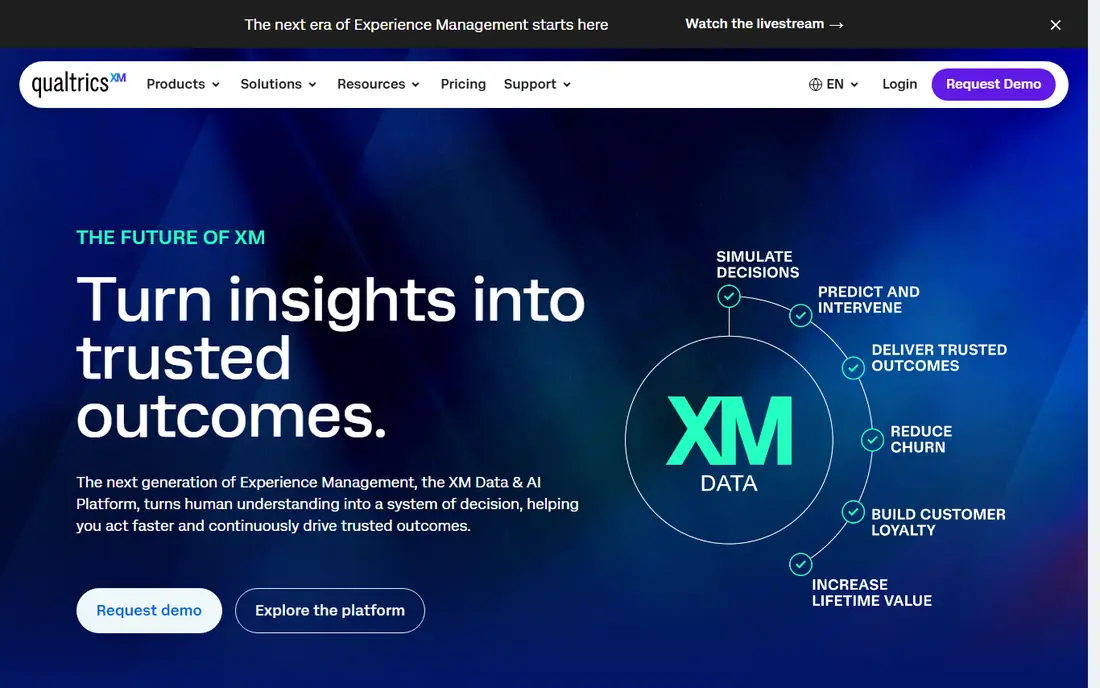
Qualtrics XM covers surveys, digital feedback, calls, chats, and social signals, with text analytics and AI recommendations layered on top. For a large company, that breadth matters: one platform can run brand, product, employee, and customer programs, and route findings to the teams that own each issue. Its integration catalog also helps feedback reach CRM and support systems.
The cost is the main hurdle. Pricing is quote based and based on interactions processed, and its Discover module for unstructured feedback carries its own pricing on top of the core survey platform. Smaller teams may find the platform heavier than they need. For an enterprise with a dedicated experience team, the depth and governance are the reason to choose it.
- Broad survey, text, and workflow coverage
- Strong integrations
- Enterprise governance
- Quote-based pricing
- Modules can add cost
- Setup can be a large project
Medallia is built for companies that track customers across many touchpoints, from stores and contact centers to websites and apps. It combines surveys with operational signals, applies text and speech analytics, and helps teams trace a score back to a journey stage or root cause. That journey view is useful when a single survey score hides different problems in different channels.
Implementation is a serious project, often with professional services, and pricing is custom. A small team with one feedback channel will not use most of what Medallia offers. A large retailer, hotel group, or bank with complex journeys and a dedicated team is the natural fit.
- Journey analytics across touchpoints
- Text and speech analytics
- Action management
- Enterprise pricing and implementation time
- Steeper learning curve for small teams
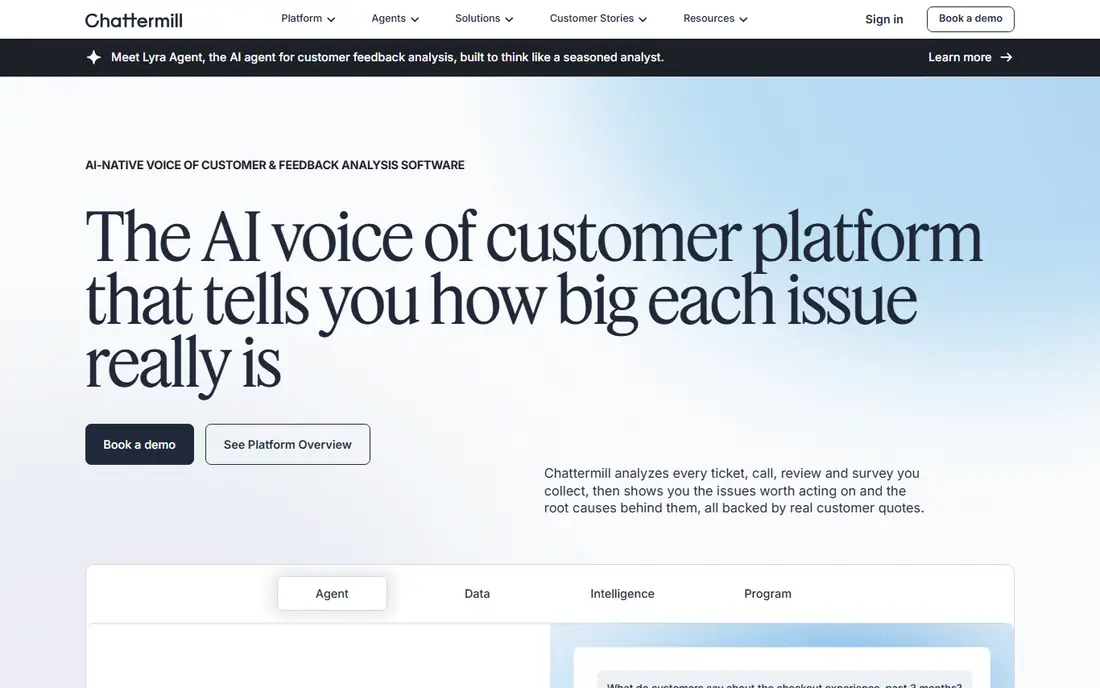
Chattermill focuses on turning unstructured feedback into themes, sentiment, and impact analysis. It pulls in surveys, support tickets, reviews, chats, and calls, then shows which themes drive satisfaction or dissatisfaction. That makes it a good fit for SaaS and ecommerce teams that already collect feedback in several places but cannot read it all by hand.
Pricing is based on data sources and feedback volume, under one contract with no separate module add-ons for feedback types. That is simpler than a module-based quote, but you still need a sales conversation to get a price. If your main need is survey design rather than analysis, a survey-first tool may suit you better.
- Unifies surveys, tickets, reviews, and calls
- Theme and sentiment analysis
- Impact scoring
- Quote-based pricing
- Less of a survey builder than Qualtrics or Survicate
Thematic analyzes large volumes of open text from surveys, support, reviews, and social posts, building themes from the words customers actually use rather than from a preset list. Each theme links back to the original comments, so analysts can check the evidence before they act. Impact analysis shows which themes move scores most, which helps teams prioritize fixes.
The entry tier is reported at $25,000 per year, so this is a tool for insight, product, and experience teams with serious text volume. It is not a cheap survey tool, and it works best alongside your existing collection tools. If traceability and analyst control matter more than a quick dashboard, Thematic stands out.
- Bottom-up theme discovery
- Sentiment and impact analysis
- Clear links back to original comments
- High entry price
- Analysis focus means you still need collection tools
Dovetail started as a research repository and now covers customer feedback analysis for UX, product, and CX teams. It stores interviews, calls, surveys, and support feedback in one place, then uses AI to cluster themes, summarize findings, and answer questions with links back to the source. That evidence link matters when a team needs to defend a product decision.
A free plan makes Dovetail easy to test on a small project, while larger teams move to custom enterprise pricing. It is less focused on high-volume survey scoring than Qualtrics or Medallia, and more focused on understanding why customers say what they say. For research-led teams, that balance is a strength.
- Free plan for small research work
- AI summaries and clustering
- Evidence linked to source material
- Enterprise pricing is custom
- Less of a mass survey analysis tool than Chattermill or Thematic
Survicate helps teams run surveys on websites, in products, by email, and through links, then analyze open answers with AI topic categorization and sentiment. It suits SaaS and ecommerce teams that want continuous feedback, not a one-off study, and it connects to tools such as HubSpot, Intercom, and Salesforce. A free tier lets small teams start, with paid plans from $56 per month billed annually.
The limit to watch is responses: plans hinge on response counts, so a fast-growing program can outgrow a tier quickly. Survicate is also stronger on survey feedback than on mining years of support tickets, so teams with heavy ticket volume may pair it with a text analysis tool. For survey-led programs, it is one of the most approachable options here.
- Multichannel surveys with AI text analysis
- Clear pricing tiers
- Broad integrations
- Response limits vary by plan
- Large feedback volumes can push you to higher tiers
Zonka Feedback collects feedback across many channels, including email, SMS, WhatsApp, web, mobile, kiosks, and offline surveys, which suits frontline and service businesses. Its Salesforce integration can trigger surveys from Salesforce events and sync scores, sentiment, and tags back to contact records. AI feedback intelligence adds theme and sentiment analysis on top of collection.
Pricing is quote based and tied to response volume and data credits for AI features, so you need a demo and a volume estimate to get a firm figure. Teams that only need web surveys may find the breadth unnecessary. Teams with field staff, stores, or clinics will use the channel range more fully.
- Surveys across email, SMS, web, kiosk, and offline
- Salesforce integration
- AI sentiment and feedback intelligence
- Quote-based pricing
- Setup for advanced channels takes more work
Enterpret pulls feedback from tickets, calls, surveys, product usage, social posts, and reviews into one product intelligence view. Its adaptive taxonomy learns themes from your data rather than forcing comments into preset buckets, and it connects feedback to customer and revenue context. That helps product teams decide which requests affect the most valuable customers, not just the loudest ones.
Pricing is not publicly listed, so a demo on your own data is the practical way to judge it. It is less of an enterprise experience platform than Qualtrics or Medallia, and more of a product feedback tool. For a scaling SaaS company with disconnected feedback sources, that focus is a good fit.
- Self-building taxonomy across sources
- Links feedback to customer and revenue context
- Product-focused analysis
- Quote-based pricing
- Newer and narrower than Qualtrics or Medallia for enterprise programs
InMoment combines surveys, digital feedback, and operational data with AI analytics and action workflows, so findings can turn into assigned follow-ups rather than sitting in a dashboard. It suits medium to large companies that want a voice of customer program tied to operations, with integrations into CRM, commerce, and helpdesk systems.
Pricing is custom and enterprise oriented, and setup takes more effort than a self-serve survey tool. Smaller teams may prefer Survicate or Dovetail for a faster start. For a company that already runs a formal voice of customer program and needs governance and action tracking, InMoment is a credible alternative to Qualtrics and Medallia.
- Voice of customer platform with AI analytics
- Journey and action workflows
- Broad integrations
- Quote-based pricing
- Implementation can be complex for mid-market teams
How we picked these
We compared official product pages, pricing pages, and public product comparisons for tools that analyze customer feedback, not just collect it. We kept tools that are live in October 2026, that handle at least one major feedback source at scale, and that offer theme, sentiment, or impact analysis. We used quote-based pricing where vendors do not publish prices, rather than repeating third-party estimates as fact.
How to choose a feedback analysis tool
Start with the feedback you already have. List your sources, volumes, and the questions you need to answer each month. A tool built for surveys will struggle with call transcripts, and a tool built for tickets may not run a good NPS program. Match the tool to the source first, then to the team that will act on the findings.
Decide who acts on the insight
If product managers need themes linked to revenue, Enterpret or Chattermill may fit better than a survey platform. If support leaders need case follow-up, look for action workflows and CRM links. If researchers need evidence trails, Dovetail or Thematic will serve you better than a dashboard-only tool.
Check volume, language, and privacy
Ask how pricing scales with feedback volume, how many languages are supported, and how personal data is handled. Feedback often contains names, order details, and complaints, so check data retention, access controls, and redaction options before you connect support or call data. A cheap plan that charges heavily for overages can cost more than a higher tier with a clear volume allowance.
Pilot on real feedback
Run a pilot on a recent month of real feedback, not on demo data. Check whether themes match what your team already knows, whether sentiment looks right on tricky comments, and whether the output leads to a clear action. If the pilot only produces pretty charts, the tool will not change decisions.
Frequently asked questions
Which customer feedback analysis tool is best for a small business?
Survicate and Dovetail are the most approachable picks for a small business, thanks to free tiers and clearer pricing. Survicate suits survey-led programs, while Dovetail suits research and qualitative work. Larger analysis tools such as Thematic and Chattermill make sense once feedback volume grows.
What is the best customer feedback analysis software for enterprise teams?
Qualtrics and Medallia are the enterprise picks in this list, with broad collection, governance, and journey coverage. Chattermill and InMoment are strong alternatives when AI text analysis or action workflows matter more than running every kind of experience program in one platform.
How is feedback analysis different from a survey tool?
A survey tool collects answers to questions you ask. A feedback analysis tool also reads unprompted feedback such as tickets, reviews, and calls, finds themes and sentiment, and links those themes to scores or outcomes. Many teams need both: surveys to validate a hypothesis, and analysis to discover issues they did not think to ask about.
Can these tools analyze support tickets and reviews?
Yes, Chattermill, Thematic, Enterpret, and Medallia are built for that use case, with connectors or imports for tickets, reviews, chats, and calls. Survicate and Zonka Feedback focus more on survey collection, with AI analysis of open survey answers. Check the connector list for your helpdesk and review platforms before you buy.
How much does customer feedback analysis cost?
Costs range from $56 per month for Survicate to $25,000 per year for Thematic entry, with Qualtrics, Medallia, Chattermill, and others priced by quote. The total depends on feedback volume, sources, seats, and AI usage. Get a written quote based on your actual volume, and ask about overage terms before you sign.
Sources
See where you really rank - block by block
ProMapRanker scans Google Maps across a grid of your service area. Simple monthly plans from $19, white-label on every plan.
Start freeKeep reading
 zscaler alternatives
Best Zscaler Alternatives in 2026
Looking for zscaler alternatives? We compare 9 SASE and zero trust platforms on architecture, data protection, pricing, and fit for your network and team.
Read → zapier alternatives free
Best Zapier Alternatives Free in 2026
Nine automation tools for zapier alternatives free in 2026, all with genuinely free tiers, plus free plan limits, starting prices and upgrade paths explained.
Read → which platform is best for online reputation
Which Platform Is Best for Online Reputation in 2026
Wondering which platform is best for online reputation? We compare 8 review, listing, and response tools for small and multi-location businesses and agencies.
Read →